


By Bonnie Eissner
Photographs by Beth Bergman
While spring and fall mark the peak birdwatching seasons in New York, winter is the prime time to see the waterfowl who flock to the city from northern latitudes in search of warmer weather and plentiful food.
New York City lies along the Atlantic flyway, which is like I-95 for migrating birds. That means that millions of birds fly over the concrete jungle on their way south in the fall and north in the spring, and while the endless steel and cement may not appeal to them, Central Park does.
“It’s like the best rest stop you’ve ever seen,” said Nick Baisley, an NYC Parks urban park ranger, who on Sunday co-led a free winter waterfowl walk in Central Park.
About 45 people came to the park for a guided walk along the Reservoir with Baisley and fellow urban park ranger Mara Pendergrass. The tour proved that with a little curiosity and some decent binoculars even inexperienced birders can enjoy urban biodiversity at its best in these cold months.
In just over 90 minutes, the group spotted 11 species of waterfowl in addition to some gulls and a Cooper’s hawk.

A resplendent male wood duck drew the most gasps as he paddled close to the eastern edge of the Reservoir, a treat almost too good to be believed. Distinguishable by its iridescent green crested head feathers that are outlined in bright white, the male wood duck is considered one of North America’s most beautiful ducks.
The female wood duck, like the female mallard, is far plainer with mostly brown and gray feathers.
If this seems unfair, blame evolution. First, the relative splendor of many male ducks makes them attractive to mates. And camouflage protects nesting ducks. Bird species that look alike, or are monomorphic, such as Canada geese, tend to share nest duties, Pendergrass pointed out.

Hooded mergansers, the punk rockers of ducks, are dimorphic, like wood ducks and mallards. The adult male is decked out in mostly black and white plumage, while the female sports a gray-brown body. But both have high head crests that resemble hoods, or in the case of the female, a spiky mohawk haircut. The pairs that swam by on Sunday delighted the crowd.

Tiny male bufflehead, with their bright, mostly white heads also please the eye. On Sunday, a few were spotted as they popped up to the water’s surface, bobbing for a bit between their dives to snack on insects.

Northern shovelers, aptly named for their broad, spoon-shaped bills, were out in force on Sunday. Groups of males and females swam by, their colors similar to mallards, but their oversize black bills making them less debonair. Comb-like projections at the edges of their bills filter out seeds and tiny crustaceans from the water. Shovelers often spin as if in a vortex as they suck up their meals.

The male ruddy duck is also known for its unusual bill. Black most of the year, it turns a bright blue, from hormones, as it courts mates in the spring. A few of these small brown and white ducks paddled by on Sunday.
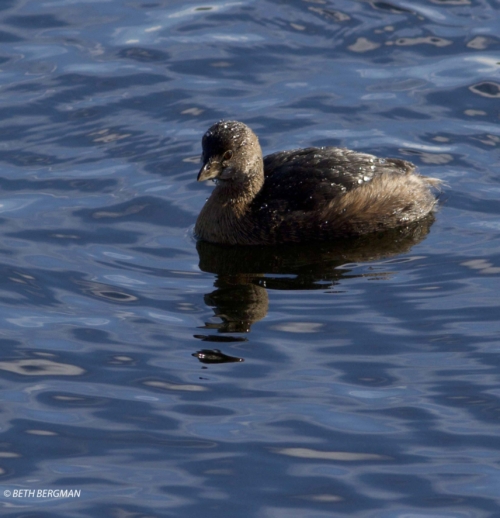
Besides Canada geese, two other non-duck waterfowl made appearances. A compact pied-billed grebe popped up between its long submersions for food, including fish and insects. Fun fact: the pied-billed grebe ingests its own feathers, which they sometimes feed to their chicks or use as sieves to filter out indigestible parts of their prey.

The American coot that scooted past also drew some excitement. The coot is a fast mover with a distinctive black body, red eye, and short, mostly white bill. Unlike ducks, they lack webbed feet. Instead, they have long lobed toes — think giant chicken feet — that propel the birds through the water.
At 40-feet deep, the Reservoir offers abundant feeding ground for waterfowl, making it an optimal viewing spot. But its vastness means that decent binoculars, with magnification of at least 8×25, are needed to see most of the birds. The slightly smaller and shallower Central Park Lake (mid-park between 71st and 78th) is a favorite waterfowl watching spot for Leslie Day, author of Field Guide to the Neighborhood Birds of New York City. “At the lake, you can really get close,” she wrote in an email. Her book offers photos and detailed descriptions of scores of birds that inhabit or frequent the city.
Baisley recommended eBird as a useful reference for tracking and reporting bird species in an area.
Still, even with resources like eBird, one of the joys of birding, he said, is that there are always surprises. “I do love that you never know what you’re going to get,” he said.
The Urban Park Rangers are leading a free bald eagle watch at Inwood Hill Park on Saturday at 10:30 a.m.
Subscribe to WSR’s free email newsletter here.





Love the park! Just came back from a little walk, and while I was delighted to see snowdrops, I have to admit a bit of ‘oy vey’ for seeing the daffodils pushing up. It’s not even the middle of February yet. How will bird migrations patterns change now that winters are warmer?
I”m not a birder at all (although I have Merlin on my phone) – but I must compliment you on the marvelous photography!
Lovely article, divine photos — thanks much, WSR. And a shout-out to former neighbor Mara. Bonjour!
It’s Canada geese not “Canadian” geese.
Yup!
Thank you WSR – so love these informative piecesand wonderful images about natural treasures of the seasons around us, for those of us too lazy and inexpert to go with the groups and make lists. We still can learn something and appreciate more when we have our outdoor chances!
Terrific article, Bonnie – very informative. And beautiful pictures. I met you at the beginning and we chatted for a bit. I had to leave early but I think I need to go back on my own. Central Park is truly majestic.
Incredible! I guess you have to see it to believe it! Gotta get over there soon:)
How many old coots showed up? (I had to look that one up;)
Thank you! I love the bird reports.
Thank you Bonnie Eissner for delightful, educated yet mirthful description of water fowl. Who knew? I now will walk my Chicago pond with new eyes. Not fair that the males have the beauty advantage.
Thank you for this article and the photos. Now I finally will be able to name the ducks I see in the reservoir. So good to have the identifications together in one article.