
By West Side Rag
At the beginning of March, West Side Rag received an inquiry that caught our eye.
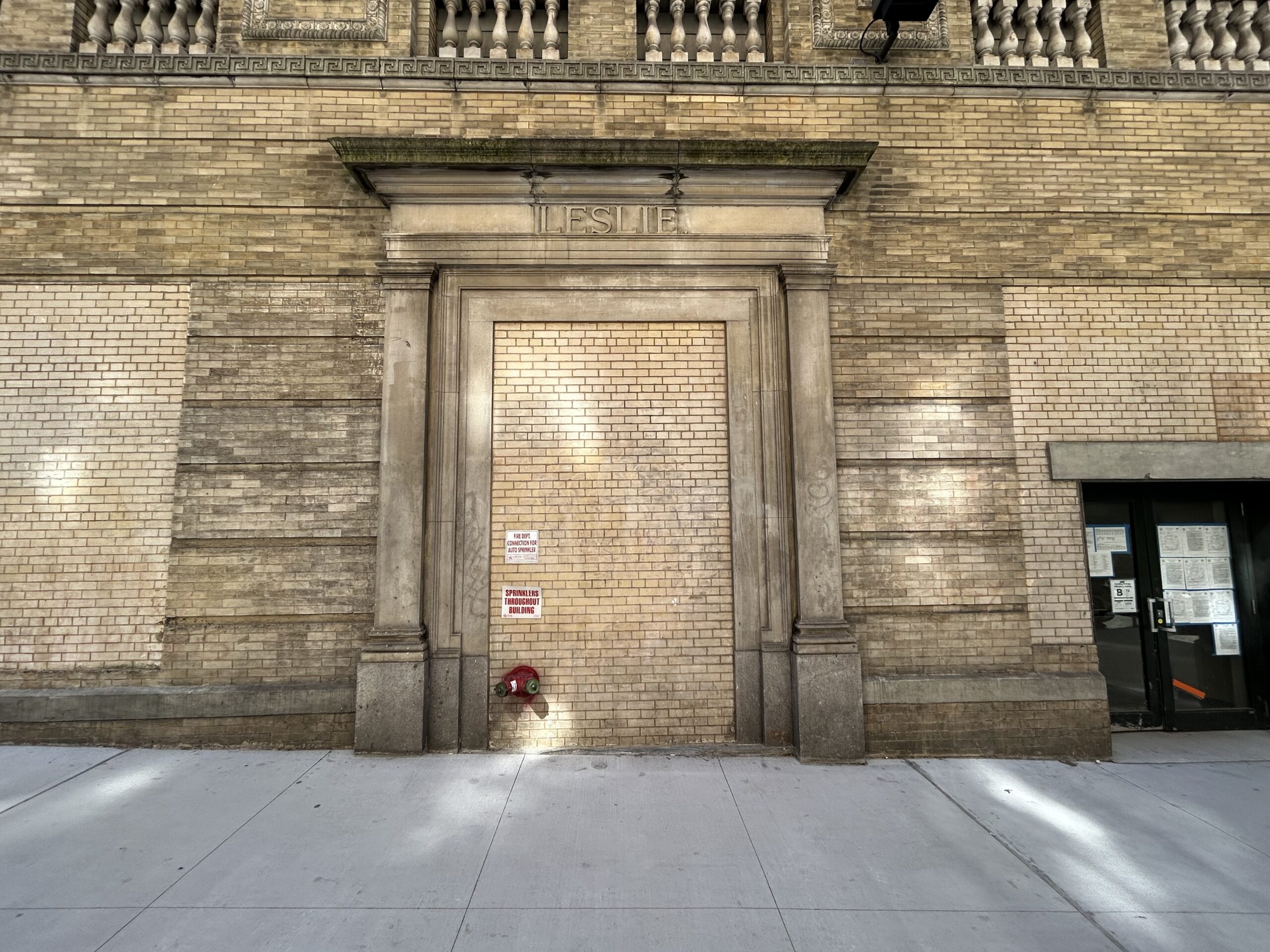
“I’m hoping you or your readers can help solve a mystery that has nagged at my family for years,” Upper West Sider David Leslie wrote to the Rag. “There is a bricked-up entryway on the 83rd Street side of 2299 Broadway — i.e., the Harry’s Shoes building — with ‘Leslie.’ (period included) inscribed in the stone arch above. Leslie is my family’s surname, and I’ve tried in vain to learn more about the history of the building in hopes of turning this into an anecdote for my kids.”
“So far, I’ve come up empty. We pass by this building multiple times a day, and it eats at me more and more every time,” he added.
While we did not immediately have the answer, we knew someone who could help: Rob Garber, the author of WSR’s Upper West Side Historical Photo Challenges, and a historian of the neighborhood.
We sent the query to Garber, who rose to the challenge.
Here’s how he responded.
The answer to the question about the word “LESLIE.” over the door is that the upper floor of the two-story building that faces Broadway between 82nd and 83rd was home to a meeting space called Leslie Hall for more than 30 years, from 1896 until the late 1920s.
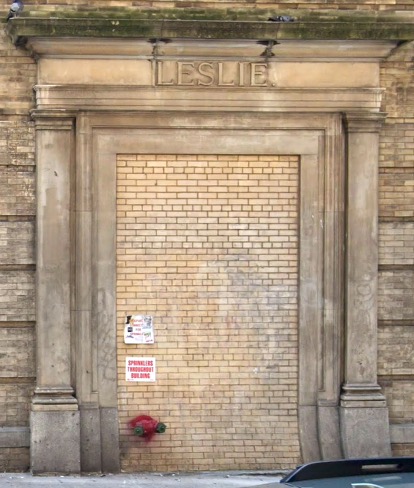 The doorway at 260 West 83rd Street that caught David Leslie’s attention.
The west side of Broadway from 82nd to 83rd Street was devoid of structures until the 1890s. Throughout much of the 19th century, land on the Upper West Side remained largely undeveloped. Many pieces of property changed hands repeatedly, with investors and speculators anticipating rising property values as the city inexorably developed northward. An 1885 map shows the blockfront composed of eight lots, and all eight, plus six adjacent lots facing 82nd and 83rd Streets, were sold for a total of $120,000 in December 1887. As late as 1894, a fire insurance map still showed no structures at all along the block, even as the surrounding neighborhood began to fill in with buildings.
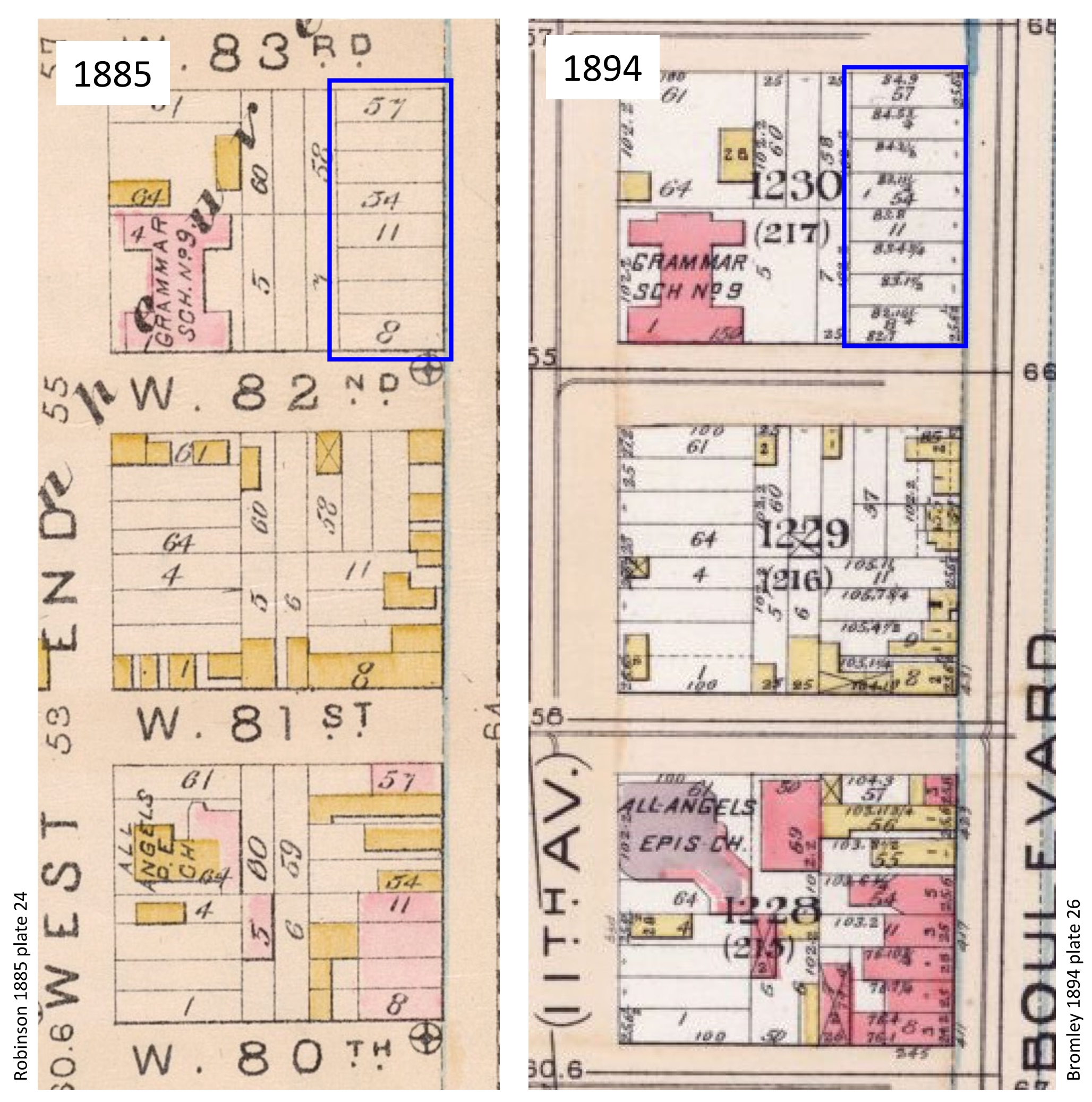 Development on the west side of Broadway in the late 19th century. Wood structures are yellow; brick or stone structures are pink.
The property was finally “improved” in the late 1890s. Charles T Barney, a wealthy investor and president of Knickerbocker Trust–now chiefly remembered for having committed suicide when the Knickerbocker failed in the Panic of 1907–engaged architect William Strom to design a two-story structure. It went up in stages, according to a 2009 New York Times Streetscapes column by Christopher Gray: first the north half, then the south half. Insurance maps from the turn of the century show that the building was sometimes called the Leslie and sometimes was known as the Lansing Building. Such two-story buildings, known as “taxpayers”, were common on the Upper West Side and were often built as temporary commercial structures, with the expectation that they would be replaced by taller buildings when the economics could justify the investment. In the case of the Leslie building, it never happened and nearly 130 years later, it’s one of an increasingly-rare species of low buildings on Broadway.
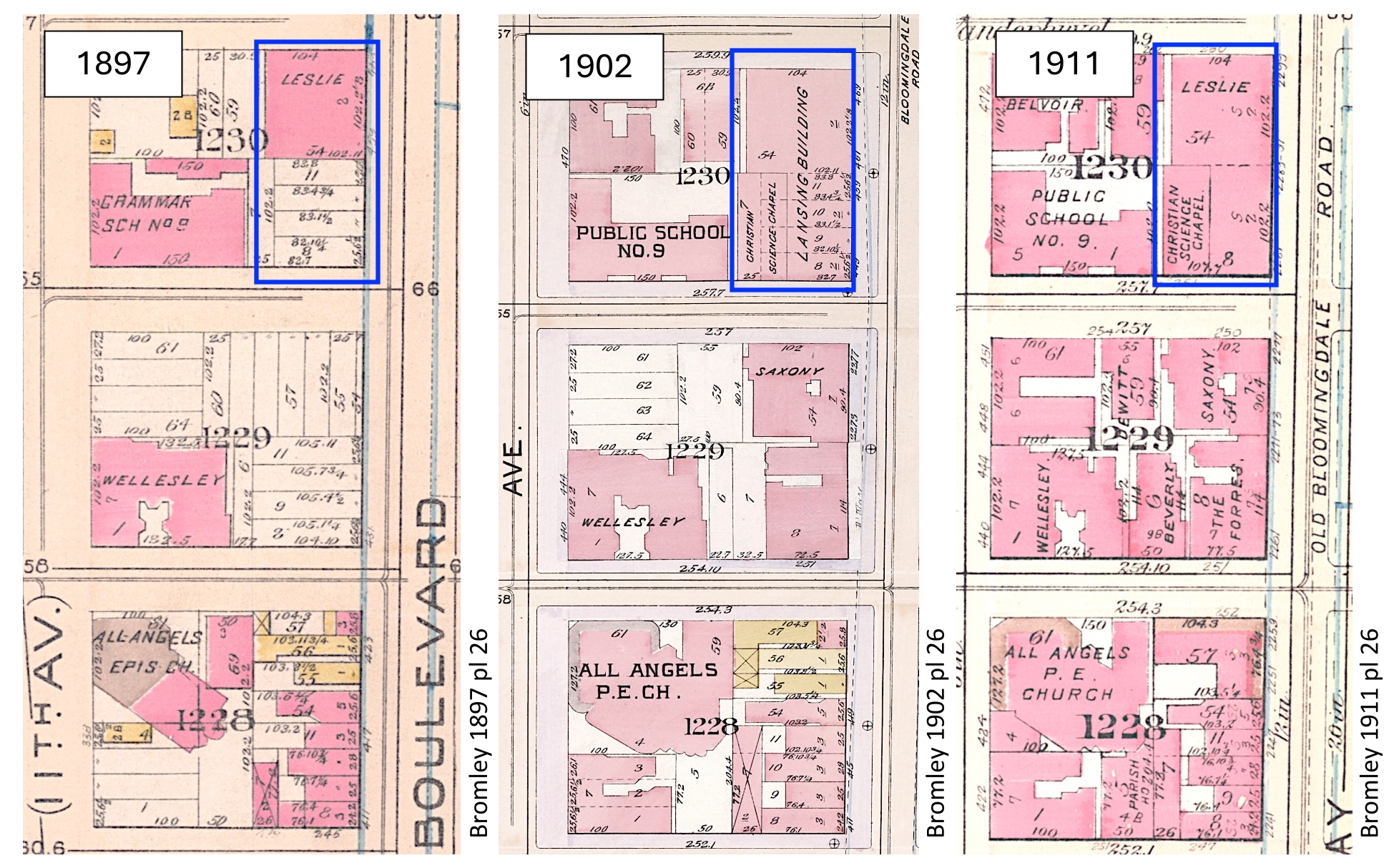 The Leslie or Lansing Building was built in 1897-98. By 1911 every lot has been developed between 80th and 83rd, and the last wood structures are gone.
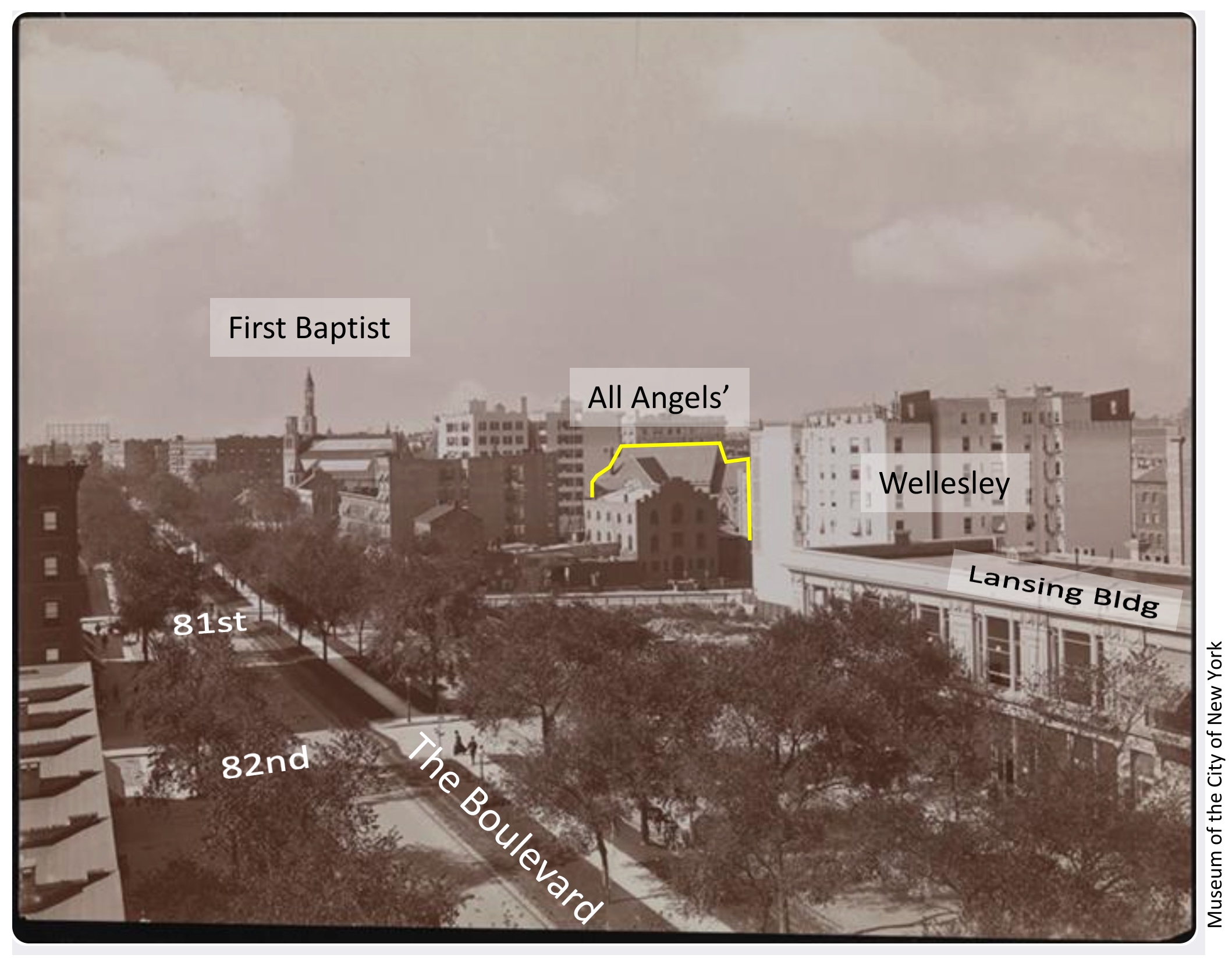 Looking south across Broadway, probably at the very end of the 19th century. The Lansing and Wellesley buildings were brand-new. A piece of All Angels’ is visible on the northwest corner of West End Ave and 81st, as are the asymmetric spires of First Baptist Church at Broadway and 79th.
So, who or what was The Leslie? Variously called Leslie Hall, Leslie Rooms, Leslie’s Rooms, or the Leslie Ballroom, it was a public meeting space that could be rented for everything from weddings to a 1927 rally by striking barbers, as well as musical performances, religious services, and twice-monthly meetings of the Associated Electrical Contractors of New York. From its earliest days, dance classes were also held at Leslie Hall.
In the era before broadcast media, there were numerous meeting halls in New York where political rallies were staged, and where speeches or performances were given in a less formal atmosphere than a theater or auditorium. Leslie Hall was one such space, and during its 30 years, it hosted speakers that ranged from Eugene Debs to Emma Goldman to Macy’s owner Oscar Straus, as well as countless worthy events such as a 1917 reading by the Dramatic Society of Columbia Grammar School.
Its capacity was impressive—when Theodore Roosevelt appeared at Leslie Hall in 1910 to deliver a political speech, the New-York Tribune reported that “two thousand persons awaited the coming of the colonel, in addition to the large crowd gathered on the outside”. In January 1924 Leslie Hall was the site of the first American performance of sacred dances by the philosopher and mystic Georgij Gurdjieff and his troupe. Thomas de Hartmann, a pianist and composer who accompanied Gurdjieff, wrote a description of the interior of Leslie Hall: “it was a longish two-storey building. Each floor had a hall along its length, but on the ground floor there was only a small stage and a meeting room, which was not appropriate. The upper hall had plenty of space but no stage from which the movements would be visible, so Mr. Gurdjieff had one quickly built by the pupils…”
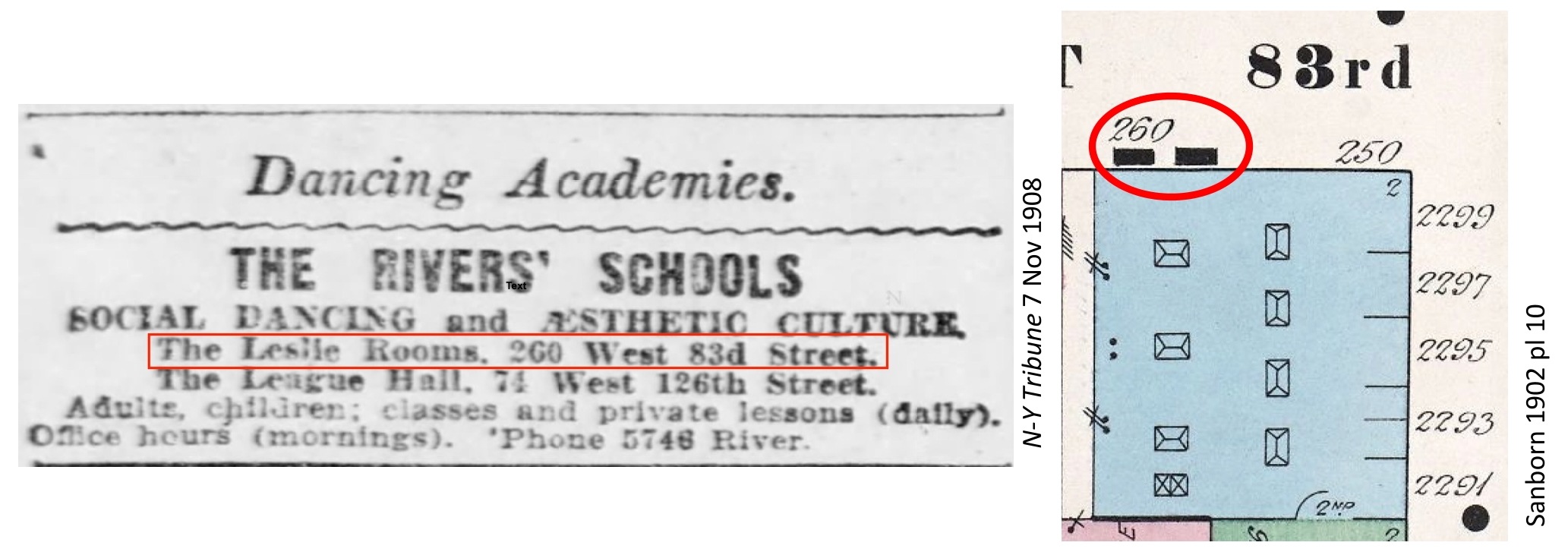 Events advertised at Leslie Hall used the street address 260 West 83rd Street rather than a Broadway address, suggesting that the entrance on West 83rd that retains the LESLIE sign over the bricked-up door was the main entrance in the early 1900s.
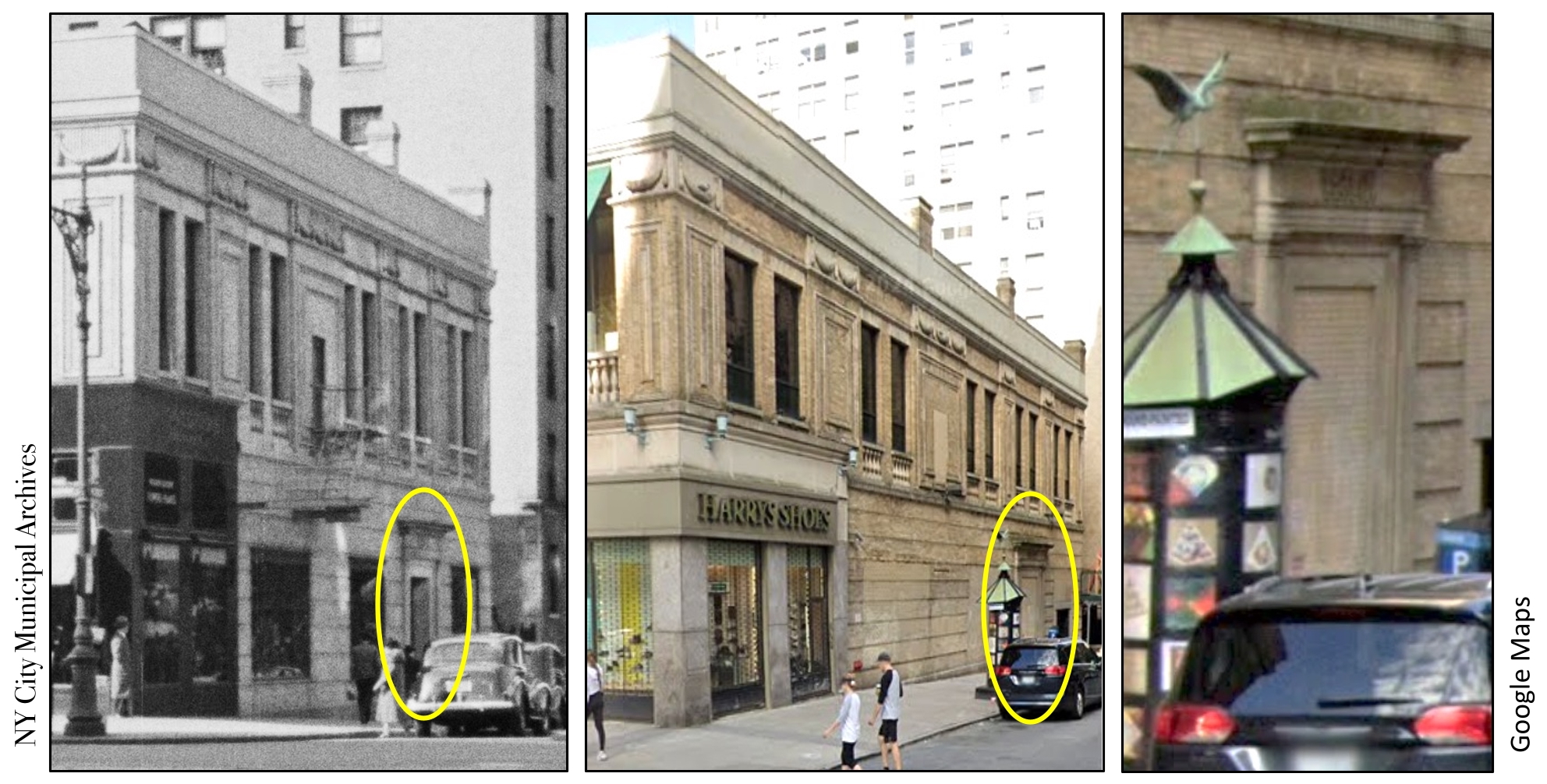 The north facade of the block-long building looks much the same today as it did in 1940, including the now bricked-up doorway noticed by David Leslie.
Just who Leslie was, remains a mystery—the name “Leslie’s Rooms” suggests that Leslie was the proprietor, but neither advertisements nor city directories of the time identify a person behind the place.
It’s not clear whether Leslie sometimes referred to the entire building or only to the upper floor. As early as 1905, newspaper ads for businesses described the addresses from 2281 to 2299 Broadway as the Lansing Building. Several real estate brokers had offices in the Lansing Building, and Schrafft’s, a candy counter and lunch spot, was notable among the retail tenants.
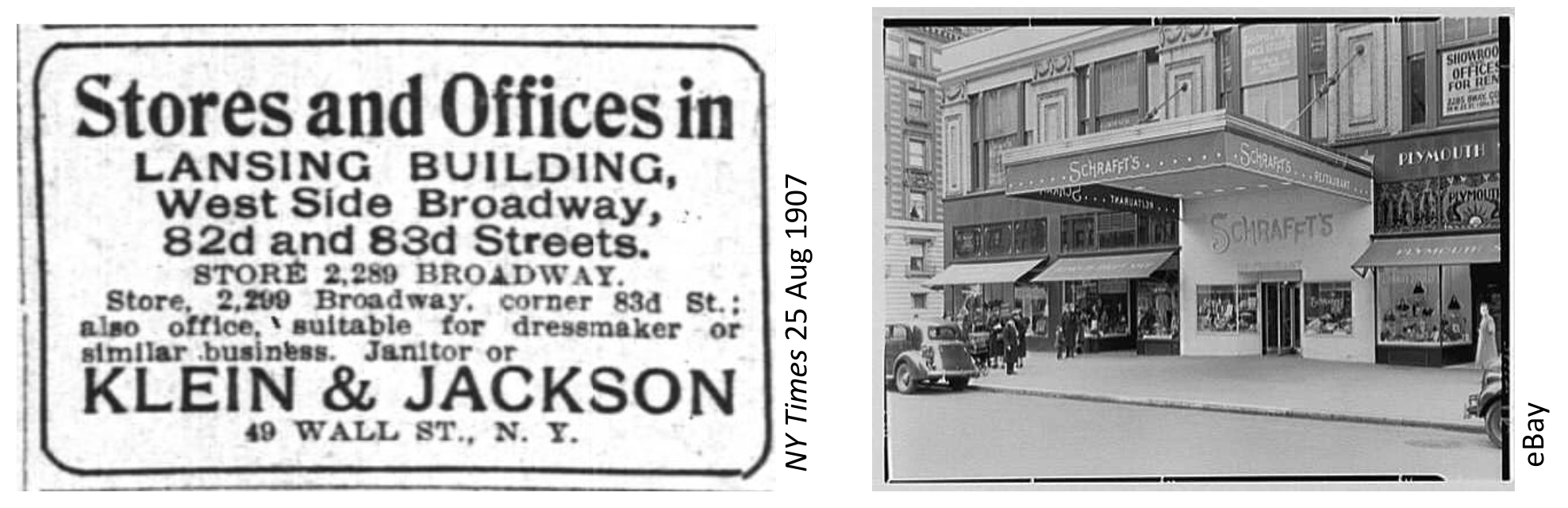 Popular with generations of UWSers, Schrafft’s took out a lease for 2285 Broadway in 1929, the same year that the Lansing Building was renovated, according to a social history by Tom Miller at LandmarkWest’s “The Boulevard” website. The neoclassical exterior appearance we see today, including what Tom described as “terra cotta swags” on the second floor, were not original to the building, as a before-and after comparison of photographs demonstrates.
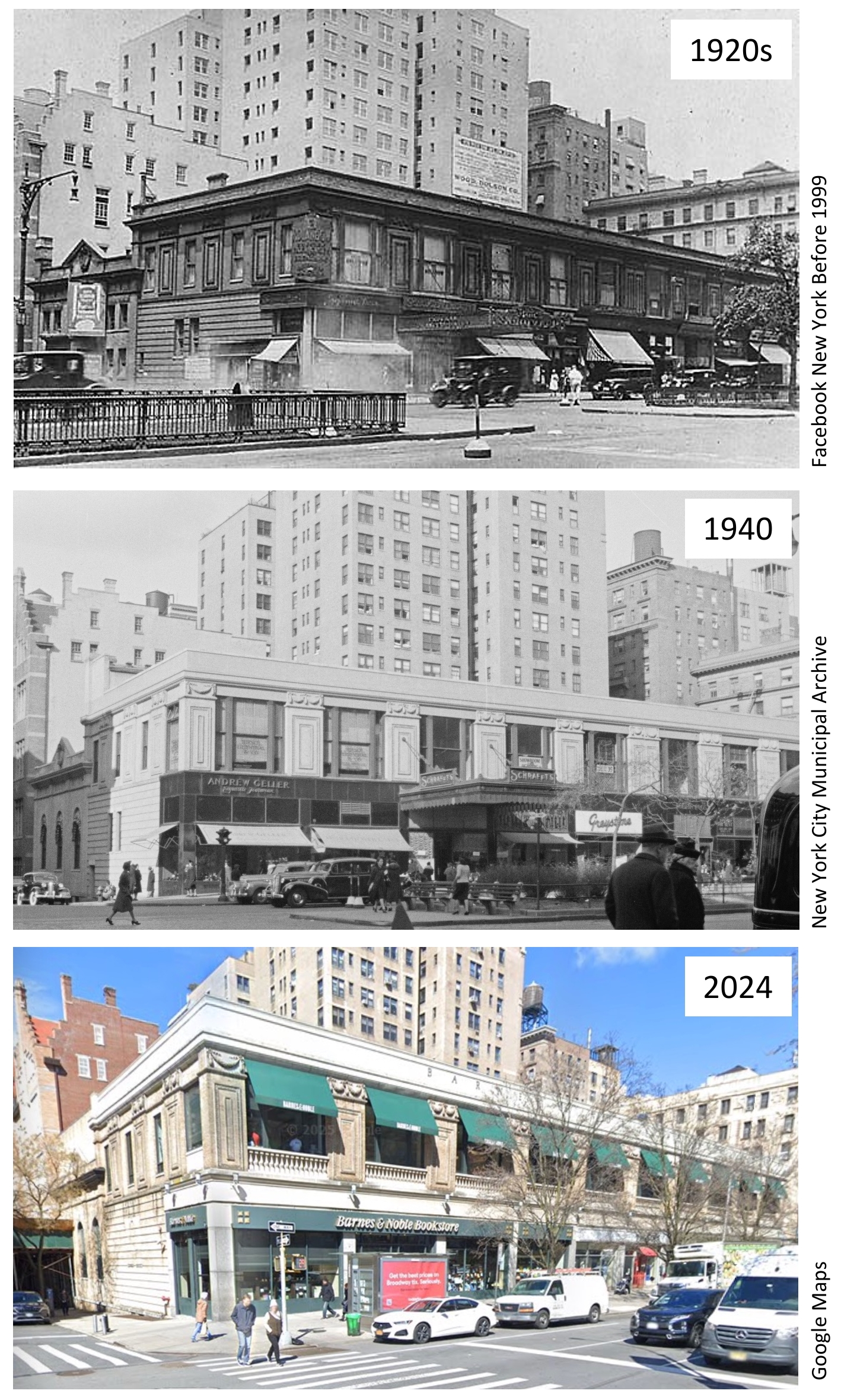 2281-2299 Broadway as it appeared over the course of a century.
After its 1929 do-over, the building took the appearance that it has today. Its most celebrated tenant was Geoge Balanchine’s School of American Ballet, which was upstairs from 1956 until moving to Lincoln Center in 1969. It was succeeded by the New York School of Ballet, which continued the building’s long dance tradition until it was evicted in 1985.
Mr. Leslie responded, “Our daily walks past the old Leslie Hall have been completely enriched by this back story, and the final lingering piece of the mystery will be left to our imaginations.”
Subscribe to West Side Rag’s FREE email newsletter here. And you can Support the Rag here.



Leslie’s Rooms, a popular public meeting space and banquet hall that occupied the upper floors of the building for roughly 30 years.
Not named after a specific person
What is this, an AI summary of the article everyone just read?
Thanks for the cool write up! Very informative
what a wonderful and informative piece! Thanks!
George Balanchine had only a short stroll to his ballet school from his home. He lived in the Apthorp, Broadway between 78th and 79th.
Such a shame the entrance was boarded up.
This was a great read!! I love our city and its rich history!!!
This is why the Rag is my one unskippable news source. Such a fascinating and well-researched story–a real window into another time.
Wonderful history of our neighborhood
I always wondered, never asked. Thanks for the great research and the historic phoitos.
Davey!!!!!
Thank you for this wonderful article! A community center!! The Upper West Side could use a community center like this again….what a great thought for the controversial Presbyterian church on Amsterdam and 86th St.!! ( I remember the ballet school and was so sorry it disappeared from the building. )This is giving me a good feeling, just thinking about this possibility!
Great research. Such a fun story to read. Thank you
I enjoyed reading this article. I wish Schrafft’s was still there! I noticed in one of the photos it shows “All Angels.” Was that the church that “mysteriously” burned down after they refused to sell to a developer? I also enjoyed reading in one of the Comments, “George Balanchine had only a short stroll to his ballet school from his home. He lived in the Apthorp, Broadway between 78th and 79th.” Thank you “John.”
Loved reading this story! It amazes me how the history of one building has had so many lives!
Love it! Uneven childhood memories have been coalesced to a current reality.
So well researched–incredible.
I can add some history and present-time info here, since I live on that block.
First, given that Barnes & Noble owns far more space in the building than Harry’s, most UWSers that I know call it the Barnes & Noble building.
Second, after Schrafft’s closed, that space became RFK’s New York City headquarters during his run for the presidency. After he was killed, and the space closed, it re-opened once again as the Red Apple Supermarket, though they only used the first floor space; I do not remember what was on the upper floor.
It was after Red Apple closed that Barns & Noble took over the entire unoccupied space on both floors, and it has remained there ever since.
Also, you refer to two-story” taxpayer” buildings. It might interest your readers to know that almost all of those that remain in the West 70s, 80s and 90s are owned by the Zabars. In fact, they own a large number of the buildings on that stretch of Broadway that are 5 stories or fewer (including Zabar’s own building, the “taxpayer” in which P.C. Richards is now located, the “taxpayer” in which Barnes & Noble is located, and the 5-story building in which Town House is located).
And it was due to Saul Zabar’s absolute refusal to allow Broadway along that stretch to become a row of large buildings that they have remained that way for decades. Saul told me that he even turned down a $100 million offer for the location on 79th, because it would have led to a truly massive building (possibly 50 stories or more, despite the “regulation” that the Broadway building line must be relatively even). He even had a famous fight with his son-in-law (a commercial realtor who owned the “taxpayer” next to the P.C. Richard’s site), begging him not to develop that property. He lost that fight, and we got the terrible, drab 15-story building that is there now. And now the family is in a fight with the co-owners of the “taxpayer” across from the Zabar’s store (on 80th Street ). The co-owners want to develop the site; the Zabars’ family is holding firm against it.
Thanks for your detailed “current” update.
Thank you for this thorough and thoroughly fascinating story and walk down the UWS’s history lane. How fun! Loved learning all about this piece of neighborhood!
Great historical lesson. Thanks!
What a priceless report this is. Thank you, thank you, thank you!
Thanks for this story and to the Zabar family for maintaining the building and the character of this part of the UWS.
Fabulous story. The history lessons for a neighborhood that’s only 175 years old are fascinating.
Fascinating read. Thanks! We have far too few community spaces like this now, and I think it has weakened the social fabric.
Wonderful & interesting article. Thank you, and congratulations to David Leslie!
Great story!
Great story. Thank you so much.
Thank you Rob Garber for such a great and colorful story — a reminder about the fascinating, evolving history about just one small block in our neighborhood.
Fascinating !
Although not related to the Leslie Legacy, I remember purchasing my baby’s first shoes at Harry’s in 1990 when I lived on West 93rd St.
We have Saul Zabar and the Zabars family to thank for a large stretch of Broadway NOT becoming just a row of 15- and 16-story residential buildings. And this is not unrelated to this article.
It is the Zabars family that owns the two-story “taxpayer” in which Barnes & Noble, Talbot’s and Harry’s Shoes thrive (and the Leslie used to be). And the Zabars family owns quite a few of the “taxpayers” along Broadway between 72nd and 86th Streets. In fact, they own close to a dozen 2- to 5-story buildings along that strip, including the B&N building, the NE corner of 79th Street “taxpayer” that houses P.C. Richards, the 5-story building in which Town House currently thrives and, of course, Zabar’s own buildings on B’way b/w 80th and 81st Streets. They also co-own the taxpayer across 80th Street from their store, and they are currently in a fierce legal battle to prevent the co-owners from demolishing and developing that corner. And he had a previous huge battle with his own son-in-law (a commercial real estate agent), begging him not to develop the old Circuit City taxpayer that sat next to the P.C. Richard’s site. But the son-in-law ignored him, and we got the drab, boring building on the SE corner of 80th and Bway.
In fact, so determined was Saul to keep this section of the UWS as “low” as possible that he turned down a $100 million offer for the 79th/Bway taxpayer. Although there is a regulation that requires all new buildings on Broadway to remain at the “building line” (~15 stories), with air rights and variances the corner of 79th/Bway could have become a 50-story (or more!) monstrosity. Saul wanted none of that.
So we really do have the Zabars, and particularly Saul, to thank for how many low-lying buildings remain along Broadway b/w 72nd and 86th Streets.
What a fabulous piece of information. Thank you for your research.
Our stoop is directly across the street from the Leslie doorway. Our building was built in 1892 and was one of the earliest apartment buildings in the neighborhood at the time. That’s interesting because “As late as 1894, a fire insurance map still showed no structures at all along the block, even as the surrounding neighborhood began to fill in with buildings.”
Our building called the Amidon was erected by James Rufus Amidon and was designed by architect E.L> Angell in an Italian Renaissance style. If I’m not mistaken, the article did not mention that the building is owned by the Zabar family. Its two story height allows me to see the buildings on West 82nd St. from my 4th floor apartment windows for which I am so grateful.
I also designed a trompe l’oeil mural for the 3 bricked-over panels of the Leslie which would have given the illusion that we would see a dance studio on the ground floor and 82nd Street through arches on the south side of the building. Maybe some day I will paint the mural instead of removing graffiti from the wall every so often.
As the keeper and curator of the kiosk, I try to keep the wall of the Leslie as clean as I can so that the area will have a nicer vibe.