

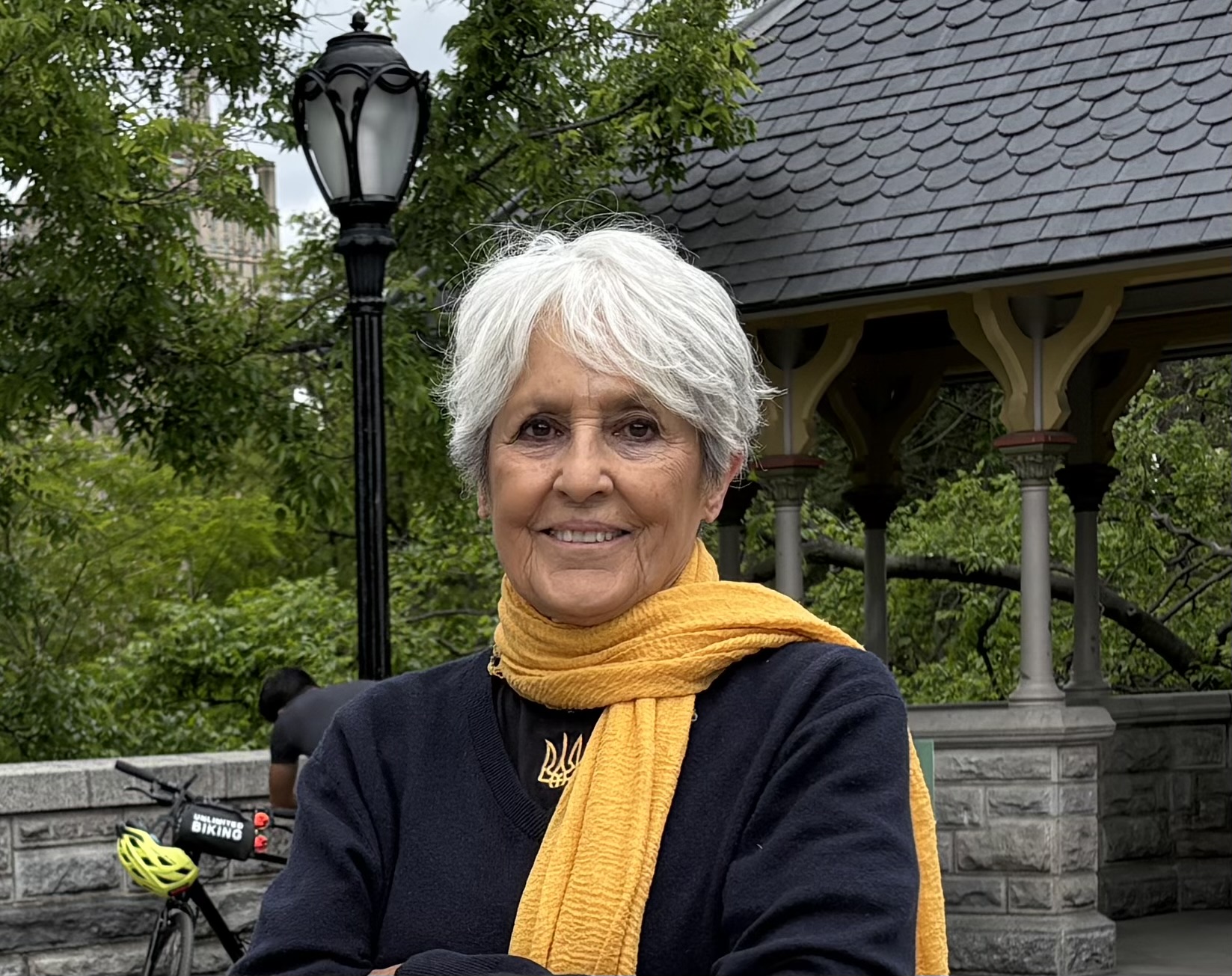
By Carol Tannenhauser
Joan Baez met Bob Dylan for the first time in 1961. She was 20 years old, staying with her boyfriend, Michael, in a friend’s parents’ apartment on Riverside Drive, on the Upper West Side. She had come to New York from her hometown of Cambridge, MA, where she had been making a name for herself as a folk singer.
“Everybody was coming to New York,” she said. “People would say, have you been to the Village? Have you met so-and-so? Have you played here, played there? I was all starry-eyed about the Village.”
Joan and Michael went to the Village, “and this ragamuffin showed up,” she recalled, referring to Dylan. “I could feel my boyfriend bristle – and he had a right to bristle! There was chemistry, yeah,” she added, softly.
Joan and I were sitting on a window seat in my apartment on a Sunday afternoon, our backs to Central Park, when she told me this and other stories. Through “a simple twist of fate,” she had been staying with me for the past four days.
She had flown in from her home in Northern California to attend the May 16th Bruce Springsteen concert at Madison Square Garden. “Bruce and I had reconnected at the massive ‘No Kings’ rally in Minnesota in March, where we performed, along with other artists, united in protest against Trump’s immigration policies,” Joan recalled. “Bruce uses his concerts to speak clearly and directly to his fans about what’s happening to our country, and, of course, I can relate to that. I wanted to be there.”
Mutual close friends, Karen and Irwin Redlener, suggested that Joan stay with me, because the Beacon Hotel, where she usually stays, was under construction. My place was perfect — after I spent a week cleaning and decluttering it and filling it with groceries and flowers. I wasn’t actively anxious about her coming, simply because it didn’t seem real. How could this iconic figure — singer, activist, artist — whom I had admired all my adult life be coming to stay with me?
Then, from the time she appeared in my doorway, having Joan Baez as a houseguest felt as natural as Joan herself.
We moved around the apartment effortlessly, like familiar roommates, laughing and talking. We ate yogurt together and went to the building’s gym, walking on treadmills. One night, I had a horrific nightmare (If you must know, I was lost in Bloomingdale’s), and woke up trembling. Joan comforted me and offered tea. Her kindness and our connection were remarkable. To my delight, she later wrote in a text to me, “I’ve made a new friend in Carol Tannenhauser.”
How can I explain what it’s like to wake up to Joan Baez softly singing in the next room? Or to watch her stretch in the morning, using the living room furniture as a gym?
Having Joan Baez in my home felt like being in a state of grace. Not only does she have the purest of voices, but the purest of hearts. She is a civil-rights and anti-war activist and has been since she was a young girl singing ballads about Emmett Till. She was a close friend and ally of Dr. Martin Luther King Jr., performing at King’s 1963 March on Washington, where he delivered his “I Have a Dream” speech. A few years ago, she went to war-torn Ukraine to visit and sing to the children.
We took a walk in Central Park with Karen up to Belvedere Castle and through the Shakespeare Garden.
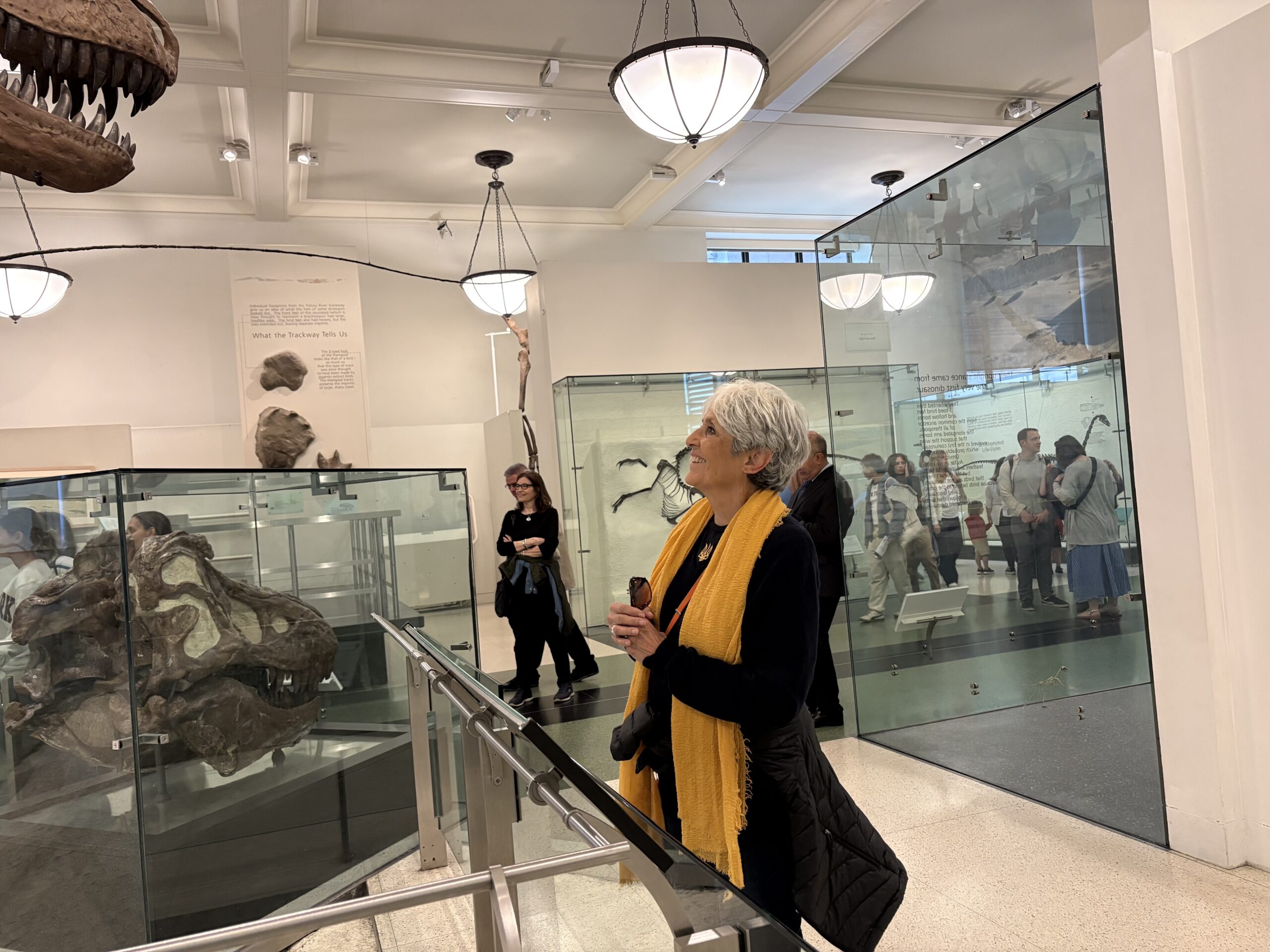
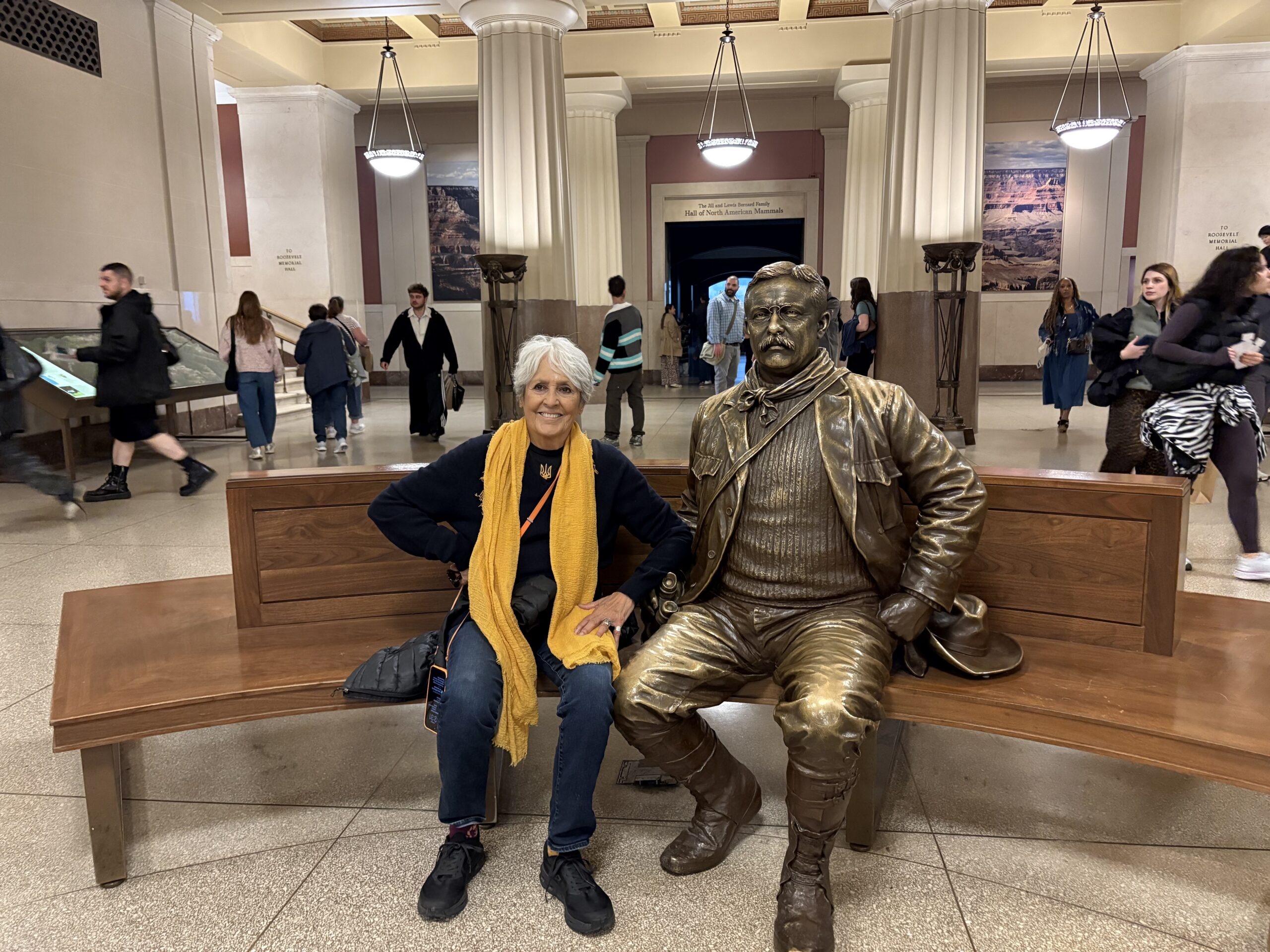
We got a personal guided tour of the dinosaurs, one of Joan’s passions, at the UWS’s American Museum of Natural History.
We threw a small party for her on the eve of her departure and she sang, a haunting version of the freedom song, “Ain’t Gonna Let Nobody Turn Me Around.” Everyone in the room was spellbound. Then, she chatted with each and every guest, young and old, all strangers to her, warmly.
At 85 years old, she is an American treasure.
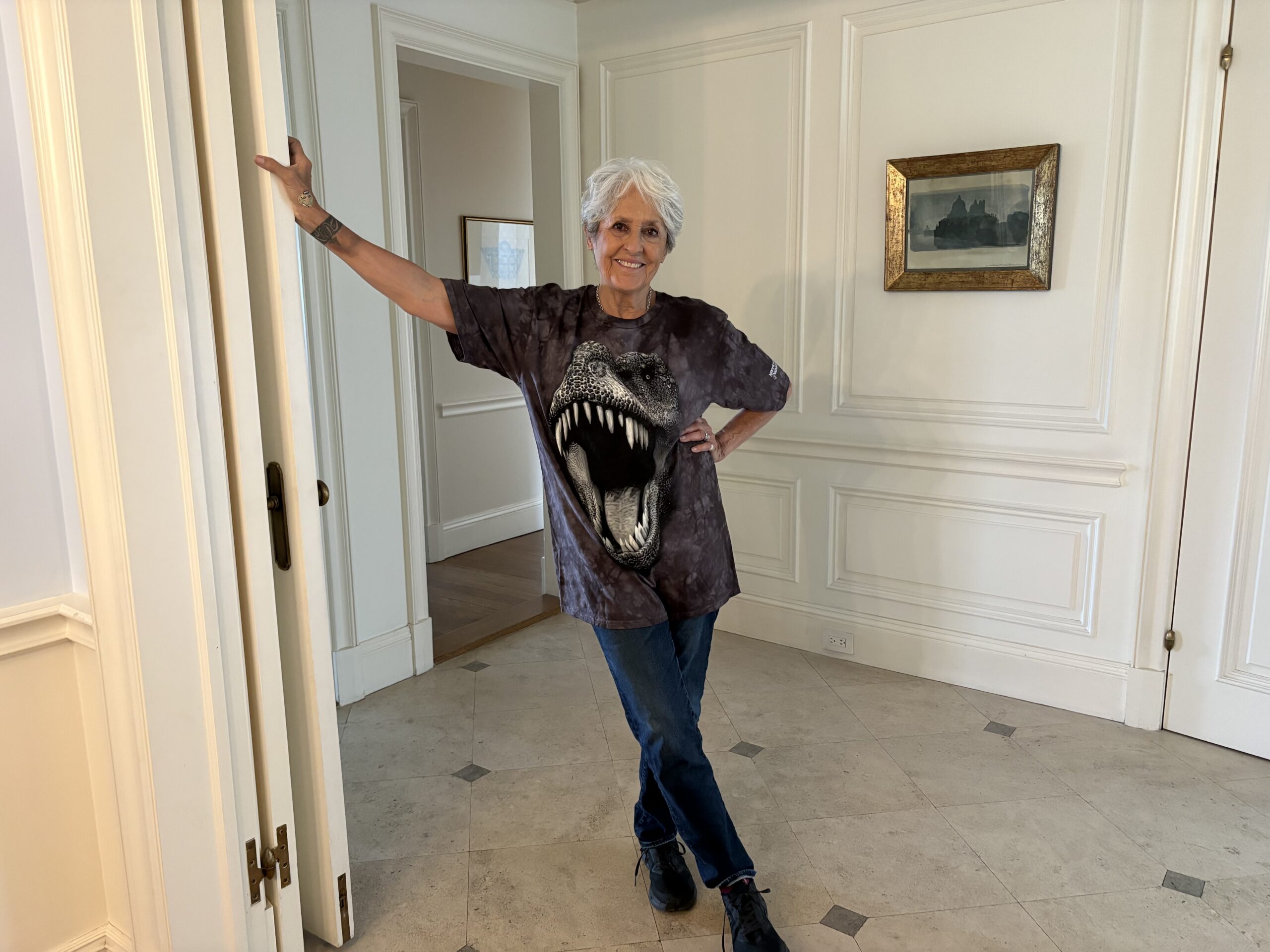
Here are some excerpts from WSR’s conversations with Joan Baez:
WSR: So, how was the concert?
Joan Baez: The concert was a musical blockbuster. 20,000 fans singing every note of his hits. Most impressive to me were the mini sermons [Springsteen] gave between songs. While perched at the edge of the stage, he let loose an unfiltered tirade against the administration, the billionaires, global warming, eventually switching to lauding community, resistance, hope, and music. This phrase was vital for all of us to hear: “And it’s happening now, and it’s happening now.”
WSR: How are you dealing with today’s world?
Joan Baez: I have different responses, but probably the most helpful is, people should spend 80% of their day in denial and enjoy doing all the things they do. And the 20%, or even 10%, is, quit thinking about yourself. Look at the mess, pick out one thing you could do. Forget about trying to do it all. That’s my little whatever you wanna call it. We may not be able to turn the tide, but we can save a few fish. That’s when you get involved with a group. It could be anything, what you’ve been putting off for the last five years, whether it’s the homeless guy on the corner or cats and dogs. Just do it.
WSR: So, what are you doing these days?
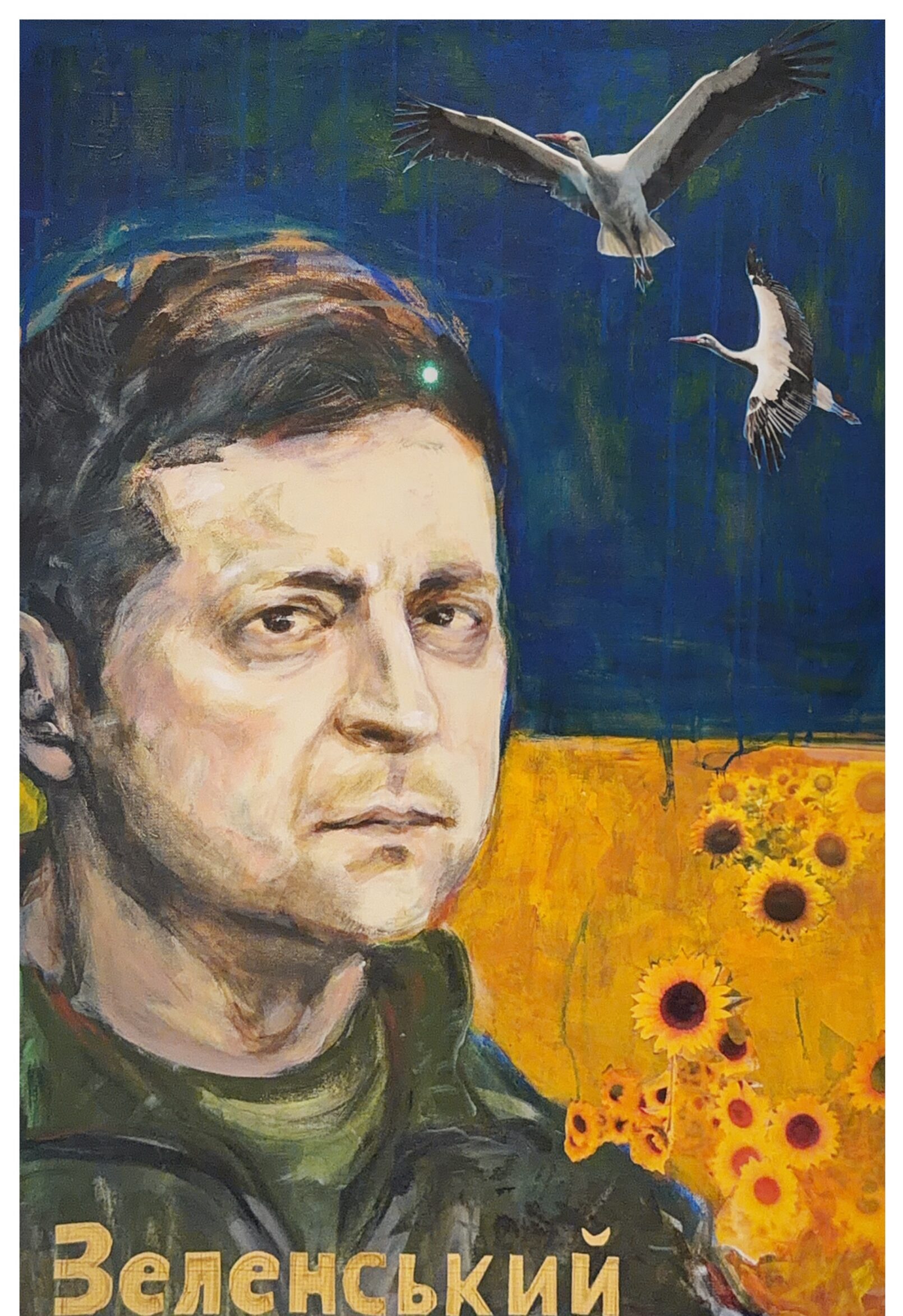
Joan Baez: I’m doing different things. For instance, I’m painting portraits of people who’ve made nonviolent change on a big scale, you know, from Gandhi to [Ukrainian President Volodymyr] Zelensky. Zelensky’s a big one. Fauci. And Dylan. In spite of his being a weirdo, he gave us so much. And others. We sell the signed prints for $500 and give the money to different organizations.
WSR: Did you study art in college?
Joan Baez: No, no, I, you know, I had terrible grades, and the push was on because everybody went to college. I didn’t want to go. So I was still with my family and the guitar came along and the voice came along and I never looked back. I mean, this voice wasn’t like anything I’d heard before.
WSR: Do you consider it a gift?
Joan Baez: Oh, absolutely, totally. I almost feel as though I can say I think it’s a great voice because it isn’t something I created. I call what I do maintenance and delivery. For the rest of it, I’m just grateful.
WSR: Tell me a little about Bob Dylan.
Joan Baez: I was mystified by him. I just thought he was so brilliant, and he was channeling from somewhere. We didn’t use the word back then, but he was just writing songs a mile a minute, all day and all night. And most of it was good. He once said, “After I’m dead, they,” meaning critics, “they’re going to try to figure all this shit out.” He said, “Shit, I don’t know what it means.”
WSR: So, now you’re 85. How does that feel?
Joan Baez: 80 was one thing, 85’s another. 80 was a shock that I was 80; 85 is difficult. Keeping up the body and the mind, flexibility, balance. It’s a lot. I’m not…I have a difficult balance, so I work on that constantly, and I’ve fallen. You know, I try to learn how to fall right. Some of the physical therapy really is getting how to fall right. And I’m good at falling backwards. You kind of roll up.
WSR: As long as you don’t hit your head. What about singing?
Joan Baez: Singing… my voice that people know, just basically I don’t have anymore. I have the one that last night you heard. So singing… I try to find what songs I can do in that range that are good. And right now, I sing at different events, you know, at tributes to my fellow songwriters.
WSR: How did you like your visit to the Upper West Side? What do you think of the neighborhood?
Joan Baez: I had a wonderful time walking up and down your neighborhood. And you’re right, people are friendly. They’re probably not that friendly in my little tiny town. New Yorkers have a special thing with each other, I think. They’re proud to be New Yorkers.
Subscribe to West Side Rag’s FREE email newsletter here. And you can Support the Rag here.




This article and the interview are so delicious. This is why I love the UWS. Thank you, Carol, for taking in the wondrous Joan.
So amazing! She IS a American treasure!
Of course we love Joan I am a pianist vocalist love to play with her and if she need a place to stay walcome
Ten years ago at the end of my interview with Joan Baez, she was (un)surprisingly gracious when she accepted to tape a brief birthday wish for a friend on the Upper West Side who was about to turn 80. Next week at his memorial on West 77th Street we shall replay Joan’s voice wishing Lee a happy birthday. Her unmistakeable voice will leave guests at the memorial as stunned as the guests at Lee’s birthday party ten years ago.
I’ve always admired Joan’s talent and commitment to activism. However, I believe that an artist/entertainers primary responsibility is to their audience. I’m not there to hear they political, economic or religious views. In the 1970’s, I walked out on Dave Van Ronk in the Woodstock Playhouse(I think that Joan knew Dave) because of his rants after each song. I knew Dave, but I felt “audience abuse”. If the artist wants to do that, then the show should be appropriate labeled. I paid for enjoyable entertainment, AND NOTHING MORE.
I was in diapers when Dave Van Ronk was in the prime of his career, so I can’t comment on what his shows were like, or how aware people were back then of what they’d be seeing when they paid to see him. But nowadays, when you can view at least part of probably hundreds of his shows online, it takes a conscious willfulness to be unaware of what a Bruce Springsteen concert is like or to feel cheated if you didn’t expect what you got. His stories and his commentary resonate with me and I welcome them. And that stage is his soapbox if he wishes it to be. But if that’s not someone’s thing, it’s incredibly easy to NOT get a ticket to his shows.
Absolutely the opposite. Art is politics. Always has been, always will be. The artist is the sum of his/her/their parts. The audience is meaningless. How could it not be, when every single person in every single seat has his or her or their own opinion about everything? No artist is a mind reader! Oh, which mind to read?! What an absurd notion. If you don’t want to hear what someone has to say, stay home and listen to a record or listen to yourself. Their art is not about you — it’s about them. No one is there to appease you, either. The artist doesn’t even know who you are. Get over it.
But Dave Von Ronk’s audience was there because of his political views! “Audience abuse???” You know protest music is a thing and always has been.
Entertainers are as entitled to their opinions as anyone else. Stop whining.
Is @Frank Volz complaining about Ronk’s opinions? It sound more like he is complaining that he paid to hear Ronk sing- and felt like he didn’t get the product he paid for. If an artist sprinkled his concert with short 2 minute sermons that isn’t a problem, but if i pay for a 2 hour concert and it’s a 10 minute sermon between every 5 minute song…. I would feel cheated too. If that is what the artist plans to do, he needs to advertise the event more accurately- like “Music & conversations with Ronk”. If he just calls it a concert… then maybe it is “audience abuse”- or false advertising. But I’m definitely not getting my money’s worth. If I paid for music, I don’t want sermons.
Penny, Frank said distinctly more than just about Ronk’s concert. He said “I believe that an artist/entertainers primary responsibility is to their audience.” That is Frank’s opinion, and I think it is an erroneous one. Artists/entertainers don’t have a “responsibility” to anyone. They are who they are and are free to express themselves through their art. For people like Joan and so many who came to the fore in that era, their politics was inextricably part of who they were as artists. And they made that very clear. So audiences had every right NOT to go see them. But people flocked to people like Joan because of who she was, in totality. And that was a person deeply concerned about what was going on in the world, as a citizen of the world. (She still is.) Her art was and is an extension of that.
Stay home and listen to the record. I rather hear what a great artist has to say, because I’m interested in all of the person, not just my own crappy opinion.
Thanks for a wonderful article about a great person. I would just like to share one experience: Joan showed up with Jesse Jackson and sang the Our Father with a gathering of thousands at Concord, California, where arms were being shipped to Central America in 1987. Just before the gathering a peaceful protester was hit by a train and lost his legs.
Such a beautiful article. This actually lifted my spirits tonight after another day of depressing news coming out of Washington DC. Thank you so much!
I just read the article about your conversation with Joan Baez, and….Wow! Do I relate! I am a singer/songwriter the same age as Joan and have always been such a fan of hers.
I have been suffering from a depression, and I think her advice might be just the right advice for me. In fact, her words have lifted my spirits somewhat. I don’t feel quite as alone and, hearing that advice from someone like Joan Baez, who I have always followed and admired — I’ll take that and see where it goes. Thanks for sharing….
Bonnie Lee Sanders
bonnieshimkin@gmail.com
I will subscribe now to the West Side Rag….
Joan Baez is amazing and she is a good person. We truly need her these days.
Enjoyed this article. In a small world way, Irwin Redlener’s mother was my 6th grade teacher. She was ahead of her time and I think her son inherited many of her caring and progressive ways.
I love everything about this piece! What a life highlight! 🩷
My name is Susan. I am a 71 year old woman. I grew up in a family where the guitars came out at every gathering. I just wanted to say thank you to Ms. Baez for being my idol since I was 10. My older brother and sister saw you at the march on Washington. My parents wouldn’t let me go, even though I begged and pleaded. My siblings still tease me about it.
Thank you for the decades of joy.
Oh my, tell Joan if she ever wants a place to stay on Long Island, I will rename my guest room, “the Joan Baez Suite,” 😍 Although I have idolized her since my preteen years (I was a deep thinker full of angst), I am not the type to be starstruck. We could sit out back on the deck, smelling the flowers, petting my Great Dane, and talking about life. 🙂
While Joan Baez might be hard to book, I’m sure there are others who would like to stay with you and talk about life, some of them also very talented. If you don’t know anyone, I’ll introduce you ;-).
What a totally fabulous story, Carol! If I didn’t know better, I’d think perhaps you had a crazy, wild dream that icon Joan Baez came to stay with you for a while and you ate yogurt together, went walking to Belvedere Castle and to see dinosaurs at the AMNH. A story to remember forever. ♥️
Nice. Very nice. Thank you WSR
For Joan Baez fans, there is a fascinating 2023 documentary covering her 2019 farewell tour as well as vignettes of her life and career. Well worth watching. Called Joan Baez: I Am a Noise.
I saw the documentary Joan Baez :I Am a Noise at the end of last year and it was wonderful..
Thank you for this wonderful visit with Joan Baez, still inspiring after all these years. I love her advice about coping with our world: Allow yourself denial 80 percent of the day. The other 20, do something about it: “Look at the mess, pick out one thing you could do. Forget about trying to do it all.”
I was honored to be at this dinner in honor of joan. . I was so impressed with Joan’s friendliness and warmth. She is beautiful and inspiring. And, hearing her sing was very touching. What a great voice. I will always remember this evening as one of my favorites!
I remember my very first concert was seeing Joan Baez at the Greek Theater a gorgeous half bowl venue. my Mom was mesmerized by Joan Baez’s music. I was in my early teens and I recall leaning against my Mom then drifting off to sleep for a little while. once I woke up both Mom and I were enthusiastic fans. Joan Baez in the 1970’s was a legend and she still is.
The early Joan Baez voice is a very special sound. It rings like the sweetest bell. During my long walks through Central Park, her voice sweetens even more the tweets and twitters of the many songbirds in the Ramble. In English, French and German, whether the song is happy or mournful, I feel somehow enriched by the experience and always end the walk with a Satisfied Mind. Thank you for the article, Carol.
On 10/27/61, as a student at the University of Michigan, I saw Joan Baez in concert at the Ann Arbor High School Auditorium. Her voice was exquisite, accompanied by her guitar only, and her stage presence was commanding. Next was an evening at The Bottom Line with herand the McGarrigle Sisters. And sometime in the 90s, as I was walking on Broadway/75 Street with my daughter, I heard a voice behind me say,
“I like your jacket,” I turned around to say thank you and it was Joan Baez, which presented me with the perfect opportunity to thank her for years of enjoying her voice and music.
Those Bottom Line concerts were amazing. I went to two, and a rehearsal, which gave me great material for my biography Jan Bae: The Last Leaf.
Loved your book, Liz. Read it when it as soon as it came. Thanks for writing it 👋
Thank you
My dissertation advisor was at that Joan Baez concert in Ann Arbor in 1961! I have always had a clear memory of her telling me (in the 1980s) that she had seen Joan Baez performing in a high school auditorium in 1961! Lucky you and lucky her.
Interesting connection! I remember the specific date of the concert because I still have the program and ticket stub in a scrapbook of my days at Michigan. Joan Baez was mesmerizing, with her long dark hair and bare feet. Then she sang and I was transported. I recall some audience members being late getting back to their seats after intermission and she quietly but repeatedly sang, “Please sit down, won’t you please sit down” and everyone did. Funny how some events stay crystal clear forever.
Wow! This is so interesting, and so human! Thanks!
Such a beautiful article! I have always loved Joan Baez. I wish I could have met her too where I live on the UWS.
Lovely piece. Thank you. I never met Joan Baez but took guitar lessons from bob dylan in early 60s. Not the nicest guy to be around. She always seemed a nice decent woman. Hard to imagine the two of them together
Fantastic.
Great story. Thanks for sharing.
I love you Joan Baez
Come back to the Isle of Wight Joan! You were here once, but next time, you can stay in our cottage, free obviously, and speak to us of many things, and adore our quiet countryside, our 2 golden Retrievers , and we can just watch in wonder and enjoy our time together, for the days you choose to spend here. It will of course be TOP SECRET! So you will be safe.. You and I are the same age too. Followed you entirely since 1968 and have every record you every made.
When counting my blessings, number one is having grown up during a time when Odetta, Seeger, Simon and Garfinkle, Dylan, and Baez, were sharing their voices and messages with us.
Though the world was not at its best behavior these artists were there for us to express and explore our own sentiment s and to inspire a a path to follow. Never has the world needed their input than now !
Kudos to Joan Baez for everything. Kudos to Carol Tannenhauser for having her over. More people should invite more people to stay.
This story was lovely.
This has brought back happy memories for me. Joan Baez has always been my favorite singer and I continue to listen to her music and look for things about her on the internet. I did also get to watch Dave van Ronk perform once in San Bernardino close to our college at a small coffee house called the Penny University. I really enjoyed his wonderful folk music.. He did talk a little when he was tuning, his guitar, but was very laid back and friendly. It was the first time I heard his song.Take a stick of bamboo. So happy.I got to see this article and see all of your posts and memories.
What a pleasant surprise it was to stumble upon this article! I’ve always admired Joan Baez, but even moreso now. Your story made me feel like I was there with you and experienced this treasured moment as well. Thanks for sharing!
Carol’s article so captures the essence of this iconic, unique force in world music who showed artists everywhere how you could be a star and a powerful voice for justice.
Karen and I met Joan in 1972 when I was medical director of a federally funded clinic in the 6th poorest county in America. Karen was a VISTA volunteer from California running social services.
When President Nixon decided to pull funding for the clinic, I reached out to Joan who, incredibly, responded by visiting us in Lee County Arkansas and eventually held a benefit concert in Memphis, giving us the resources to continue.
We’ve been very close friends since.
Now she’s on the board of our Ukraine Children’s Action Project, http://www.UCAP.help, and actually accompanied us on one of our visits to Ukraine!
The power of Joan’s voice as an extraordinary artist and as an inimitable force for good holds a very special place in the American story.
Thank you, Joan…
This was an excellent article on Joan Baez. I wasn’t aware of all things she has accomplished as a song bird, a political activist and philanthropist. I really enjoyed this article
Good to see – coincidentally – your work, Carol. How amazing that you hosted Joan Baez. Next time Bob Dylan??
❤️
Yes, what a voice. What a spirit. What a personality and tango dancer! Thank you, Carol, for the memories. Not another voice like hers.
Wonderful article about your magical house guest. She has always been so inspiring, funny and refreshing all at once.
JOAN! BRUCE! DYLAN!what more can one ask for?
Absolutely lovely. I listened to Joan Baez sing and speak at a protest in Northern California only last year. She continues to use her voice – literally & figuratively – & she still sounded wonderful. What a delight to see her here in the WSR — thank you (and gosh this made me miss my years living on the UWS!).
this was such a treat! Thank you!!!
What a wonderful piece. Beautiful to read something different, and so personal, about JB, this world treasure. Splendid artist. Genius human.
Great write-up. Thanks for sharing.
I met joan baez a few years ago at Balboa Park in san diego. She’s a dead ringer for my mom, (helen), and she signed the autograph to helen. Wonderful concert and a voice (as if it was coming from the angels from up above) . Enchanting experience . I moved to pacific grove, calif, to be near my elderly parents and found it to be quaint with the victorian homes at the time. The weekly newspaper wrote an article about an old manifesto that still states ” no non-whites allowed”. We have many churches here and a 3% racist extremeist group, that only got worse when a certain reality star stole the show. I started a gofundme for my deceased folks, George and Helen arroyo, al siekert, & renee agee, seniors. My dad was a veteran and I want to make him proud. Thank you ms baez, kamala. Etc for protesting for our rights, freedom and justice. ✌️ ☮️
She still looks like she’s 20 years old,she’s amazing!
I met you in the 1980’s at an outdoor concert in balboa park in san diego and was enchanted by your aura and how down to 🌎 you were. Your voice and music was beautiful and I told you that you looked exactly like my mom and to sign the autograph addressed to helen for my mom, who has her records. We had moved to pacific grove to be by the ocean and heard that you had once lived in nearby carmel, which made it extra special. You have a voice like an angel and I want to thank you for continuing to protest like you used to back in the 60’s and 70’s for our rights and freedom marches, along with others. Happy belated birthday joan!!! Thank you for being you. Your bring in this 🌎 makes it a kinder and better place. ✌️ ☮️
Happy belated birthday joan!
Thank you, Carol T. for sharing this intimate portrait of your brief time hosting Joan Baez. I am a long time fan, having first heard her albums and sung her songs in the mid-late 1950’s as part of my Jewish summer camp experiences. I think the song, “Banks of the Ohio” may have contributed to my growing pr-adolescent feminist awareness. I attended one of her farewell concerts at the Beacon Theater, saw the documentary about her, and am so happy to hear about the current work she is doing in the Ukraine and her art projects (is there a website?). Give her my LOVE!