

By Scott Etkin
If it seems like a medieval castle just appeared out of thin air on West 66th Street, it’s because it has… kind of.
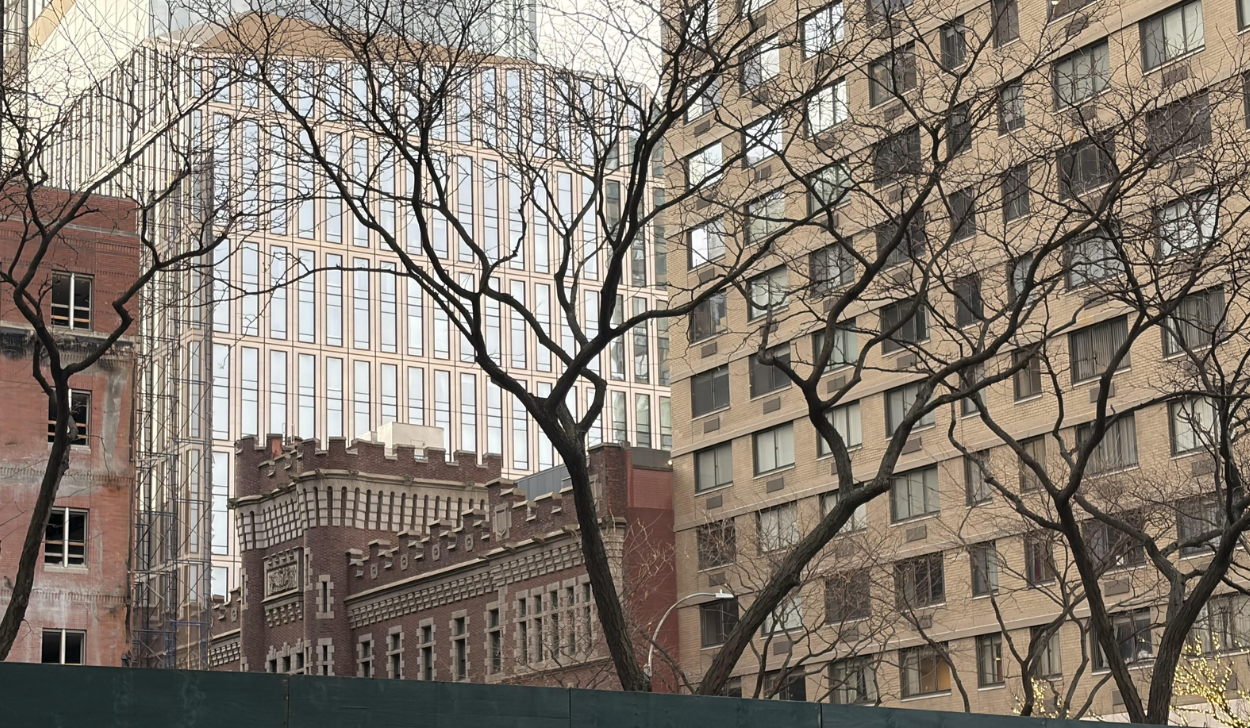
The First Battery Armory, with its imposing brick and granite facade, has been stationed at 56 West 66th Street, between Columbus Avenue and Central Park West, for more than a century. But at just three stories tall, it has long been surrounded by taller modern buildings, making it impossible to view from a distance – at least until recently.
Now, if you’re on Columbus Avenue looking southeast, the armory’s distinctive turrets can be seen from 350 feet away (according to a Google Maps measurement). This unique view has opened up, for the first time in decades, because of the demolition of 147 Columbus Avenue, a 10-story building that was part of the ABC network’s UWS campus. Extell Development, which now owns the area, intends to build luxury residential apartment buildings on the former ABC site, but it has not made public its plans for this particular lot. Based on the current zoning regulations, there are no height limits for the site.
A closer look at the armory reveals not only interesting architectural details, but a winding history that chronicles the changing needs of a neighborhood. In its very long life, First Battery Armory has housed a civilian militia, a television studio, and ESPN offices. Soon it will become a Jewish college, just the latest in its tale of architectural reinvention.
The building was designated an individual landmark in 1989, and its exterior is largely unchanged since it first opened its doors in 1904. But the interior has undergone many iterations; the armory is one of the Upper West Side’s best examples of “adaptive reuse” – when an outdated building is repurposed while retaining its historic character – a practice that’s especially relevant in a neighborhood that has partially been classified as a historic district.
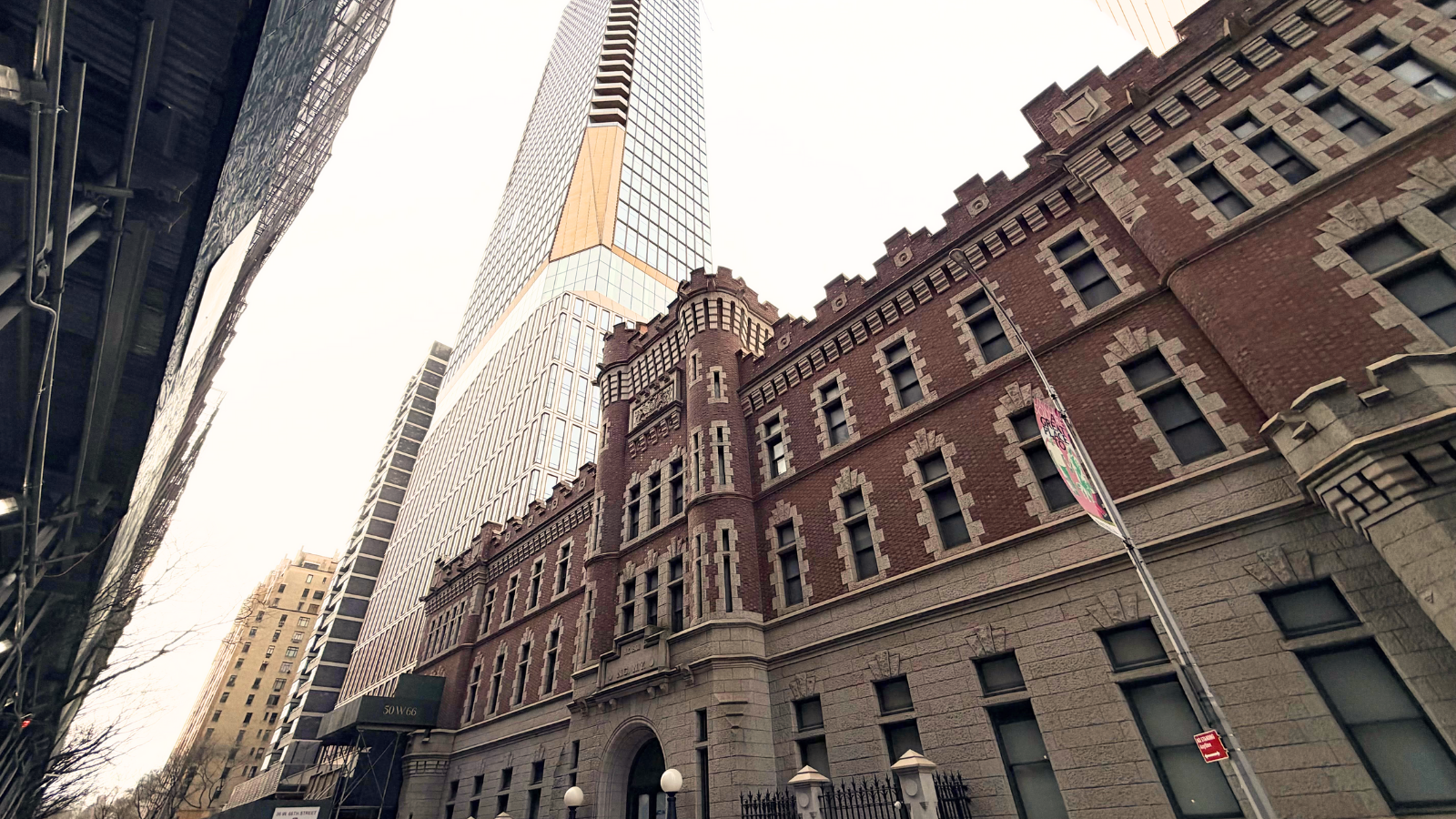
When it opened in 1904 it was the home of the First Battery, a mounted field artillery unit of the National Guard of the state of New York. Civilian militias were common in those days, and the First Battery Armory was one of ten armories commissioned in New York City in response to workforce riots. Even as far back as 1792, a law required states to have militias as a counterbalance to the federal government.
The First Battery was a “well-regarded volunteer unit,” but it did not see active duty during its ten years stationed at the Armory, according to a Landmarks Preservation Commission Designation Report by researcher Michael Corbett.
The building was designed to look like a fortress, but it wasn’t really intended to function as one. “The 19th-century National Guard was in large part also a social organization,” Corbett writes. “In fact its major activities were athletic events, dances, parties, picnics, and entertainments of all kinds.”
The role of armories as social hubs is “something we might use more of in society today as news outlets bemoan the ‘loneliness epidemic’ in our nation,” Sean Khorsandi, executive director of the UWS preservation group Landmark West, wrote in a message to the Rag.
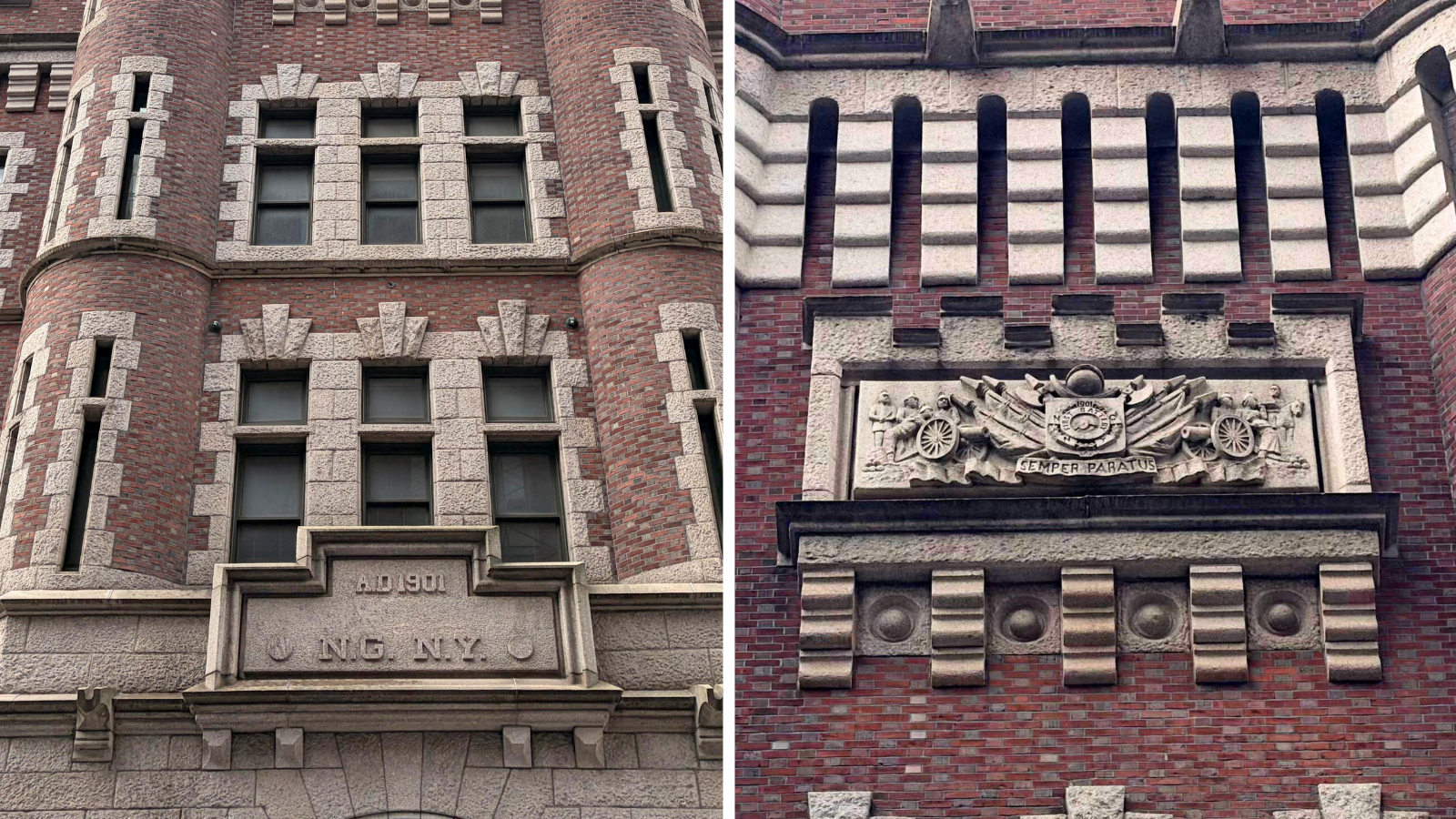
Still, military iconography is clearly visible throughout the Armory, which was designed by Horgan & Slattery, a firm commonly known as the “Tammany architects” for its many contracts with City Hall. Cannons, a horse, spears, and soldiers are depicted near the top of the building, next to the Latin motto “Semper Paratus,” meaning “always ready.”
Horses played a big role in the early days of the Armory. There were stalls for 76 horses in the basement, Corbett writes. Then, beginning in 1913, the armory transitioned over to home for the 102nd Medical Battalion, a medical unit that served in World War I and World War II.
That unit turned out to be the building’s longest tenant, with the next major change not coming for another six decades. In 1976, after a brief stint as a private club that brought tennis courts to the drillroom, according to the Designation Report, Capital Cities/ABC bought the building at public auction and, in 1977, remodeled the space as a television studio. In addition to daytime TV shows, its credits include the long-running soap opera “One Life to Live.”
In 2012, the building was remodeled again to serve as offices for ESPN, a subsidiary of Disney, also ABC’s parent company. The Armory was part of the media giant’s campus in the West 60s up until last year, when the whole operation relocated downtown to a new building in Hudson Square.
The future of the First Battery Armory promises to be entirely different from its previous lives. Last year, the building was bought by Hebrew Union College (HUC), an academic and professional training institution for Reform Judaism. The college’s current New York campus is located in Greenwich Village, and it plans to “fully occupy” the First Battery Armory in early 2027, a HUC spokesperson confirmed to the Rag.
Construction on the interior is underway to create spaces to study, worship, and gather. “It’s exhilarating to be creating educational and spiritual spaces to cultivate the next generation of Jewish leadership – especially in an iconic New York building,” the school’s spokesperson, who asked not to be named, wrote to the Rag.
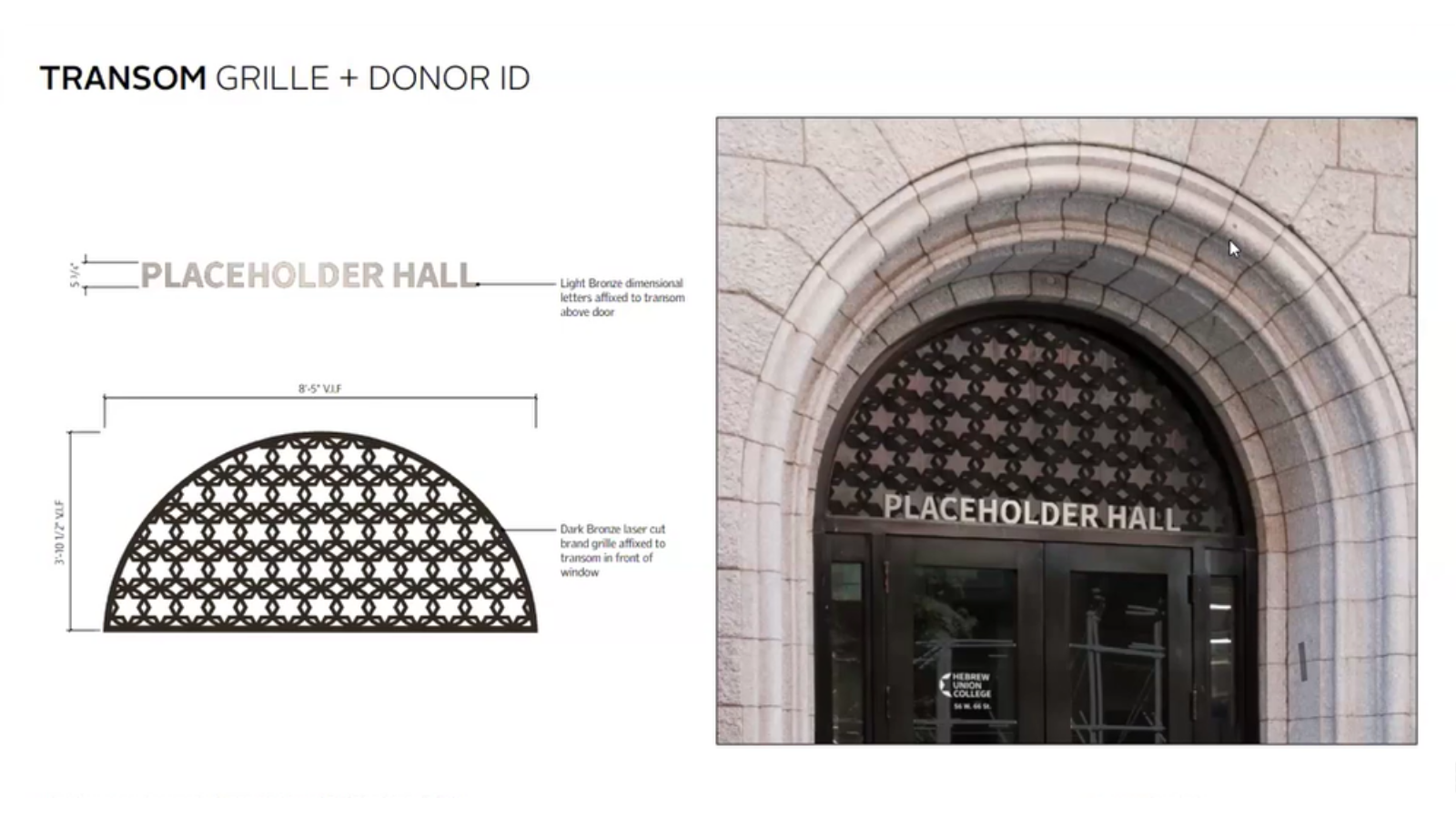
Earlier this month, architects from LVCK (a studio that’s part of Beyer Blinder Belle, the firm retained for the project), presented a plan to Community Board 7’s Preservation Committee to install signage for the college. A flagpole and grille with interlacing six-pointed stars above the main entrance, as well as plaques with the college’s logo, are designed to add branding elements for the college while respecting the building’s history and the integrity of its structure.
The plans will be presented again, this time to the city’s Landmarks Preservation Commission, in two weeks – almost 122 years to the day after the First Battery Armory officially opened its doors on February 3, 1904.
Another Upper West Side armory, the 212th Coast Artillery Armory, was lost as part of the urban renewal plan for Lincoln Center. The former site of that armory is now part of Fordham University’s campus. Landmark West has more information about the building – HERE.
Subscribe to West Side Rag’s FREE email newsletter here. And you can Support the Rag here.



Academic use by the Hebrew Union College seems to be a good use for this landmark.
No height limit to replace a ten story building is not good news for our leafy neighborhood of mostly human scale.
When will this zoning be changed in our favor???? Who is listening?
I hope Extell builds a building that is as architecturally interesting. So many of their buildings (One 57 and the Nordstrom building) are horrible and classless modern monstrosities.
I love the building, but there may be more details we can add to its history. As an actor working on One Life To Live circa 2008, I was standing in front of the building when an older neighbor walked by and explained that his high school was down the street and this building was used as a gym while he was in school in the 1940s-1950s.
Do any other long-time neighbors have memories of the building?