

By Scott Etkin
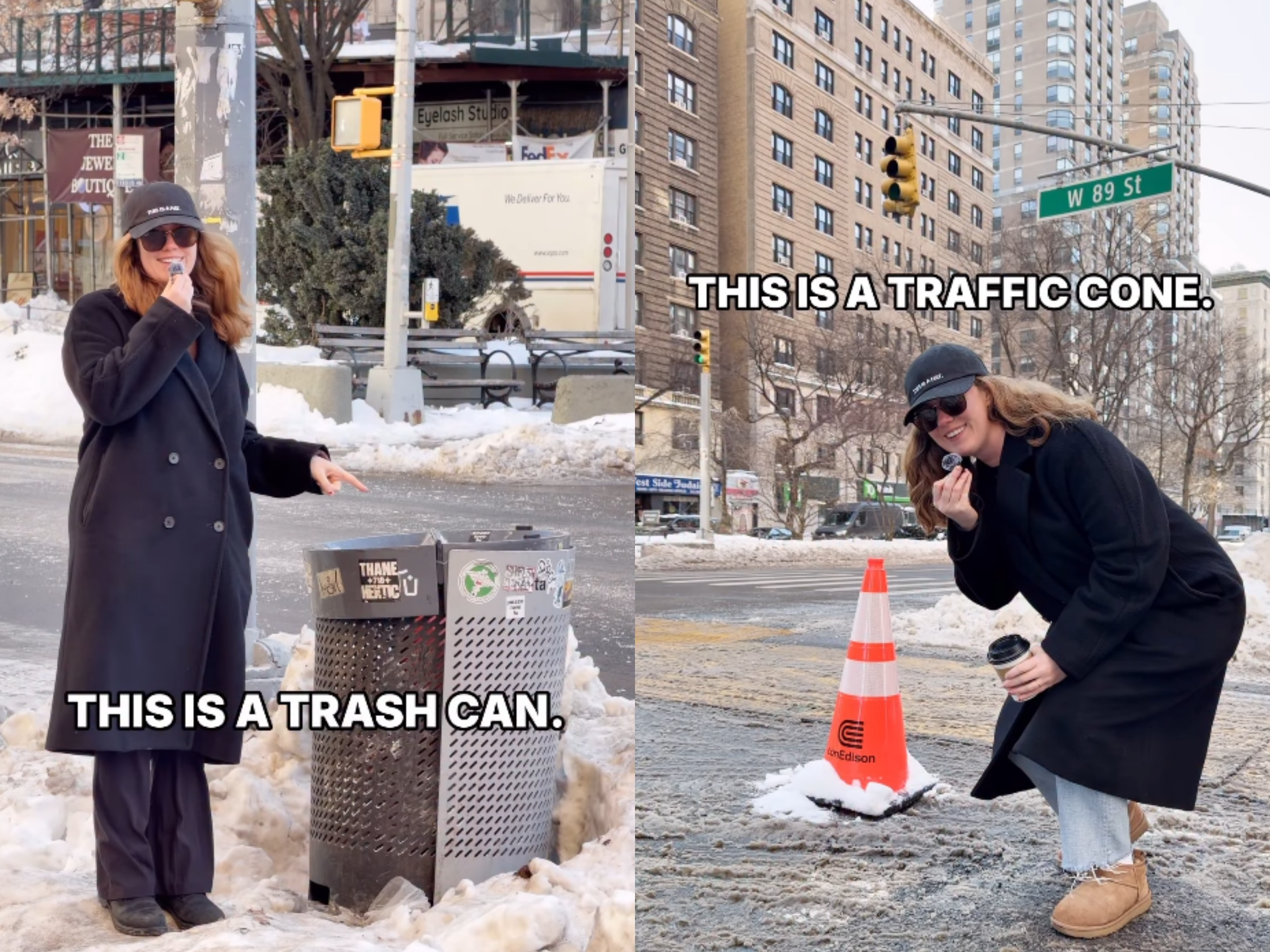
In the opening shot of one of her recent short videos, Upper West Sider Caroline O’Leary crouches next to an orange traffic cone on the corner of West 89th Street and Broadway.
“This is a traffic cone,” she says.
The fact that she’s stating the obvious is kind of the point. Last December, O’Leary and her husband, Will Rose, started uploading videos to YouTube, Instagram, and TikTok that explain mundane elements of the urban landscape, highlighting the history, design, policy, and technological factors that influenced their development over time.
“Everything that is around you in the city has some, honestly, probably shockingly deep history,” said Rose on a call with West Side Rag. “It’s touched a lot of human hands. A lot of people have thought about the way it should be.”
For example, traffic cones were the brainchild of a road painter who, in the 1940s, designed them as an improvement on wooden tripods, which were then commonly used as road safety markers. The tripods were bulky, tipped over, and largely had to be rebuilt at each job site. Today’s ubiquitous orange and white traffic cones, in contrast, don’t damage a car when hit, will pop back into place after a glancing blow, and can be stacked and stored for reuse.
Rose and O’Leary have found an audience for their videos – collectively posted under the handle “What Is This?” – despite the commonplace nature of their subject matter (park benches, water towers, intercoms, and the history of containers used for collecting the city’s street trash, for example). Their video about zebra boards, the striped bars in the subway that help train conductors stop in the middle of the platform, has racked up more than 1.6 million views on YouTube. And this past Sunday, O’Leary explained what triggers a blizzard warning like the one sent out for NYC this weekend (it’s not the amount of snowfall, she explained, but whether the storm is accompanied by winds of at least 35 mph that reduce visibility to a quarter mile or less for at least three hours).
There are plenty of videos available online that explain many elements of life in New York City – high-visibility infrastructure projects, or dazzling architecture, for instance. But Rose and O’Leary believe they have found a niche explaining something else: the common items that easily fade into the background of everyday life.
“You see it every day. It’s not that you miss it,” said O’Leary of their choice in subject matter. “It’s that it’s so mundane that why would anyone even bother to ask questions about it?”
The idea for the channel came about after Rose and O’Leary got married last July. They hand-made the stationery and other materials for their wedding and found they enjoyed having this creative outlet. Once the wedding was over, they looked for a new project.
The inspiration for “What Is This?” came, in a roundabout way, from a phone case that Rose made for himself. He wrote “This Is a Phone Case” on the case – a phrase that made O’Leary laugh and sparked the idea for a channel that explains ordinary things.
Each video takes a few days to produce. Rose, who graduated from Columbia Business School last spring, takes the lead on research and writing the script. O’Leary, who has a 9-to-5 job, reviews the script at night, and they film on the weekends.
The research process in particular can be tricky, given that the things they’re interested in haven’t gotten much attention.
“It’s usually like one person did a stab at [researching the topic] once, and it gets regurgitated in a bunch of different things,” said Rose, who told the Rag that he often relies on the archives of The New York Times to get historical context. But even venerable sources can come up short.
“I was trying to get a solid answer to when they actually extended [the platform of] the 79th and 86th street [subway] stations,” he said. “Shockingly hard thing to really pin down.”
At least for now, “What Is This?” is more of a passion project than a side hustle, though the couple is considering how to expand the project to include long-form videos, a field guide, or walking tours.
“Making any money would be nice, obviously, because that’s like a signifier of it working,” said O’Leary.
Perhaps the biggest influence the project has had so far is how it has changed the way they view the neighborhood.
“I go outside and I look at a random object, [and] I think, ‘Oh, I wonder who designed that,’” O’Leary said. “Inherently, to me, that’s a really great way to go about your day.”
Subscribe to West Side Rag’s FREE email newsletter here. And you can Support the Rag here.





Making this content has been a real joy, and we loved speaking to you about it! Thanks so much for the kind words!
If you’d like to follow us elsewhere, we also have Instagram and TikTok accounts, both under the handle @whatisthis_brand
Happy ordinary explorations!
I eagerly look forward to catching your videos on Invidious.
Do one on the orange steam towers!
What a phenomenal addition to the neighborhood 😁
The videos are excellent. Great work Caroline and Will
Creative and wonderful humor.
How fun! It is a little like seeing the world through a child’s eye – where wonder and curiosity often include the most (supposedly mundane). Like the children who asked me just this past week: “why do some forks have four poky things and some forks have only three?” and “who decided to make the post office boxes blue?” 🙂 So, yes, it is all of it a story. Also, I’m told that traffic cones make excellent hats (not that I’ve ever tried, of course … 😉 )
Ah, the traffic cone, a contemporary signifier of the many moods of the roadway and beyond. I like when there’s one warning of a large pothole. I understand when ConEd overdoes it so we don’t fall into one. And I also hate it when some super or trucker decides to block off a legitimate public parking space because they’re saving it for a delivery. In this last instance I had a standoff with a super and had to tell him what he was doing was illegal. A very nice police officer explained the rule to him; he nodded at her, picked up the cone, and I parked my car.
This is a comment. And a compliment.
LOVE THIS, Caroline and Will!!
So glad Scott Etkin spotlighted this wonderful series! I watched the first episode on the benches in Central Park (a favorite piece of furniture of mine!) and learned so much. Three cheers for Caroline and Will on their in-depth research and beautifully designed, engaging videos!