
By Rob Garber for the Bloomingdale Neighborhood History Group
Welcome to another installment in the Rag’s Historical Photo Challenge. The image above was taken somewhere on the Upper West Side, sometime in the past. Can you figure out where, when, and what it shows? Look closely; this week’s challenge photo, like the others in the series, includes clues that will help you identify the scene, if you’re a dedicated UWS history sleuth. And even if you don’t recognize the picture—not to worry! Come back in two weeks and I’ll decode it, show you the clues that help identify it, and—best of all—tell you a story the image unlocks, because this column isn’t just a test of your neighborhood knowledge; it’s also a rolling celebration of the people, buildings and events that wove the tapestry of the Upper West Side.
Ready? If you think you know where and when the photo was taken and what it shows, post your answer as a comment on this column.
Solution to Historical Photo Challenge #20
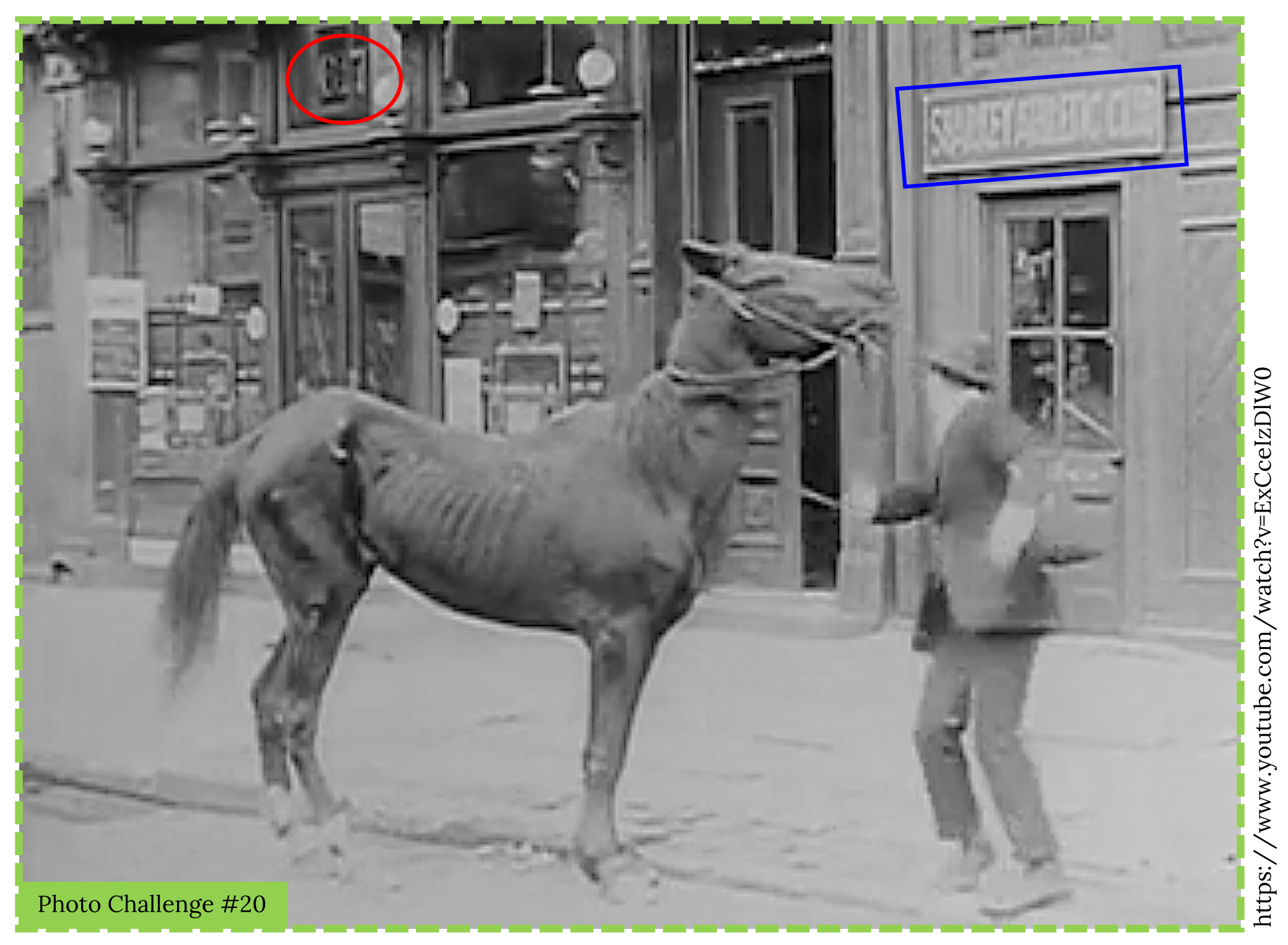
Subject: Sharkey Athletic Club
Location: Columbus Avenue at 65th Street
Date: 1915
Image Source: His Picture in the Papers at YouTube.com
Clues: This was a tough one, not least because it probably doesn’t depict what it purports to. The sign over the door says Sharkey Athletic Club, which was variously described as being at 127 Columbus Avenue or at 116 West 65th Street. But at either address, there wouldn’t have been a #617 address next door. This might have been a movie set, because the image is a still from the Douglas Fairbanks Sr. movie His Picture in the Papers, about a man who will be permitted to marry his sweetheart only if he can get his photo in the newspaper; a boxing scene in the movie took place at Sharkey’s. That’s Doug (no, not Chico Marx, despite the hat) who has just dismounted and is about to run into the entrance of Sharkey Athletic Club. If you’ve never heard of the Sharkey AC and its namesake, read on …
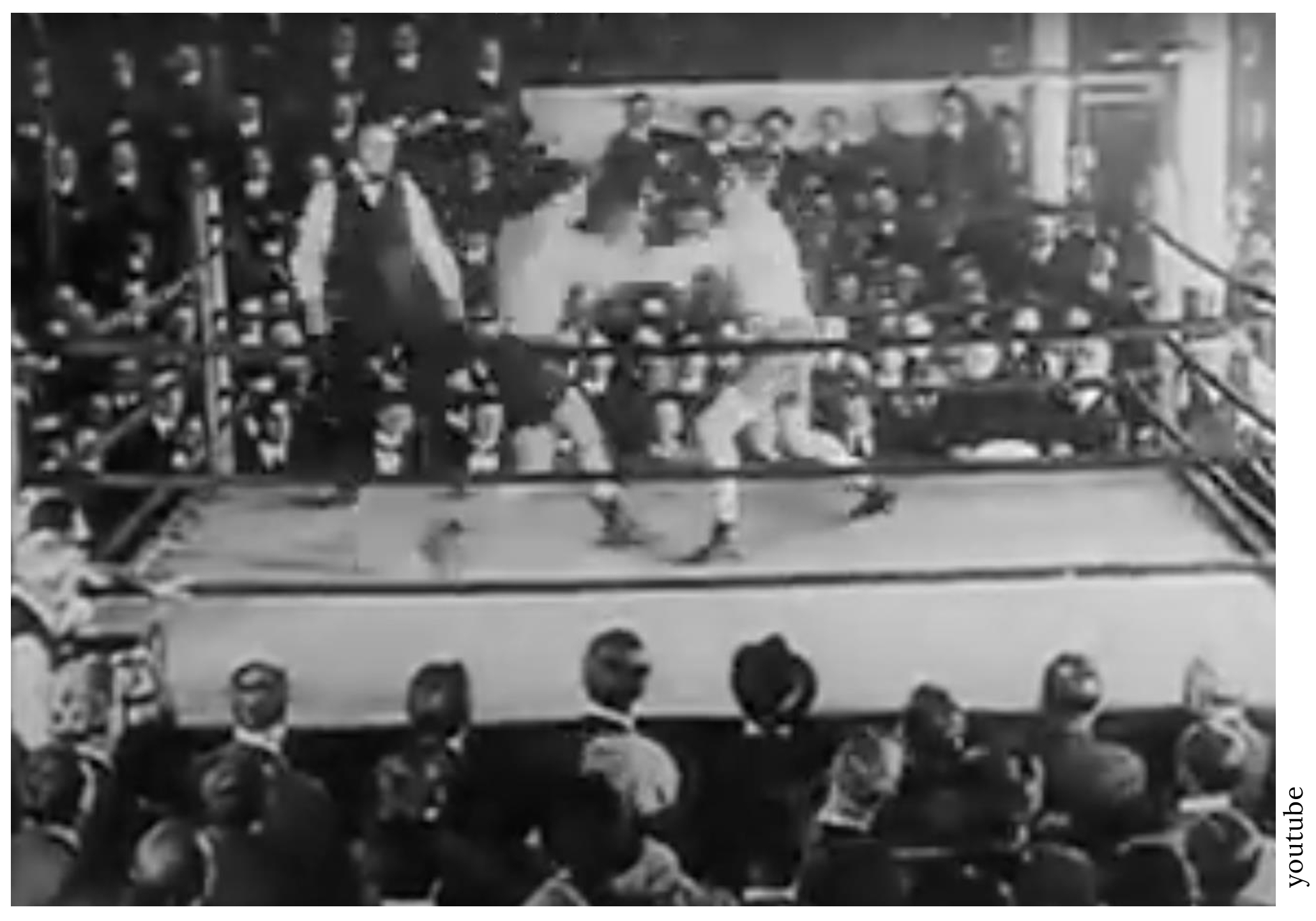
The rest of the story: In the early 1900s, prizefights were illegal in New York State. But there was a large loophole: Athletic clubs were allowed to stage boxing matches. So, saloons declared that they had an adjunct athletic-club business, and members could join at the door by paying not an admission but a membership fee. The result was a thriving boxing industry in New York City, and a cat-and-mouse relationship with the police department. One of the best-known such venues bore the name of Thomas J. “Sailor Tom” Sharkey. Tom Sharkey was a legitimate boxing legend: a 5’9” Irishman who joined the U.S. Navy, became its boxing champion, then fought professionally at the highest level for a decade. As his autobiography’s title says, “I Fought Them All.” Sharkey took on a Who’s Who of heavyweights during the golden age of American boxing, from James Jeffries to Gentleman Jim Corbett. He finished with a record of 37-7-6, with five of his seven losses coming in his last seven fights. Sharkey went into the liquor business in New York City after retiring from boxing, and lent his name to a saloon-cum-athletic club at 65th and Columbus, in the shadow of the El. Sharkey’s was a serious venue—it apparently held 600 fight fans and although Gene Tunney later called it “nothing more than a loft with tiers of wooden benches to the ceiling…an absolute fire-trap,” a scene from Douglas Fairbank’s movie His Picture in the Papers shows a legitimate-looking arena.
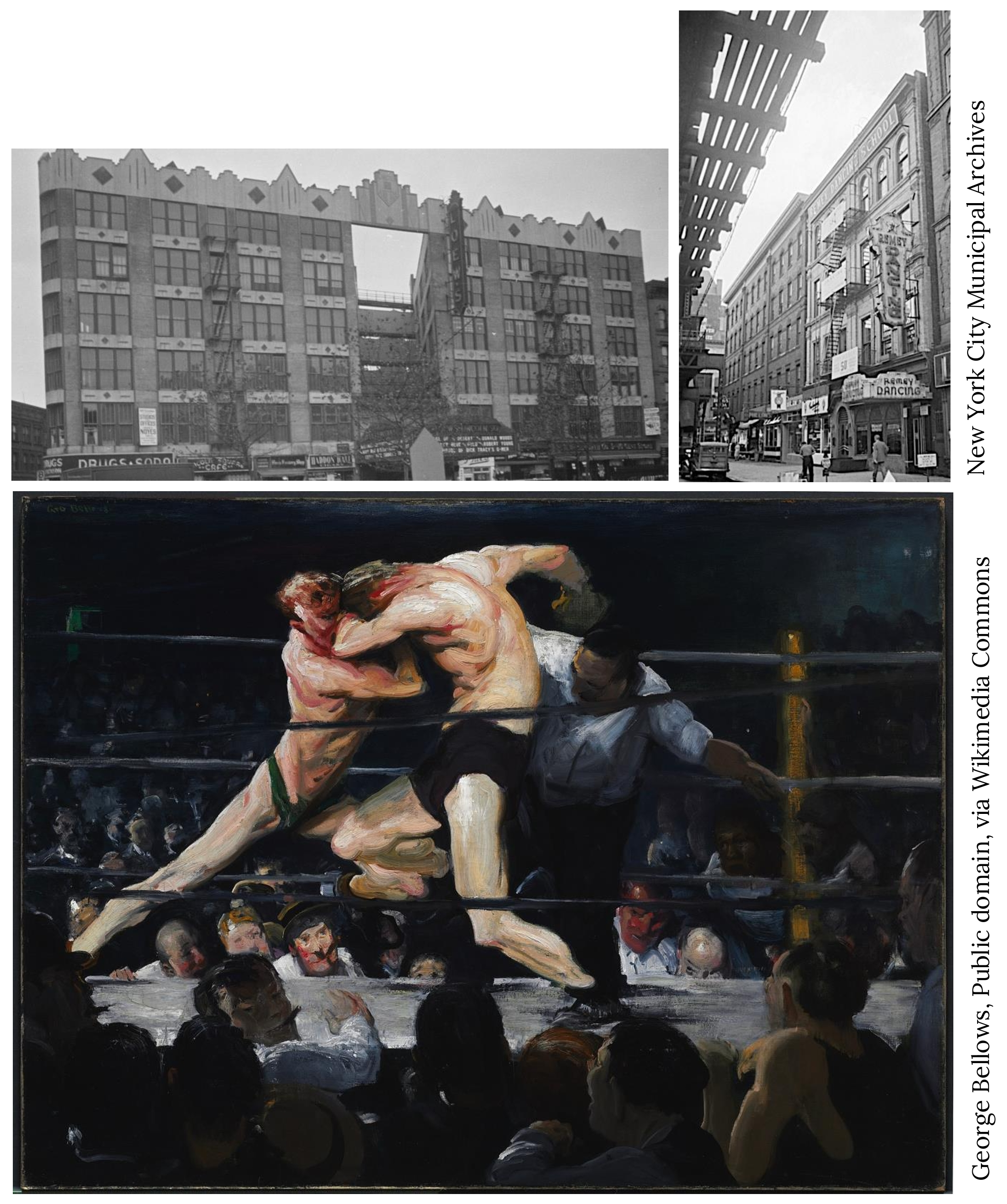
Wait–there’s more! Across Broadway from Sharkey’s was Lincoln Arcade, which provided rooms and studios for artists ranging from Marcel Duchamp and Eugene O’Neill to Ashcan School painter George Bellows. Bellows attended the fights at Sharkey’s, and what is arguably his best-known painting, Stag at Sharkey’s, is set there.
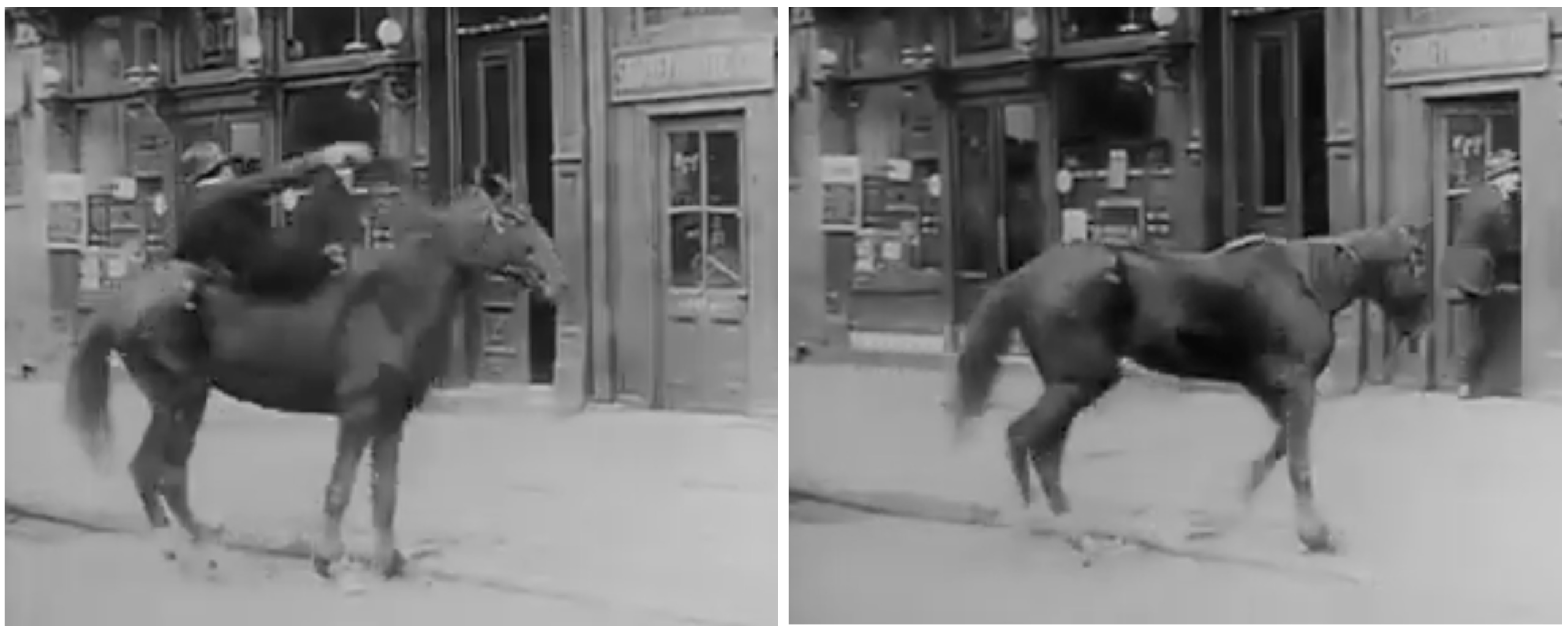
Shoutout to readers: Sasha Charnin noticed the Sharkey’s sign and correctly linked it to the saloon/boxing venue on Columbus Avenue in the mid-60s. For readers concerned about the underfed appearance of the horse, here are screen grabs taken immediately before and immediately after Fairbanks dismounted—the horse’s ribs aren’t showing in these images, so perhaps his body was briefly turned at an angle that pressed his ribs against his skin and made him look emaciated.
…and that’s the story behind the mystery image. Now scroll back to the top of the column and take on your next challenge, Sherlockians! If you’ve missed any pictures in this series, here is the complete collection.
About the author: Rob Garber has lived on the Upper West Side since the late 20th century and is a member of the Bloomingdale Neighborhood History Group. To learn more, visit their website at upperwestsidehistory.org. All photos in Upper West Side Historical Photo Challenge are used by permission.
Subscribe to West Side Rag’s FREE email newsletter here. And you can Support the Rag here.



Columbia University!
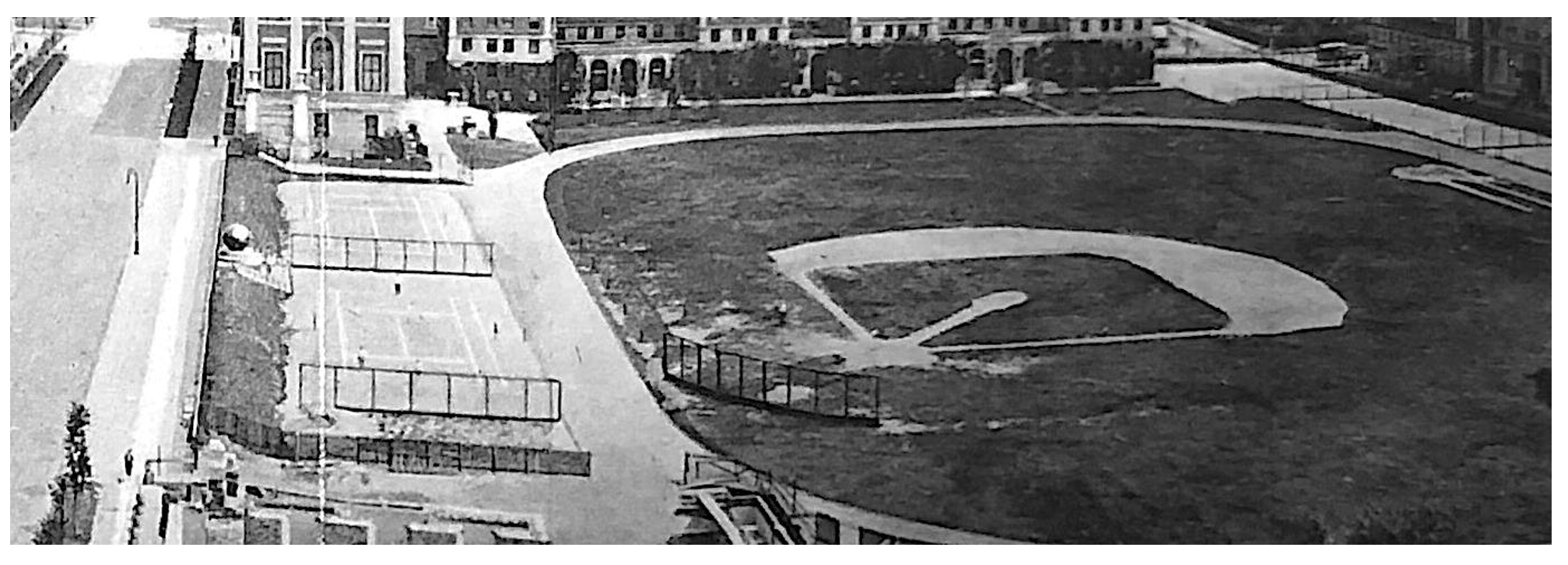
South Field at Columbia. Broadway on the left, 116th at the top and Amsterdam Avenue on the right.
Baseball Diamond at Columbia University. That’s 116th Street on the left (The portion now taken as part of the Columbia U. Plaza) 114th Street is beyond Right Field.
Lou Gerhig played baseball for Columbia on this field.
(Gehrig, I meant)
I’ll add that Gehrig studied Engineering but left before graduating to pursue baseball with the Yankees.
Eddie Collins, would have also played on this field (a few years before Gehrig)
Collins finished and got his degree from Columbia.
Both men are in the Hall of Fame in Cooperstown.
I think photo #21 is what is now a little running track in Riverside Park at 72nd St. No idea when the photo was taken, and when there was a baseball diamond within the track, but let’s say 1925. The viewing seats above are what gave me the clue.
The ballfield shown was on the southeast corner of Columbia’s campus, roughly at Amsterdam Avenue and 115 (or 114) Street. The giveaway is the dormitory, John Jay Hall, in the background. As for a related notable event, it was from there that Lou Gehrig, at the time on Columbia’s baseball team, hit a prodigious homerun that struck a building across campus. It was witnessed by a scout for the Yankees and led to Gehrig’s being signed by them.
I heard this story when I was on campus in the 1970s, but for it to be true, home plate would have to have been located completely opposite to where it is in the photo. I believe the legend originates from the 1942 biopic Pride of the Yankees, which has a scene of a professor being startled as a baseball flies through the window of the lecture hall. Another hilarious blooper – Jackie Cooper, who plays the great southpaw, using his right hand to sign his contract with the Yankees.
Tom, That would be Gary Cooper, you mean.
Cooper had not played baseball prior to the role and required extensive coaching to look the part. To further fool the audience, scenes on the field were shot using a mirror and mirror image uniforms so that Cooper could throw and bat right handed but appear a lefty on screen. Third Base appears as First Base on screen.
The Film was made in 1942 which would rule out the actual field having been used for the film as it would have been gone by that time.
Actually, the “mirror” theory has been debunked. It wouldn’t make much sense when you think about it, as not just the letters would have to be flipped, but literally everything. I recall that arose because there’s one brief clip of a guy sliding into first base where the negative was inadvertently flipped. If you watch the film, there aren’t too many scenes of Cooper playing; any of the action is a far shot and likely a body double, which here was former major leaguer Babe Herman. (Richard Sandomir wrote a very good book on Pride of the Yankees a few years back.)
Also, Lou Gehrig batted and threw lefty, but signed with his right hand, as did Babe Ruth and many other lefties back then who were victims of “correction.”
If that’s John Jay Hall, the photo would have to date to no earlier than about 1927, right? I’ve read that South Field was used until 1922, after which play moved to Baker Field. Also, what appears in the photo doesn’t strongly resemble present-day John Jay Hall to my eye.
I do however believe this is probably South Field, only earlier, say 1897–1905.
I believe 1923 was the last year, and they moved up to Baker Field in 1924. At the end, you’d see Hamilton Hall if you looked down the right field line, but other photos are configured with home plate by Lewisohn/Journalism (as it is here, based on where the sundial – ball intact! – is located). I don’t know if it was an earlier configuration that flipped the actual field, or if it was rotated from year to year, since the field had to be converted for football every fall.
And it’s definitely pre-John Jay, which will eventually occupy that big white space in straightaway center.
See this photo from 1922, for instance:
https://www.vintagecitymaps.com/product/columbia-university-new-york-city-ny-1922/?srsltid=AfmBOopyNKigHm99dWi6JDnihJMpwVfLsVGiN9OzmtP3rM6TFbdOkg25
The two buildings straight ahead are Harley and Livingston, with Hamilton Hall to their left. The open street to the left of the photo is College Walk (116th Street). John Jay is not built yet (It will be to the upper right of the photo.) The Sundial globe is seen in the middle of College Walk.
Interesting that your linked-to 1922 photo refers to *this* as Baker Field! Any historical basis for that?
Baker Field is named after George F. Baker, who gave Columbia the land all the way uptown. https://exhibitions.library.columbia.edu/exhibits/show/roar-lion-roar/places/baker-field
I can’t confirm 100% that the land on campus was never named that, but my spidey senses say this particular seller got confused. .’-)
That’s Columbia’s South Field. Now it’s half Butler Library half the lawn where the students set up their encampment du jour.
“encampment du jour”?
What are they protesting today?
South Field at Columbia University at Broadway and 116th Street. Lou Gehrig used to pitch and play first base for the Lions there.
Columbia University South Field. The baseball and football stadiums were there.
is that the field in Inwood?
Agree with others that it is South Field at Columbia. Butler Library now occupies what was once the outfield. An interesting detail – the bygone sphere atop the sundial.
I think this is the playground that used to be on Manhattan Avenue between 104th and 105th Street. I don’t know the date but it would have been before 1980-ish. The playground was a wonderful place. Kareem Abdul Jabbar used to shoot hoops with the kids when he was in town. Late at night there was a lone saxophone player who would play mournful melodies there.
This is the campus of Columbia University at 116th and Broadway
Columbia University, alma mater.
Though I am a lifelong brooklynite I have attended church on the west side for 50 years. I love the west side rag and this contest!
The new one looks like the Columbia Morningside campus South of 116th street, looking East towards Amsterdam. It looks like Butler Library doesn’t exist yet, so that would make the picture pre-1934. Well, it looks like this is actually at the start of Butler construction, so 1933?
Okay, I think I’ve figured it out. Have a look here:
https://www.cardcow.com/images/set986/card01066_fr.jpg
At the far left is the corner of Low Library (1897). Moving right (south) we see St. Paul’s Chapel (built 1903–07), St. Paul’s Chapel (1903–07), Kent Hall (1910), College Walk, Hamilton Hall (1905–1907), Hartley Hall (1904/05), and Livingston (now Wallach) Hall (1904).
Now look again at the WSR photo: clearly, the buildings we see along the top are Hartley and Livingston Halls, with the upper floors cleverly cropped out to enhance the challenge. From this we may conclude that the view is facing east-southeast and the time-frame between 1907 and 1922, when South Field was last used. As the field was used for both baseball and football, perhaps the time can be narrowed down by reference to when it was used for what.
Ah-ha! It just occurred to me that since the upper floors of Hamilton, Hartley, & Livingston Halls are cropped out, one can’t gauge their state of completion — so perhaps our mystery photo dates from as early as 1904 rather than 1907.
But wait, there’s more! The Class of 1885 Memorial Sundial was finished in 1914, so that’s our earliest possible date … unless this is actually the temporary plaster model thereof erected in 1910. Hence, between 1910 and (per Penny) 1923.
And I should also have mentioned Hamilton, left of Hartley, as being visible along the top.
This is the “south field” at Columbia University, from 114th to 116th St, probably early 1920s, or at least before Butler Library was built.
hilltop park?!
It’s the baseball field on the Columbia Campus, from the 1920’s, prior to moving to Baker Field. That’s where Lou Gehrig played ball when at Columbia.
Columbia University Quad
Mmmmmmm – not certain, but I think that might be South Field at Columbia University, where the south lawn is today.
Anthony Bellov
Columbia University south lawn, looking east. 116th Street on the left. Probably around/before the turn of the 20th century.
This appears to be the baseball field on Columbia University’s campus–South Field–114-116 St between Broadway and Amsterdam Ave—-Lou Gehrig was rumored to have played here. I believe that it was torn down in the early 1920’s (built in the late 1800’s). Obviously, I am a Columbia alum.
I believe the photo shows the area of the future Metropolitan Opera.
Re the Photo Challenge No. 21, it looks like the baseball diamond on the Columbia campus’s South Field east of Broadway, west of Amsterdam Av, between 114th and 116 streets. Early in the 20th century? Wally Williamson
Columbia University!;
Just south of 116tj Street.
I recognized the sundial, I mean the: Gnomon
https://en.wikipedia.org/wiki/Columbia_University_sundial
See this pic for more detail:
https://commons.wikimedia.org/wiki/File:Columbiasundial.jpg
Here’s an aerial view taken in 1924:
https://arcg.is/1iPvO12
The baseball field is likely where Lou Gehrig played forthe Columbia University Lions before signing with the Yankees.