

By Lily Seltz
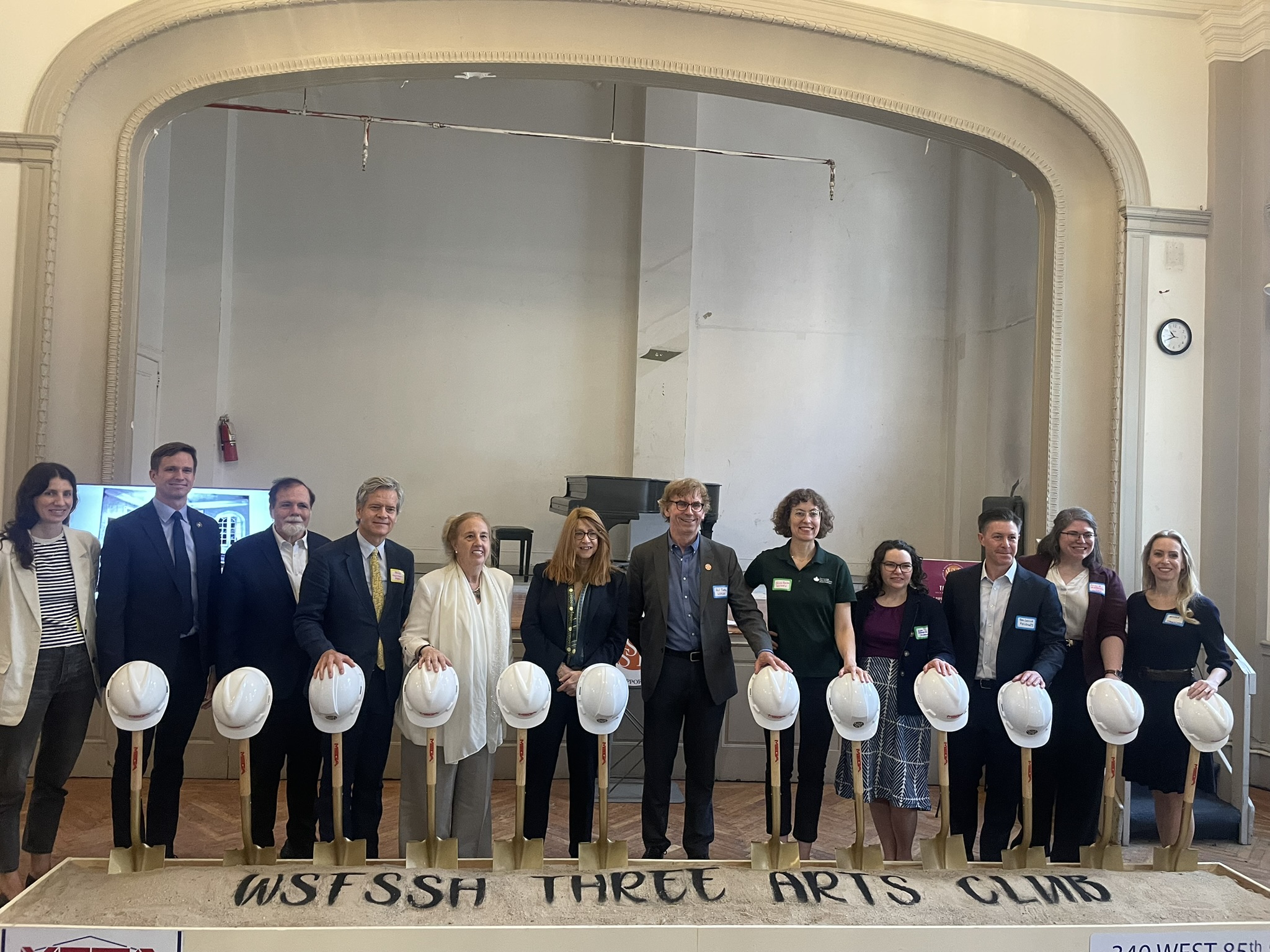
A bevy of neighborhood and city politicians turned out Friday for the groundbreaking of a new project that will restore the historic Three Arts Club at 340 West 85th Street and convert it into 61 units of permanent, energy-efficient housing.
The project, undertaken by the nonprofit West Side Federation for Senior and Supportive Housing (WSFSSH), will produce studio apartments for adults 55 and older who earn half, or less than half, the area median income. (A single adult qualifies if they make $28,350 a year or less.) On hand for the groundbreaking, in addition to the nonprofit’s public and private partners, were Manhattan Borough President Brad Hoylman-Sigal; State Assemblymember Linda Rosenthal; City Councilmember Gale Brewer; and State Senator Erik Bottcher.
Their attendance was perhaps a sign of the current prominence of housing issues in the city, including on the Upper West Side.
“These days, some think that people with needs are disposable, that people who don’t have homes don’t matter,” said Assemblymember Rosenthal at the groundbreaking event. “But WSFSSH’s work…flies in the face of that kind of philosophy.”
The restoration will launch the newest chapter for a nearly century-old building that has long served as an affordable alternative to private-market housing on the Upper West Side.
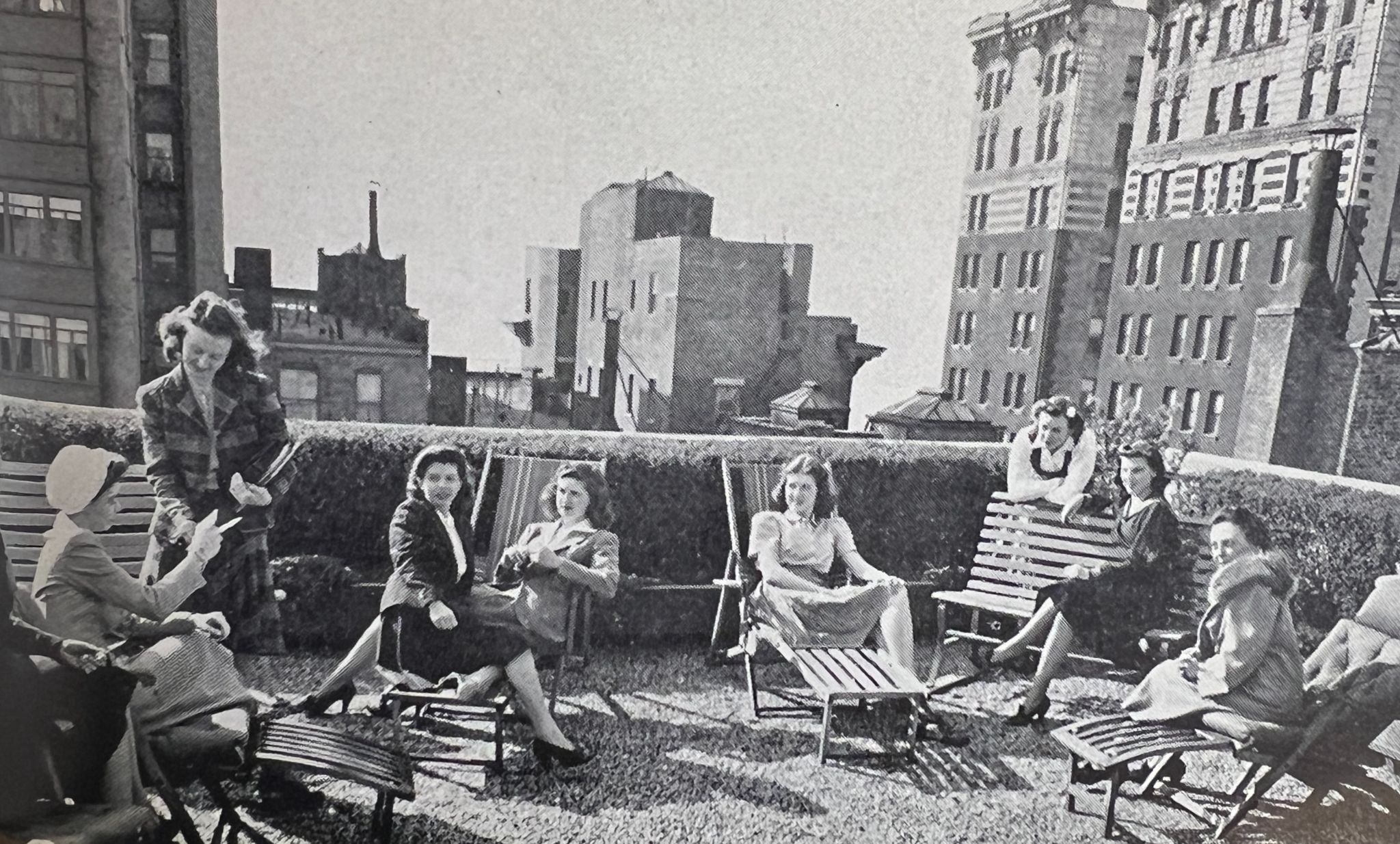
Situated on a verdant block between West End and Riverside, the Three Arts Club opened in 1927 as a residence for unmarried women pursuing careers in music, painting, and theater (including “Brady Bunch” actress Florence Henderson), before its conversion in 1953 into a boarding house for students and workers. After a close brush with private market sale in 2017, WSFSSH, which offers affordable housing and social services, bought the building and briefly used it as a shelter for homeless UWSers until 2022.
In the 1920s, “places like the Arts Club represented independence, ambition, and community,” said Nicole Marrocco, director of real estate development at the nonprofit. “Nearly a century later, that legacy continues in a new form…This building will once again serve people seeking stability, dignity, and the opportunity to thrive in New York City.”
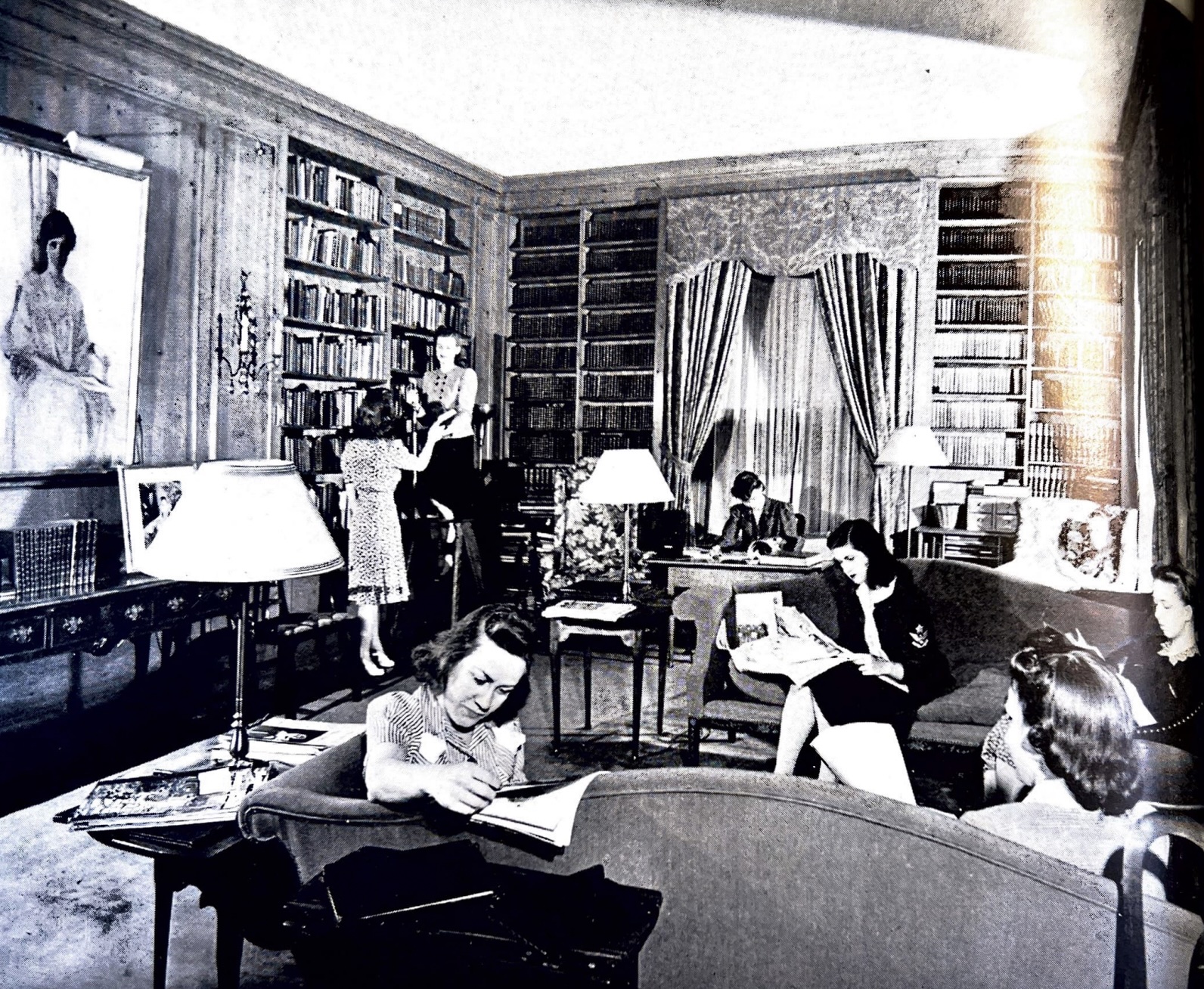
Marrocco also noted the project’s environmental ambition: to restore Three Arts in adherence with international energy guidelines known as Passive House standards. The retrofitted building will feature rooftop solar panels, strong insulation, and high-efficiency heating and cooling systems. According to Marrocco, these and other modifications will be made while preserving many of the original Three Arts Club’s architectural features.
“Three Arts demonstrates that even complex historic buildings can be transformed to help meet the city’s housing needs and its climate goals,” said Marrocco.
The building will see one major change: While the women’s boarding house and the temporary WSFSSH shelter provided single room occupancy (SRO) in spaces covering just 100 square feet or less, the restoration will combine those small rooms to create 61 studio apartments with private bathrooms.
Formerly homeless individuals referred by several city agencies will make up 40% of the project’s residents; the other 60% will gain entrance via a lottery system. All residents will have access to a range of WSFSSH-provided programming, including case management, counseling, technology access, and enrichment activities. The organization also hopes to make certain Three Arts spaces—like the grand auditorium that hosted Friday’s launch—accessible to the neighborhood for concerts and other events.
Paul Freitag, executive director of WSFSSH, told the Rag that while the organization had faced some community pushback when it opened the temporary shelter at Three Arts several years ago, the organization had overcome neighborhood objections by holding frequent public meetings. He also credited City Councilmember Brewer’s support of the project. “Gale was a huge advocate. The block trusted Gale,” said Freitag.
The restored building will join a portfolio of about a dozen other WSFSSH holdings on the Upper West Side, including Independence House at West 94th Street; the Valley Lodge shelter at West 108th Street; and Euclid Hall on Broadway between West 84th and 85th streets.
According to Freitag, when WSFSSH acquired Three Arts in 2017, seven longtime occupants of the women’s boarding house were still living in the building. “Our pledge was that nobody would be forcibly relocated,” Freitag said.
After some persuasion by Brewer (“There were some wonderful, strong, opinionated women that did not want to move out,” Brewer said), the nonprofit helped the women move into two other WSFSSH properties on the Upper West Side. Six of those women have the right to return to the Three Arts Club, if they so choose, once construction is complete on the new project.
Subscribe to West Side Rag’s FREE email newsletter here. And you can Support the Rag here.





I would love to hear the stories of those long-term residents!
I am glad to see seniors being helped and supportive housing being created on the Upper West Side. At the same time, I don’t think many neighbors realize the level of concentration that now exists in a very small corridor of our neighborhood.
Based on community district shelter tracking data, the West 94th–99th Street corridor alone contains an estimated 1,200+ shelter or shelter-adjacent beds within just a few blocks, including DHS emergency sites, supportive housing, transitional housing, and high-impact adult men’s facilities.
District-wide, the Upper West Side is estimated to have approximately 2,200 shelter beds, while the Upper East Side has approximately 350. Much of the Upper West Side concentration is adult male housing rather than family shelters.
This is not about lacking compassion. New Yorkers care deeply about helping vulnerable people. But the city’s own “Fair Share” principles were meant to prevent over-concentration in any one neighborhood — and many residents feel that standard is no longer being followed.
At the same time, we have not received proportional increases in sanitation, lighting, police presence, mental health outreach, or quality-of-life support for the surrounding community.
PLEASE contact the Mayor’s Office, City Council, and Community Board 7 and ask for true fair-share distribution across all districts — along with meaningful sanitation and public safety support for the neighborhoods carrying the impact.
I think the fact that “…many neighbors [don’t] realize the level of concentration that now exists in a very small corridor of our neighborhood.” means that for the most part, it’s working as it should. These are our neighbors, blending into the neighborhood.
The comment made me chuckle. “Blending”?
I respectfully disagree that residents are simply “blending into the neighborhood” in the way many longtime residents and small business owners are experiencing at least Broadway today.
This is not about lacking compassion or opposing supportive housing. It is about acknowledging that many streets have changed significantly over the last several years, particularly in corridors where multiple shelters and supportive housing facilities were added within a very concentrated five-block stretch.
Many residents comment on the increase in garbage, sanitation problems, visible mental health crises, storefront disruption, and feeling less comfortable walking or shopping after dark but many also do not realize how much additional shelter infrastructure was concentrated into the area during that same period.
The larger point is that the city did not provide proportional increases in sanitation, mental health outreach, lighting, public safety presence, and corridor maintenance alongside that added strain on the neighborhood.
I often wonder whether people write these comments and they don’t live here?
Broadway – 85th/86 and I don’t want to state the homeless shelter to single out these men, but the amount of drug dealing here is absolutely insane !
Who does that endanger?
Our children.
Here’s the rub, drug dealers are not good people and they don’t look at young pre-teenagers in middle school and say oh I shouldn’t sell drugs to this 12-year-old.
Thanks. The song remains the same.
1. All we hear is how the largest low income housing need is for single parents with kids. Or even 2 parent families. The UWS could change lives for these children given proximity to schools. after school activities, parks, museums, jobs, and resources. But these are not the conversions even when space becomes available. It’s never ‘the right” location.
2. The next largest outcry is our neighborhood seniors. Where will they go? Yet, given the rules attached to these lotteries a large percentage of neighborhood seniors don’t get in. And may become homeless. Or be forced to move elsewhere. Make this make sense?
So, the song remains the same. We will continue to hear about our seniors who are being pushed out of their homes. We will continue to hear about the housing crisis for single parents with children. We will continue to hear how neighborhood workers should be able to live in the neighborhood.
Does anyone think there is really a desire to solve these issues?
Yay energy efficiency!
Yet another affordable and supporting housing on the UWS.
how can one apply for an apartment?
Just a note that Euclid Hall on Broadway between 85-86th street is home to some of the most derelict people in the neighborhood. They gather in groups with boom boxes and taunt people who walk by. I am scared to walk my dog there. I don’t know what went wrong with supervision of this building, but there doesn’t seem to be any.
As I live off W. 85th St., I can tell you that there is zero supervision.
I’d have gone in here and spoken to them.
And they simply don’t care.
Please call GALE Brewer and make a complaint. I have called many times and it seems like nothing gets done. Unless more people call.
Wrap around and supportive services always sounds wonderful. What are they? Since WSM closed the area outside of Euclid Hall has become sketchy to say the least. Is there nothing else for these men to do during the day?
There’s no incentive for them to do anything.
Wonderful. Now do a building with one-bedroom apartments.
How much will it cost the City to operate this? Annually in aggregate and per person?
Where do we apply?
I’m 70 years old and need a place asap. Even though Brooklyn is all I know I’m willing to move to manhattan. After 21 years my landlord wants me out to turn over the apartment to his son. Help!