

By Scott Etkin
In last month’s UWS Shed Watch column, West Side Rag described what the city’s Department of Buildings’ data reveals about sidewalk sheds on the Upper West Side. The UWS has around 400 sheds, the third-highest number of any neighborhood in the city, though the number of UWS sheds has declined approximately 25% since the summer of 2023, when former Mayor Eric Adams announced operation “Get Sheds Down.” But in that same time period, the average time a sidewalk shed remained in place ticked up by a couple of months – from 497 to 557 days.
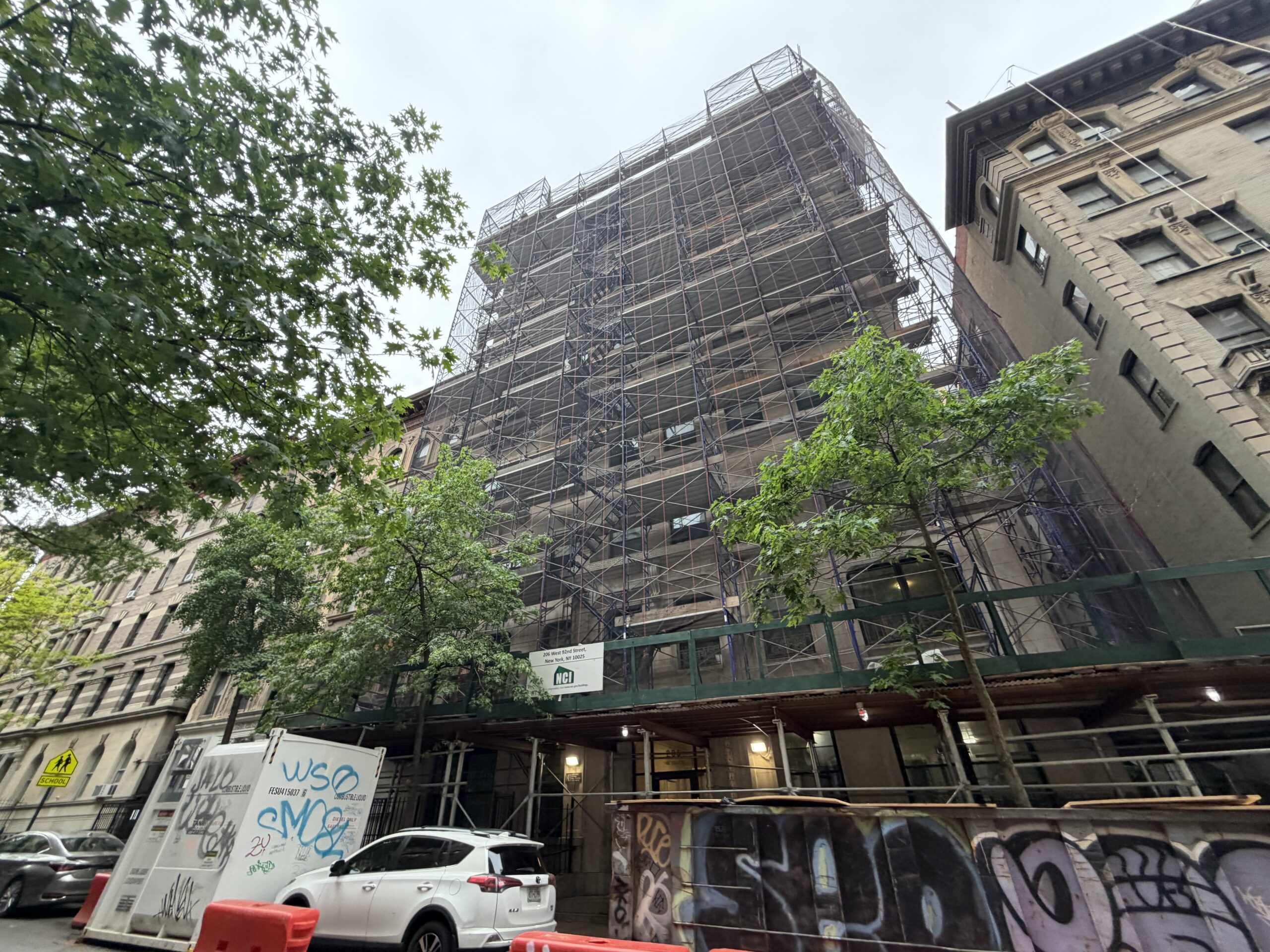
This month, Shed Watch looks at the role played by what’s commonly known as “scaffolding” in New York City’s inspection requirements for building facades (technically, sidewalk sheds are the metal beams and wooden planks that form a ceiling over the sidewalk; scaffolding is the structure and netting that covers the building’s facade). We also look at how these regulations might be amended to reduce the usage of sheds and scaffolding.
On April 27th, the city received a stark reminder about scaffolding’s importance – as well as its imperfection – when a 30-foot chunk of decorative stone fell to the ground from between the 15th and 16th stories of a building in Tribeca. Fortunately, no one was injured, but questions immediately arose: how did this happen at a building that, at the time, was wrapped in scaffolding and netting?
According to the city’s Department of Buildings, whose headquarters is coincidentally across the street from the Tribeca building, the scaffolding was there to protect passersby while the facade was repaired and inspected, in accordance with city regulations. But the netting was improperly secured, and the building had been cited for this violation even before the chunk of stone fell.
While the netting failed to do its job in this instance, the mishap also illustrates how vital scaffolding is to public safety. “There is no shed [or scaffolding] that is not needed in the city,” the DOB’s Assistant Commissioner of Existing Buildings Compliance Olga Suto said on a phone call with the Rag.
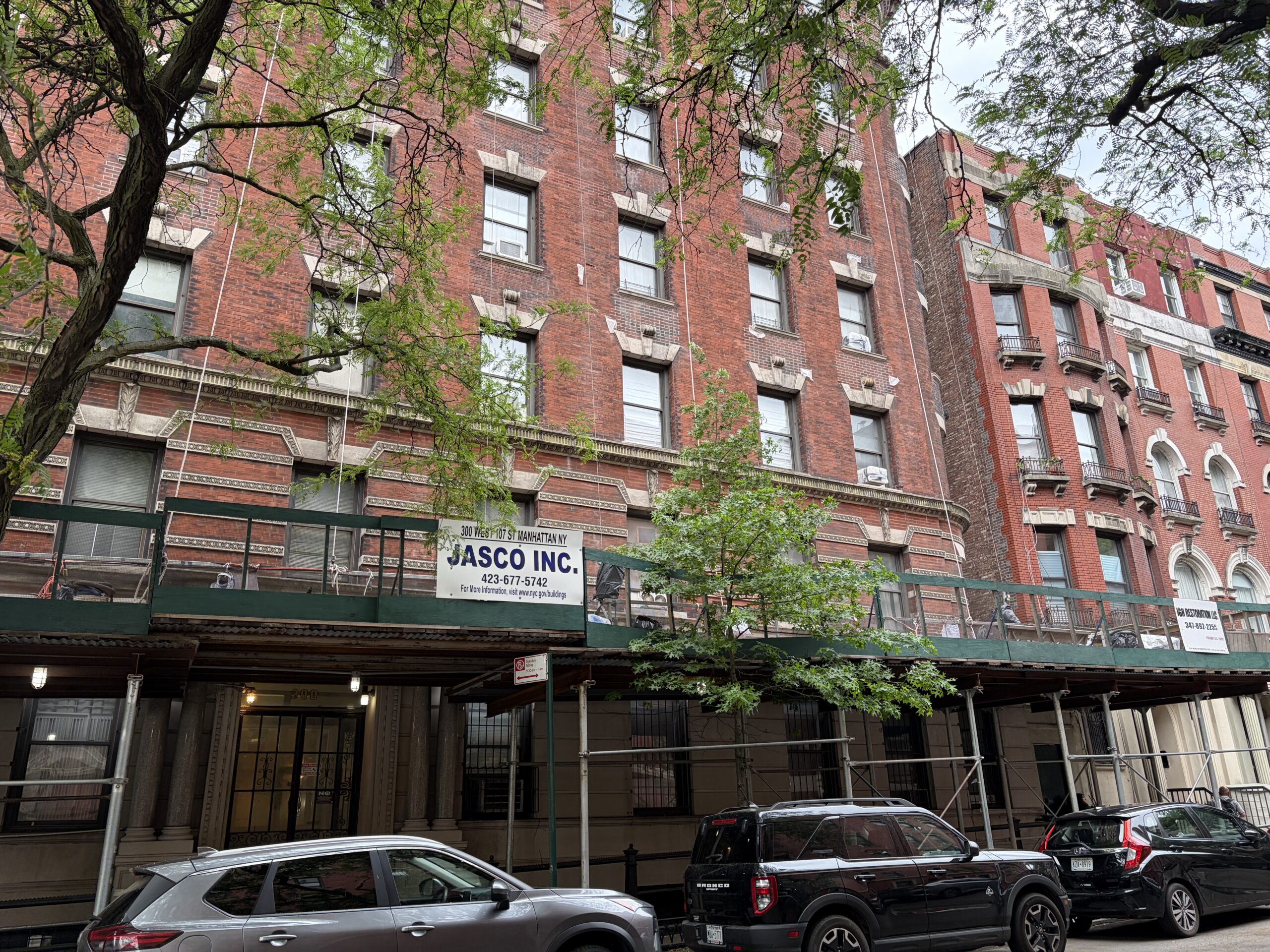
In the case of the Tribeca building, the scaffolding was in place to enclose a dangerous facade in need of repair. Indeed, much of the scaffolding we see is put there to protect the public from unsafe conditions. Often, the unsafe conditions are found during inspections carried out as part of the DOB’s Facade Inspection & Safety Program (FISP).
There are 17,000 buildings that fall under the city’s facade inspection program. “We have one set of requirements for all of these buildings,” said Suto. At a high level, the main requirement is simple: Owners of properties taller than six stories must have the exterior of the building inspected every five years and file a technical facade report with the DOB.
For building owners to meet the agency’s rules, they must hire a Qualified Exterior Wall Inspector (QEWI) to do a visual inspection from the ground and a hands-on inspection up on the building itself. There are more than 500 firms approved to carry out these inspections in the city. The DOB also has its own inspectors, who do inspections only from the ground using binoculars and digital cameras.
The city’s inspection program mandates that for a hands-on inspection, the contracted inspectors must examine the building’s facade up close every 60 linear feet. Usually, that means erecting a sidewalk shed topped with scaffolding.
Building owners and the contracted inspector can instead decide to access the facade through other means, if conditions allow. These alternatives include using a boom truck (a large truck with a crane mounted on its bed), walking along the building’s fire escapes, or – by far the most exciting option – using industrial rope to rappel down the facade. Some modern buildings have window-washing rigs, which can be repurposed for inspections.
Each of these options has its own benefits and limitations. Boom trucks, for example, can only reach 15 to 20 stories. They also might require a permit from the NYC Department of Transportation. Using fire escapes seems like an opportunistic solution, but not all fire escapes cover enough of the building’s facade to access every 60 feet.
Once the contracted inspectors are positioned on the building’s facade, they touch the material to see if it crumbles, sound it with a mallet to test if it’s hollow, and take photos. This information is then recorded in a report that is submitted online to the DOB.
The duration of an inspection varies, depending on the size of the building, the type of rig used to access the facade, and the availability of the contract inspectors. Suto estimated that a hands-on inspection could take up to a week, whereas a visual inspection, which involves walking the perimeter of the building at ground level and scanning it with binoculars, can be done in a couple of hours.
An experienced inspector can still conduct an effective visual survey, even from a distance, according to Suto. “You would be amazed at how well our inspectors are finding things that QEWIs and other people do not, and they are doing it from the ground,” she said.
Visual inspections are faster and cheaper than hands-on inspections. As a result, they’re a priority as the agency and the City Council seek to streamline the inspection process through new legislation.
The engineering firm Thornton Tomasetti highlights a shift toward more visual inspections as one of its recommendations in its review of the city’s facade inspection policies. The report, commissioned by the DOB in 2024 and published last December, offers several ways the DOB can make inspections less onerous or less frequent – and thus, in principle, reduce the time sidewalk sheds and scaffolding remain in place for inspections. One recommendation, which the city is pursuing, is to change the inspection cycle from every five years to every six years. If this legislative change is implemented, this would be the first adjustment in the cycle timeframe in the inspection program’s 45-year history.
The report also suggests that the DOB could safely allow the facade of certain buildings to only be inspected every 100 feet, instead of every 60 feet. Lower-risk buildings could also enter a program where they skip the close-up inspection for a full cycle.
While implementing such reforms would likely reduce the amount of scaffolding citywide, the effect might be muted on the Upper West Side. The UWS has among the highest concentrations of sidewalk sheds in the city because of its older building stock and, in particular, high prevalence of fragile ornamentation that requires extra maintenance.
Terra-cotta is the most problematic building material when it comes to maintenance, according to Suto, and there is plenty of it on the Upper West Side.
In March, Mayor Zohran Mamdani’s announcement about reforming facade inspection rules – including extending the timeline for inspections from five to six years, and allowing lower-risk buildings to get an inspection only every 12 years – cites the Thornton Tomasetti report.
Though legislation from the City Council could change inspection rules, it will be a while until the effects are seen on the ground. FiSP runs on a five-year cycle, and changes will not be implemented until the next cycle begins in 2030.
Until then, the city continues to live with the ups and downs of scaffolding. “Nobody likes sidewalk sheds, right?” said Suto. “But for us, they are not created equal.”
Read more: UWS Shed Watch: A New Monthly Column from West Side Rag
Subscribe to West Side Rag’s FREE email newsletter here. And you can Support the Rag here.





One question: The time between inspections is five years, but the clock doesn’t reset when work is completed. So an inspection (and thus possibly a shed) may be required after only two or three years, if the original inspection required work that took several years. Why doesn’t the next inspection cycle start when the work is done and the building is re-inspected?
This is an excellent point and would be only fair as the building is supposed to be at its safest after all thr repairs are finished. Was this proposed to mayor Mamdani, to start the five years from the time the repair work has been inspected and approved?
Why? Because most politicians in NYC have never had a job or built a business and therefore are incapable of any real world insights or foresight into the impact that the laws they write will have.
“scaffolding is the netting that covers the building’s facade.”
No, netting is not scaffolding. Netting wraps scaffolding on the street side.
Thanks, corrected.
Dear NYC there is this cool new technology called a drone.
Bill W:
Drones can’t test a brick or cornice to see if it’s loose.
There are also restrictions against flying drones within NYC.
Golly, you’d think you could make an exception for one bureaucratic restriction to enable the resolution of another…
Drones can absolutely test for loose bricks.
“There is no shed [or scaffolding] that is not needed in the city”
Color me extremely skeptical of this
what did the City do before scaffolding etc. ?
Too many things on our streets.
Get rid of all outside dining sheds.!’
It seems to me that there is an obvious “disconnect” between the time that a building is “expecting” an inspection and the time that an inspector (either City or other) actually does the inspection.
Can’t the City provide building owners with a more accurate inspection schedule so that they do not put up sheds or scaffolding weeks or even months in advance of the actual inspection? This way, sheds and scaffolding will be up for a shorter time, which will also save building owners money, since they pay for the sheds/scaffolding by the month.
As I understand it, you have to set up a shed the moment an initial inspection (from the ground) identifies any problems. This is for the protection of people on the ground. Unfortunately, there can be a time gap between when that’s done and when the building can start the more detailed inspection. Then there’s the work to repair, which can take many months.
I’m glad you ran this article. Many people who complain about scaffolding around the City don’t know anything about the FISP program and how that plays out. I certainly had no idea until I joined the board of my condo.
Sounds like we need more inspectors, but that would mean more money to pay them and that means more taxes which makes more people scream about more things than just the ones they’re already screaming about.
I’ve commented about this issue extensively every time the WSR publishes a report on sheds/scaffolding.
There are many ways to update the laws without sacrificing safety.
Changing from 5 years to 6 is a band aid at best.
If they are going to revise the laws, they should do a comprehensive overhaul which includes (but not limited to):
– Updating the time frame to start after the work is finished
– Changing the terra cotta replacement to allow for synthetic replacement
– Hold the DoB accountable for schedules (in my building, we finished the work over 3 months ago and are still waiting for DoB inspections/approvals). No firm date has been provided
– Hold the engineering firms to certain standards. As of now, they do whatever they want, take however much time they want, and bill whatever they want despite diligient program management and monitoring. Building owners have no control and can’t hold them accountable
It’s beyond ridiculous how much this costs condo/coop owners above and beyond what is necessary.
Reducing costs, time to implement and shed times should be the focus of the administration, not applying band aids.
“Updating the time frame to start after the work is finished.”
That this common sense update–repeatedly urged by many, over many years–has never happened makes me wonder if the old rumor it’s a mafia operation isn’t true after all. Can it really just be bureaucratic negligence and incompetence?
In the 10 years I’ve lived in my building (pre war, 32 units) I’ve paid $80,000 special assessment in facade repairs ($30,000 one time, $50,000 the other).
To clarify your statement that “I’ve paid $80,00…”, did you personally pay that amount or was the burden shared by the 32 households? The second possibility sounds rather more reasonable.
Personally. It’s based on square footage so mine being one of the 1000 sf paid more than the smaller units. Larger units than mine would have paid more than me. The total bills for the whole building as I recall were around $800,000 one time and $1,000,000 another time. And that’s without interest as I paid the whole amount upfront, the folks who couldn’t and had to do the payment over years paid even more.
Btw this was after we had already taken as much as we had in our reserve fund to use to pay the facade repair cost before the remaining $1m / $800k was left which we had the (extra) special assessment imposed for – we have been replenishing the reserve fund through 7-10% increases in condo fee every single year.
Honestly the facade repair cost is enough to make it not worthwhile owning in a building that requires it. Multiple units are selling in my building now because people are scared of the next upcoming facade repair amount. Who can afford $30-50k every 5 years?
Oh, dear.
Were it only so.
I, too, have paid over $80,000 for facade repairs in my building – PERSONALLY.
The entire cost was over $4 million.
$30,000 and $50,000 per person is very feasible. Facade repairs are many times more than million dollars.
As I read this article, particularly the part about increasing inspections from street level, I wondered why drones are not being considered. A quick check found a 7/22/2025 article “How Drones Are Used For Facade Inspection In Singapore.” Singapore’s government adopted a regulation encouraging a move towards use of drones for this purpose in 2021. “Fast forward to 2025, and that vision has taken off – literally. The government has been exploring the use of drones, now a common sight buzzing around buildings across Singapore’s cityscape, inspecting everything from HDB flats to commercial towers. These high-tech flying tools are revolutionising how we maintain and monitor our urban environment, and they’re doing it with speed, precision, and safety in mind.”
Why on earth is NYC not even considering use of the best available tools?
The time should be changed to every ten years. This is a huge cost burden. Also agree, drones could go a lot of the inspections now.
The cure is worse than the disease. More people are now hurt from scaffolding than protected. My own friend got a concussion from scaffolding at 83rd & WEA a couple of years ago. The DOB does not enforce violation fees, and it is easier to just pay any violation fees than do the work and take down the scaffolding. And many times the violations are not even checked on. Checkout the scaffolding of over 15 years with multiple violations and rusted scaffolding at 125 Riverside Dr. And no work being done for months. Dangerous and so hideous. Checking every 5 years, just keep the scaffolding up so much easier for the scaffolding companies and buildings.. And if management changes on a building, the clock starts anew. Like there was no scaffolding from before.
I once saw a huge metal chain drop to the ground from a scaffold across the street. If someone had been walking under it they would have been killed instantly.
When this started back in the ’90s or so (please don’t all pile on and correct me), my comment was always “Oops, someone forgot to pay the bribe money again.” I know the basis for the law, but I still think most of the process is governed by bribes, greasing palms and paying off inspectors to just get it over with, then paying the companies to actually take the stuff down. They are all in on it.
One of the worst things about the sidewalk sheds especially the one that cover most of the block is that delivery people think they have a right to ride their electric bikes under them. I’m looking at you Domino’s!
Scott — Excellent article. Thanks. Keep up the good work.
But there’s a huge question at the heart of the shed problem: We know some sheds stay up for years, as you mentioned. But why?
The three word-on-the-street answers we all hear (and sometimes pass along, rightly or wrongly), are:
–Building owners find it cheaper to just leave the shed up than to pay for the inspection.
–There just aren’t enough inspectors to go around.
–The clock doesn’t reset when you inspect a building — so, for example, if you get your building inspected after 4-and-a-half years, you’re just six months away from your next required inspection.
Any truth to any of those? And, if not, why does it take years?
#2 and #3 are true — it takes surprisingly long to do the work, especially if you are in a landmark district (much of the UWS).
“No way to prevent this,” says only city in the world with this problem.
5 going to 6 is an insult. Make it 10. How is that a building on my block has had the shed up for 5 years and no work has ever been done? Why are the owners allowed to get away with this? The stores beneath the shed have gone dark and the homeless have moved in. It’s a total blight on a very nice street.
New York City’s sidewalk shed regulations were triggered by two tragic deaths from falling masonry in the early 1980s.
Traffic crashes, meanwhile, kill 200 to 250 New Yorkers every year. That’s almost four of us every week.
We’ve simply decided that one kind of death is unacceptable, and the other is just part of urban life.
I wish someone would study how these sheds actually work. Some years back a person working on a facade on my block fell from a high floor and his body went through the shed to sidewalk, of course killing him. I’ve heard of other similar instances as well. I understand the importance of the sheds when work is being done BUT are they really protecting us or are they just giving us peace of mind, thinking that we are safe underneath them.?
While my building’s owners faff about (the scaffolding’s been up for about 2-3 years so far) while work has just started, maybe, in the last 6 months, and underneath it stinks of piss and weed and unsavory characters are lurking there most days/nights smoking and generally creating worrisome conditions. This building is on the SE corner of Broadway and 98 St. without ID-ing it further. It’s a disgrace and the work is causing super amounts of dust and debris, and in a few cases holes in the outside walls which go through to the apts. –I know of at least one neighbor’s apt. where this has happened.
I watched some of the “work” from right outside my window. Days on end, the “work” was two guys on a rope pulley platform thing using a toothbrush sized hammer to occasionally peck at the wall, but most of the time just sitting there doing nothing whilst playing loud music and talking to each other nonstop.
There has been scaffolding on the NE corner of West End Ave and 84th St for OVER SIX YEARS. Nothing gets done.
I think accountability is the most important consideration! I can’t understand how buildings with violations after violations can continue to function. “Easier to pay a fine” is not the answer to safety and community. Accountability of landlords, and accountability of the timeliness of inspectors should be the standard.
The complaints about this local law have been well catalogued, but no one has challenged the very premise of this law. Just how necessary is it? Yes, we know that the daughter of a Columbia professor was killed by fallen masonry years ago, but just how many people were injured by fallen masonry BEFORE that? Unless we are willing to accept without question the “if-we-can-save-just-one-life” rationale, I wonder whether the reputed juice of this law (supposedly saving lives) is worth the squeeze (expense, ugliness).
I’ve traveled all over the world, to many cities with many tall, vey old buildings. I have never seen a city with anywhere near so much scaffolding. Are other cities just less conscientious? Does NYC just have worse building materials? I don’t understand.
“The report, commissioned by the DOB in 2024 and published last December”… So it took them over a year just to issue a report on the problem of scaffolding!
And we wonder why these useless sheds never get taken down after months and years…