
By Yvonne Vávra
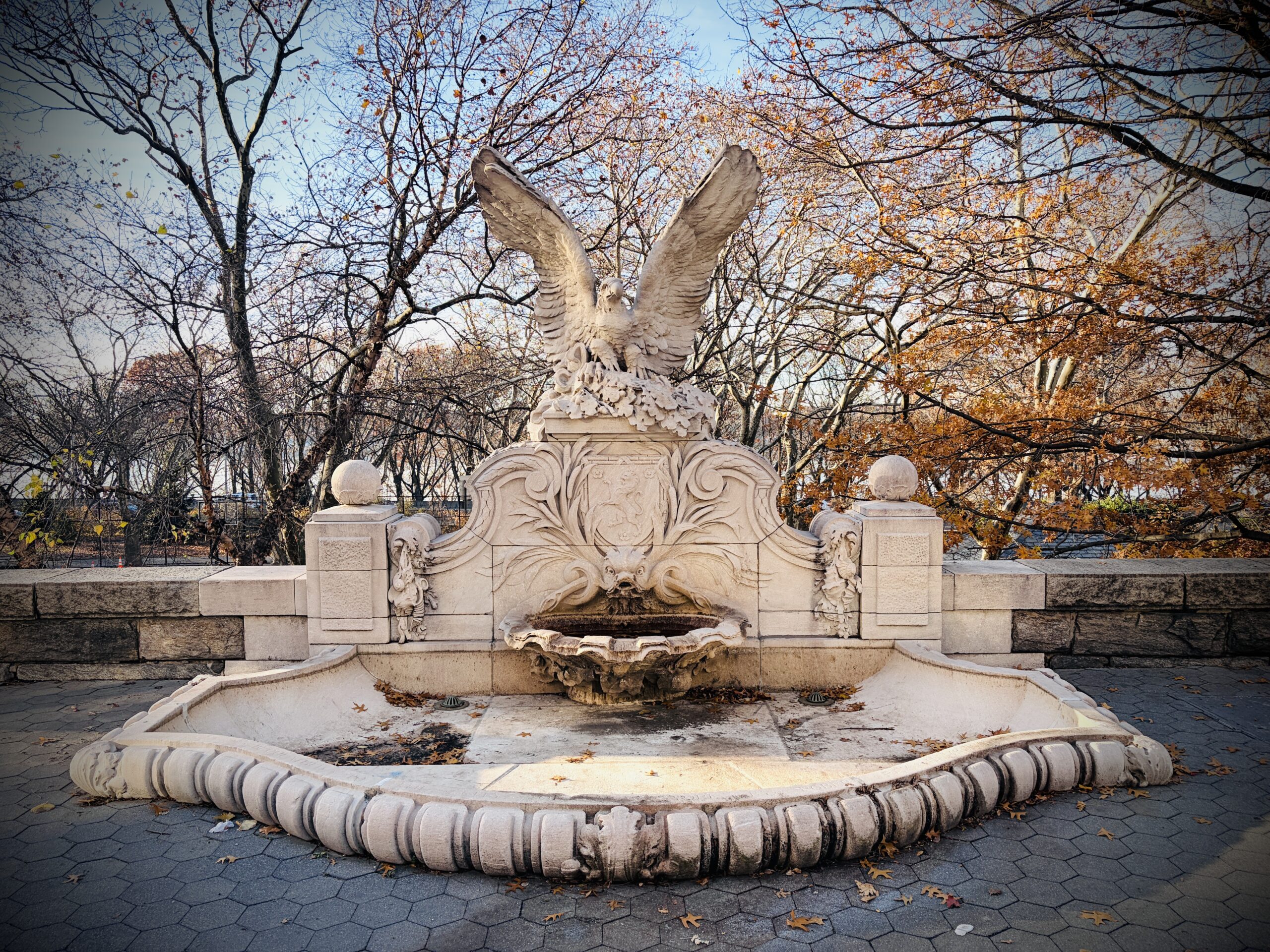
Something happened on West 76th Street and Riverside Drive. I know this because Lieutenant Louie, my dog, refused to leave the scene. Which is how I ended up lingering by the fountain at the wall of Riverside Park. Pretty fountain, I thought, circling it, checking out the big eagle on top, touching the marble. Louie kept sniffing. I got bored. Bored enough to read the plaque.
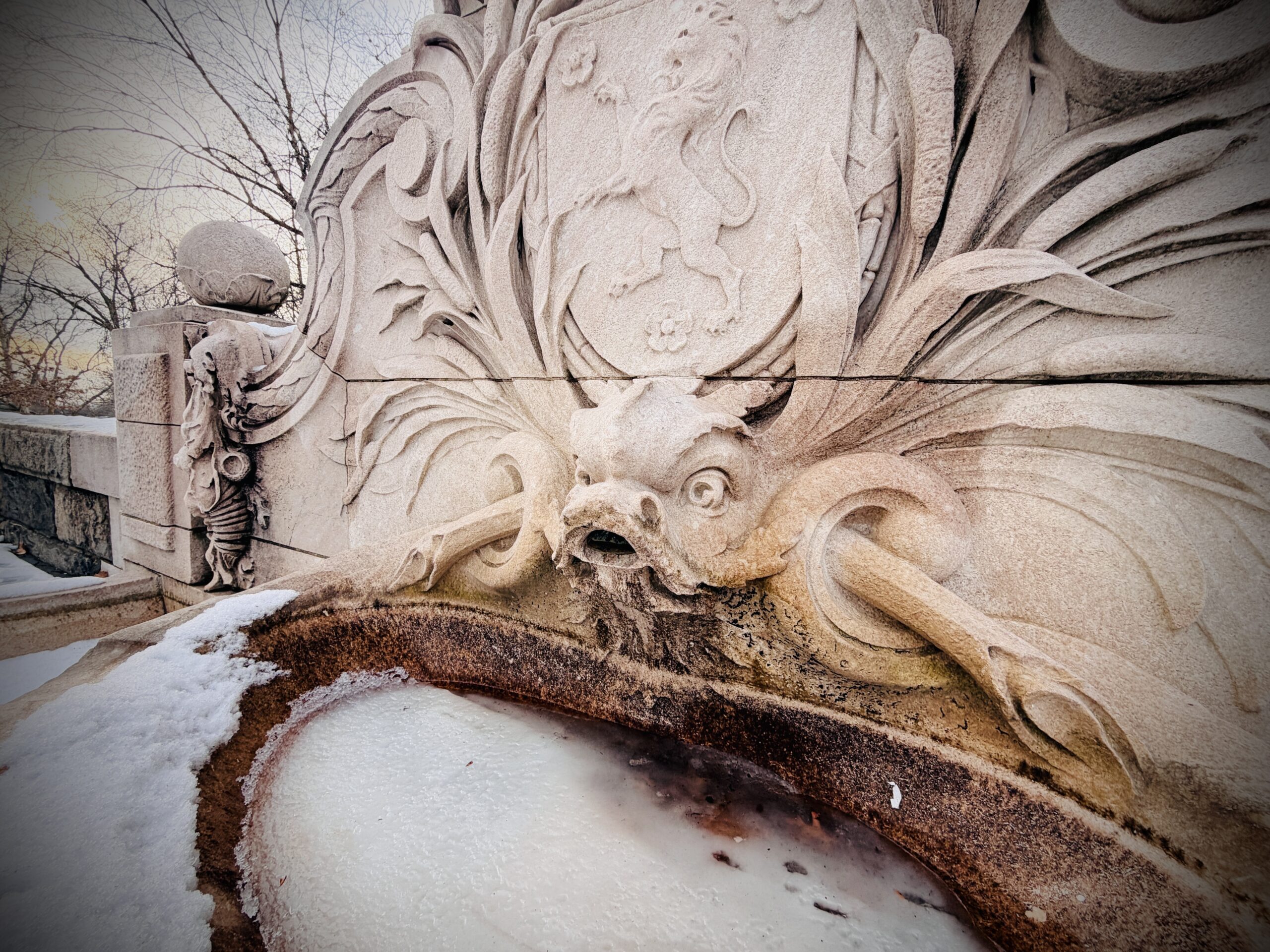
It was full of fascinating details, but one baffling claim derailed me. It said that the “lavishly carved fountain” is surmounted by an eagle with wings spread – true – a coat of arms – yep – and a dolphin’s head spray feature – what now? A dolphin? I looked back at the fountain. I would have noticed a dolphin, I’m a fan. But all I could see was what looked like a curious carp, at best. There’s an agitation to its expression that just isn’t giving dolphin vibes. At all. I consider myself a friend and admirer of marine mammals. In fact, I adopted a whale when I was a teenager, certificate and all, so I think I know what I’m talking about.
I started looking for other spray features. But there were none. Fine, the googly-eyed carp is a dolphin. So be it. Let the experts have their dolphin.
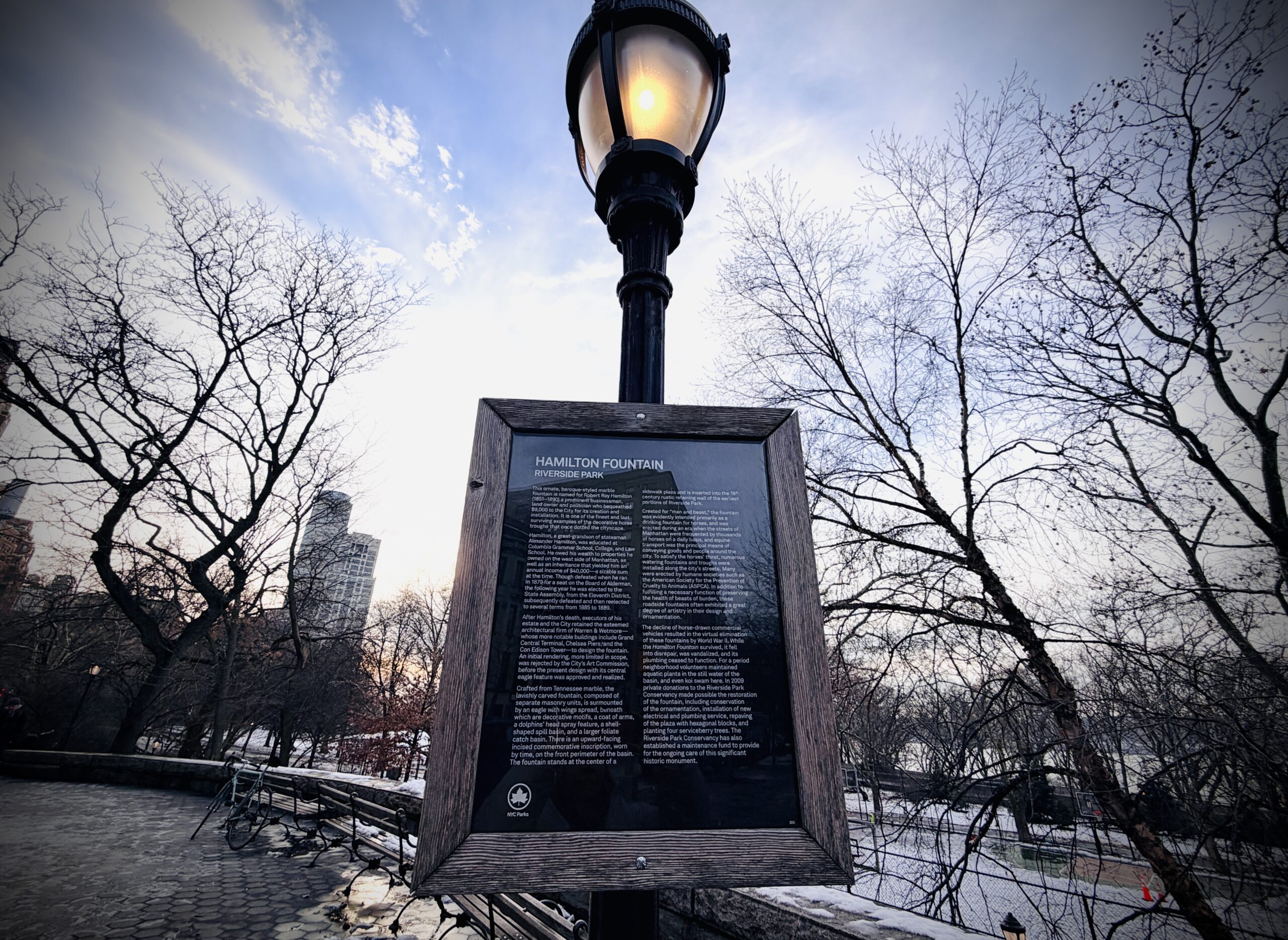 The plaque had more to offer, though. The Hamilton Fountain is named not for famous Alexander, but for his great-grandson, Robert Ray. He bequeathed $9,000 to the city to have it created and installed, and today, it’s one of the “finest and last surviving examples of the decorative horse troughs that once dotted the cityscape.”
It’s fun to imagine that the Upper West Side was once crawling with horses, its streets lined with fountains like this one, built for “man and beast” to rehydrate. But my mind was still on the dolphin. Back home, I searched for mentions of it in turn-of-the-century news reports about the fountain. But I found something much better.
Robert Ray Hamilton was a well-educated, well-off businessman, landowner, and politician – one with a juicy scandal attached to him. He had an affair with Evangeline Steele, later called by newspapers “a notorious woman” with “a disreputable life,” who neglected to mention that she was married. According to historian Tom Miller, she schemed with her husband to buy a baby from an illegal orphanage for $10, convincing Hamilton he was the father. But the baby died of starvation because Evangeline had no breast milk. So the couple bought another baby for $10, and this time made sure to care for it properly. Hamilton knew nothing of this and honored his responsibility by marrying Evangeline in 1889. They moved in together, with Evangeline’s husband renting nearby and living off Hamilton’s wealth while happily benefiting from the fact that politicians are often out of town.
The newlyweds fought constantly, not least over the baby nurse, who saw right through Evangeline. One day, things got out of hand. The two women got into a physical fight, the nurse winning at first but ending up sprawled dead on the sofa, a knife through her heart courtesy of Evangeline.
The story made the front page of New York papers and hundreds more nationwide for two weeks straight. A Hamilton! Involved in a tale of second husbands, purchased babies, and a murder! Hamilton fled to the Rocky Mountains, where in 1890—at just 39 years old—he was “found drowned in the Snake River under suspicious circumstances,” according to Miller. New York investigators later unearthed him from a hole where strangers had stuffed him into a box far too small for his size.
After all the chaos of his life, Hamilton at least had a will and a love of fountains, and he wanted one built in New York City. His family, however, fought his wishes, declaring in The New York Times in 1891 that they wanted to “let him be forgotten.” But the city pressed on, if slowly. The still-young architectural firm Warren & Wetmore – later famous for Grand Central Terminal and the Con Edison Tower – was commissioned to design it, and by 1906, the fountain was finally up and running. Evangeline, who had served her prison sentence and died penniless in 1904, never got to see it.
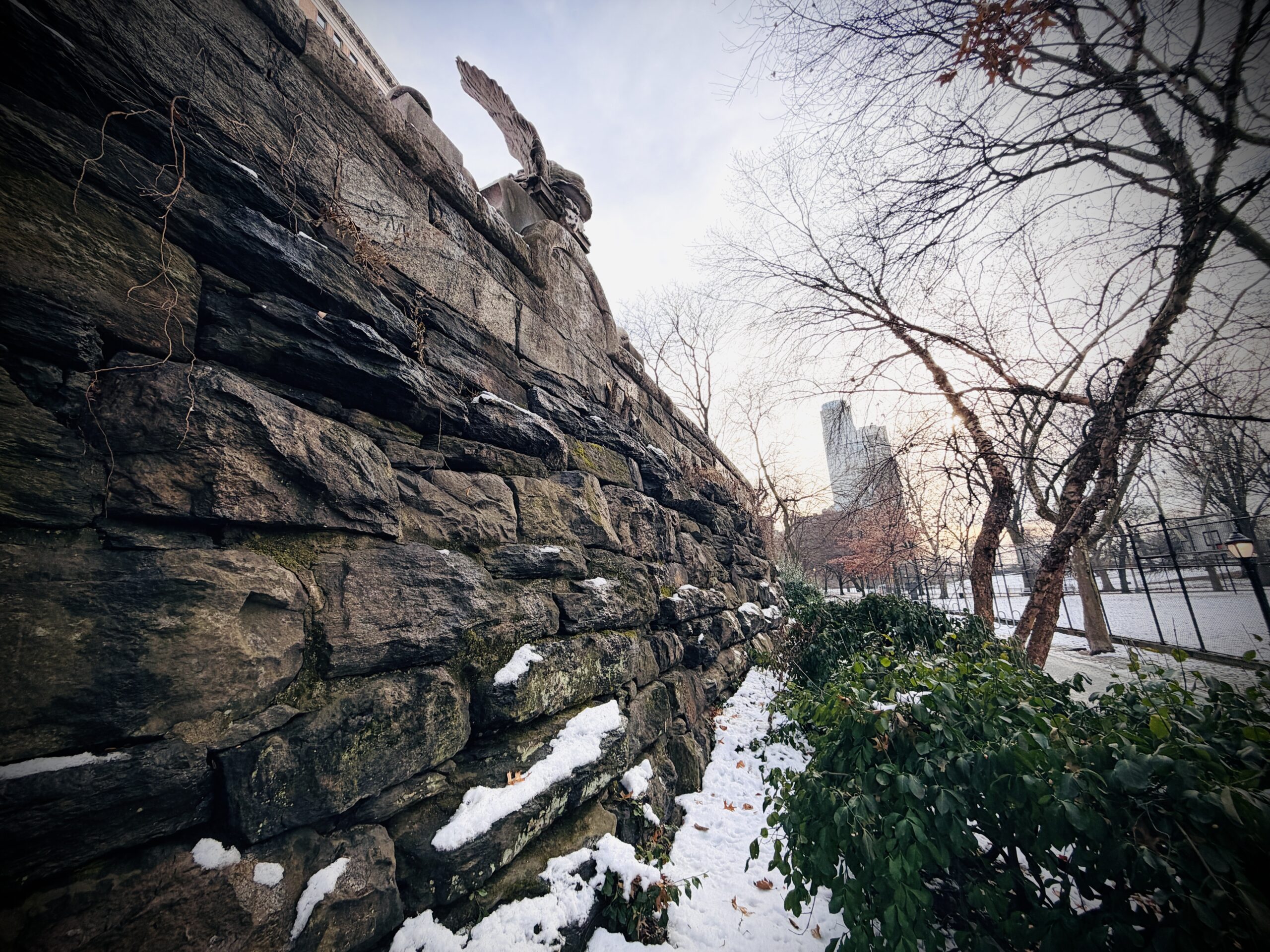
There’s still one more curious layer to the story. The fountain, embedded in a wall along the sidewalk, is widely thought to have been a horse trough. But historian Tom Miller points out that on the other side of that wall, down in the lower part of Riverside Park, there used to be a small marble bowl. Could that have been the part meant for the horses? Did they never drink from this stunning fountain after all?
The bowl was eventually covered by dirt. It might still be—who knows? Not me, because I’m not one to brave the brush and thicket looking for horse troughs. I’m just a city walker, happy to have paused at the fountain that day and let the neighborhood surprise me with a story. And this one definitely cries out for a second Hamilton musical.
Subscribe to West Side Rag’s FREE email newsletter here. And you can Support the Rag here.





I never would have known this fascinating but grisly story. Thanks for uncovering yet another UWS detail, Yvonne!
Thank you Yvonne, you always write with such interest and love,I really appreciate you.
Wonderful–I hope Lin-Manuel reads this!
To me and my family, this fountain is called The DeeDee Bird, so named by my brother when he was about 2 in the early 1950s. We drove past it often on our way from Westchester to visit our grandparents on 69th street. So we never saw it on foot–I never realized there was so much text to enjoy and history to be gleaned–not even recently, as I live nearby and do pass it on foot often. So thank you for this terrific story–that babies could be bought for $10–yeesh!
Just the other day, I asked my brother why he called it The DeeDee Bird, but of course, he couldn’t tell me. Maybe he was trying to say Dolphin Bird? 🙂
Well, the first gilded age was the height of the “free” market.
love this story thank kyou
Thank you! What a great article!
Oh my, thank you for researching the whole story! I pass by there often, both up on Riverside Drive and down below. That stone wall is particularly beautiful in the summer with all the little plants growing in the gaps. .
For more history on the Hamilton and other UWS fountains, check out local author Stephanie Azzarone’s new book, “Fabulous Fountains of NY.”
Good heavens! What a story! All I knew about the fountain was that the eagle’s nose was vandalized (I assume) and repaired years later.
For at least several year at least a decade (or more?) ago, the fountain was cleaned and filled in summer, and stocked with goldfish/carp!
Wild history and funny that the younger Hamilton got caught up in a similar (though worse) scandal to his grandfather.
Also, that’s a Romanesque dolphin, which have always looked a bit odd.
https://quodlibetroma.com/2024/10/20/dolphins-in-romes-baroque-fountains-a-symbol-of-power-and-beauty/amp/
We see them in maps and in the US Naval submarine fleet insignia, too!
The artists at the time in Rome were relying on secondhand descriptions of dolphins, hence their oddity.
Great story! Thanks for writing it
This is so great Yvonne! What a story.
Thank you.
Parsons has the proper documentation as referenced below as a fish.
The Beaux-Arts philosophy that Whitney Warren embraced was fully brought to bear in the revised design for the Hamilton Fountain. The plain, semi-circular base was replaced by a gracefully bowed basin finished with an ornately scalloped edge. The simple, four-foot-tall rectangular stile that formed the backdrop of the fountain was now an eleven-foot-tall, elaborately carved amalgamation of references to water, land, and sky that metaphorically told the story of Ray Hamilton’s sad passing.
The river in which Hamilton drowned was depicted by the head of a fish that spouted water into a scalloped seashell and then emptied into the basin below. Just above the fish’s head, centered within the entire tableau, was a crest used by the ancient Hamilton clans in Scotland and Ireland.
Just goes to show how unobservant some people (meaning me) can be. I have lived within a few blocks of this fountain for over 60 years, and probably passed by it hundreds if not thousands of times during walks down RSD. Yet I never even stopped to read the plaque.
Thank you for this fascinating story – not just an Upper West Side story but, I think, a true “New York story.”
Amazing story and story telling. Thanks for your curiosity, research and bringing this gilded age tale to us
Did you learn the fate of the second adopted baby? What a tragic scam!
Great story. Thank you!
The Gilded Gentleman podcast recently dedicated an entire podcast to this story and the UWS-who wrote a book about it. https://podcasts.apple.com/us/podcast/the-gilded-gentleman/id1595160782?i=1000731739818
Thank you! I’m the author of the book and was the guest on the Gilded Gentleman to discuss the story. Thanks for listening!
nice catch and thanks for the link. lots of pieces of interest there—lives of the very rich then perhaps not all that different from lives of the very rich now.
To answer your cry:
(Sung loosely to the tune of… well, you know):
How does a rich kid, niche kid,
Grandson of a founder
Dropped in the middle of a
Scandal with Evangel
–ine
Grow up to be
The founder of a fountain?
Not so much a husband of a dauphin
As a donor of a dolphin
Our man saw the water
Drip-dripping down the drain
To the music of a harp
Thought it looked more like a carp
Robert Ray Hamilton
My name is Robert Ray Hamilton
And I wound up in the Rockies
In a box
Like so much lox
So much lox
Now there’s a million things I never done
But at least I’m not forgotten and gone
Thanks to Yvonne….
Wow!
Loved the story! Whatever the sea creature is–whether dolphin (likely) or fish–it takes its inspiration from the Italian baroque. Bernini’s Fontana del Tevere (google it for a pic) offers a good parallel.
The beek or nose of the “renovated” eagle done years ago to replace the original that was broken off, is out of scale, too large for the head.
Great story!
Yvonne, thank you for this porpoise-ful piece (oy). You are a delight. And shout out to Phil for his excellent parody.
This fountain is the focus of a wonderful children’s story by Sally Lloyd-Jones called Goldfish on Vacation. https://www.sallylloyd-jones.com/books/goldfish-on-vacation/.
Fascinating story, well-told. Thank you to Ms. Vavra, for researching and bringing back this once-famous story.
Hmmm. Buying babies. Then allowing one to die. Illegal adoption. Just a dark reminder of the adoption industry in New York. Very sad story.
this is such a great story, thank you! I literally LOL’d. It was so funny throughout the whole thing. thanks!!! p.s. looks like a carp to me
I’m grateful for the research and the wild stories. Fascinating history. Many decades ago I walked my cousin’s dog down there. It was a pleasant enough environment. I never associated it with any scandals. I always considered Riverside Drive as one of the most pleasant streets to visit and take a walk on in New York City. One or two blocks away parallel to it is busy bustling Broadway.
Nice story but WHAT ABOUT THE DOLPHIN???
The approved design of the fountain specified it as a fish.
Symbolic of his drowning in The Snake River as detailed by the architect Whitney Warren.
I am a UWS resident and the author of a book about this fon tain, Robert Ray Hamilton, his wife Eva, and their entire tawdry scandal. It’s called “The Scandalous Hamiltons” and can be found on your preferred online bookseller or your neighborhood bookstore.
https://www.amazon.com/Scandalous-Hamiltons-Disgraced-Descendant-Journalism/dp/080654225X/ref=monarch_sidesheet_title
It was unearthed in 2008, and reburied.
https://archive.nytimes.com/cityroom.blogs.nytimes.com/2008/12/11/in-riverside-park-a-horse-trough-and-a-scandal/
This was excellent! Love your writing, Yvonne. 💯
The real scandal of this story is the failure of the inert NYC Parks Dept. to repair the fountain and keep it repaired and cleaned with the fountain running for all to see and enjoy.
There is also a species of fish commonly known as dolphins which may have led to confusion at the time of the fountain’s construction.
Dear Yvonne,
For quite some time, I have been meaning to let you know how much I enjoy reading your articles. With the end of the year upon us, I have finally sat down to write you a note.
You are a very talented writer with a sharp eye and a keen sensibility. You are able to take the smallest item and, with your wonderfully nuanced writing, imbue it with life and transform it into something interesting and meaningful. Amidst openings and closings and other neighborhood news, you invite us to pause and consider something we otherwise would not have noticed or given any consideration to. The West Side Rag—and we, its readers—are lucky to have you.
Wishing you a very happy holiday season and a New Year that brings only good things. I look forward to reading more of your work in 2026!
Very sincerely,
Marion Neustadter
Well, 100% CORRECT from what I recall, having not been born yet, but… I must arrogantly step on your toes here, I am very domineering like that, as a NYC person. Anyway, I GOT YOU! HA! WRONG, WRONG, WRONG! MUAHAHA!… READ IT AND WHIP, you rote it! “crawling with horses,”! Now, try to deny that! They never crawl! TRAFFIC CONGESTION! They fly! Haha!
According to Wikipedia the fish we call mahi-mahi used to be called dolphin. The confusion between the fish (dolphin) and the mammal (dolphin) led to mahi-mahi being called dolphinfish to disambiguate. That’s probably why the fountain lacks the familiar mammal image and instead has a fish image.