

By Abigael T. Sidi
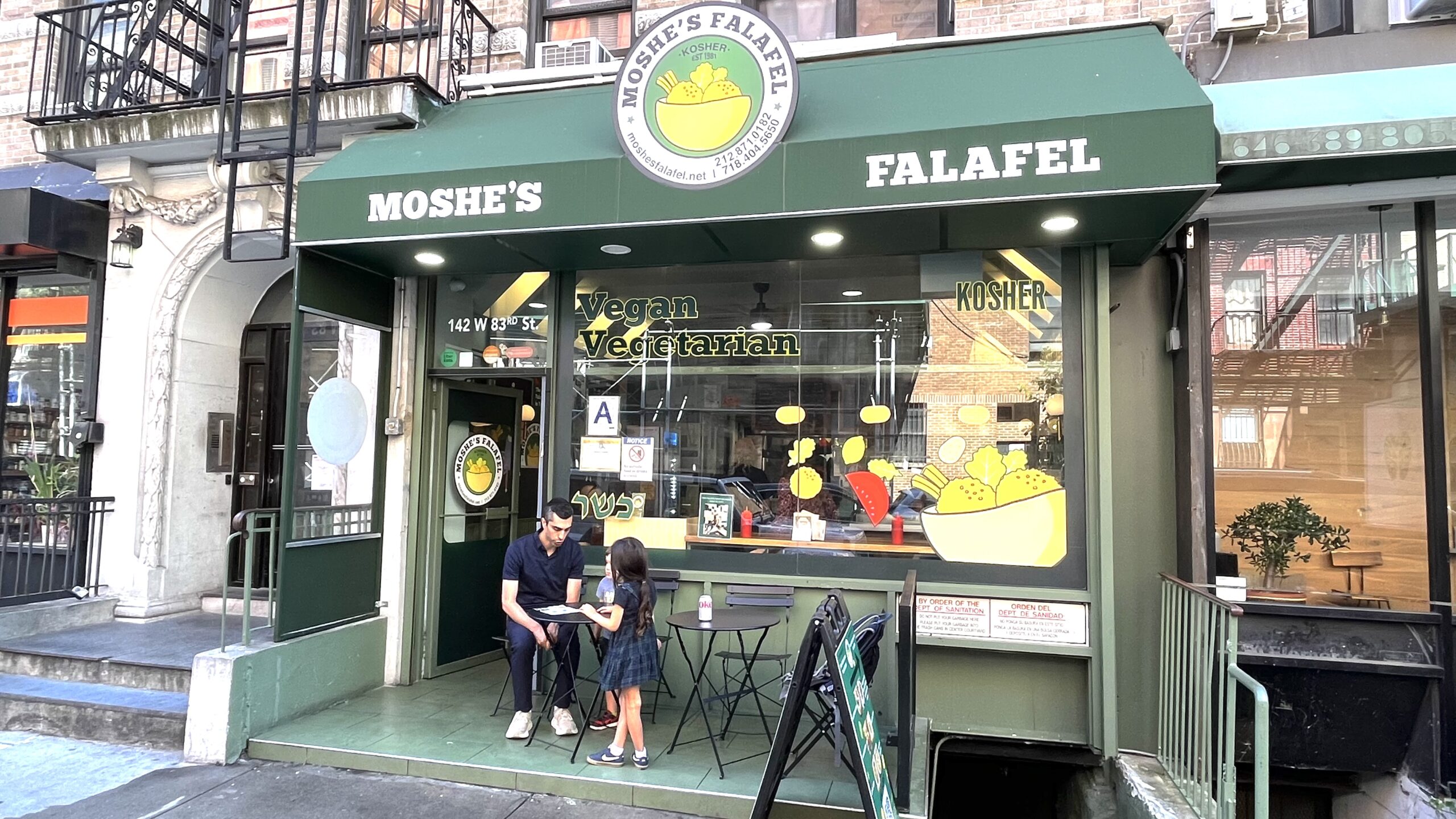
Squeezed between the Redeemer Presbyterian Church and car rental agencies on West 83rd Street is the brick-and-mortar version of Moshe’s Falafel, the four-decade-plus icon of the Midtown food-truck scene.
It’s been highly advertised by self-described falafel connoisseurs at my school and on social media channels, and when the place opened its doors last year, NY Jewish Week went so far as to report the food truck had a “cult following” in the community and beyond.
As I entered Moshe’s, a patron looked at me with excitement, pointing to his oversized, overflowing, over-everything falafel/pita sandwich: “Mest im mown!” he garbled, his mouth completely full and cheeks entirely covered in dripping tahini sauce (plus other bits and pieces from the sandwich). “Sorry, I meant best in town,” he eventually clarified, reaching for what must have been his 77th paper napkin.
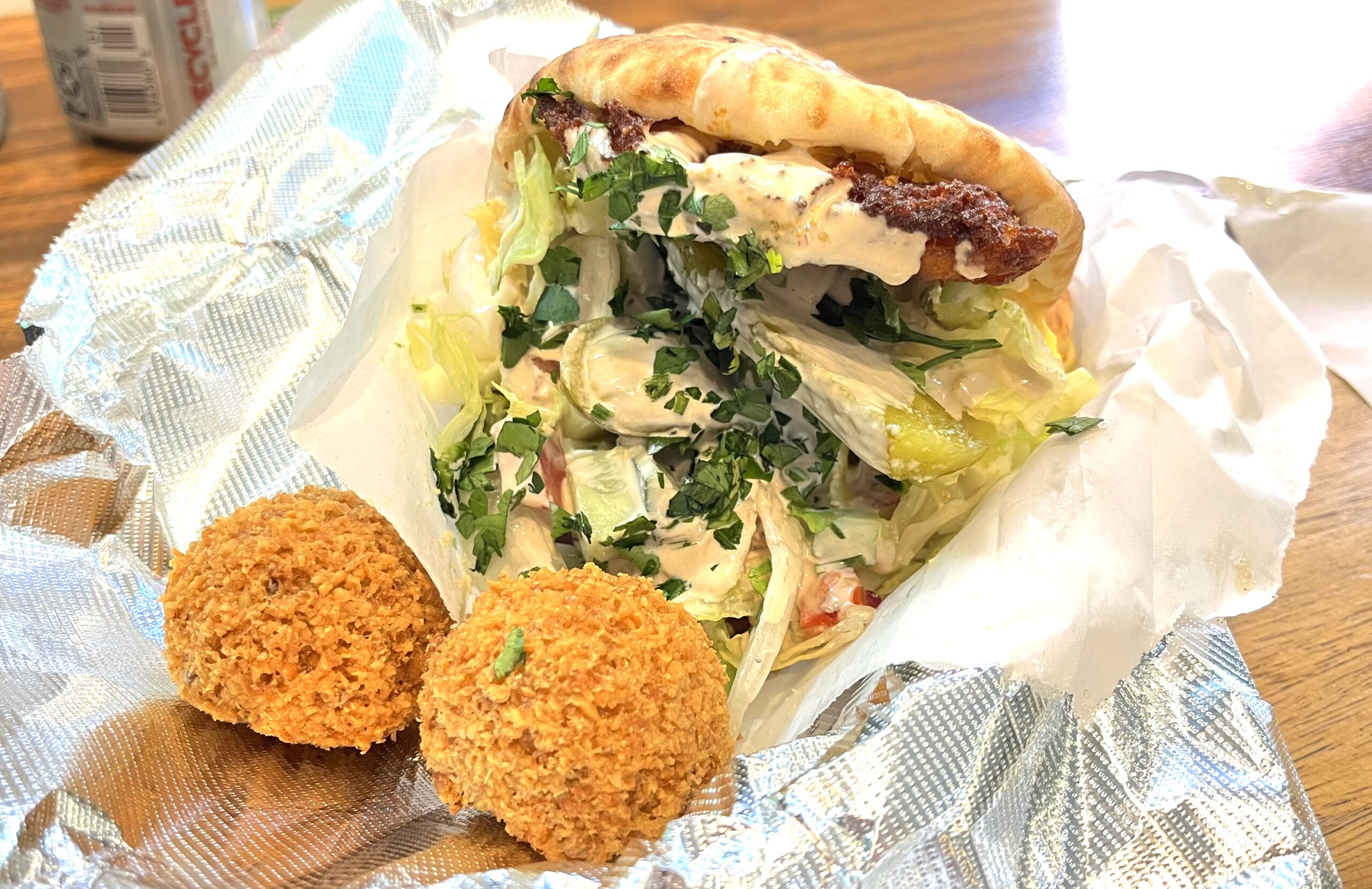
As I was definitely considering having what he’s having, I spotted an item on the menu I hadn’t heard of: “Sabich.” The sandwich maker behind the counter pointed to slices of fried eggplant, then mentioned hard boiled eggs, Israeli salad, pickles… “I’ll have that,” I said. At his table, Mr. Mess looked at me with a mix of shock and incomprehension. “With a couple of falafels on the side,” I added.
Moshe’s original sabich ($14.95), and its eggless, vegan variation ($12.95), closely resemble the traditional sandwich served in Israel, down to the two spicy sauces most commonly used in the recipe, the Yemenite schug (“zhoug”, a vibrant blend of hot peppers, garlic and herbs; a very decent one is available at Trader Joe’s and is a mainstay in our fridge); and my new favorite condiment of all time, the Iraqi/Israeli mango-based hot sauce, amba. (A full description of this marvel is — HERE). While I had my sabich in a pita, Moshe’s can also fix it for you using the thicker, chewier, Iraqi flatbread known as laffa.
After a short wait, the sabich arrived. To say the sandwich was intimidating would be the understatement of the year, and I tried to hide my apprehension from an equally impressed Mr. Mess, whom I spotted peeking in my direction. A bit panicked, I chose to start with the more manageable side order of falafel.
Let me tell you: I have never, ever tasted falafel this good. The exterior was crispy and, for once, not greasy, and the filling was unbelievably light and delicate, almost airy in texture, with cumin undertones dominating over the parsley and other herbs in the mixture. I had no idea chickpeas could deliver such a delicate bite, with these falafel resembling more the exquisite density of well-executed codfish accra or my great-grandmother’s legendary Moroccan fishballs. I nodded back in approval at Mr. Mess.
I then switched to the sabich, which, at that point, was just staring at me in the face. I contemplated various strategies. Fork and knife? Bite from the side? Or go straight for the center? Is the napkin dispenser full or do I need to preemptively ask for a refill? At some point, I stopped delaying the inevitable and went right in.
How exactly do I even describe this bite? Lavish, and ridiculously so, is probably the best I can do. Sure, there were interesting contrasts in texture between the silky eggplant, crispy and starchy potato latke, and crunchy diced cucumbers from the Israeli salad. And there was the tahini’s creamy tartness, nicely balanced by the amba’s sourness and herby heat from the schug. But, really, the sabich was about gluttony and gluttony only. Mushy, messy, tasty, filling and delicious– the kind of sandwich that leaves you satiated for a week!
Moshe’s Falafel is not just about the sandwiches: The restaurant always offers specials such as malawach (Jewish Yemeni flatbread, served with spicy sauces and Israeli salad), shakshuka (eggs poached in spicy tomato sauce, cooked and served in a cast iron skillet), and almighty bourekas “mefuneket,” where the cheesy puff pastry is split open and filled with hard-boiled eggs, salads, and pickles (mefuneket translates to “pampered,” in reference to all the added goodness). Everything is kosher and vegetarian (vegan if you remove the eggs).
Moshe’s Falafel is open from 11:00 a.m. to 9:00 p.m. from Sunday to Thursday, from 10:30 a.m. to 5 p.m. on Fridays, and is closed on Saturdays. Pickup and delivery available at these times. Should you require their catering services, use their commission-free platform.
The Dish: Sabich ($14.95) and a side of falafel ($2 each)
The Restaurant: Moshe’s Falafel, 142 West 83rd Street (between Columbus and Amsterdam Avenues)
Read all Here’s the UWS Dish columns here.
Subscribe to West Side Rag’s FREE email newsletter here. And you can Support the Rag here.





yum.
thank you for the review!
Never tried the sabich but can confirm that the falafel is top notch !! Not as heavy as Mamoun’s and actually quite light, as described. I had no idea they had a spot on the UWS, had all my falafel from their midtown truck
The sabich is great!
I found Moshe’s when it first opened and I can say that this article gets it just right! Sometimes I arrange my day of chores and work around the restaurant’s location across from the post office on 83rd so I can enjoy the amazingly fresh menu for lunch. Do yourself a favor and have the best falafel in town.
I started eating at the Moshe’s cart in midtown in the late 1980s when I was a college student and I still go when I’m in that area.
Moshe’s food is awesome. So glad they have a restaurant on the UWS!
The best, this should help as its location is a bit hidden. Worth the effort to get there!!! Cant imagine going back to Mamoun
Best falafel place in town.
Falafel is NOT Jewish food. It is Palestinian
Cope and seethe.
Given that “Palestinian” as some kind of specific modern national identity goes all the way back to….um….the mid-20th century, and that falafel is far older than that, maybe you need to check your math.
Are you responding to someone or something in particular? Was there a claim that falafel is a Jewish food?
Falafel is a middle eastern food that is commonly eaten by Jewish, Muslim, Christian, and other people in the Middle East.
The owner of the restaurant is Jewish and they serve kosher food.
All good?
All good!
I thought it was Ancient Egypt (though many Palestinians are, in fact, Egyptian, so there might be some truth to your statement, depending on how you look at it)
You can order falafel in any Middle Eastern restaurant – Egyptian, Lebanese, Syrian, Moroccan, Turkish….
I guess all these cultures stole the idea of falafel from the Palestinians.
Who said it was?
It’s the link in the article that implies it is.
The link implies it’s Kosher, not Jewish. Any cuisine can be prepared to be Kosher, and there are numerous options in NYC including chinese, japanese, italian, steak house, vietnamese, mexican, fren ch, spanish…. none of which are “Jewish food”.
The link is to a website called “NY Jewish Week”.
Yes. It might surprise you to know that Jews eat things that are not considered Jewish food although some of those foods might be commonly eaten by Jews. And events that include various foods, including falafel, may be offered.
Jews participating in Jewish week events might wear clothing that is not traditionally Jewish and even bring non-Jewish friends.
Sometimes they even speak English and not Hebrew or Yiddish.
I’m just pointing out the name of the website linked.
Yes but the link is used to reference the falafel’s “cult following”, not their origin. How does the link imply that falafel are Jewish?
The link is to a website called “NY Jewish Week”. Really now, stop with the pettifoggery.
Also, notice how I said: “the link in the [WSR] article implies it is.” I didn’t say that the article linked says that falafel is exclusively a Jewish food.
I don’t see that implication. Would you mind sharing the language that you see?
“NY Jewish Week” is the website linked.
You can browse through the other articles on that website; they are exclusively Jewish focused — albeit, they don’t seem to go up real regularly, example Jay Robert Lifton died at least a few weeks ago, but his obit is a current article on the website.
So if there was a link to “New York Haitian Week” and there were festivals where pork was featured, would you say there was an implication that pork is a Haitian food?
Jane,
Pork is many dishes, falafel is one dish. If some particular preparation of port is consumed in Haiti; it would be Haitian food, BUT it could also of course be part of other national cuisines.
Furthermore, Jewish is a religion, not a country, while Haiti is a country.
There’s only one way to serve falafel?
“Jewish is a religion”? So Jews can’t be atheists and atheists can’t be Jews?
Sorry, you seem terribly misinformed and your logic is shaky.
Jane,
It would be very hard to be Jewish and be an atheist. There are certain central spiritual beliefs central to being Jewish, eg the flight from Egypt.
I guess someone who identifies as Jewish could say, “I don’t believe in a old man g-d overseeing everything but some of the events we Jews mark occurred”.
You’re getting into the thicket of how belief in one religion or system nearly always implies a belief in a different history of the world and a different physical description of reality.
Careful: calling Jews a unified race is not a good place to go, but that’s where you’re heading.
Jews are a people and a nation. Many Jews are religious. Many (perhaps most) are not.
Many are atheists. One can be part of the Jewish people and not participate in the religion.
Sorry, but this is a reality even if you don’t believe it.
And I didn’t use the words “people” or “nation”.
Jane,
Okay, but didn’t use the word “people” or “nation”.
I will say that second word is dubious, and comes real close to the “r” which is to be avoided.
I’d stick with tribe.
Moshe’s is the only place where I will order falafel because it is so light. The pita is also the best so fluffy. Located next to the Vitamin Peddler one of my favorite businesses.
Pita shouldn’t be fluffy. Real pita is very thin and chewy; no yeast added. Very hard to find in NYC.
I look forward to trying them. I appreciate that they use Israeli in their descriptions. While I really love Miriam’s, I’m saddened that their relatively new menu scrubs “Israeli” and replaces it with “Mediterranean”. Plus they removed all Jewish stars and imagery from their decor.
It makes me very sad.
Best falafel in town bar none
Ha the word of mouth on this place is nuts, but this is the best/clearest review of it I’ve seen. I’m not even usually into falafel because it’s usually just like deep-fried feeling and boring, but at this place it’s like a whole different thing. Pure magic.
Many years ago when I worked in Midtown, I would go by the truck and get the falafel sandwich. It was amazing. It was the pinnacle against which all the other falafels I have ever eaten have been judged and found wanting. Just last week on the bus I was looking wistfully as we passed the spot where I used to buy the sandwich. Now you tell me I can just go to 83rd St and get my falafel fix? Can’t wait!
Nah.
More for the rest of us
Oooh I’m a big fan of the falafel it’s as described here, but I’ve never strayed and the sabich sounds intriguing! This might be today’s lunch adventure, thank you WSR