

By Abigael T. Sidi
I’ve always had a thing for Persian food – one of my earliest culinary memories was a lunch at Iranian friends of ours, where I tasted what I’d later learn was tahdig, the country’s addictive scorched rice dish, with its succulent crunchy/buttery layer of golden grains from the bottom of the pan. I’d constantly ask for it at home, and my French parents, to their credit, gave it their best shot (but it was never the same, and often outright disastrous).
Of the many underrepresented cuisines on the Upper West Side, Iranian food is surely at the top of the list. So, when I heard that a Persian restaurant, Eshel, had recently opened in the spot previously occupied by the vegan Blossom (on Columbus, between West 84th and 85th streets), I got excited. Not only that but the restaurant was… glatt kosher and run by a Jewish team. Intrigued, I made my way there for a late Sunday lunch.
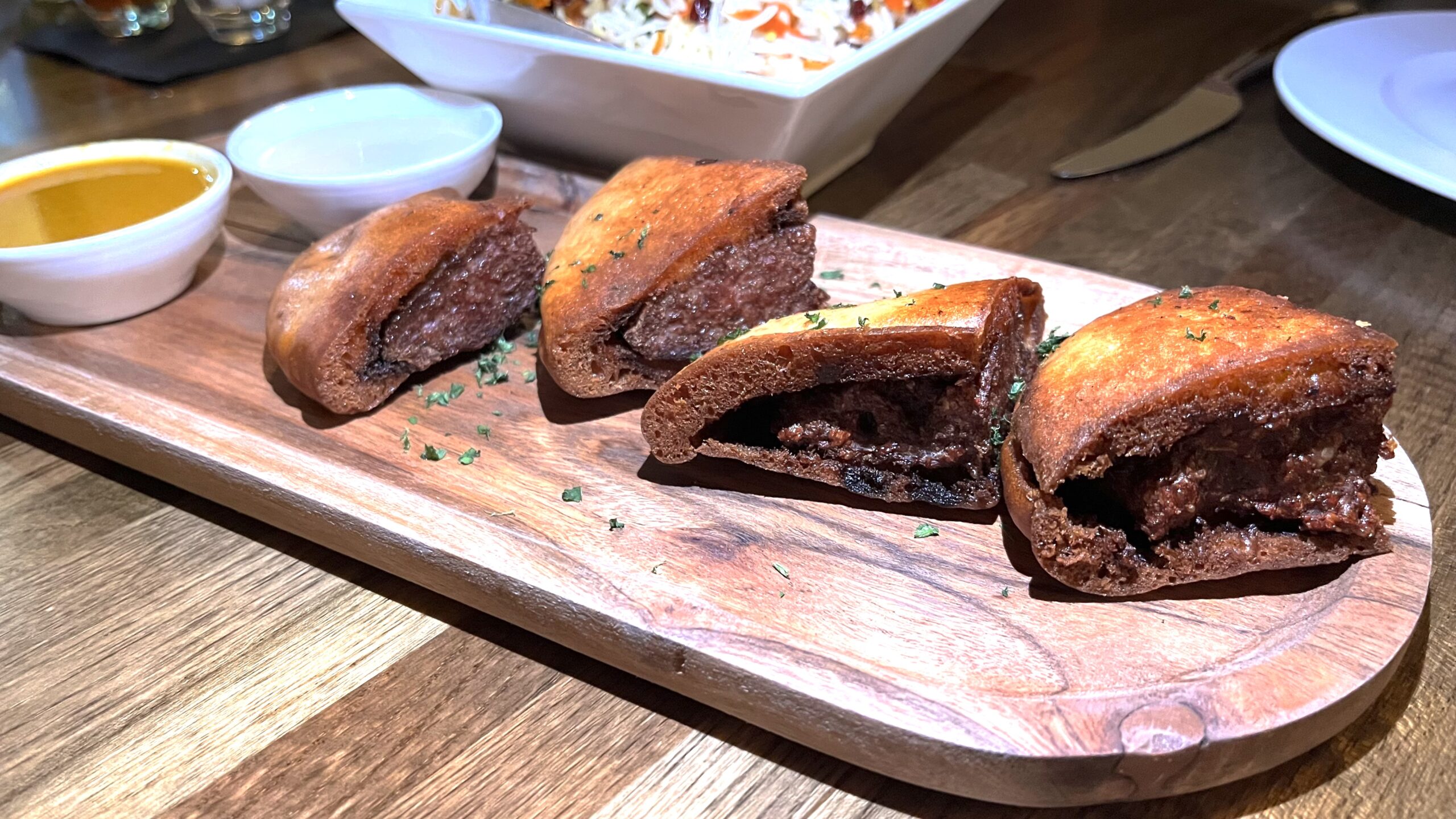
I’d already decided on ordering tahdig, so my heart sank when I couldn’t find it on the menu, even in the rice section. As is unfortunately often the case with kosher restaurants, prices were hefty, so I went with the “affordable” lamb arayes ($30, in the appetizers section) along with a side of jeweled rice (more on that later).
Arayes are the Levantine equivalent to sliders, in which the patties are stuffed into open pitas, and then toasted together until the bread becomes slightly charred and crispy. Arayes, which is plural for aroussa (“bride” in Arabic), refers to the way the pita and meat are married together. They are a Middle Eastern street food classic, with likely origins in Lebanon.
Eshel gives you four Arayes per serving, along with two dipping/seasoning sauces – tahini and the spicy, tangy amba, an Iraqi condiment (with former roots in India) made of pickled mangos, turmeric and other spices, which became wildly popular in Israel after the arrival of Iraqi Jewish immigrants.
Because Eshel’s pita is of the thicker kind, the bite was crunchy rather than crispy, offering a forceful, charry and textural contrast to the impeccably cooked, tender lamb patties. The pinch of smoky za’atar seasoning only further showcased the bread’s charry/burnt flavors, while the meat itself was not overly seasoned or spicy, allowing for its characteristic gaminess to shine. Simple, straightforward, with no unnecessary complexity or fuss: Street snack personified.
Things got more interesting was when I started dipping the arayes in the amba. You want flavor, that’s flavor! Sour, fruity, with a good kick of heat, the amba was a delightful enhancer to the arayes, pairing beautifully with the charred pita and gamey lamb. Pop-like and delicious, I could just drink gallons of this potion.
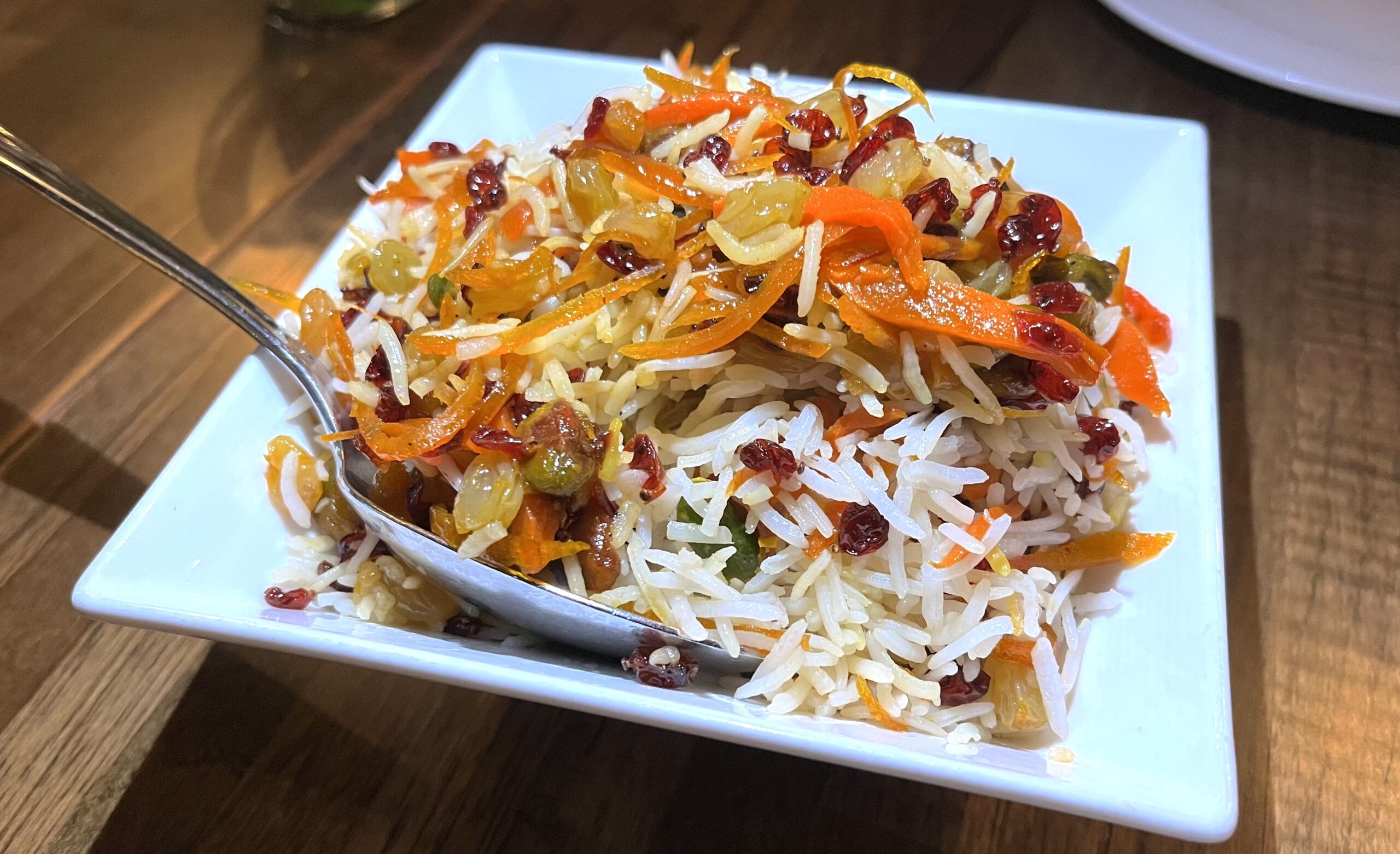
With no tahdig to choose from, I paired my arayes with jeweled rice, in which expertly steamed, airy basmati is mixed with caramelized onions, carrots and sweets including barberries, candied orange peel and golden raisin, and finished with almonds and pistachios. While it was beautiful to look at and the rice was, indeed, perfectly executed, the dish lacked in fragrance somehow, as well as structure, with the ingredients not blending together fully. Or maybe it was just me and my disappointment at not being able to delight in the tahdig I was craving. I hope they add one to the menu — hint, hint!
With the Jewish High Holidays, co-owner Rafael Yaghoubian was understandably too busy for an interview, so I researched what, on the face of it, felt like a surprise given recent history: a Jewish Iranian restaurant. Of course, I’d soon learn of the long story of the Jews in Persia, culminating with Cyrus the Great allowing them to escape Babylonian captivity in 539 BC and return to Jerusalem. One of my grandpas claims to be a descendant of Persian Jews who were involved in the saffron trade. More to dig there, for sure!
While out of my price range, Eshel also offers authentic Iranian stews other customers were raving about, including a dried-lime-and-herb beef stew (ghormeh sabzi, a celebrated national dish, $38) and tomato and split pea stew (khoresh gheimeh, $35). Also available were what looked like succulent beef kabobs whose prices were also of the succulent variety ($40 and up). The steam emanating from those plates was mouthwatering. If you have the funds, this looks like the place in the neighborhood to discover authentic Persian cuisine.

Eshel offers a dim, intimate and cozy space, with traditional and modern Iranian music alternating in the background. While it’s quiet at lunch time, I’ve heard that it can get loud with the evening crowds. The restaurant is open Sunday through Thursday from 12 p.m. til 10 p.m., opens for lunch on Fridays (11 a.m. – 2 p.m.) and then closes for Shabbat (it does not reopen on Saturday night, as do Malka and other neighborhood kosher spots). To order, use Eshel’s commission free platform or call 212-299-4759.
The Dish: Lamb Arayes ($30)
The Restaurant: Eshel, 507 Columbus Avenue (between West 84th and 85th streets)
Read all Here’s the Dish columns here.
Subscribe to West Side Rag’s FREE email newsletter here. And you can Support the Rag here.




thanks for the review!
Good photographs of a delicious looking meal!
I checked their online menu looking for other hidden gems and there appears to be many (https://www.zmenu.com/eshel-new-york-online-menu/).
One thing holding me back: the meal you had (Lamb Arrays, $33.04 and Jewelled Rice, $21.24) comes to just over $60 with tip and I’m wondering if the amount of food was satisfying—the photographed portions look small to me (good idea to include the spoon with the rice dish).
Regardless, I will skip one or two weekly lunch outings first, and then look forward to trying this fabulous looking food!
I’m sorry but that little dish is $34. The tomato and split pea stew, which is just a bean and vegetable soup in a bowl, is $41. A grilled chicken skewer with rice and a few vegetables is $51.
Look and sound tasty but $30???
Eshel is an amazing kosher restaurant — love it so much! Food is fantastic!
I would also add that there are reasons that food prices at kosher restaurants are higher — all meat must be raised and slaughtered in a specific manner to ensure the health of the animal and cause it the least pain, fruits and vegetables must be thoroughly washed and checked for bugs by hand to ensure it is okay for consumption (this is actually really tedious with things like broccoli and berries on a large scale) — additionally the restaurant must pay a special person called a masgiach to monitor the kitchen at all times to ensure no food mistakes are made so that it remains glatt kosher. (This is a bit reductive but you get the idea…just wanted to point out that there are many “hidden” costs that result in a higher price for kosher food).
Unfortunately this is the only decent Iranian restaurant around here. Some of their dishes like the herb stew you mentioned are delicious but prices are prohibitive, even when you factor in the kosher part (which, in itself, costs the operation big time.)
“Iranian?????”
Brother this is Israeli food
It would be great to get a Ravaghs on the UWS. That’s really good Persian food and a little over half the price but they’re only downtown or on the east side.
Wait.
Does that menu really truly say $26-31 US dollars for DESSERT!!!
I feel a heart attack coming on as we speak.
Wish them well but damn.
They have tahdig as an off-menu item!
Will definitely try. Your descriptions are the best!
Thank you for these, as always!