

By Bonnie Eissner
Flaco, the Eurasian eagle-owl who captured worldwide attention as he lived his final year as a free bird in New York City, now has a memorial on the Upper West Side, where he spent his last days.
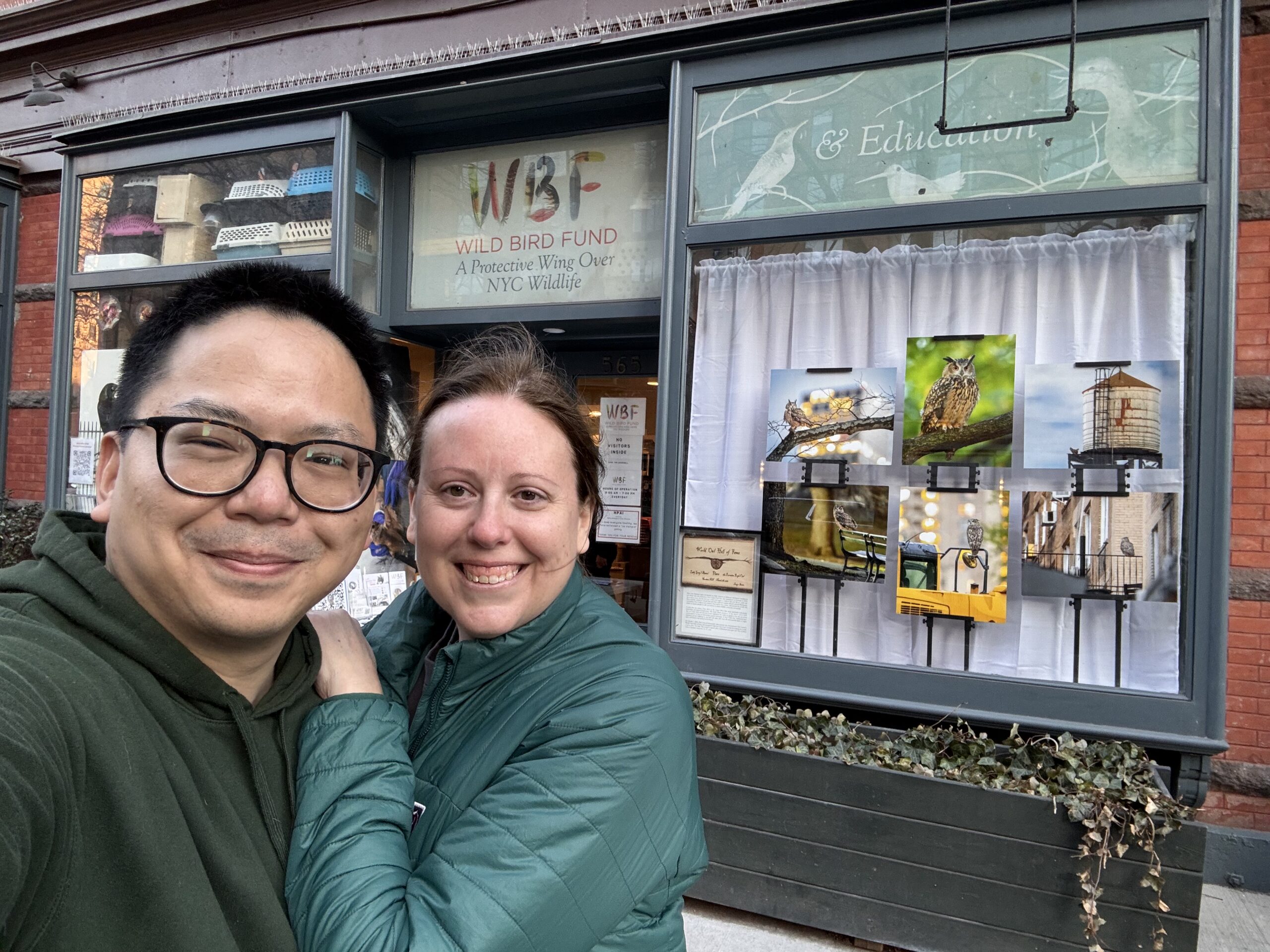
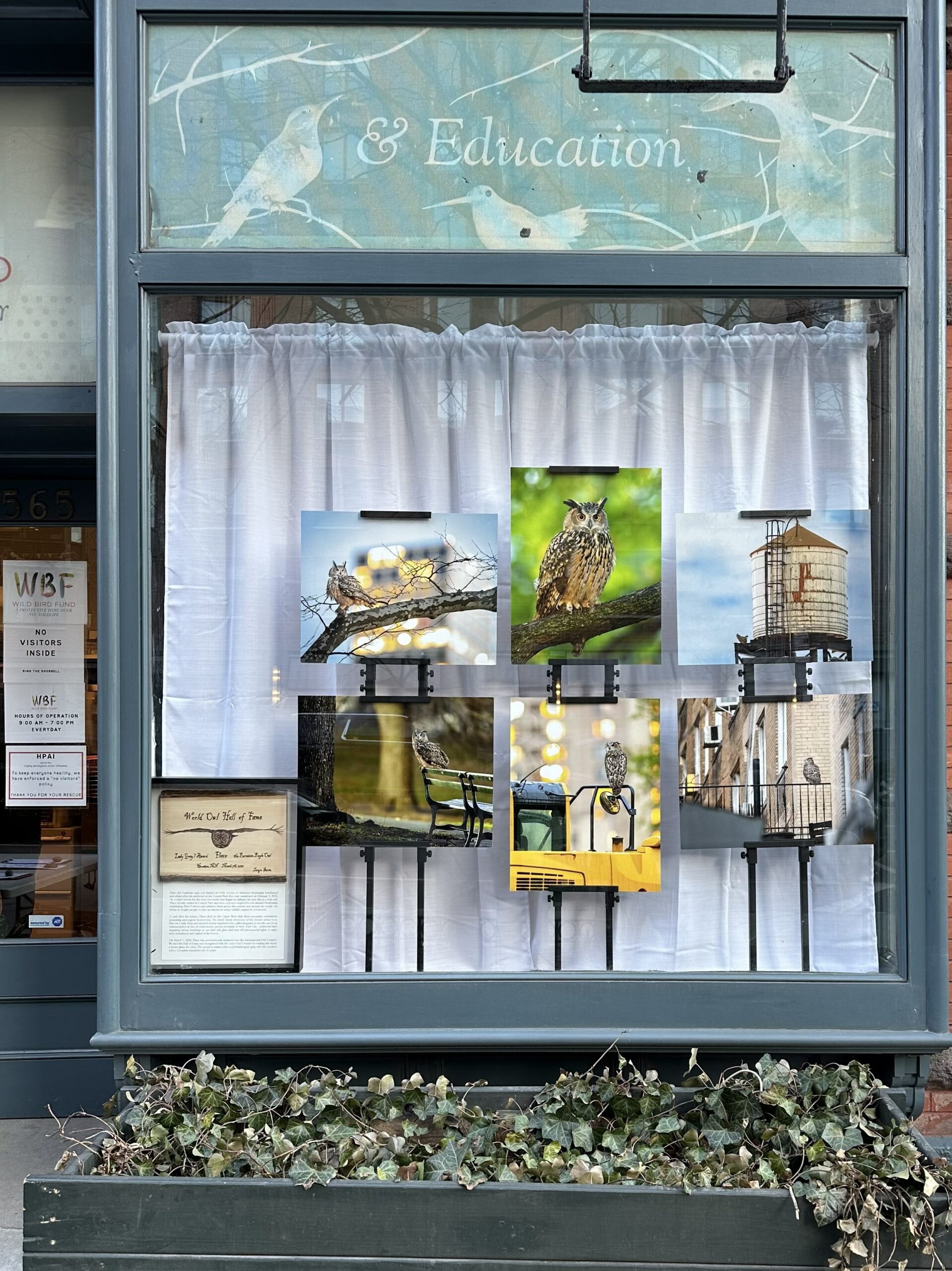
Last month, Flaco made history as the first New York City owl inducted into the World Owl Hall of Fame. His award was accepted by Jacqueline Emery and her partner David Lei, authors of “Finding Flaco: Our Year with New York City’s Beloved Owl.” They nominated Flaco for the honor, along with two other people, and arranged for the wooden plaque and six of their photos to be placed in the window of the Wild Bird Fund on Columbus Avenue, between West 87th and 88th streets.
“It’s kind of the Wild Bird Fund to offer to house and display the award,” Lei said, “in part because people really wanted a memorial to Flaco, and that never happened.”
Three petitions for a Flaco statue in Central Park have garnered over 8,000 signatures. But such memorials are only considered 20 years after the individual’s death, the New York City Parks Department told Our Town in 2024.
“This will be what those people wanted,” Lei said.
People will get to have “a quiet moment with Flaco,” Emery said.
Emery and Lei also hope to draw attention to the work of the Wild Bird Fund, New York City’s only wildlife rehabilitation and education center. It treats over 13,000 sick, injured, and orphaned birds and other animals a year and was called when Flaco crashed into a building on West 89th Street in February 2024. The center’s staff confirmed his death.
“There’s no organization doing more to help birds in the city,” Lei said. Beyond rehabilitating birds, the organization educates people about the perils birds face, including anticoagulant rodenticides, which pose a particular danger to raptors and contributed to Flaco’s death.
Emery and Lei, who photographed Flaco throughout his year of freedom, have started a grassroots campaign to ban rodenticides in Central Park and at buildings near the park.
Rodenticide use is halted in city parks during nesting season, from February through August, or when a breeding pair of birds of prey is in or near a park area, the Parks Department told The New York Times.
“But raptors and other wildlife that could be susceptible to secondary rodenticide poisoning live in the park year-round,” Lei said. “So it doesn’t really make sense to us to only stop using rodenticides part of the year.”
Rat poisons, he observed, address the symptom of too many rats, but not the cause, which is trash.
Recently, he and Emery noticed that the Central Park Conservancy started using secured containers, rather than trash bags, at trash pickup sites along Park Drive. “It’s better than rodenticides,” Lei said of the measure.
Flaco’s widely mourned death spurred legislation to make New York safer for fellow birds of prey, including a law that established a pilot program to study the use of rat contraceptives as an alternative to rodenticides. Other pending laws would require private buildings to turn off unnecessary lights at night and replace reflective glass windows by 2030.
The impact Flaco had, and may still have, on the lives of birds of prey, in addition to his popularity, qualified him for the World Owl Hall of Fame, which stipulates that owl inductees must make the world a better place for their kind.
While people have been inducted into the World Owl Hall of Fame every year since its start in 2006, Flaco is the first owl since 2016 to make the cut.
Inspiring legislation that will protect owls was key to his induction, said Karla Bloem, executive director of the International Owl Center in Houston, Minn., which hosts the hall of fame. His celebrity, she said, “has the power to make a really big difference for all the owls that are living today.”
Flaco is restored to full-color splendor in the six photos that flank his hall of fame award in the memorial, which fills one of the Wild Bird Fund’s large picture windows. In the images, he perches regally in Central Park, on a balcony railing, and next to an Upper West Side water tower.
“We’re honored to have the memorial to Flaco,” said Rita McMahon, executive director of the Wild Bird Fund. He died just two blocks away, and Wild Bird Fund staff brought him to the clinic immediately after, before he went into rigor mortis, she recalled.
“Flaco was a magnificent creature who we all enjoyed watching as he explored and created his own life in New York City,” McMahon said. “But what he did for New York City’s precious wildlife was probably much greater, as he made people care.”
Subscribe to West Side Rag’s FREE email newsletter here. And you can Support the Rag here.





Dear Flaco —he never asked for the life he got and as any animal would just tried to survive in captivity and then on the loose—sadly on his own with no hope of seeing another of his kind in NYC —humans have romanticized his experience and overlayed it with human meaning—it’s great tho that his experience has shown a light on rodent poison and other dangers for wildlife—and rodenticide is a problem for more than raptors—with all our technology can’t we do better than stupid poison that gets in their food chain?
I think as New Yorkers we are so starved for any connection whatsoever with actual wild animals that we just connect to these types of stories.
Flaco, Romeo & Juliet, or Chompy, the rat that lives in the garbage outside my building. Even the wildlife become celebrities in NYC:)
Don’t forget Mandarin Patinkin!
And maybe the dead bear that RFK Jr. dumped in Central Park 10 years ago….
And, some years back, the redtailed hawks whose tale was told in the book Red Tails in Love.
This is so offensive to beloved Barry the Barred Owl who was killed during the pandemic years by a combination of eating rat poison and being hit by a Central Park Conservancy vehicle.
JUSTICE FOR BARRY!!!
Barry was beautiful and even personable. I knew she was poisoned, but I didn’t remember that a CPC vehicle hit her — awful!
Do we have other owls. I am 99% certain the bird that flew over the path just west of 91 and rsd abount 10 pm the other night was an owl. Flat face with white eye pockets.
Birds are migrating through, and you could easily have had an owl, maybe even a Barn Owl.
2 instances I know of are the great horned owl that lived in Central Park and one year snowy owls were at the airports in some numbers so u probably saw an owl—a real manhattan bird watcher probably has much more info on this—yours sounds like a barred owl and I hope u saw one!
The WBF do amazing work. I’ve been supporting them for years. Had brought in an injured Coppers Hawk from near West End Ave, and smaller birds (in paper bag ‘ambulances’) who were window strike victims. The staff received their little patients with professional care and gentleness and immediately assessed and treated them. A perfect place to display Flaco’s award! Speaking of injured wildlife – what’s with all the dead geese in Central Park waters? Is it really the Bird Flu again? Poor geese! Please make a report to 311 and/or the park’s staff if you see anything.
Central Park may not accept it for display for another 20 years, but could the authors start a GoFundMe now to commission a statue of Flaco – perhaps a lifesize bronze figure of him which could be perched in hos favorite tree with a plaque below?
FYI Latest NYC celebrity bird is a woodcock in Bryant Park!