

By Abigael T. Sidi
Eighty years, three owners, and a post-World War II front signage almost unchanged since 1945: “Murray’s STURGEON SHOP.” I’ve known this place my entire life; whenever we’d walk back from a Sunday trip to Barnes & Noble, Dad would always make the stop to stock up on Murray’s schmaltz herring. The snow-haired man with an equally immaculate mustache would always hand me a slice, never surprised that a little girl would just swallow it up, like candy.
Today’s piece on Murray’s is one of the ones I always had in mind when I took over “The Dish” almost a year ago. The shop’s sights, its scents, its sounds, its history, the herring’s texture and flavor, the fishy oil stains all over my face and shirt that drove Mom nuts, and the man behind the magic of it all, present-day owner Ira Goller – all these things have a lot to do with my passion for the NYC food scene and the New Yorkers behind it.
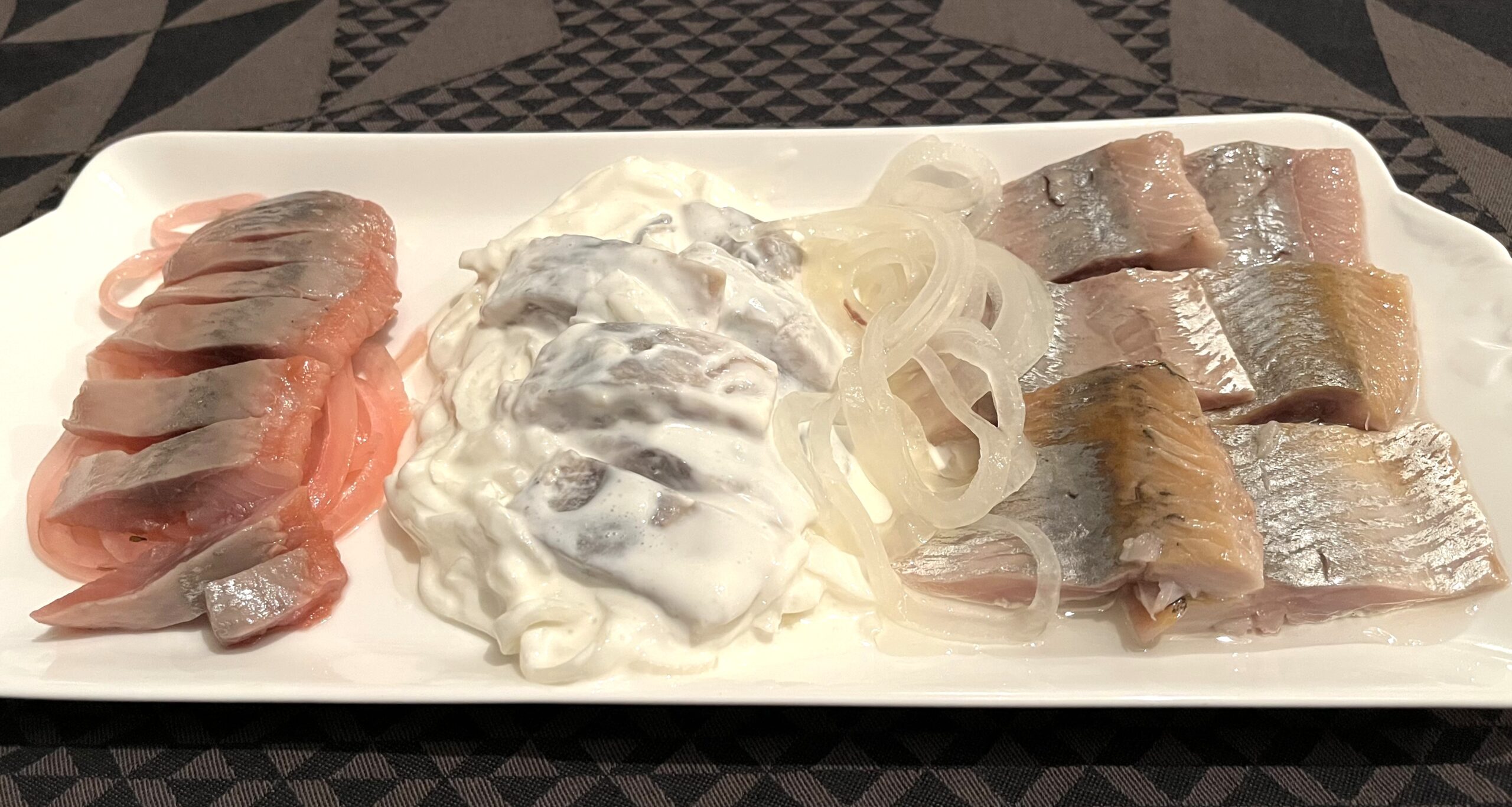
Over the years, I got Dad to loosen up on his infallible loyalty to the schmaltz (the herring from his childhood in Paris); we started trying the two other varieties offered at Murray’s: the matjes and the pickled herring (the latter can be had with or without cream sauce). In fact, on our latest visit, we got all three, completing the trifecta.
The pickled herring, which we always get with the yummy, decadent cream sauce, is probably the variation with which New Yorkers are most familiar. Murray’s uses top-quality fish from the cold waters of Newfoundland, but you can find imported European pickled herring in any supermarket. They are probably the safest way to discover the joys of herring: The pickling in a vinegar/sugar/spices solution, together with the savory cream, markedly tones down the filet’s fishiness and softens the texture for a pleasant, semi-sweet and briny, palatable bite.
The schmaltz, by contrast, is your “real deal” herring. Cured in oil, fatty, drippy, with its meaty texture essentially intact, the fish is front and center, and it is common etiquette to feast on it with a couple of raw onion strings from the marinade. The herring flavors explode in your mouth, further enhanced by the crunchy and pungent onion. Try it on rye or, as the French do, with a potato salad (“hareng pommes à l’huile”).
Lastly, my personal favorite: the matjes. These “maiden” herring, which Goller gets from Sweden, refer to the young, immature fish caught in May and June before they’ve had a chance to spawn. They are exceptionally tender with a high fat content, giving them a distinctive delicate flavor I would liken to a slice of ultra-fresh mackerel sashimi. They are ideally eaten straight-off-the-boat fresh, with minimal pickling or curing of any kind. (You’ve probably seen pictures of grown Dutch men and women shamelessly swallowing their matjes pelican style.)
The key to the supreme quality of Murray’s herring is that “every fish is hand-picked according to size and firmness, delivered to us with head and tail on, and then each of the preparations are done here [in the back kitchen],” Goller said. The curing processes (whether in vinegar, oil, or spices) are intricate and follow precise recipes, taking up to two years of training.
For instance, a distinctive feature of Murray’s herring, which I’ve always felt is key to their greatness, is that they are far less salty than those sold at other renowned shops in the city (Barney Greengrass, for example, even says on their menu that their schmaltz is “very salty!”) Murray’s curing process, by contrast, starts by soaking out the salt from the fish in fresh water. “For the schmaltz, we do that for up to 24 hours, otherwise the fish becomes unstable,” Goller said. “There’s a whole process to make sure the fish are safe.”
After desalinization, the curing process starts, whether with a mixture of vinegar, sugar and spices (for the pickled variety); onions, oil and spices (for the schmaltz); or just water and spices (for the matjes, where the filets end up bathing in their own juices, giving them their characteristic pinkish/light purplish color). The result: best herring in town, and it’s not close.
I had always imagined that — like Bosino’s Davide Puppilo, who says that at birth, he was basically thrown in a bag of flour, or Gary Greengrass, who had grown with the family business — Murray’s snow-haired man had been born in a herring barrel, or at the very least grew up in a deli run by his parents.
Nothing could be further away from the truth: Goller, who holds an MBA in economics and master’s degree in accounting, had a career on Wall Street in the 1980s and was intent on going to law school when a friend approached him in 1989 with “an opportunity.” “He was in the deli business,” Goller said. “We never agreed on anything much, but of everything we looked at, this was the only thing that somehow made sense to me, just the numbers themselves.” With zero knowledge or prior interest in the smoking and curing business, Goller bought Murray’s from Artie Cutler (the legendary restaurateur who owned Carmine’s, Dock’s, Ollie’s, and Gabriella’s) in September 1990. “And the rest is history,” Goller said.
By 1990, Murray’s had already been running for almost half a century and founder Murray Bernstein (a Jewish immigrant who had fled Poland in the 1920s) and Cutler had made the shop the gold standard in the business, with the New York Times calling it “one of the busiest places on Broadway” and praising the products as “first quality” back in 1964. As the Jewish Journal reported, the shop attracted magnates, politicians and show-business stars, and “limousines would line up in front of the store.” In 2019, 20 years into Goller’s tenure, the same paper would call Murray’s “the last of the great Jewish appetizing stores,” a testament to Goller’s incredible success in the face of the highest of expectations.
As I did with Gary Greengrass, I asked Goller about a potential successor. “Since I haven’t decided to hang them up yet, there’s no plan – I’m not there yet, so how I can choose?” he answered firmly, with the gentle defiance of a master of his craft still at the top of his game.

The line at Murray’s moves as a function of the time it takes the slicers to expertly hand carve the smoked fish near the end of the counter. (I focused on the herring, but the lox and silky, buttery sable, while top dollar, are nothing short of world-renowned.) And few customers come in just for smoked fish or herring; once they’re done with the big shots, they’ll start pondering between the Waldorf, whitefish and tuna salads, gefilte fish, pickled vegetables, chicken and vegan liver pates, and all the other homemade Jewish deli fixtures that are lined up in the counter. Unless you carefully avoid peak or pre-High Holiday hours, plan for a solid 45 minutes (but that wait is magical, quintessential old-school New York).
For orders, give Ira a call at 212-724-2650. Murray’s Sturgeon Shop is open every day from 8 a.m. until 5:30 p.m. (until 5 p.m. on Sunday). Let’s hope it stays that way until I can take my own kids for their first free herring tasting one day!
- The Dish: Schmaltz, Matjes and Pickled-in-Cream-Sauce herring filets (approx. $9, $8 and $6.50 per filet, respectively)
- The Restaurant: Murray’s Sturgeon Shop, 2429 Broadway (between West 89th and 90th streets)
Read all Here’s the Dish columns here.
Subscribe to West Side Rag’s FREE email newsletter here. And you can Support the Rag here.




With all due respect to Murray’s schmaltz herring — and it is delicious — it strikes me as a tiny bit, shall we say, insensitive to run a story on the Sturgeon Shop in the same edition of the Rag as the one on Saul Zabar’s shiva.
Funny, I posted a similar comment (about this article being at best ill-timed and at worst disrespectful), but WSR refused to post it. I wonder if they’ll post THIS one.
I think it’s the perfect time to review all of the stores in the neighborhood that have been plying their trade in the appetizing business for decades, just like like Zabar’s.
Yes, but you could also argue that Ira continues Saul’s legacy, both in spirit and talent. Somehow a feature story on Ira does make sense.
Less concerned about Zabar’s future than I am Murray’s, especially now that it appears Ira is resisting a successor plan.
Zabar’s, BG, Murray’s, they’re all part of the same UWS identity and should be cherished and protected as a whole.
And I’d bet that Saul would be the first to admit Ira’s schmaltz and matjes are in another league compared to Zabar’s current offerings.
Mixed feelings
Le roi est mort. Vive le roi!
Exactly my feeling about this. Ill timed.
It’s always a pleasure to read Abigael’s column, for the discoveries but also for the places I have known for years. She is a great food writer!
I stopped shopping at Murray’s when I saw the counterperson using the rag he used to wipe the counter clean to wipe his knife. Yuck.
Nice story but it might’ve have been a good idea to mention where the shop is located a bit higher than the bottom of this long article.
That’s the traditional, time-honored format for reviews. (The New York Times uses it too.)
Who doesn’t know where Murray’s Sturgeon Shop is??
Brings back fond memories. My dad was a matjes herring fan. He ate it with boiled potatoes and rye bread. It was a Saturday treat.
Here’s how I go:
– Smoked fish, herring: Murray’s
– Non-smoked nova etc.: Barney G
– Pastrami, egg salad: Zabar’s
Their pickled salmon is also excellent
Oh man, I just love Murrays. Everything is so great and and I really enjoy the guys behind the counter. The matjes are also my personal favorite.