

By Yvonne Vávra
Nothing much happens, repeatedly. Four couples fall in love, no one gets slapped, and a parrot saves romance. Louis N. Parker’s 1910 British play “Pomander Walk” doesn’t have much of a plot or dramatic arc. No climax, no hero, and no villain. It’s just a charming stroll down a magical little London street where the secrets are mild, the doors slam politely, and everyone ends up happily ever after. “Downton Abbey” on decaf.
Upper West Side nightlife impresario Thomas J. Healy was a fan of “Pomander Walk,” even though he was anything but decaf, personality-wise. He was known for ice-skating cabarets, defying liquor curfews, and sparking riots on Columbus Avenue when police tried to shut down his dining-and-dancing hotspot at Broadway and 66th Street, dragging patrons out by the collar.
So perhaps it was out of a longing for the idyll of a quaint English enclave that, in 1921, Healy commissioned the construction of Pomander Walk—a hidden walkway between West 94th and 95th Streets, tucked between Broadway and West End Avenue. According to the Landmarks Preservation Commission, his intention was to recreate the picturesque village atmosphere of the play.
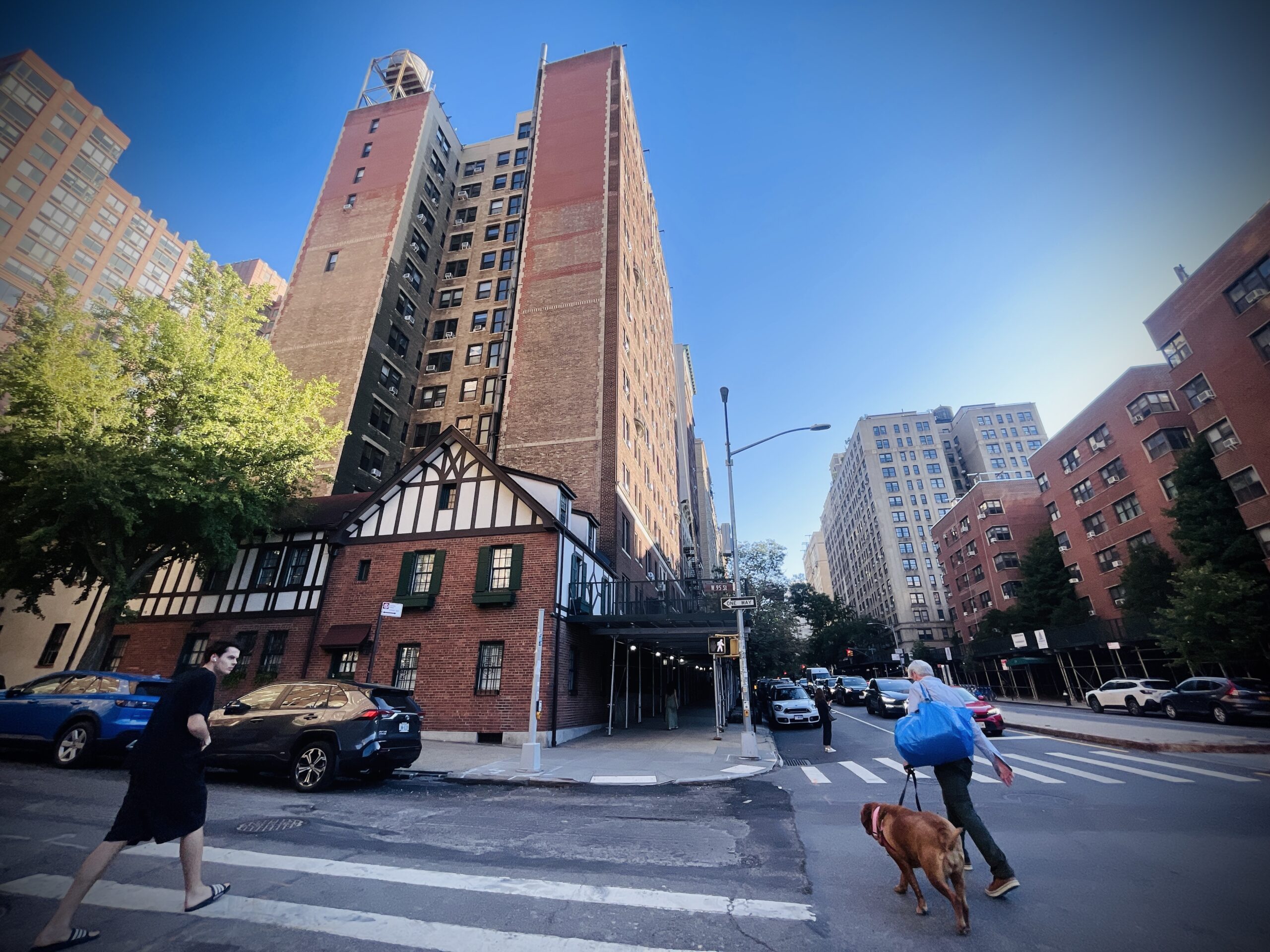
You’ve probably had the strange, time-bending experience of walking up West End Avenue and suddenly spotting a tiny Tudor cottage clinging to the corner of 95th Street—all flower boxes, pitched roof, dormer windows, timber frames, and wooden shutters. A house straight out of a storybook. And right next to it? A towering 16-story apartment building—broad-shouldered, stone-clad, and totally unbothered by the whimsy at its feet. It’s a corner of confusion: half Hansel and Gretel, half prewar monolith. Both buildings were built in the 1920s, yet one came dressed for a period drama.
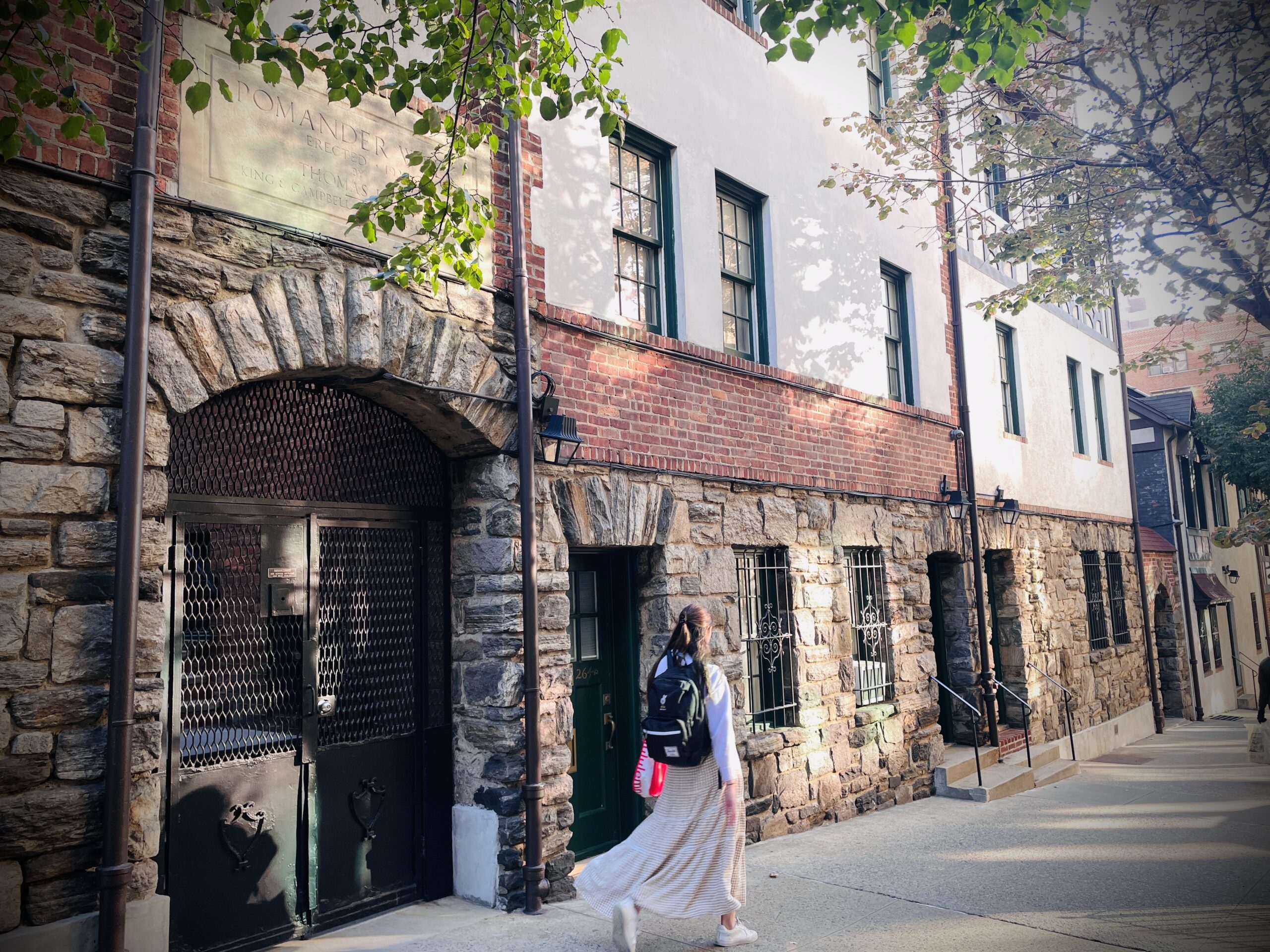
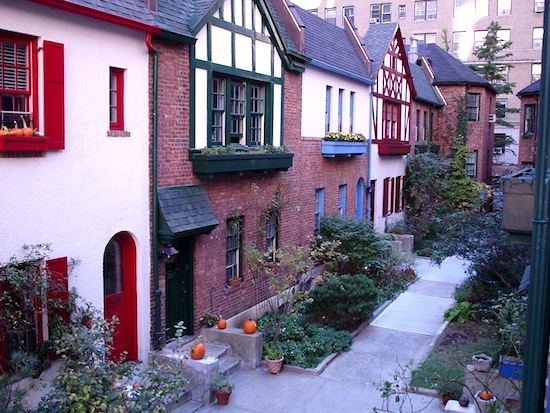
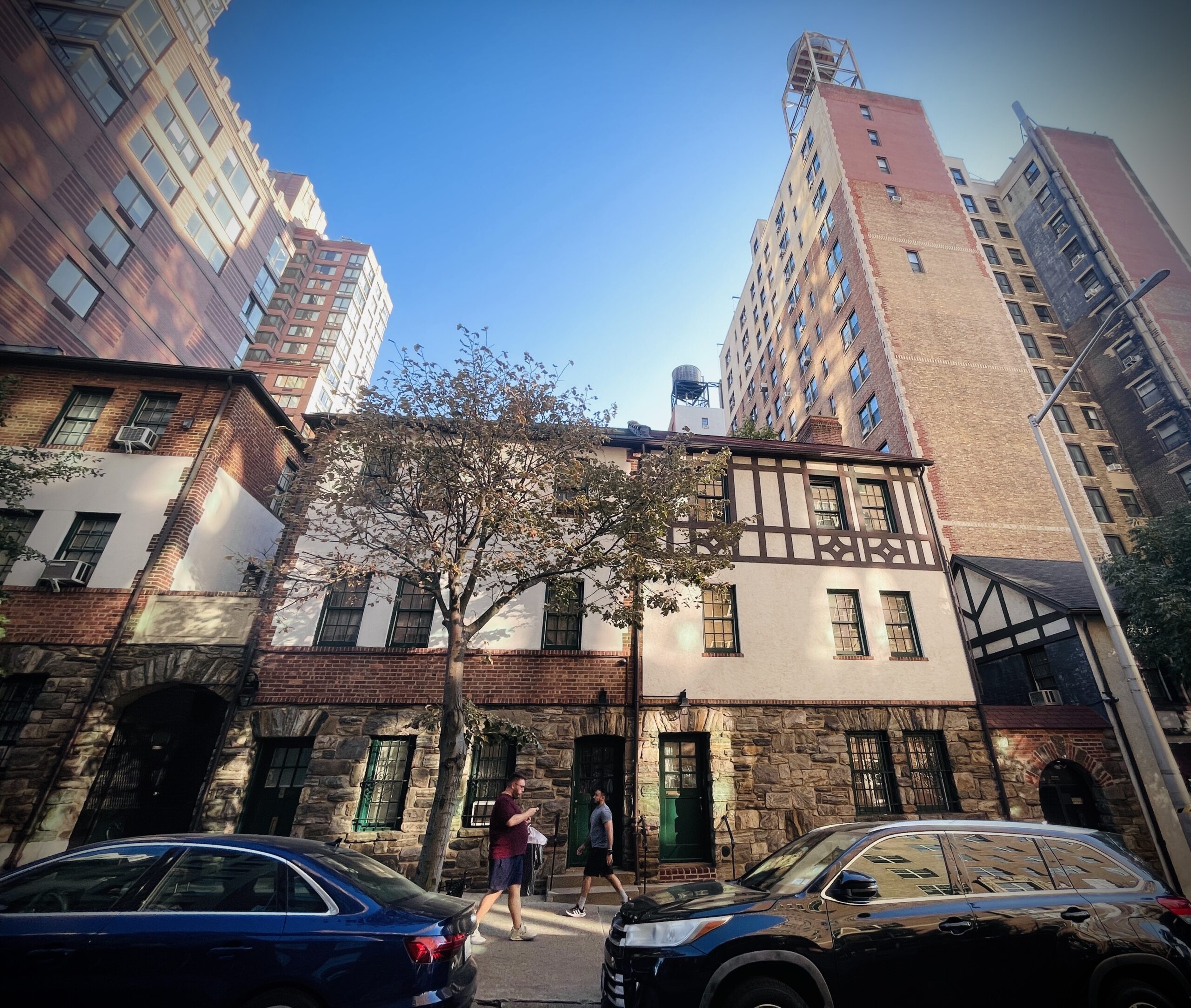
There are more of these cute cottages as you walk up 95th toward Broadway. But as magical as they seem, they’re just the prelude. Tucked behind a gate between Broadway and West End hides the heart of Pomander Walk. Unless you’re one of its fairy-world residents, you can’t enter, but, through the gate, you can catch a glimpse of sixteen dollhouses, eight on each side, lining a narrow walkway.
It doesn’t look like full-sized Upper West Siders could possibly live in there. But they do. They go in and out of their red, blue, and green doors, tend to tiny gardens, trim miniature hedges, and live a picturesque dream. The courtyard looks exactly like a stage set—and like nothing much happens here, repeatedly. How could there be drama on Pomander Walk? No villain could be villaining behind those adorable windows. How the residents handle the culture shock of stepping out into Broadway, 2025? I’d love to know.
Funny thing is, this storybook lane was never meant to be the story—just the intermission. Pomander Walk was only ever supposed to be a brief set piece while the real production was being staged. Healy had bought the plot with big dreams of building a high-rise hotel, but he wasn’t financially ready. So he built little Pomander Walk—easy to raze when its time was up—as a temporary way to generate some income in the meantime. As a lucky twist in the fairy tale (for everyone but Healy), he died in 1927, and Pomander Walk lived on. If that’s even the right way to put it, since it seems very clear that no time at all has passed behind those gates.
 The enclave survived multiple redevelopment attempts, a rejected landmark status in 1966, and near-collapse in the 1970s, until it was finally saved for good. This weekend actually marks its moment of recognition: on September 14th, 1982, Pomander Walk was added to the National Register of Historic Places, and in the same year, after years of advocacy by locals and residents, it was also officially declared a New York City landmark.
That’s worth celebrating. Because while our city is obsessed with dramatic arcs into the future, Pomander Walk reminds us that the best things can happen when grand ambitions fall through, that small dreams can outshine big ones, and that maybe it’s not so foolish to believe in miracles. Sure, they often get bulldozed by reality. But every now and then, a fairy tale gets away with it.
Maybe more than anything, Pomander Walk reminds us that even in the most chaotic times and places, there’s still room for stillness—if only the idea of it. We can’t all live on Pomander Walk, but we all deserve regular escapes to a place where the plot pauses for a while. No news, no drama. Just a charming tale where nothing much happens, repeatedly. I should probably tell you now how to find that place. But I have no idea. I wish I had a quiet miniature garden in front of a fairy-tale cottage to ponder it. People of Pomander Walk—if you’re reading this—I’d bring cookies.
* * *
Yvonne Vávra is a magazine writer and author of the German book 111 Gründe New York zu lieben (111 Reasons to Love New York). Born a Berliner but an aspiring Upper West Sider since the 1990s (thanks, Nora Ephron), she came to New York in 2010 and seven years later made her Upper West Side dreams come true. She’s been obsessively walking the neighborhood ever since.
Subscribe to West Side Rag’s FREE email newsletter here. And you can Support the Rag here.



I always wanted to live there, just for that ambiance. But then I grew up and realized that I can create that ambiance wherever I am: It’s a chosen mindset. Funny, then, how few people choose it for themselves.
I would bring a bottle of wine. I absolutely LOVE those houses! Walk by there as often as I can and always wish I could visit the inside.
When I was a child Pomander Walk was an open street. We regularly cut through just to enjoy the unexpected atmosphere.
Now the public is kept out, though. Of course.
Is it an HOA?
A delightful Saturday morning read
Lovely piece! One fun addition: Pomander Walk features prominently in Emma Straub’s novel “This Time Tomorrow.” A fun read with lots of local flavor.
Beautifully written piece. I would love the addition of who lives there (not names but professions, couples, singles, old, young, etc), and how they obtained residency. Are these little pieces of beauty handed down from generation to generation? I passed it many times and one wants to keep going back to have a peek. It’s so charming…
They come up for sale from time to time. It’s a co-op complex.
https://streeteasy.com/building/pomander-walk
I had to see if I could fine some interior shots.
Enjoy!
https://www.6sqft.com/this-2-2m-tudor-home-is-part-of-the-upper-west-sides-hidden-pomander-walk/
Wonderful story Yvonne…they’re one of the best parts of the UWS Rag. I loved peering into that little enclave when I lived on the UWS before retiring out of the city.
Before The Salvation Army moved us, my apartment in the Williams Residence for Seniors looked out on Pomander Walk. I have some lovely photographs of the little houses covered in snow. However, I was told that the houses are dark and cramped inside. Pretty, but not very practical.
You are right!
Lovely piece, as always! I live across the street from Pomander, and have had occasion to visit a few apartments on the rare occasion when they’ve been up for grabs. Fairy-tale-like as they appear, the reality suggests that these are very (as in overly) cramped gems. The charm factor remains through the roof, though. The 90s (and above) have taken a serious nosedive in the last half decade or so, but it’s comforting to know this place will remain un-bulldozed, a quiet nook.
More history: Lillian Gish and Rosalind Russell were residents once upon a time, and it is rumored that Humphrey Bogart was, too.
Humphrey Bogart lived at 245 West 103rd street.
The people we know who used to live in one of the end houses moved out after the homeless shelter opened a block away and they were getting drunks passing out and urinating on their front door several times a month. There were times they called 911 to help people who were incapacitated and another time they put a guy in a cab and paid the cabbie to take him home. They finally had enough.
Yes, and most notorious one, 316 W. 95th has reopened with NO community input.
Thank you for this story! Nice to have this picturesque escape in our neighborhood.
I lived on WEA and 94th Street for years and saw Pomander Walk every day..and it is very charming. When I got married we looking for a larger apartment and a house was available on Pomander Walk. I couldn’t believe my luck. But the house was so small, it would not have worket out for us.
Anyone else remember Pomander Books? It was easy to blink and miss it.
Yes! I was checking to see whether any comment mentioned it. I bought a Latin text of Livy, printed in France, at that shop. I think the owner was named Carlos. I think he passed years ago. He was always very courteous and knowledgeable.
Glad to hear someone else recalls the sliver. I found, among other treasures, a 1st-edition of “Tiger! Tiger!” there one fine day. It was around from 1975 to ~1986, I believe.
I lived around the corner from Pomander Walk for about 6 years and passed by every day with a mixture of envy and enjoyment.
I so enjoy your columns! They’re not only filled with fascinating information, and they perfectly crystalize what makes the UWS unique and magical. Perhaps most importantly, you’re just such a vivid, imaginative, and eloquent writer. I hope that you’ll someday compile these UWS columns into book form.
Pomander Walk appears briefly in “Hannah and Her Sisters”
Thank God for preservation and those who work hard preserving so many fantastic places.
So these cramped small apartments were built with the intent to be temporary? How are they deserving of the National Register of Historic Places / landmark status?
Everything is temporary and temporary doesn’t mean low value.
From the comments – it sounds like cramped dark apartments with mentally ill homeless and drunks urinating and passing out… is no fairytale. This is a fantasy piece. Why no asking the people who live there what it’s like?
The end houses are bigger and brighter but an old door is the only thing separating your kitchen from the sidewalk. There was another side door that went out to the walk which is beautiful.
You seem to have taken two comments as gospel, but in my experience word of mouth is not the best, most reliable way to inform oneself, and certainly not infallible. More broadly, due to the way US and NYC choose to exist, without the safety net of public healthcare that exists in other wealthy democracies, there are “mentally ill homeless” everywhere. If you want to pretend they simply don’t exist living in a gated community someplace is probably ideal for you, though even then I’d think you’d leave it from time to time.
It is one of the best ‘get-their-reaction’ spots to take visitors to the neighborhood. I often plan a little walk to Riverside Park, and take guests down through 95th Street, just to see their awed reaction to the totally unexpected slice of City they never knew existed. It’s fun! Never been in proper (Pomander neighbors – I’ll bring cheesecake or apple pie ‘from scratch’ to supplement the cookies!), but love the vibe nonetheless. Here’s to the never ending surprises of NYC.
Thank you, a sweet read, so well written, thank you!
My brother and his wife looked at a tiny house on Pomander Walk, and invited me to come with them! It was utterly charming–I would have bought it in a minute. The interior was bright with lots of historic touches. But my brother is 6’3″, they had a big dog, and were planning to have children. Sigh. It was such a treat to go in there!
Yvonne, please bring ginger cookies. I’ll make tea!
During the 1980’s I was lucky enough to do carpentry in three of those houses. All the work involved creating storage spaces within each house. Since the housing was temporary there were minimal foundations and no basements. One young couple had me build overhead storage in their hallway for their off season clothes. One resident wanted a closet built into her bedroom for dresses and another wanted a multipurpose builtin bookcase. All pretty typical Westside concerns. It was charming inside the close but not safe in those days. The very nice super acted as guard. People sometimes climbed over the roof! But 94th was pretty rough in the 80s.
The street should be open to the public. How are they allowed to keep it closed?
Philadelphia has a few of these developments, too.