
By Leonora Desar
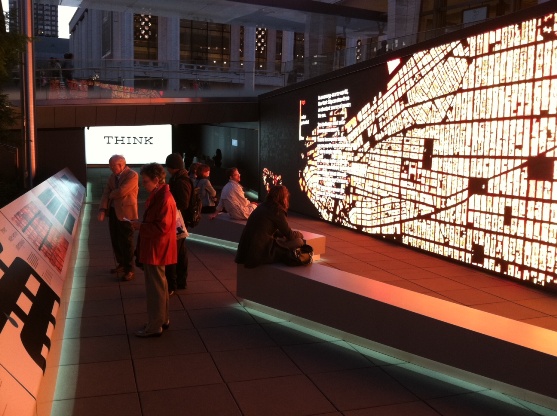
Against the night sky the colossal wall seems almost limitless. It emanates a pale radiance from within, eclipsing all other nearby light sources. Tiny particles begin to dance across its surface like a constellation of winking stars. Text slowly appears, taking shape across the screen:
“Each year in NYC fine particle pollution causes more than 300 deaths…”
The wall, in spite of appearances, is not part of a planetarium or some new, futuristic art installation but our introduction to I.B.M.’s “Think” exhibit, a celebration of I.B.M.’s centennial anniversary located on Jaffe Drive in Lincoln Center (the roadway that goes under the entrance to Lincoln Center’s main plaza). Composed of LED tiles weighing over 37,800 pounds, the data wall reaches 11 feet high and stretches 123 feet long before receding into the bowels of Lincoln Center. The wall streams data in real time, in part from nearby sensors, turning the natural world surrounding the exhibit — from the quality of air on Broadway to traffic congestion — into brightly lit data points. The wall’s resplendence transfixes the eye as patterns emerge, flashing across its endless expanse and then into undulating waves, perishing in its own pixelated dust only to reemerge again, reborn into something else entirely.

Inside the main exhibit lies a darkened theater lined by mirrored walls, a narrow border of pale, white light framing the room with an almost eerie glow. Forty plasma media panels reaching just over seven feet high fill the room with the same image of eternal sunset, frozen in time. But slowly, the images shift. Forty suns begin to set in a dying sky that fades to charcoal gray, then black. A female voice fills the room:
“From the beginning we sought to improve the way we live…”
The narration takes us through a 12 minute film which explores, in line with the fundamental theme of the exhibit, how “the world works and how to make it work better” by highlighting how society has become more effective through science and technology.
“We sought to make the world more productive…”
The panels flash images that launch the viewer on a trajectory of advancement, from the typewriter to a rocket ship as it shatters through the silence of unexplored space. Visuals of falling grains of rice are accompanied by an explanation of how scientists, with the use of I.B.M. technology, were able to map the rice genome and make more resilient crops.
“This is a pattern of progress…”
After the film concludes the panels transform into interactive touch screens resembling gigantic iPhones, enabling visitors to learn about the role technology takes in promoting progress. Visitors exit along an upward slope flanked by a wall of achievement illustrating I.B.M.’s own advancement. The wall showcases I.B.M.’s icons of progress, each crowned by the I.B.M. logo and a synopsis of a major corporate milestone, from its position as a leader in environmental responsibility to its pioneering role in securing online transactions.
What is the point of all of this? According to Lee Green, the event’s producer, the objective is to “intrigue and inspire.” Visitors are left with a sense of I.B.M.’s contributions to society, as detailed by its achievement wall, the recital of the 12-minute film and a multitude of signage and imagery, all of which come together to fix I.B.M. as the protagonist in its own heroic journey.
Where I.B.M falls short of its own objective can be gleaned through its juxtaposition with its surroundings, where its presence creates a dichotomy. Lincoln Center itself, with its historical sweep of performance art, foils the apparent intentions of the I.B.M. exhibit. Lincoln Center’s works conjure awe – or fail to conjure awe – by evoking our emotions, illustrating what humanity is capable of through direct illustration, and by appealing to the senses. They speak for themselves rather than trying to explain what the point is. And whether they are good or bad art they are still art, as opposed to corporate messaging, or glittering spectacle, dressed up in art’s guise.
“Think,” in spite of some visually arresting features, is experienced mostly as didactic telling rather than as immersive showing, a public relations display that defines its own chest-beating in vague terms. What, exactly, does making the world “better” mean? How are “progress” and “improvement” measured? What does “efficiency” look like in this context other than as a subtly dystopian infusion of Brave New World flavor?
Ultimately, I.B.M.’s “Think,” instead of acting as an impetus to achieve enlightenment, leaves us scratching our heads, a bit befuddled, and questioning why we don’t care more.
“Think” will be on display through October 23 at Lincoln Center; lincolncenter.org.
Photos by Avi