

By Scott Etkin
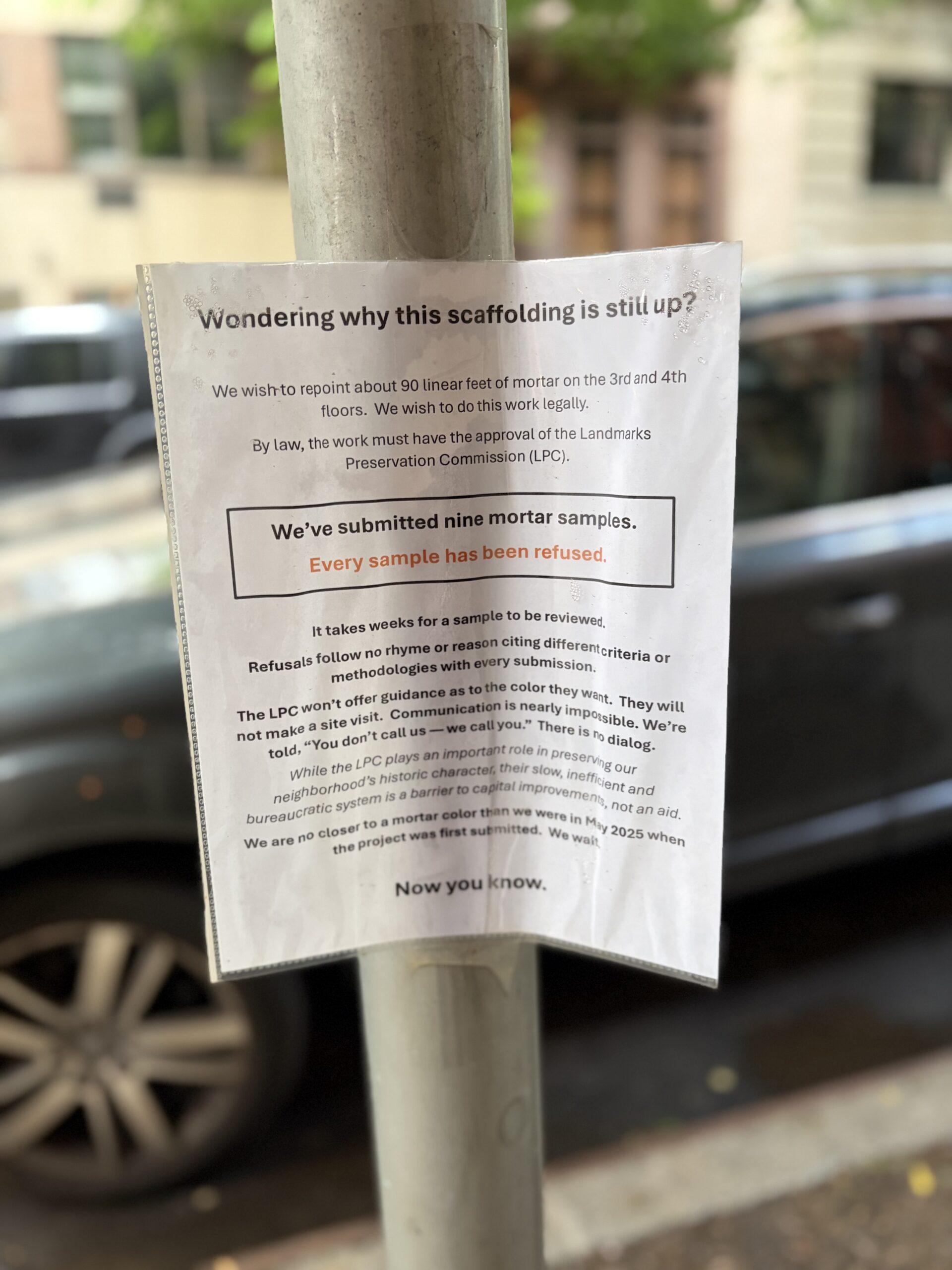
A notice posted on a sidewalk shed outside an apartment building on West 71st Street recently offered a public, and startlingly frank, attempt to explain why a network of poles, boards, and netting are masking the building’s facade.
For the past year, according to the notice, the building – between Central Park West and Columbus Avenue – has sought the NYC Landmarks Preservation Commission’s (LPC) approval to repoint 90 linear feet of mortar on the third and fourth floor facades.
“We’ve submitted nine mortar samples. Every sample has been refused,” without suggestions from the commission, according to the unsigned notice. “While the LPC plays an important role in preserving our neighborhood’s historic character, their slow, inefficient and bureaucratic system is a barrier to capital improvements, not an aid.”
Asked about the notice, a spokesperson from the LPC told the Rag that it strives to make its review process as “efficient and seamless as possible for applicants, but we are aware that in a small number of cases, the process has been overly long.” The LPC’s records show that the commission provided feedback on the applicant’s samples, first issuing a permit for minor work on the West 71st Street building in November 2025 and approving the final material sample submission on June 10th.
The commission also told the Rag that it is making changes to its processes to speed up reviews. Still, the notice on West 71st Street, with its harsh description about its interaction with the commission, is a message that likely resonates with frustrated board officers at some other historic buildings on the Upper West Side. The neighborhood’s brownstones and prewar apartment buildings are iconic, instantly recognizable in countless TV shows and movies like “You’ve Got Mail.” But these aging, often ornate structures, can be a headache to maintain – especially when it comes to complying with the city’s requirement to have repairs closely match the structure’s original colors and design.
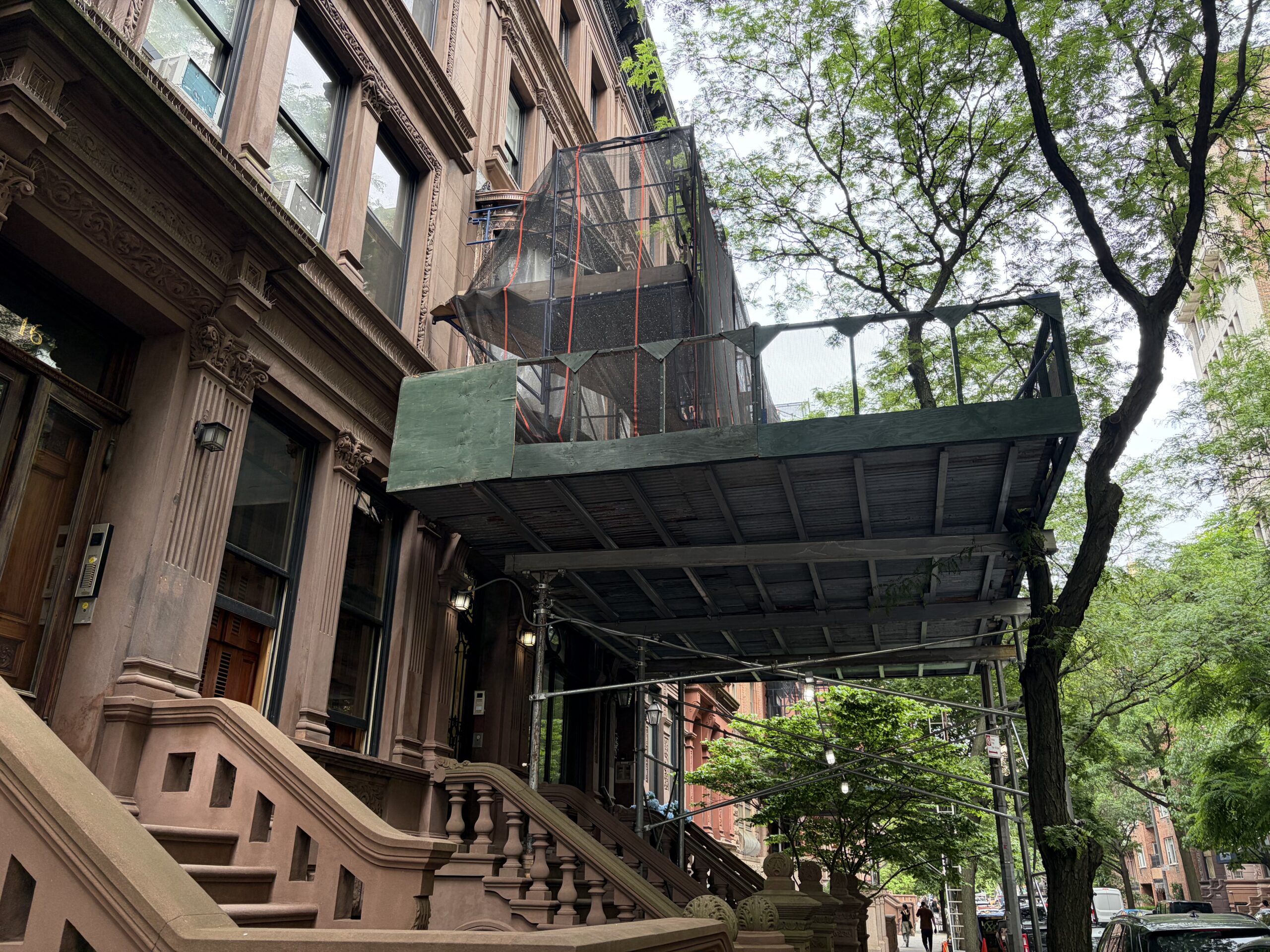
As described in last month’s UWS Shed Watch column, the NYC Department of Buildings (DOB) mandates that buildings must undergo a facade inspection every five years. If the inspection finds unsafe conditions, the property owner must put up a shed, often with scaffolding on top, to protect people below.
The Upper West Side’s historic buildings are particularly vulnerable to failed inspections, which may help explain why the UWS has the third-highest number of scaffolding permits of any neighborhood in New York City. Ironically, the same characteristics that make the Upper West Side buildings desirable – the distinctive facade designs made of relatively fragile materials like terra cotta and brownstone – are the same reasons why these buildings are often wrapped in scaffolding.
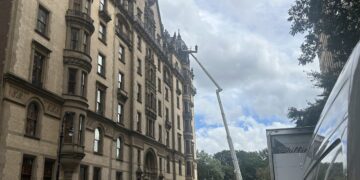
Once a building makes the necessary repairs, it must get sign-off from the DOB to take down its shed. If the building is individually landmarked, such as the famous Dakota apartment building on West 72nd Street, or located in a historic district, it must also get approval on its repairs from the LPC, according to the city’s Landmarks Law. This extra oversight comes with stricter standards for ensuring that the repairs match the property’s original designs and materials.
The LPC and its earlier iterations have been part of the city government for seven decades. Its formation, and the city’s Landmarks Law, followed a backlash to the demolition of the original Pennsylvania Station in 1963. Since then, the commission has designated as “historic” more than 38,000 buildings and sites (NYC has approximately 1 million buildings in total).
If you live on the Upper West Side, there’s a decent chance that you live in a historic district. There are a half-dozen Historic Districts on the UWS – ranging from the very small (West 71st Street Historic District and Manhattan Avenue Historic District together make up less than four blocks) – to the very large; altogether, these districts cover approximately 25% of the area of the neighborhood.
Two of the big historic districts on the UWS are the Riverside-West End Historic District, which spans from West 79th to 108th street along those two avenues. The Upper West Side/Central Park West Historic District is about as long, bordering from West 63rd to 96th street, primarily along Central Park West.
Several of the neighborhood’s historic districts were originally established in the 1980s and early 1990s. Some have continued to grow in scope more recently: The Riverside-West End Historic District was expanded twice in 2012 and 2015, and the West End-Collegiate Church Historic District was expanded in 2013.
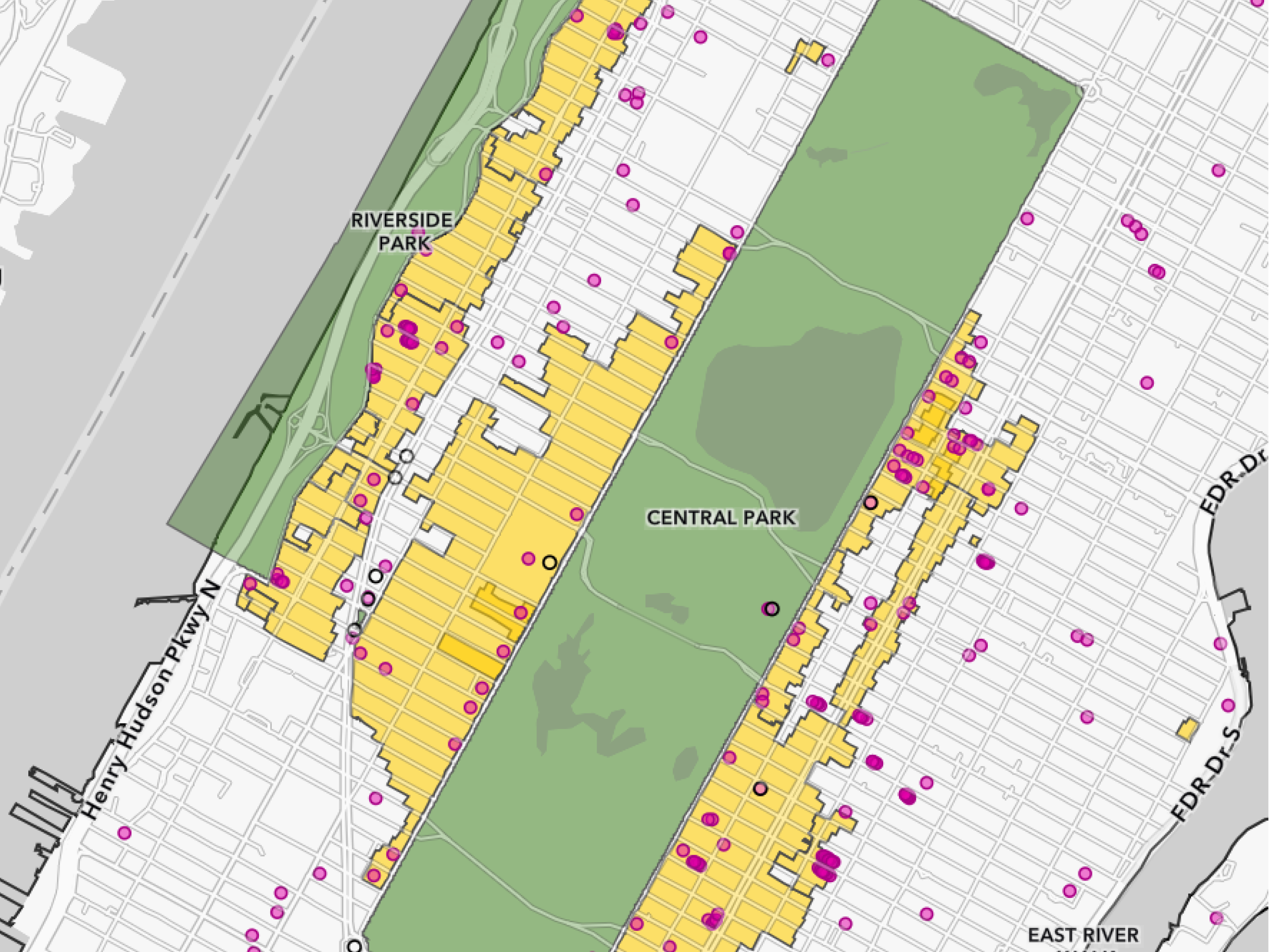
A disproportionate number of the Upper West Side’s sidewalk sheds are concentrated in historic districts. Comparing the city’s registry of sidewalk shed permits (as of June 19th) and a map of its historic districts shows that 41% of the Upper West Side’s sidewalk sheds are located in historic districts, despite the fact that historic districts make up just 25% of the neighborhood.
Permits for sidewalk sheds outside of historic districts have an average age of 636 days, which is older than the average age of those inside historic districts (548 days). However, shed permits that are more than five years old are equally split inside and outside the historic districts, with nine each.
Longtime residents of the neighborhood might remember in 2017 when the neighborhood’s latest historic district was created, or even live in buildings that were incorporated into new historic zones. The latter is the case for a UWS resident who spoke to the Rag, and asked to remain anonymous, who has been on her co-op board for three decades and now serves as its president.
“For years, being on the board wasn’t a lot of time or effort,” she said. That changed when a facade inspection in 2021 revealed the need for repairs. The resulting project took nearly four years and cost $3.8 million, or approximately $80,000 per apartment. This cost was around four times greater than first estimates; initial construction work revealed the need for greater repairs. The cost was partially covered by the building’s existing reserves, but the rest was paid for by the building’s apartment owners through an approximately 75% increase to their monthly maintenance fees. The increased assessments were paid for two and a quarter years.
While the project took longer than expected, “it was not because we were malingering,” said the board president, who coordinated with an engineering firm, construction firm, and the building’s managing agent to complete the work, in addition to fielding the many complaints from residents about the project.
One cause for delay was the fact that there are only two main firms that can supply many terra cotta elements to buildings in New York City. And, as with many things in the city, there’s a long queue to purchase their products.
Then there was a seasonal delay; construction slows between December and March, due, for one thing, to the fact that concrete requires warmer temperatures to set properly.
The project was also slowed by the back-and-forth with the Landmarks Preservation Commission to get approval for the materials being used. Multiple color samples for terra cotta, limestone, brick, and grout had to be provided before approval was given, according to the board president.
The LPC’s regulation is largely the same for both individual landmarks and buildings inside a historic district. When a building submits an application for changes to the exterior, the LPC determines whether the proposed work meets LPC rules for a staff-level permit, in which case the application can be approved by an LPC staff preservationist and a permit issued. Most staff-level permits are approved within 10 days of the application being completed.
In cases not involving a staff-level permit, the applicant may present their proposal to the commission at a public hearing, which are held two or three times per month. During the public hearing, the commission discusses the proposal and either makes a decision at that time, or at a later public meeting if significant revisions to the proposal are required.
Applicants seeking permit approval via an LPC public hearing are required to first present their proposal to the local community board. Community Board 7’s preservation committee meets once per month, and its decisions are then voted on by the full board the following month.
At LPC public hearings, a frequent source of input are representatives from Landmark West, a preservation group on the Upper West Side. Sean Khorsandi, the nonprofit’s executive director, said on a call with the Rag that he doesn’t have an adverse reaction to scaffolding because it “usually tells me someone’s paying attention to something.”
He likened scaffolding to having your leg in a cast – a necessary part of the healing process.
“With preservation, everything’s about the long game,” he said. “So if we don’t get to appreciate the building now, the whole point is that future generations can.”
Thanks to data scientist Robert Adelson for his help analyzing the historic district and shed permit maps.
Preview of New Sidewalk Shed Designs
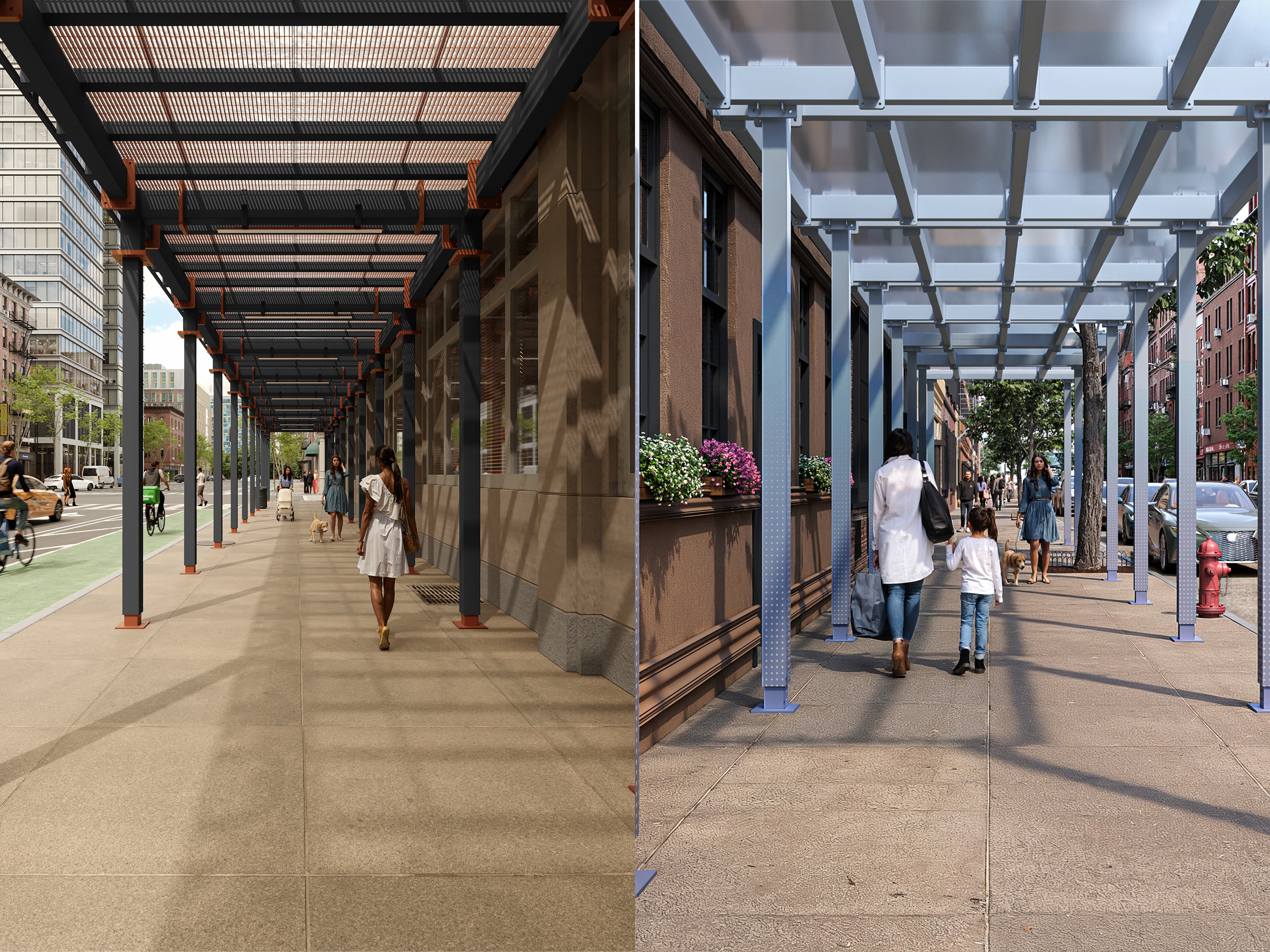
Would sidewalk sheds be easier to stomach if they allowed for more light and space below? Shed enthusiasts willing to take a trip downtown can check out two new sidewalk shed designs that aim to accomplish this goal.
The two new scaffolding designs (known as the “Flex Shed” and the “Rigid Shed”) are both designed by the firm Arup and are installed for viewing in front of the DOB’s headquarters near City Hall until July 10th. The schematics for these sheds and four other new designs are being codified by the agency’s rulemaking process, with the intention of being made available for the city’s property owners to use.
Additional information about the designs is available – HERE.
Read more:
- UWS Shed Watch: A New Monthly Column from West Side Rag
- UWS Shed Watch: Many Sidewalk Sheds Are There for Mandatory Facade Inspections — Could That Change?
Subscribe to West Side Rag’s FREE email newsletter here. And you can Support the Rag here.



Please start fining buildings for sheds up more than six months.
Did you read the article?
Of course not. Saw headline – made a bee line to the comment section to vent
Seriously? That’s your response to an article that details how bureaucratic delays by the city cause sheds to be up for so long? It would make more sense to fine the city for any delays it causes, with the money payable to the building owners to compensate them for the expense of maintaining the sheds.
Very informative article.
A quibble: WSR’s linked article about Local Law 11 points out that the five-year cycle applies to buildings over six stories. That detail could have been stated in this article, since not everyone will click on the link to the earlier article.
What has happened with efforts by politicians like Mark Levine and Keith Powers to get the five-year cycle in Local Law 11 lengthened? I thought that the DOB was supposed to submit a study about this by December of 2025. Anyone know where that stands?
There are “shed enthusiasts” amongst us? I guess it takes all types.
Well, there is the famous modern composer, Arthur “Two Sheds” Jackson.
That’s a very well-written thoughtful article full of rich detail. Here’s the short version: one vested interest pays another vested interest to perpetuate a superfluous, bureaucratic industry, which keeps them both perpetually and gainfully employed. Their PR departments do most of the clean up. Rents climb steadily at 5% per year.
Agreed. This is the type of nonsense that needs to be addressed by any politician who claims to be interested in controlling rents. No wonder it’s so expensive to build, renovate or simply maintain a building n NYC (well, this is one of many reasons…)
I lived in Istanbul for 4 years. Nary a shed. When one was necessitated it went up the work was done and the shed came down. Local Law 11 is a travesty at every level. The buildings where absolutely no work has been done for years after a shed has gone up are a disgrace. While not on the UWS the iconic Plaza hotel has had a shed for years. Local Law 11 needs to be nuked and totally revamped.
“No way to prevent this,” says only city where this regularly happens.
In the case of the building I live in – The shed was put up and the repairs were immediately done. The post repair inspection was approved and it still took the city 4 months to shuffle the papers around and allow the scaffolding to come down.
The LPC, likely the most useless organization ever to befell this City, needs to be disbanded ASAP.
Anyone who plans on succeeding Gale Brewer needs to be asked whether historic district landmarking is good or bad for the UWS and whether they would support removing parts of the UWS from the historic district to build enough housing to curb gentrification elsewhere?
If you live in a building where your finances are seriously decreased by the insane rules of the LPC, as I do, you would understand the frustration of dealing with this elitist and inefficient group. As a retired individual on a fixed income, the LPC has made living in my building a financial burden because we have to maintain exacting terra cotta decorations on the building’s 15th floor that nobody can see unless they happen to be standing in the street with high powered binoculars or they send up a drone. And who would be that interested? It’s one thing to preserve Grand Central Terminal from the greedy real estate developers but another to burden NYC residents with ridiculous, costly repairs. But that’s what the LPC does now.
Precisely. It is impossible for me to save. I save a little each month then every 5 years I get a bill for my apartment alone for tens of thousands for facade repair. How am I supposed to save? This is on top of the thousands I pay per month for mortgage, and $2k for maintenance. It’s a small, old, crummy two bed on a now cess pit of a street. This apartment will one day bankrupt me but to sell it I’d lose so much, I’m told by brokers it’s now worth $300k less than what I paid for it 11 years ago.
Which candidate for elected office on the UWS would publicly urge Governor Hochul to override historic district landmarking for more housing? So many people who live uptown want to live on the UWS but cannot. The COVID rental market on the UWS was an example of this. So many moved in from elsewhere.
Stop letting this racket compromise residents’ quality of life concerns. Get rid of cars. Get rid of sheds. Most of the chain restaurants and stores. Repair sidewalks.
Please change this law to at least a minimum of ten-year cycles. and budlings over ten stories.
Just on a hopeful note, it’s below the UWS of course, but the scaffolding/shed just came down on the fountain and public plaza outside the Plaza Hotel and it looks incredible! I had completely forgotten what that space looked like before becoming a yearslong construction zone
Nyc used to be a temperate climate. It is now subtropical. More moisture, more salt in the air. How does this impact stone?
Great thorough column. Keep it up. Thank you
The level of research done for this article is outstanding. Thank you!
I live in a 6-story tenement in the West 80s in a landmarked district. When my landlord needed to make repairs to the parapet, she had a shed and scaffolding put up. Her contractors completed the work in a timely manner. But it took the LPC over a YEAR PLUS to get an inspector to approve the work.
So sometimes it is not the landlord’s fault that sheds or scaffolding stay up “too long.” It is the incompetency of the City agencies tasked with approving the work (and LPC is the worst). As an aside, this delay unnecessarily cost my landlord tens of thousands of dollars to keep the shed and scaffolding up for the extra (unnecessary) time.
The LPC rules can be onerous and their decisions capricious, but as a coop owner in an UWS historic district I support their purpose.
However, private property owners are compelled to provide a public good in maintaining these buildings which is often beyond many coop owners resources.
There are a few grants available but these are insufficient to meet the need.
An equitable solution would be to offset these costs with an equivalent reduction in property tax.
I have raised this idea with my city council member and there has been some interest.
Please push the idea.
The LPC process is so inane it would be funny if it weren’t bankrupting small coops. We had a shed up for more than 3 years while they denied brick after brick, mortar samples galore and insisted on a terra cotta replacement. I still don’t even know where it is and I’m on the board. Maybe when there are no leaves on the trees and you go across the street with binoculars you can find it. We were unable to get permission for 50 bricks because they didn’t match the other 125 year old bricks which are no longer even made in that exact size. Not to mention that in the intervening century countless other bricks were used, so what exactly are we matching? Take a look at the Dakota and tell me how many different shades of brick you see. We had somewhat affordable housing until we spent 300k on cosmetic and useless repairs.
My frustration is buildings that are owned by either landlords who won’t pay for LL11 facade work or HFDC Coops that cannot afford to do the facade work. In those cases, the sidewalk sheds stay up indefinitely. I know of a couple of HFDC coops in my Morningside Heights neighborhood that have had sheds up for years with no likelihood of ever being able to afford the work, plus their facades are continuing to crumble even more as nothing is done. I wish the City had some kind of low-interest loan program so that these coops could get the work performed and take down the sheds.