

By Scott Etkin
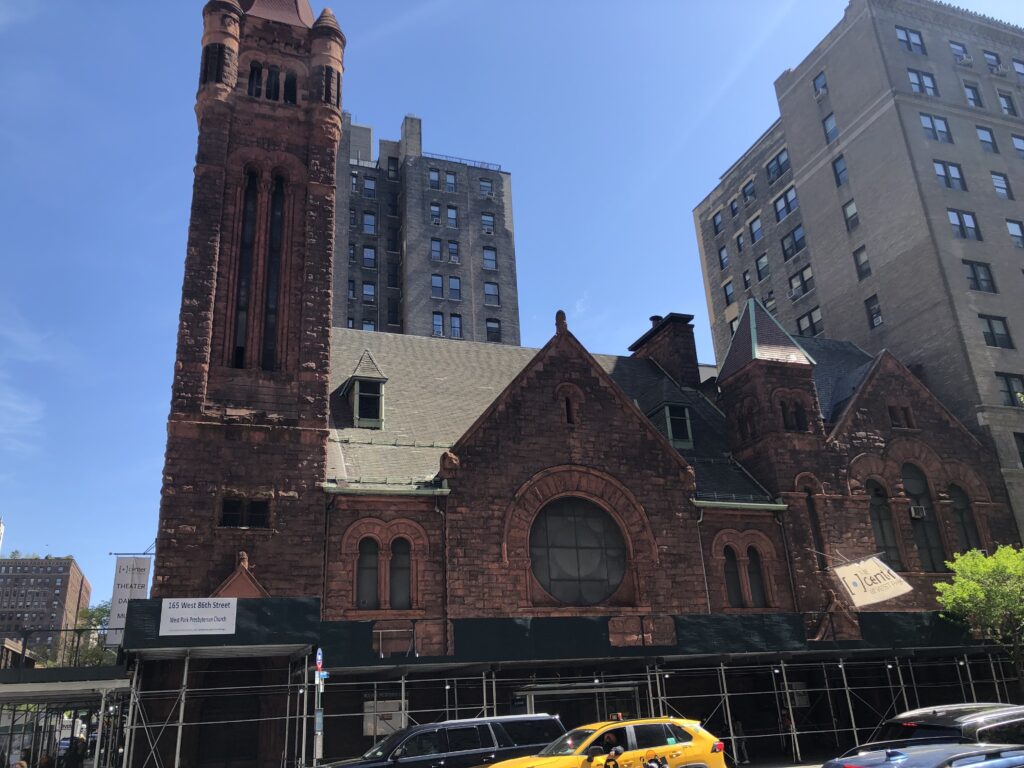
Several commissioners at a meeting of the Landmarks Preservation Commission (LPC) Tuesday suggested that West-Park Presbyterian on West 86th Street and Amsterdam Avenue likely meets the criteria for a hardship application that could allow the demolition of the church and a new development on the property.
The commission did not make any final decision, but several commissioners and LPC’s general counsel, Mark Silberman, indicated that they think the more than 130-year-old church does not have a viable way to pay for the extensive renovations needed to fix its facade or bring the interior up to code.
Over the past eight months, the LPC has held four meetings, including one five-hour session with testimony from the public, received extensive written testimony, and had analyses from three independent firms to review the financial standing of West-Park and the claims of the Center at West Park, the arts nonprofit that is trying to stop its demolition.
At the meeting on Tuesday, the LPC summarized these findings and discussed their implication on the four criteria needed for the commission to grant the church’s hardship application.
The first of the four requirements mandates there is a bona fide contract to sell the property contingent on hardship approval. West-Park has an agreement with Alchemy Properties, a real estate firm, which plans to build a residential building that includes a space for the congregation.
The second, and perhaps most complicated, question asks whether the property would be capable of earning a “reasonable return” (defined as 6% of its assessed value) going forward, primarily through rent and recurring income.
To make this determination, a test year (in this case, September 2024 to August 2025) was used to represent what West-Park can earn. Weitzman Associates, LPC’s real estate advisor, modeled several scenarios based on these numbers and found that none of them produced a 6% return.
The commission noted that while the church has received significant funding from the Center at West Park, which is a former tenant of the church, over the years, the Center relies on donations and grants, and therefore its income is highly variable. Typically, this kind of financial history would be scrutinized by landlords seeking to rent a property, according to LPC vice chair Angie Master.
The commission also spoke about the church’s Transferable Development Rights (TDRs), commonly known as “air rights”, that it could sell to other nearby properties as a source of revenue. While West-Park has TDRs that could be worth in the millions of dollars if sold, the practical matter is that there are no large-scale potential buyers of the rights in the neighborhood for the foreseeable future.
The third criterion focuses on whether the building is still suitable for the owner’s purposes. While the commission appeared in agreement that the structure is physically usable for worship, community services, and arts programming, the sticking point comes in determining whether the cost of maintaining the building prevents or seriously interferes with the congregation’s purposes.
Estimates vary on the cost of making repairs to the facade and bringing the interior up to code. The recent offer by the Center at West Park to enter a new $7.2 million lease agreement with the church would go a long way toward covering these costs. But some commissioners were skeptical such a deal would come about.
“[The Center at Park West] is proposing to pay a rent that is 24 times higher than the $30,000 it was previously paying [to West-Park],” said LPC chair Lisa Kersavage. “As we understand the Center’s finances, it doesn’t have much more than the cash on hand. The rest are pledges […] The church is entitled to look at the creditworthiness and track record of the Center, and conclude it’s not an organization with which it would be reasonable or prudent to enter into a tenure relationship with.”
The fourth criterion has to do with the purchaser’s good‑faith intent to demolish the existing structure immediately and build the new one promptly. Alchemy has a demolition contract, a contract with an architect, and a preliminary design for a new building already in hand, though the Center has objected that this criterion is not met because the church has not yet obtained court approval of the sale contract and Alchemy has not yet filed applications for demolition or the new building with the Department of Buildings.
Silberman, LPC’s general counsel, said that it would be unreasonable to require the church to obtain court approval of a contract before it knows whether a hardship will be granted.
At the outset of the meeting, Lisa Kersavage, chair of the LPC, said that their discussion would focus only on the building’s financial outlook, not its architectural or cultural importance, of which there is no doubt. “The commission isn’t considering de-designation or anything related to the church’s significance. None of that is at issue,” she said. “In fact, the demolition of the building is inherently inappropriate, and that is why this is being considered under the hardship provision.”
Hardship exemptions to allow the demolition of architecturally important buildings are rare. The LPC has granted slightly more than half of the 23 hardship applications that have been filed since the city’s landmarks law was adopted 60 years ago, Kersavage said in her opening remarks.
The LPC’s next step is to draft a determination, which will be circulated among the commissioners. No date was mentioned during Tuesday’s meeting about a final vote on granting the hardship. But Councilmember Gale Brewer’s newsletter mentioned that the vote will take place on Tuesday, August 18.
To watch a recording of the LPC’s meeting, click – HERE. The discussion begins at the 17:00 mark.
Read More:
- Process Begins to Determine Fate of Upper West Side Landmark Church
- UWS Community Board Committee Votes Not to Support Hardship Application for West-Park Church
- UWS Community Board Makes Its Official Recommendation on Fate of 135-Year-Old Church
- West-Park Presbyterian Makes Its Case to Demolish the UWS Church So its Mission Can Continue
- UWS Arts Center Offers $7.2M Lease Proposal in Effort to Stop Demolition of West Park Presbyterian Church
Subscribe to West Side Rag’s FREE email newsletter here. And you can Support the Rag here.



The applicant and the LPC’s consultant did not include expected revenues from The Center at West Park in their fuzzy math about money the church can expect. Moreover, they used generic market-rate rental projections and not the larger amounts the Center is actually prepared to pay. The figures were cooked so that “hardship” appears the truth. Michael Goldblum, one of the commissioners on the LPC, pointed all this out.
The Center (and its celeb contingent) had been offering the same $5 million for repairs from Day 1, and had never increased that. All they did was offer more for a new lease (which was simply a manipulative roundabout way to try to get a new lease) at a higher per-month cost – but even THAT amount would have been peanuts compared to what is needed.
So no matter how one “does the math,” it would not have been enough to cover the actual costs of repair, which LPC’s own engineer estimated at a MINIMUM of $7-$9 million. (And that was just for BASIC repairs, and only EXTERNAL; not one penny for the interior, which is also falling apart.)
The wsr reporting here specifically quotes LPC members questioning the viability of the Center paying above market rent given how much cash they have on hand. That’s another way of cooking figures.
There is no “cooking the figures” The numbers used are from the tax etc fillings presented by accounts etc for both sides. If they were cooked, as you say, they would be different from their tax and NYS/NYC Charity Beaeru filings taht all Nonprofits are required to submit each year.
I don’t trust the trustees. They may have financial incentives from the buyer to get the building torn down.
It would be great to see it torn down. Not every old building is worth saving.
Of course not. But the trend here fis for deelopers to prevail, no matter what the virtues of preservation would offer for the future. Rome has a long and complex history, One of the things that makes it worth viisiting is that although there is always new construction, there is also room to preserve pieces of every era within the city limits. A richness that New York seems unable to contemplate.
Why is it that Churches are being torn down and not mosques or synagogues.
Please give an example of a synagogue that should be torn down This church has been in physical shambles for decades. Blocked by activist politicians with no plan how to salvage it or realistically raise the money- literally a crumbling infrastructure.
Congregation Habonim on 66th Street was demolished to make way for the new residential building (with a new congregation space included as part of the construction).
Congregation Shaare Zedek on 93rd Street was also demolished to make way for a new residential building (and I believe a new congregation space is included in this construction as well).
That’s a pretty bold claim to make. Can you support this claim with any factual evidence?
It is not a claim at all. It is a possible scenario. We are talking about a large sum of money 30-million in control by a very small group of people. All kind of promises may have been made by the developers to get the project accepted.
This response demonstrates some ignorance around church governance; the proceeds go to the Presbyterian Church who owns the building, not the individual members of the congregation.
Thank God! (Both figuratively and literally.) This farce is finally going to end. And while the opposition “fought the good fight” (some for “legitimate” reasons; some not so much), the LPC apparently saw through the Center’s most recent “offer,” which was simply an attempt to get a new sublease while offering the same amount of “repair” money they had been offering since the beginning. And since they have a new, welcoming home at SP&SA, they no longer “need” West-Park.
Yes, even I, as one who has been on the side of the congregation and the Presbytery since the beginning, will be somewhat sad to see the building go. Not my favorite UWS landmark, but I do see its “charm” to others.
But it is clear that the LPC gave this issue more time than it deserved (creating the farce it became), but did so with good intentions and the authority they have.
I am thankful that they seem to have come to the right decision: to allow the congregation and the Presbytery to decide their own future at that location.
Please tear down this unsafe eye sore wrapped in scaffolding for over 25 years.
I’m sure that whatever replaces the old church will be beautiful, culturally relevant and an enrichment to our community.
It will have a use, which this building has not had for many years!
The sheer bloodlust people have for this 19th century architectural landmark is weird. It’s like you’re CRAVING to see it torn down. Only to be, what? Replaced by boring condos for the wealthy? Interesting values system there…
Agree. It has put on some terrific shows and has been used. It is a landmark. They will just jam more people into every space they could find with more high rise ugly boxes.
Don’t forget that the new building will include a significant amount of space for the church, including a sanctuary and lots of program space. So the congregation will have everything they need – in a building that is NOT in disrepair and falling apart. And this may even allow them to (finally) grow; no one wants to join a congregation and have services in a building that is falling apart.
I don’t particularly care about the church congregation per se. I care about the building as an architectural landmark and one of the rare things our neighborhood has from centuries ago. The city budget is bigger than that of several developed countries. Surely some money could be allocated to saving an interesting example of Romanesque architecture. It’s depressing how allegedly educated upper west siders really don’t care about history.
Thank you!
People living in “boring condos” pay taxes and contribute to the city.
Where is the money to repair and maintain this building coming from. The so called “arts center” has not been able to come up with it; Gale Brewer has not come up with it, none of the posters on here have come up with even close to what is required (as noted above). No one has come up with funds sufficient to save this church. and that is the operative word, “church.” A church is more than a building, it is a collection of believers with a mission to go out into the world and do good as best they can; the money from the sale of the building will enable them to continue their salutary mission in the neighborhood. However for the past several years they are being thwarted in their mission by people who wish to crush them down under a pile of red sandstone. In fact, one could question what the motives of those who wish to stop the congregation from doing good work and striving for social justice at the expense of maintaining a crumbling pile of stone? It would seem to me to be people with only the darkest of motives.
Repairing this building would be spare change in light of our gargantuan city budget. There’s just no political will to do it.
If the city gave them a penny it would be great to watch the regular bunch of self-appointed community leaders that would normally scream about separation of church and state, cashing a check to allow them to keep their very nice south and west apt views over teh church
It is a church; the government cannot give it money.
Everyone in this debate wants to save the church. To some people the church is a building. To others, the church is a community of believers. Which church should we save?
The one who is an amazing landmark.
The landmark law applies to buildings. It is the building that the law was designed to protect.
that is correct and the law also provides for a hardship exemption, which at a minimum, some of the LPC members seem to be indicating the Church has met.
I hope this is finally the end of this eyesore. The delay alone should be a scandal and a huge embarrassment for Brewer for her long term support of this charade
They will replace it with a real eyesore.
You cannot embarrass someone who has no shame.
In the spirit of progress….its time to tear it down and move forward. Learn from this and apply the learnings to future designations. Imagine what good use this space could become? Something that serves the needs of the community at large today? There have been other relics that didn’t survive the passage of time and financial mismanagement or disrepair. I’d rather see this as a green space vs eyesore it has been for decades. Tighten up the contracts and control for next time if you feel some people played the system and won this time. That’s life. Create a new tax to stick it to anyone profiting from the outcome if it makes you feel better. Move forward already.
Remember the old Penn Station. And the (admittedly limited ) glories of the original Schwab Mansion — especially compared to its replacement by a cookie-cutter mid-century modern pile o fb rick,
In both instances City of New York was offered or otherwise could have acquired either property, but declined. Same goes for also demolished Singer Building that once stood in FiDi.
Jackie Kennedy and her group knew this and worked on “saving” Grand Central Terminal on two fronts. Legal action forbidding development *and* getting a deep pocket entity to take the thing off Penn-Central’s hands.
It was the MTA taking out a 99 year lease (they’ve subsequently purchased GCT outright) that truly saved the place. Penn-Central didn’t have the money nor will to invest in that barn of a head house much less maintain the thing.
The old Penn Station so gorgeous with all those streams of light coming downwards from the top. Have a book out of print with photos of those lovely landmarks that just cannot be replaced or have the soul of the city like its original glory.
If you want or wanted to preserve West Park, the only way to realistically do it, was to allow transfer of air rights somewhere else in Council District 6. Nothing else was going to provide the funds needed to fix the building and provide for tis upkeep.
I don’t believe that option has been seriously considered.
Much easier to stall for years and keep it falling apart until there are no options but to end it and build something with no soul.
It is an interesting take, but the air rights are not West Park’s to transfer. West Park was a tenant in the building. Only the Church could sell the air rights above the building (and I don’t know the laws around the selling of air rights — I don’t know that you can transfer air rights other than to neighboring projects).
At the end of the day, you can’t force the Church to sell the air rights above the building and do we really want government telling people what they must transfer?
In cases of landmarked properties only air rights can make transfers across street say. Otherwise unused FAR can only be transferred to properties that touch each other.
That being said there isn’t anything being developed south, east or north across street from WPC that could use those unused FAR.
Best use of air rights for WPC is right where they are, over the church, That is why property is worth much as it is, and residents in buildings on either side with lot facing windows adjacent are fighting tooth and nail to prevent WPC from coming down.
Apologies for any confusion. By West Park I meant the Church which is named West Park Presbyterian. You would need a change to the law to allow this, but I suspect that could have been achieved over the more than 20 years this situation has lasted so far.
You should read the LPC analysis of the air rights. There really aren’t any parcels that would be appropriate to receive it. Ironically the few that would work are the co-op buildings next door whose members sit on the Board of Center at WP and have both opposed the church’s attempt 15 years ago for a solution and forced this designation that was doomed to fail in the first place.
Those co-op boards should have taken a leaf from buildings elsewhere in Manhattan and simply banded together and purchased WP property themselves. Then they would have full control of any future redevelopment that threatened their lot line views.
That of course would involve money, causing shareholders of both buildings to face increase maintenance fees in aid of financing such a deal. Far easier to browbeat a church congregation than get dozens of shareholders to agree upon self taxing themselves.
Several years ago a co-op in Chelsea purchased a low rise corner building from Extell to prevent it from being torn down and lot redeveloped into high rise housing.
I disagree. JUST the top five celebs who are supporting the Center – Mark Ruffalo, Matt Damon, Kevin Bacon, Scarlett Johansson and Matthew Broderick (and there are several others) – have a combined net worth of over $500 million. They could EASILY have raised the full ~$30 million to repair the ENTIRE building, inside and out. And they would not even have had to dip into their bank accounts; given their net worths, they could have gotten loans or lines of credit for the full amount, which is literally pocket change for them. Yet they never offered more than $1 million each. What does THAT say about the seriousness of their intent to save the building?
They COULD have done so. But they did not. And apparently never had any intention to. That speaks VOLUMES.
Exactly. There has been more than enough time for celebs, Brewer, etc to do something besides lip service. I would love to see a beautiful landmark preserved – the key word being “preserved” instead of “left to rot.” Give it to the developers.
Good point, but very sad. (Although I no longer live in the neighborhood, I was actually married in that church.)
It COULD be restored with the money you mentioned AND be a functioning church and community resource.
I said realistically. Since that hasn’t happened over the last decade plus, that option isn’t realistic.
It really shouldn’t be on private citizens to save historical landmarks. That should be the purview of city and state governments.
In our dreams……
Many of NYC’s landmarked buildings are privately owned. Should the city pay for the upkeep of the Waldorf, or the landmarked apartment building across from the church?
I am not saying that a disagree with your premise, but with the City’s budget out of whack to the tune of $12B, where would the money come from to (a) buy the church (remember, if the City were to claim eminent domain, you have to pay the owner the fair market value of the property (which, if memory serves me, would be in the $30M range given the price the developer was willing to pay for the property) and (b) make the necessary repairs? Honest question.
Yes, or even anywhere else in Manhattan. Buildings in landmark districts should be able to sell their unused development rights to fund maintenance.
Imagine the howl of anguish we’d hear if this were so, and some sharp developer amassed enough air rights to build a (for example) 50 story tower on Riverside Drive.
What I think is missing from all of these discussions is the fact that this church has never paid any real estate taxes in 130 years, including those recent years when apparently no services were held in the building. If the congregton can no longer keep up the building and wants to sell it, fine, but why shouldn’t the City have a first lien on the proceeds? The alternative – which is what we are witnessing – is little more than tax-free real estate development.
That’s not how it works. What would happen is that the city would get paid outstanding real estate taxes from the sale of the church. So the church would get the selling price minus any outstanding debts which include real estate taxes, any mortgage amounts, and payment to any other creditors.
Abolish historic district landmarking in the UWS! We cannot call out suburbs for exclusionary zoning when we do our own exclusionary zoning through historic district landmarking!
“The fourth criteria” Mr. Etkin, I’m just being my usual helpful self by noting that “criterion” is the singular form. “Criteria” is the plural form.
Thanks, fixed.
I am no architect but why not develop the site while preserving the facade (or its elements) into the final structure?
While mostly opposed to a tear-down before a wait-and-see consideration before moving on…in either direction. I have to say this church is less worthy than several others in NYC now closed and facing demolition. (Particularly the Venetian-Gothic landmark near Mt Morris Park.)
A thirty story building with tons of housing and community space can replace this eyesore.
Great, This was rushed to landmarking to protect as number of politically connected residents in buildings that looked south over the church.
If LPC doesn’t not grant this it will sit empty as the Amsterdam Ave facade separates more and more until DOB declares it a hazard and orders it taken down.
Our local ected wasted large amounts of $$$ of a Con Ed program ment to help people redoing
the mechanicals in the building. The courts have ruled that the church doesn’t have to rent it to former tenants.
If you take the churchs number or the nearby residents number it will take tens of millions to repair.
Perhaps the well heeled folks pushing this could step up and pay for the reno themselves.
This is similar to the boondoggle a bit north. the Metro theater. A number of very. very wealthy folks got the city, ie us taxpayers, to already commit millions of dollars to this vanity project.
There is NO way it can make a profit or even cover its expenses as a nonprofit the way the space is configured. Those millions where just to buy the shell of a mostly demolished building..
I can see into it from my windows. Our elected have committed to pay, taxpayers, additional millions to restore it. Its only a roof and brick walls, as the entire interior was demoed 15+ years ago. It looks like an airplane hanger.
If it does go forward the taxpayers will surely be stuck supiziseing it to keep it open
Yes amazing waste of money for the Metro – its an empty gutted space on the inside that needs a tremendous amount of work to configure into theaters. And who exactly will be covering their operating expenses annually? Plenty of other great theaters in NY including Film at Lincoln Center, Paris, Metrograph etc.
The purchase of the Metro was via state arts funding, not the city. If the state wants to commit money already earmarked for arts funding towards its operations, that’s a completely reasonable use of grants.
I agree that the Metro is a boondoggle, but it’s very different than CPW. Nobody is stepping in and telling the theater owners what they can/can’t do with it. Ironically, the Metro would be a project where Mark Ruffalo’s involvement would actually be appreciated.
Our city councilman Shau Abru has publicly made statements and guarantees that he will get city funding for. The NYS arts funding is given to NYC in a form similar to a block grant. IE our local electeds say give to this or that in my district.
“Councilman Shaun Abreu and MBP Mark Levine are already anticipating that the city could support the project with as much as half the construction cost.”
April 14th, 2025
This is an absolute tragedy and it shows the short-sightedness and philistinism of our culture that we cannot preserve this magnificent monument to the vision and taste of our predecessors.
Agree. This is American mentality. In Europe, they cherish and preserve landmarks. Why did this go on for so long without proper care. Tragic for those who love the hard work and artistic hearts that created it.
This building is old but not at all truly significant in any other way. It’s questionable why it received landmark status in the first place. But, had it been in good shape with a thriving congregation that could keep it that way, this massive waste of time would have been avoided. But that is far from the case. The building is serving no one. It’s in serious disrepair. The owners can’t afford to fix and/or maintain it. A viable alternative has been available for years. The neighborhood will be just fine if not better off without it. But thanks to the monumental bureaucracy surrounding this situation, this “prized” specimen of a building has been a scaffolding blight on the neighborhood for years. Finally, it appears that common sense has finally taken hold at the LPC. This is something to celebrate.
I disagree. I am disgusted with all the high rise buildings all over Broadway and every other possible space they can grab. All the charm is vanishing.
Mr. Gorbachev, please take this church down.
Keep the church up, if not just to annoy the 20ish people who vocally oppose it on this forum vs everyone else in the actual neighborhood who doesn’t want a condo built over it.
Just announced. On August 31st at Guild Hall in East Hampton there will be a star studded reading of The Big Chill to support the center at Parks West. No idea what happens if it is decided before that that the church will be torn down.
https://www.guildhall.org/events/the-center-at-west-park-the-big-chill/
I have to laugh….held in East Hampton???? I guess the folks in the surrounding buildings that pressured their political contacts to ush the landmarking in record time, they were so concerned they only moved to do this when West Park announced its first deal, to protect their views south and west are not back in NYC as its still summer.
They only did this to protect their own $$$ value
If you are trying to sell tickets to a reading of a play for between $1,000 and $10,000 on the last weekend in August, I think East Hampton is your best bet.
Maybe it pays to be kinder to the wealthy neighbors who many are so quick to dismiss? Residents who have this kind if money to invest in buildings or opportunities they feel are beneficial to the neighborhood and residents not to mention what it can do to benefit the welfare of society. Think about this the next time you strut your disdain towards the successful business people who live on UWS and have the funds to do these things. Maybe hold your tongue before flippantly suggesting they move if they don’t like it here?
What would benefit the UWS is if it wasn’t as desirable as it is now. The UWS is a victim of its own success.
To do what things? None of these wealthy people has coughed up the money needed to save the church.
This is outrageous! The Presbytery and their consultant must be arranging their champagne brunch. It’s infuriating a tax free organization will now enjoy a windfall for allowing their church to rot! The City should demand that all of the back taxes be paid!
The Church fired all their staff, sold their other properties on the UWS and 15 years ago proposed building a mixed income multi-family development on part of the parcel to help pay for maintenance. The neighbors opposed that attempt, rushed through the historic designation which left the church with no income and no way afford to maintain the building. They literally went bankrupt because of this historic designation. It isn’t a windfall, it was their property.
This church is a rundown building that has been surrounded by scaffolding for a quarter a century. By ALL accounts it will take many millions of dollars to make it safe to use. By ALL accounts nobody has come up with the funds to rehabilitate this church.
All these sanctimonious, lefty celebrities who are advocating against the church’s demolition haven’t put up a penny to save it.
It’s a shame so much time, effort and money has been wasted for decades agonizing over what to do with this building.
This church should have been torn down years ago and replaced with an apartment tower that will provide space to the congregation and broader community.
The vocal support in this comment section for this church to get torn down only shows who WSR readers are not what neighborhood wants. If it does get torn down it just shows that people who benefit from its destruction (and the building of a new luxury condo in its place) are the people in charge of making the decisions about said demolishment…but we already knew that!
The neighborhood wants the owner of the building to spend $20-50 million in repairs they don’t have and rent it for free to a theater group that has no money.. Fixed that for you, though what people want vs. what they are willing to pay for are two very very different things.
Real Estate always wins in NYC. This is a tragedy.
New York City becomes a more bland and uninteresting city with every historical building demolition.
Bottom line is we need housing, not old churches. Even luxury housing helps take pressure off the existing inventory. Build build build!
Just as with St. Vincent’s application to demolish O’Toole building, LPC will cave and allow WPC to be demolished.
Reasons are pretty much same, you cannot save everybody.
LPC/NYC does not wish to risk a federal court declaring part or all of landmarks laws violate USC. Better to let a property go than fall on that sword.
Ironically it was St. Vincent’s going bankrupt that saved the O’Toole building. Rudin family having gotten their prize (main hospital campus) sold building to Northwell (then LIJ/NSH) who remade it into Lenox Hill South urgent care.