

 By Rob Garber for the Bloomingdale Neighborhood History Group
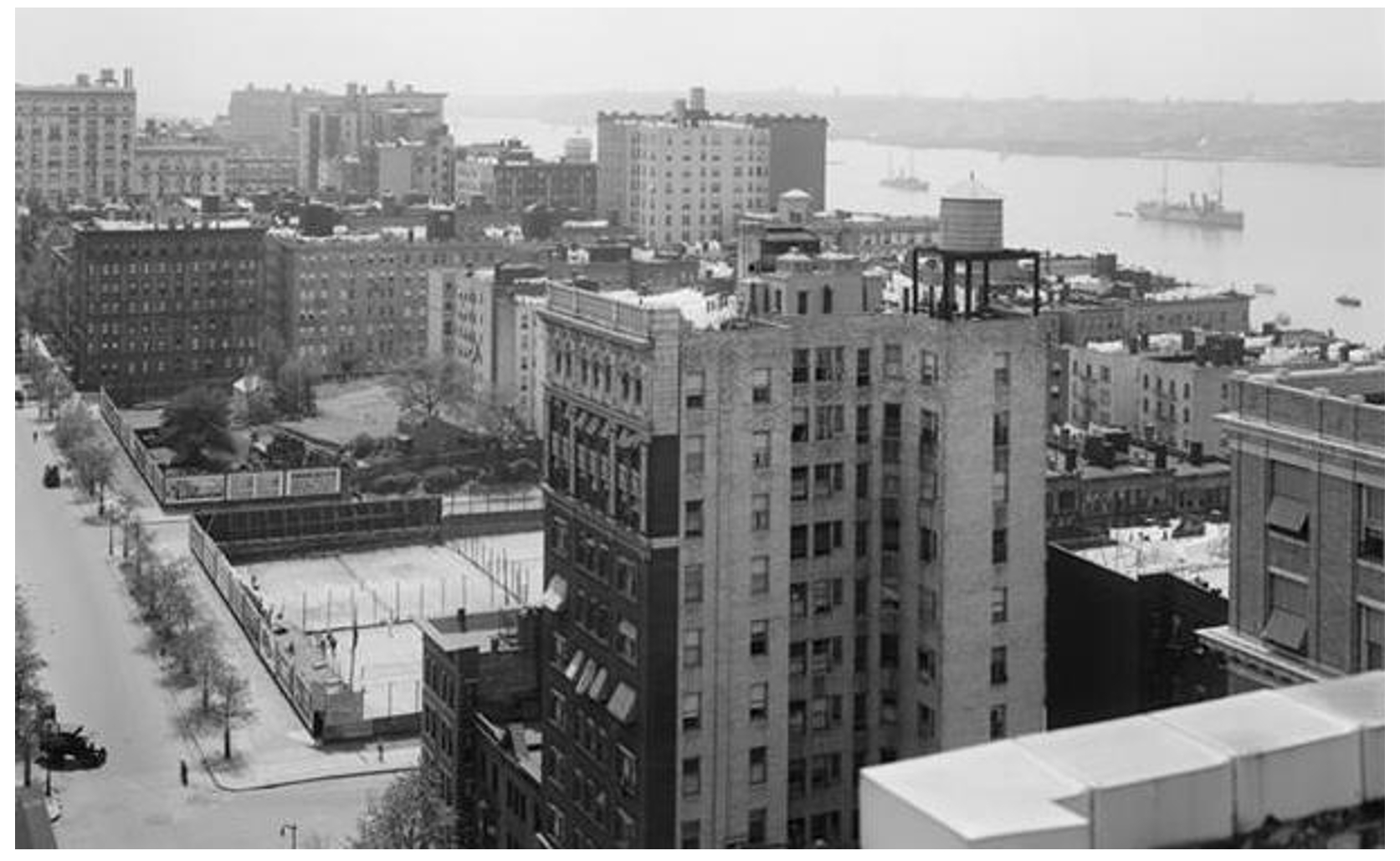
Welcome to another installment in the Rag’s Historical Photo Challenge. The image above was taken somewhere on the Upper West Side, sometime in the past. Can you figure out where, when, and what it shows? Look closely; this week’s challenge photo, like the others in the series, includes clues that will help you identify the scene, if you’re a dedicated UWS history sleuth. And even if you don’t recognize the picture—not to worry! Come back in two weeks and I’ll decode it, show you the clues that help identify it, and—best of all—tell you a story the image unlocks, because this column isn’t just a test of your neighborhood knowledge; it’s also a rolling celebration of the people, buildings and events that wove the tapestry of the Upper West Side.
Ready? If you think you know where and when the photo was taken and what it shows, post your answer as a comment on this column.
Solution to Historical Photo Challenge #26
Subject: Moorish Garden Open Air Theater
Location: 610 West 110th Street
Date: 1913
Image Source: Reel Life
Clues: The dominant building in this image, the Hendrik Hudson Annex on the NW corner of Broadway and West 110th Street still stands, although the elaborate cornice has been removed. Remarkably, the low building in the center background is still there as well—it’s now a CVS. It had an additional story until 1981, when a fire caused the top floor to be removed. The taller building whose backside is on the far right was the Beauclere, a seven-story apartment house that was inexplicably torn down around 1934 when it was less than 40 years old, to build a Woolworth. That entire blockfront—the west side of Broadway between 109th and 110th—thus has the unusual distinction of having lower buildings now than it did 100 years ago.
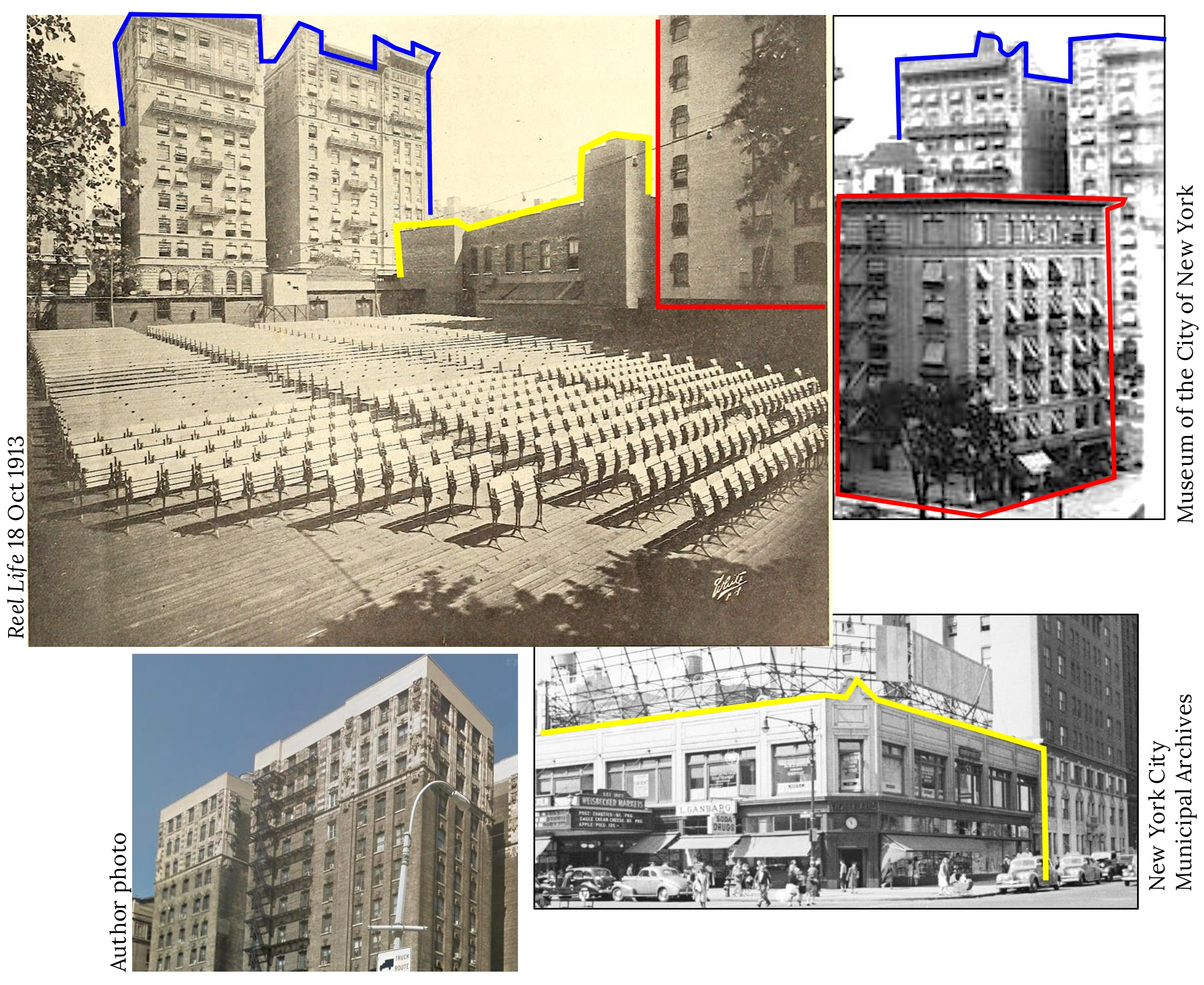
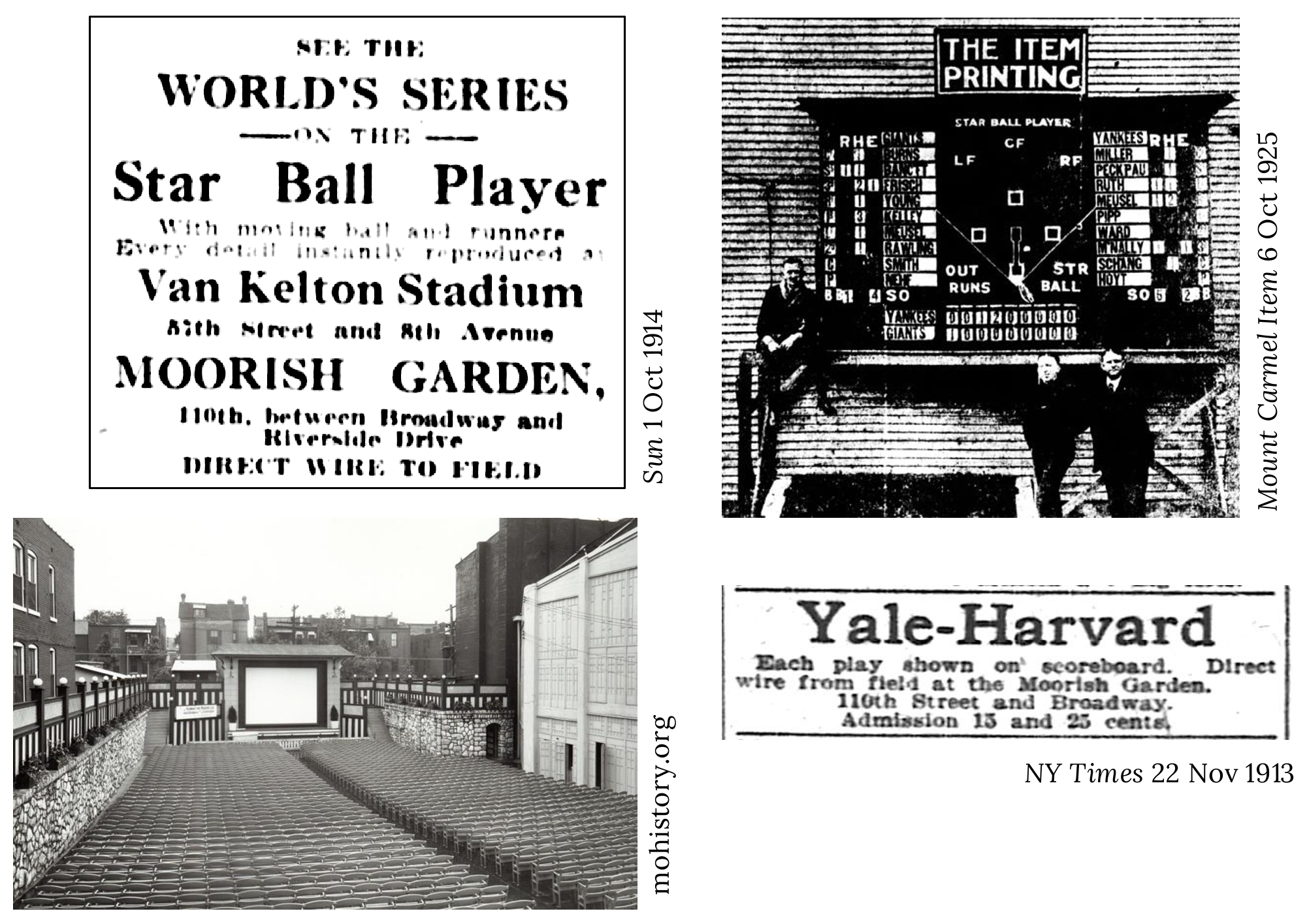
The rest of the story: In the 1910s and early 1920s, there was a window of time when theaters were not yet air conditioned and movies were still silent. This combination gave rise to urban outdoor theaters, known as air domes or aerodomes. They were often quite large—the theater on West 110th sat 2,000 people—and showed movies, hosted concerts, and were even used to present live updates of major sporting events using a system of lights and signs. A live pianist or even an orchestra provided the soundtrack to the silent movie. The Moorish Garden, which bore no discernible resemblance to anything Moorish or garden-like, was owned by outdoor advertising magnate Amedee van Beuren and Harry “Doc” Kelton, an UWS sports entrepreneur. They leased the lot from 1913 to about 1919 from Margaret Sage, widow of Wall Street financier and social science philanthropist Russell Sage.
…and that’s the story behind the mystery image. Scroll back to the top of the column and take on your next challenge, Sherlockians! If you’ve missed any pictures in this series, you can find the complete set on my author page. All photos used with permission.
About the author: Rob Garber has lived on the Upper West Side since the late 20th century and is a member of the Bloomingdale Neighborhood History Group. To learn more, visit their website at upperwestsidehistory.org. All photos in Upper West Side Historical Photo Challenge are used by permission.
Subscribe to West Side Rag’s FREE email newsletter here. And you can Support the Rag here.



Seems to show the West Side of Broadway looking South from about 96th Street.
The lower vacant lot lot being where the Symphony Space is now.
Soldiers and Sailors Monument was completed in 1902 and the Thalia / Symphony site was first built in 1915 so that would place the photo between these dates, as would the truck making a U-Turn.
This is West End Avenue and W. 96th Street looking south. PS 75 is where the tennis courts used to be.
Good to see the old neighborhood. Can see my former residence in the picture. My family lived on 96th Street for 58 years, so this was easy to figure out.
Have always looked at historical pictures of my old neighborhood.
The photo appears to be taken from what used to be the Paris Hotel, now it is known as just “The Paris” it is at 752 West End Avenue.
Sure looks like 96th Street and West End Avenue to me – – – – a long, long time ago – long before the building of the elementary school that’s there now. That was constructed in 1950.
That’s my guess, anyway.
Yes, it was taken just north of 96th and west end avenue, looking south. The elementary school on 96th has not been built yet, and the apartment building across the street from it on West 95th and west end has also not been built yet, but the buildings next to it on west 95th and west 94th have. That means it’s after 1906 (that’s when 310 West 95th was built, which you can just see next to the empty apartment building site, but before 1925 when 755 West End Avenue was built
96th St 300 West End Ave.. The large enclosed space on the left side of the street showcases the historic Rip’s Tennis Courts.
Above: Asphalt Green, in the East 90s of Manhattan?
Looking south on West End Avenue towards 96th. Sort of South West.
I think this is West End Av and 96th st. Sometime before th Emily Dickenson PS 75 was built in late 1940’s. 749 West end is the tall building in front between 96 and 97.
Building in the foreground is 749 West End Ave, but 755 WEA isn’t built yet so this must be before ~1925 which means the Paris also isn’t there. Soldiers and Sailor’s Monument is visible because 675, 677, 685 and 697 WEA are also not built. But those buildings were all built in the 1920s too.
BUT I can see 645 WEA, which was built around 1912. I would say this could be the Fleet Review in May 1915 but that doesn’t look like a warship.
My money is this was taken from 780 WEA between 1913 and 1923.
I should clarify, taken from 780 WEA looking southwest to be more precise 🙂
Correct with a lot of detail.
West 110 Street and Broadway? I see the Hudson River.
West End Avenue looking south from 97th St
Westside Tennis Club, sometime between 1902 and 1908.
Located off Broadway at 117th Street, near Columbia University.
Oriented by seeing Grants Tomb in the distance at 122nd and Riverside Drive.
At lower left corner of photo, barely see tennis net crossing a tennis court. On researching, found that between 1902 and 1908 Westside Tennis Club’s location was at 117th Street, just off Broadway, near Columbia U.
History: In 1892 The Westside Tennis Club’s original thirteen members rented space in Central Park between 88th and 89th Street. In 1902 it moved to 117th St. near Columbia University. It relocated In 1908 to a larger space at 238th and Broadway, eventually moving to Forest Hills Stadium where it has hosted the U.S. Open and today is a location for world-class summer concerts.
West End Avenue at 97th street facing south – maybe from a balcony at the Paris Hotel (now rental apartments). I lived at 749 West End for years and recognize the facade and water tower placement, the tennis courts between 95th/96th streets are now PS75 and the Soldiers and Sailors monument in the blurry background on Riverside Drive should be final confirmation. What must be a driveway midblock on West End is confusing, but I guess was used to access the courts – looks like 95 1/2 street. 749 West End was built in 1912, so I am guessing photo dates to around 1920-30.
Amedee van Beuren was also an independent distributor of motion pictures during the 1920s-1930s. Van Beuren’s early 1930s releases included scored editions of 1916-1917 Chaplin shorts that wound up on TV in the 1950s-1970s. He also distributed a short-lived series of light comedy shorts made in NYC in 1921 that starred Ernest Truex.
That’s Astor Court
210 west 90th
Or 89st side!
1915 Vincent Astor!
This photo is looking south along West End Ave from 96th down. I remember “Rips Tennis Courts” being where PS 75 now is. In the winter when the courts were frozen over, there was some ice skating. 711 WEA was built on the open area just south of the tennis courts. I was born on 96th St. in 1939 — and lived on 94th and WEA from 1966 till four years ago — so spent a lot of time over that way. I was in the first graduating class the year after PS 75 was built and opened. I see that the SW corner of 94th and WEA has 6-7 story building — but 697 WEA was built in the 1920’s so this picture was taken before my building was built. Does anyone know when — and from where — this picture was taken
After what I previously wrote, I have a question for Rob, or anyone. All the low buildings on the west side of WEA from 94th to 93rd are long gone. What do you know about their demolition and the timing of the construction of the two buildings that are there now?