
By Pam Tice
I spend a lot of time combing an online archive of old New York newspapers, digging out the history of local venues for the Bloomingdale Neighborhood History Group. When did a building go up, who built it, who owned it, how was it used – all that can usually be found online.
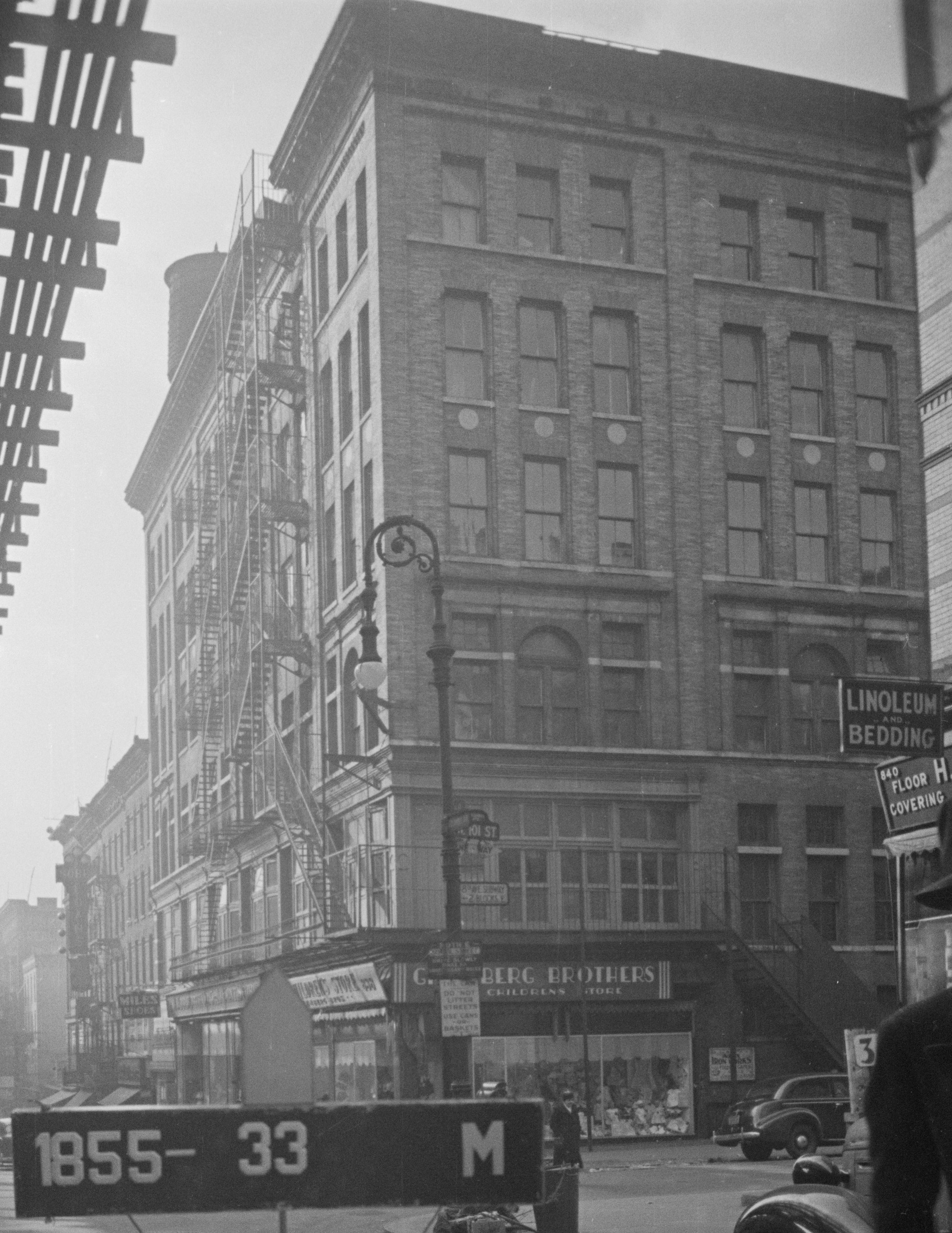
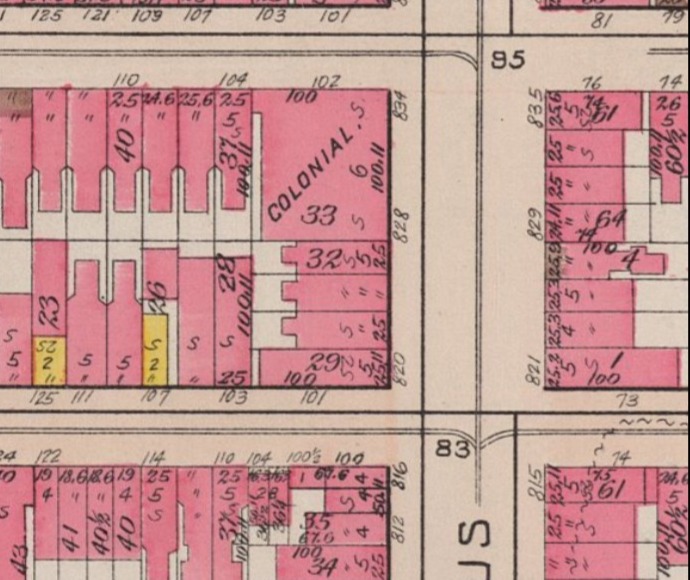
The online articles also provide a window onto the social norms and political pressures of long ago. That’s what I found in a series of stories, published between 1895 and 1950, about the six-story Colonial Hall on Columbus Avenue at West 101st Street.
Opened in 1895, Colonial Hall had an auditorium that served as a meeting place for the local Republican Club, for Civil War Veterans, a group called “Free Cuba,” and others. It had a bicycle academy, teaching both men and women how to handle a new skill during the 1890s bicycle craze that swept the city.
In the same year, an entertainment promoter, Benjamin Steinrich, applied for a license to open a roof garden at Colonial Hall. Such venues were popular in the summers before air conditioning, but owners of nearby property and many of the neighborhood clergy rose up in protest, led by Dr. Shaw, the minister at the West End Presbyterian Church on Amsterdam at West 105th Street. More than 400 people came to Shaw’s church to object to Steinrich’s application. “We want no beer or ballet on the West Side,” said the Reverend Shaw, according to the New York Tribune on June 2, 1895.
Steinrich’s application was reviewed at a hearing held right in Mayor William Lafayette Strong’s office, as was customary. Mayor Strong was a Republican elected on a fusion ticket with Democrats opposed to Tammany Hall. The protesters gathered around Strong’s desk, as reported in The New York Times, telling him that respectable young girls attending the bicycle academy would end up upstairs, drinking with men in the roof garden. The mayor turned down the application, and the next day, a group of women from the West Side sent him a jelly cake to serve with his afternoon tea.
The following year, the new owner of Colonial Hall, Thomas Sinnott, applied for a roof garden license, along with one to sell beer and wine, enlisting the help of the local West Side Republican leader, Abraham Gruber. This time, the mayor granted a limited license from July to October. The license allowed instrumental music to be played in Sinnott’s roof garden, but only by males. And there were to be no performances by males or females in theatrical costumes, nor could the musicians mix with the audience. Dr. Shaw and others who had protested Benjamin Steinrich’s earlier roof garden application were equally outraged by Sinnott’s proposals. But they could do nothing more than write lengthy letters to the newspapers. “He [the mayor] did what he promised not to do,” Dr. Shaw complained in the New York Herald on August 9, 1896. Once the license was approved, there apparently was no more reporting on the venue, so we do not know how long the “Colonial Music Hall” lasted or whether it became a destination for respectable young girls attending the bicycle academy.
In 1900, the New York Herald reported that Colonial Hall had a basketball team, the Colonials, and that there were classes held in the building on “dance and deportment,” and it was the home of Thumann’s Bowling Alley.
In 1901, the building was the scene of a bizarre children’s riot. A theatrical agent, Mr. Steele, handed out hundreds of red cards in the neighborhood, announcing a Punch and Judy show and promising that every child would get a souvenir. The admission for children was seven cents and a potato, which would be given to a local children’s home. Adults accompanying a child would be charged ten cents. The New York Times reported that 1200 children and a few adults showed up.
According to the Times, the show was poorly presented, and the souvenirs turned out to be thin rings, disappointing hundreds of little girls who expected a new dolly or a pair of skates. The children rioted, throwing potatoes, breaking windows, and swinging from the chandeliers. Police arrived, marched the children down the stairs, and arrested Mr. Steele for offering entertainment without a license.
Then, in May of 1914, a fire erupted on the fourth floor of Colonial Hall, where “miles of film” were stored by the Universal Film Company. The New York Tribune described the building as a loft space occupied by moving picture companies. At this time, the fifth and sixth floors were occupied by the Helfand Abek Underwear Company, and there were stores on the ground floor: an A&P, a Woolworth’s, and a shoe store. The fire was quite exciting for spectators, as the chemicals in the film ignited many explosions.
There was little reported on Colonial Hall after that date, but the building survived until the 1950s, when it was demolished to make way for construction of the Frederick Douglass Houses, which now stand there.
Pam Tice is a member of the Bloomingdale Neighborhood History Group.
Subscribe to West Side Rag’s FREE email newsletter here. And you can Support the Rag here.



The potato thing was just asking for it.
Thank you for bringing this slice of UWS history to life. As the title suggests, it told us something about social norms. And eating habits. Jelly Cake? The ladies sent His Honor a Jelly cake.
Wonderful article. “No beet or ballet” says it all.
So interesting, thanks for writing it up. The idea that you could regulate fraternizing with musicians, those horrid vectors of moral decay, is hilarious. Some people are still thinking in analogous ways, though.
Now, when I am asked of my profession, I will delight in replying that I am a “horrid vector of moral decay.” Thank you, James! And many thanks for this interesting article.
Can you imagine 1,200 children showing up at one place on the Upper West Side? This debacle has made my day 🙂
What connection is there between Bloomingdales neighborhood and the Bloomingdales department store?
Research step zero: that would be Bloomingdale and Boomingdale’s, respectively.
Fascinating! Thank you.
The potato riot sounds like the 1901 equivalent of overhyped, low budget scams like that Willy Wonka experience
Where IS/WAS Colonial Hall?
Paragraph two.
“It had a bicycle academy, teaching both men and women how to handle a new skill during the 1890s bicycle craze that swept the city.“.
Maybe bring that back?
Sounds a lot like the protests against electric delivery bikes today. Past is prologue.