

By Gus Saltonstall
While much of the Upper West Side’s political attention is on the New York District 12 Congressional race to replace Rep. Jerrold Nadler, there is another neighborhood political contest with a primary in June — the race to represent Assembly District 69, which covers the northern portion of the Upper West Side and the entirety of Morningside Heights.
The district became a future open seat when its current representative, Assemblymember Micah Lasher, announced this fall that he would be running in the NY-12 contest. The race currently has two candidates, Eli Northrup and Stephanie Ruskay, both seeking the Democratic nomination. Public records don’t show any other candidates registered to run for the seat.
West Side Rag readers will recognize Northrup from his campaign for the same Assembly seat in 2024, when he finished second, behind Lasher. Since he announced he would run again, Northrup has received a slew of endorsements, including from Public Advocate Jumaane Williams, former Upper West Side City Councilmember Helen Rosenthal, the New York Working Families Party, Three Parks Independent Democrats, and Broadway Democrats.
Northrup is the legal director for the Criminal Defense Practice at The Bronx Defenders, a nonprofit serving the public defender needs of Bronx residents. He is also on the Board of the New York State Association of Criminal Defense Lawyers.
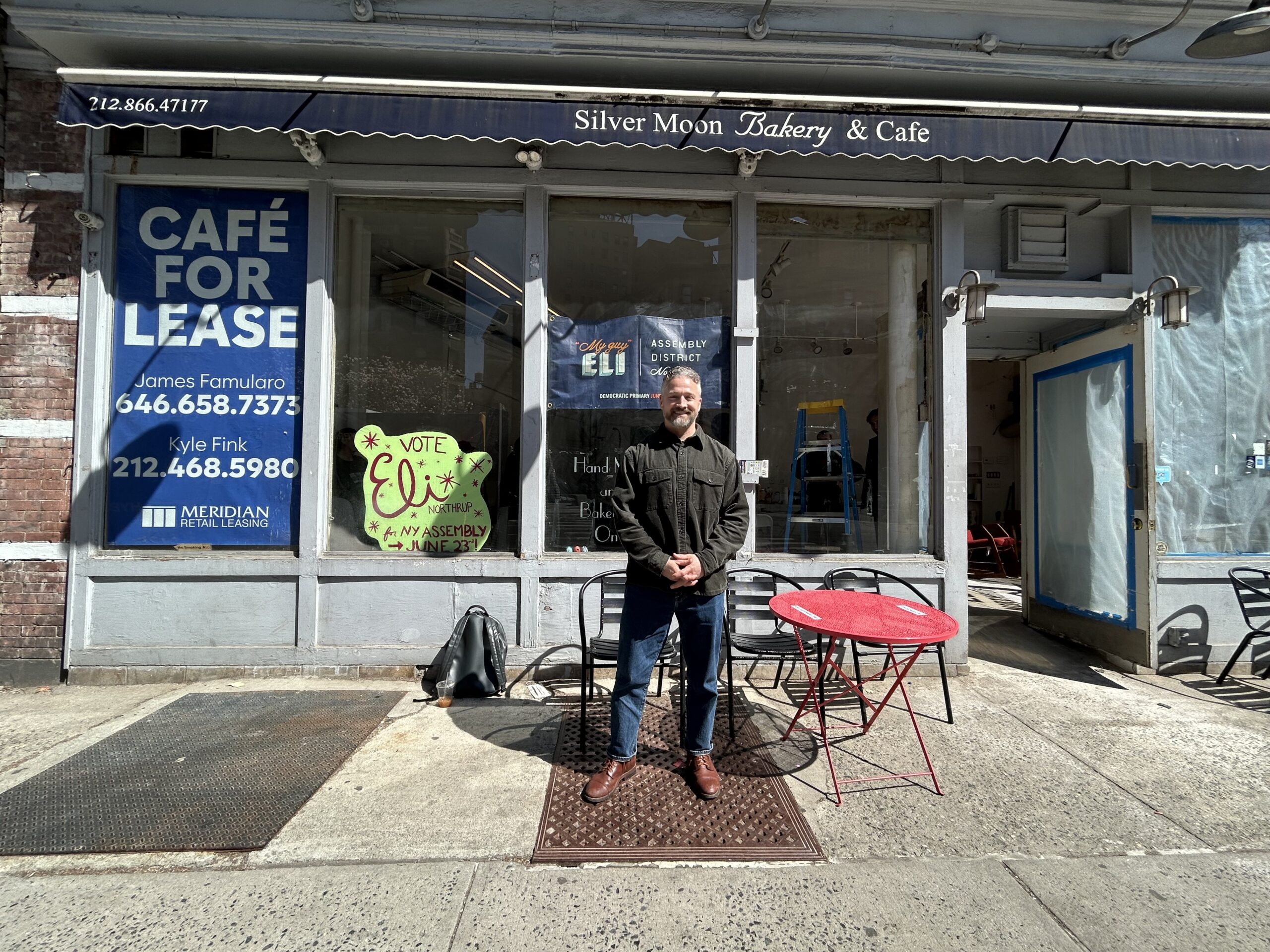
The Rag recently interviewed Northrup at his campaign office in the former home of Silver Moon Bakery on Broadway at West 105th Street. The interview included questions about his decision to run once again, his favorite spots on the Upper West Side, and his stances on important campaign issues such as housing, scaffolding, immigration, and public safety.
This interview has been lightly edited for clarity.
WSR: You ran for this Assembly seat in 2024. Why was this again the right time to run to represent this district?
Northrup: The urgency of the moment. I was new to politics when I ran in 2024 and I was proud of the campaign that I ran, but I wasn’t anticipating that I would be running for office again this quickly. Trump winning, and then what he has inflicted upon our community and the entire country, made me feel like it was really imperative to pursue this again. The background in the work that I do as a public defender, as someone who has stood up in court and fought for people who were facing deportation or otherwise targeted, really gives me a strong base to push back. It feels like it is an urgent thing to have leadership that will stand up to this administration in Washington.
WSR: Did gaining the experience in 2024 help in this campaign?
Northrup: I’m such a better candidate. You learn a lot when you put yourself out there and run for office. I had to learn over the course of that campaign how to be a good candidate. I always felt confident that I could do the lawmaking part of the job because I had spent a lot of time in Albany and understood building coalitions and writing bills, but running for office is something totally different. It means raising money, it means developing the volunteer base, and getting your name out there in different ways. By the end of that campaign I felt like I had figured some of that out, so I’m starting from a different and better point. I understand how to be a better candidate and that makes this a stronger campaign.
WSR: How does your background in law and as a public advocate set you up to be a successful Assemblymember?
Northrup: This community is such an involved community, with a lot of different, well-organized groups that are interested in different issues. It is a community that demands excellence out of its elected officials, and we’ve had a long history of people that have been doing this work, and I think I fit into that. Albany is not an easy place to navigate and there are so many good policies that exist up there but haven’t moved across the finish line. What I bring to this is both experience with Albany, where I’ve spent time understanding the levers of power and how they work, not as an insider but as an advocate. But also, I’m a lawyer. I’ve written legislation, I understand how to draft it, I understand how to organize the Ps and Qs, and I’ve worked on implementation as well. That’s what this community deserves, someone that can hit the ground running because this is an urgent moment and we can’t afford two more years with this president in office and New York not being protected.
WSR: Affordability is a leading issue in this race. How would you look to make the district more affordable, especially when it comes to housing?
Northrup: I just got my law school debt paid off two years ago. We don’t talk enough about student loans. There is a generation of people who are weighed down heavily by student loan debt. I was able to take part in public service loan forgiveness. Ten years working in public service and I was able to finally get my loans forgiven. The Trump Administration has threatened that. If you don’t work for an organization that doesn’t share their ideology, you might no longer qualify for loan forgiveness. That’s a big thing that contributes to affordability that doesn’t get enough attention that I would want to work on. New York has some programs that need to be expanded on that front.
Housing is the number one thing, though. We have a high renter community. We have many people who have been here for multiple generations and have rent control or stabilization. We need to make sure we are protecting tenants, including with statewide right to counsel. It matters if you have counsel in housing court. We also need to build more housing. I’m in favor of things like the social housing compact, the Tenant’s Right to Purchase Act, using vouchers, and making sure we change zoning upstate to make sure there can be housing around transit hubs.
We have Linda Rosenthal, the Assemblymember in the district just south of here, who is the housing chair in the Assembly and is an excellent housing advocate. The issue is that these things aren’t moving at the legislative level. It is not that we have a shortage of ideas. It’s that we haven’t seen real movement. We need to move the body. There are 14 open seats in this primary cycle, and if you have 14 people who will go to bat for these issues, and you organize and go up as a group and demand changes and that these ideas actually pass, that’s how you change the dynamic. If you look at the real estate lobby, which has immense power in Albany, they can also be a partner in some of these things in building more, and there are ways to make sure we build more and protect tenants at the same time.
WSR: Do you feel confident you’d be able to work well and build coalitions with other representatives as a first time Assemblymember?
Northrup: If you look at just the people who have endorsed me, I’ve got a number of people in the Assembly and the Senate who know me as an advocate, they know I have credibility. The reason that they support me is not because I have some sort of political relationship with them, but because they’ve seen me advocate for criminal justice reform. They know me to be an honest and credible person. So, I already have relationships up there. Everything that I’ve been able to build and accomplish in terms of policy connects to my ability to build broad coalitions.
WSR: In Columbia University’s role as a landlord, does the school have a responsibility to build housing for all types of neighborhood residents, or is any development that Columbia undertakes seen as a positive for the community?
Northrup: They have a responsibility to the neighborhood. They’re a landlord. They’re an employer. They’re the largest land owner in Upper Manhattan. And, they are also a neighbor to us in Morningside Heights. The fact that the campus has been shut down for the past three years has a real negative impact on the community. People feel it. The school is pushing out non-affiliates little by little. I’m encouraged that there is a tenant’s union that has been forming. The Morningside Heights Community Coalition, which I’ve worked with, does a lot of great work on the subject.
The disappointing thing is you see the school caving to Trump when their bottomline is threatened, but they don’t seem to be beholden to the community in the same way. Yes, we do need more housing, but it has to be for community members in Morningside Heights. The school can’t just push community members out. We need a certain number of apartments that remain for Morningside Heights residents when there is new development and I want a more equal partnership with the university, rather than relying on their benevolence.
WSR: You spoke about the struggle of finding a storefront for your campaign office. Nothing changes the character of a block quite like a new vacant storefront. What would you to do help support businesses in the district?
Northrup: It is such a salient issue here, especially on Broadway. I cite the West Side Rag story all of the time when I’m speaking to people about the number of vacancies between 80th and 110th streets. There are policies that can make the balance more even. There’s this feeling that a lot of these landlords want to wait for a chain store, for more money, for a business that has more stability, so they do wait, and they’re not feeling the vacancy in the same way that the neighborhood feels it. You can change that balance by imposing a commercial vacancy tax, and that changes the equation. You can think about things like commercial rent stabilization, which [says that] when a small business has been in a space they are entitled to a renewal at a rate that makes sense.
WSR: Scaffolding and sidewalk sheds are also much talked about on the Upper West Side. What approaches would you bring to try to expedite sidewalk sheds coming down quicker?
Northrup: I’ve been ranting about scaffolding for many, many years. Luckily, there’s a real understanding of the problem and there are new policies that have been put forward to make a change. First of all, it’s an $8 billion industry in New York state, which is crazy. Those costs are passed down to all of us, they’re passed down to landlords, they’re passed down to tenants. When a building has scaffolding go up, we’re going to pay for it.
And, there is not alignment for when the scaffolding goes up, when the work gets done, and when the inspection happens. Sometimes there hasn’t been an incentive to take it down. You need to have incentives to get it up and down quickly, and penalties if it doesn’t. There’s a package of bills that exist that I would be a proponent of, and this is especially pertinent on the Upper West Side. West End Avenue has some of the most scaffolding per-block in the city. It’s an issue that Micah [Lasher] has done good work on, and I would make sure to continue that work to get these sheds up and down as quickly as possible.
WSR: Immigration gets framed as a national issue a lot, but what would you do within the Assembly to affect the issue of immigration within the district?
Northrup: A lot of my life’s work has been to protect people that are marginalized and under threat, and immigrants. It’s one of the first questions that I ask when I meet someone in criminal court: ‘Where were you born?’, because that matters distinctly. This is something that I have a lot of experience with. New York For All should pass this year, I hope it does before I am an Assemblyman. There is no rationale for our local state agencies doing ICE’s bidding. That agency just got $75 billion from the federal government. New York should be a sanctuary state and protect its residents. I’ve been working on New York for All since it was introduced in 2020.
On a basic level, I will have robust constituent services to help non-citizens through the process. I will endeavor to bring immigration attorneys to my office to meet people and organize, both to help them know their rights but also as direct representation, because that’s the work I’ve done and feel very equipped to do. It’s really heartbreaking to see our neighbors fearful. Manhattan Valley has a large immigration community in this district, and people are considering self-deporting and leaving, and I won’t stand for that.
WSR: How would you look to improve public safety in the district?
Northrup: This is something I feel like I have expertise in because I’ve seen what works for people and what doesn’t. I’ve seen as a public defender people that have cycled through the system, cycled through Rikers Island, people who are dealing with substance abuse or mental health issues, and frankly I’ve seen that the way we’ve been treating it is not the most effective way. I’m a huge proponent of the Mayor’s Office of Community Safety, especially having people that are dealing with mental health issues or substance abuse, having those calls handled by people with competence in social work, and a connection to housing and medical facilities.
It’s not that you don’t have accountability, it’s that you want to solve these problems. Supportive housing to me is the number one thing that helps people. I have clients who have fundamentally changed their lives because they got a place in supportive housing. They text me and they reach out and they’re proud. I’m a big proponent of apprenticeship programs for union trades, as well. These are things that actually create safety in a more robust way. Then, you have responsiveness when there is violence. You have people doing the enforcement that understand this community, that are of this community hopefully. You have accountability, but you are also looking at the backend for what changes things for people. The vast majority of people that get caught up in the criminal legal system are people that are struggling for some other reason, and I’ve seen that fundamentally throughout the 10 years that I’ve done that work. Safety is the number one thing. People need to feel safe on the trains. People need to feel safe on the streets. It’s something that I will be relentless in trying to achieve.
WSR: Do you believe changes need to be made around the enforcement of electric bikes?
Northrup: There are different tiers of the bikes. It’s one thing to have a slight pedal assist and it’s another to have people zooming at breakneck speeds. A lot of this is tied up in food delivery, which we now depend on. We do need to have accountability for people acting in unsafe ways, and especially with the delivery bikes, the delivery companies need to take that accountability on. There’s huge motivation to go fast, people are paid as contractors, enforcement against the delivery companies would change the behavior in terms of their treatment of the people working for them.
That’s the lens I want to look at the issue through, especially when many of the delivery workers are not citizens. I don’t want to be funneling them into the criminal system. And then design is a big thing, when you have protected bike lanes, and people use them, that changes the dynamic. People need to follow the rules too. Don’t go the wrong way in the bike lane and create havoc.
WSR: Among all of these issues, do you have a first piece of legislation you would home in on?
Northrup: New York for All, if it hasn’t passed. And, if we’ve done a half measure on it this legislative session, we need to go all the way on the next one. Outside of that, the major things are universal healthcare and childcare. These are the things that affect all of us. There are smaller bills too, though. There are bills that would change the way sirens sound in New York. These little things become big things when they affect us every day. The vacancy tax that I spoke about related to commercial storefronts. It would be a mix of the big and small things.
WSR: Favorite neighborhood spots?
Northrup: The parks are huge. Riverside, Central, Morningside, and Strauss, all of them are great places to be. Saiguette is a favorite restaurant of mine and Pisticci is another favorite. Barney Greengrass is an institution. My gym, Liberated Fitness on West 109th Street and Columbus, is a wonderful community. Bob’s Your Uncle is a great spot.
WSR: Favorite pizza spot and bagel place?
Northrup: Mama’s Too! is my favorite pizza spot. Also, the slice at Sal & Carmines. I want to give a shoutout to Double Pie, they moved from Columbus to Amsterdam on West 105th Street, and seems like a real up and comer. Bagels 2788 is excellent, but I do go to Wu & Nussbaum quite a bit and I think it’s a little underrated. Their bagel sandwiches are really good.
WSR: Someone comes up to you and says ‘Tell me in one minute why I should vote for you,’ what do you say?
Northrup: This moment demands somebody who is ready to fight, and with Trump and the federal government trying to make New York an example, we really need people who will push back. We also need people who can hit the ground running and be effective on the state legislation. My combination of on the ground experience helping people throughout the course of my career will make me excellent at constituent services.
I really am somebody who picks up the phone and shows up for others. A large part of this work in the Assembly is being responsive to people’s concerns as they come in, so this neighborhood can count on me to do both the small and big things, and be ready to do them right off the bat. I’ve got the energy, the hustle, and the track record to demonstrate that I can accomplish things for this district.
You can find out more about Northrup on his campaign website — HERE.
Subscribe to West Side Rag’s FREE email newsletter here. And you can Support the Rag here.




Be very very careful who you vote for in the Assembly because for them it’s just a stepping stone to higher office.
You do know who was in this seat before Micah, right? And how long they were in it?
In various interviews with elected officials or candidates there is often mention of the topic of bikes/ebikes.
Generally there is a comment about food delivery workers.
Yet I’ve not seen anyone discuss Citibike riders? In my experience it is Citibike riders who consistently ignore traffic rules and pose dangers to pedestrians.
Wondering about specifying Citibike in these conversations?
Not to mention that Citibike itself takes no responsibility to keep the premises they occupy clean! Every wind-blown piece of crap, every beverage bottle and food wrapper left behind by riders, every bit of day-to-day accumulated garbage is just left at their curb-site locations to be dealt with by building supers or neighborhood do-gooders, like me. This issue needs to be addressed. It’s appalling.
Agree completely! They should have to be registered so that traffic enforcement is easier. As it currently exists it is a net negative for the neighborhood.
Perhaps Mr Northrup hasn’t noticed but landlords already pay a “commercial vacancy tax”.
It’s called real estate taxes. Landlords have to pay these taxes whether their space is occupied or vacant. So when a landlord has empty space they are still paying this tax (which is often substantial as about 50% of NYC’s tax revenue comes from real estate taxes) without generating rental revenue to cover this tax.
Politicians should not be micromanaging real estate operations and dictating to landlords how to run their buildings. Contrary to popular myth landlords get no benefits from empty space.
Mr Northrup is pandering to ignorant constituents and offering a nonsensical solution to a complex problem (for example, instead of a “vacancy tax” removing homeless encampments from streets might help encourage businesses to move into empty storefronts).
We should expect more from political candidates.
Their taxes are lower than those in the surrounding suburbs. A reasonable vacancy tax would be that they are taxed the amount thry claim the space is worth – if it is empty for more than 3 months. Also it should be illegal for them to force out tenants such as Lenny’s.
Commercial taxes in NYC are higher per square foot than residential. They are unequivocally higher than the suburbs, and levied regardless of occupancy.
Plus there is a commercial tent tax on all stores below 96th.
Why does Lennys get protection?
How was Lenny’s “forced out”?
They had a lease that expired and Lenny’s did not agree to the new terms.
That is not being “forced out”.
The part about commercial tent control is where he lost me. We should force one private business who owns a storefront to subsidize another private business?
It’s corporate welfare of the worst kind. Plus any low-rise building with stores will never get demolished for denser housing.
Meh. Some decent ideas, but some of the super progressive socialist stuff is not cool. Free markets work well. Let them do their job. The housing shortage is actually being caused by over-regulation – keep something in place for the elderly and others like them. No inheriting apartments. Have income tests. Have tenant-per-square-foot tests.
And don’t accept e-bikes as a fact of life. Do something about it. For most of the history of mankind people survived without getting food delivered to them by e-bikes. Are there suddenly that many more homebound people? Really?
More clarity on his plans for public safety would also be nice. Including social workers in some of the processes could be OK, but they can’t do it alone. And we have to accept that there are unfortunately people who truly breaking the laws and there should be adequate penalties for them. Yes, there should also be programs to help get jobs, etc. which will likely reduce the incentive to commit crimes, but once someone commits a crime, especially if they do so multiple times, there should be severe penalties. And scream these from the rooftops so that perhaps it will deter other crimes.
Awesome! I love Eli, really glad he’s getting another shot at District 69. Really like his stances on housing and transportation. What a breath of fresh, youthful air into our community. Eli, you have my vote, and at least 5 of my friends!
UWSYIMBY,
Perhaps I’ve misunderstood but seems you’ve posted several comments on WSR “critical” of “older” people?
That “younger” people do better?
Not sure what your “young-old” age categories are?
Younger people like Karoline Leavitt – age 29 ?
But older people are somehow problematic? Like President Obama?
His view on public safety is clear: don’t lock up criminals.
We can debate whether that’s good or bad, but let’s be honest about that part.
Way too liberal for me. But I’ll give him this. In this very interesting candidate interview series. He’s the only one who doesn’t say Trump every 6th word.
Opposing Trump is a necessary but not sufficient prerequisite for any candidate running for office, as the case of George Conway demonstrates so well.
I’d vote for a candidate who opposes Hamas, if only such a candidate existed on the UWS.
Too soft on crime. Next.
So unfortunate he didn’t win last time.
My only quarrel is with Bike lanes, unless & until there is police enforcement of traffic rules in them they shouldn’t exist. All bikes should have to be registered & running red lights enforced for them to the same degree as it is for cars. Riding on the sidewalk should result in bike confiscation. It’s really not that hard to fix the problem of bikes killing terrorizing and pedestrians, but someone has to want to.
It seems that the bicycling issue is the most divisive.
Ironically the major visionary of the bicycle lobby (Transportation Alternatives/Open Plans/Streetsblog) Mark Gorton is not “progressive” – he is a wealthy tech-finance businessman who was on RFK Jr’s presidential campaign team.
This wonderful interview series with candidates is an enormous and essential public service. Thank you, Gus — great questions — and thank you WSR.
Meanwhile, this is the “Equity Plan” as proposed by our equally-woke mayor. What a clown show:
Searching keyword frequency offers insight into the plan’s identity hierarchy: “race,” including its variants “racist,” “racial,” and “racism,” appears 751 times. “Black” appears 189 times, “Latin” and “Hispanic” 97 times, “color” and “white” 49, “Asian” 27, and “Jew” or “Jewish” just once.
https://www.city-journal.org/article/new-york-city-mamdani-racial-equity-plan?utm_source=virtuous&utm_medium=email&utm_campaign=cjdaily&vcrmeid=iJFROlQLtkO5idm7BOUlyg&vcrmiid=vggP4PrVeU2LpeB35rM6kw
Cant say im a fan of either canidate but given his past run I will vote for him.
With a severe case of TDS and lack of basic economics, he’s the last person I’d vote for.
Too liberal and soft on crime for me.
A lot of #1 priorities here.