By Gus Saltonstall
The race for Assembly District 69, which covers a large chunk of the Upper West Side and the entirety of Morningside Heights, is currently a contest between two Democratic candidates: Eli Northrup and Stephanie Ruskay.
Both candidates are vying to fill the seat that will be left vacant by Micah Lasher, who was elected to the position in 2024 but is now running to succeed Democratic Rep. Jerrold Nadler in New York’s 12th Congressional District.
Election Day for the primary is June 23.
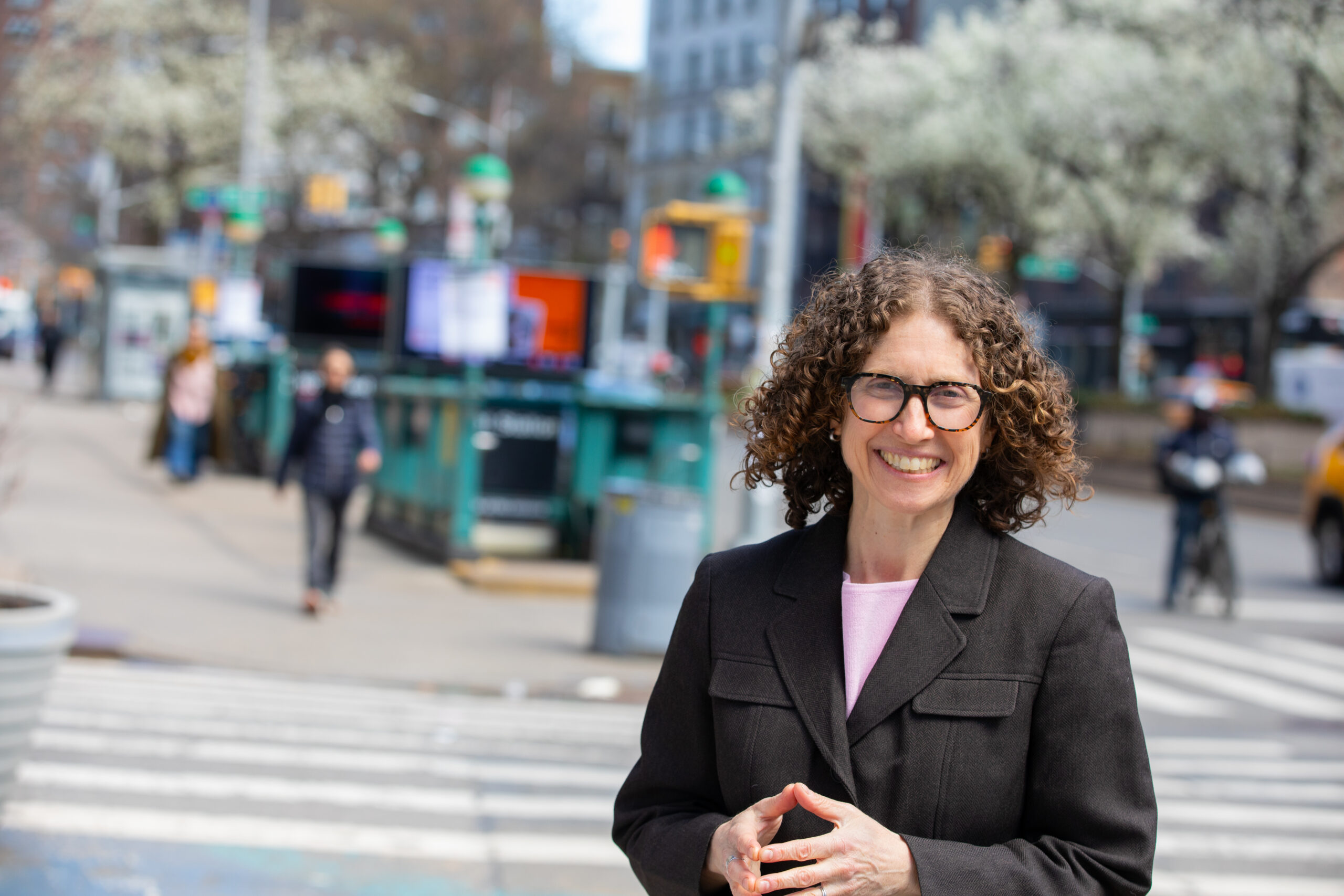
Last week, West Side Rag sat down with Ruskay in our Upper West Side office to discuss her background, stances on issues, and other thoughts related to the Upper West Side.
Ruskay, a first-time candidate for political office, is a rabbi and the associate dean of the Rabbinical School at the Jewish Theological Seminary in Morningside Heights. She is also executive director of the Hendel Center for Ethics and Justice.
She has garnered strong support since announcing her candidacy in November, receiving endorsements from Upper West Side City Councilmember Shaun Abreu, Manhattan Borough President Brad Hoylman-Sigal, and New York City Comptroller Mark Levine, among others.
“I’m a relentless organizer and agitator for things that matter to the people I represent,” Ruskay told the Rag.
The interview has been lightly edited for clarity.
WSR: Why was this the right time to run for office for the first time and why in the 69th Assembly District?
Ruskay: I’m running now because I felt a sense of desperation on how the world is and how the country is. It felt like the bright spot of hope where things could happen was at the state level. In every state, but in New York and in this district, in particular.
I thought, how could I not personally do more? All the advocacy work I do seems to land at the feet of state elected officials. I would like to be an ally and agitator. Rabbis are generalists. That means they offer pastoral care, they agitate, they organize, they educate, they offer moral inspiration, and in many ways, this is a time when we need state legislators to be able to do all of those things too.
When I was a kid, my father used to say, what did you do today to make the world safe for democracy, which is a gigantic question to ask kids. I think it was a slogan he had heard somewhere, liked it, and brought it into the family lore. When I was a kid, democracy did not seem in particular peril, it seemed to be on the ascent, and only a matter of time before everyone had it. That is very much no longer true. It feels like you cannot take it for granted. My answer to my father’s question is that I am running for State Assembly. I’m becoming part of the process, in a way where I can be in the room where decisions are being made.
WSR: Starting with the issues, affordability is a central topic for voters in the 69th District and across the city. Morningside Heights is one of the few neighborhoods in the borough where developers aren’t mandated to construct affordable housing. How would you look to improve affordability in the district, especially when it comes to housing?
Ruskay: Of course, you start with pieces of land that are owned by the city and state. We have to have a requirement for affordable and deeply affordable housing when things are being built. I also understand that we need housing for all types. Housing of all types takes some of the pressure off of the system. The negotiation tactic is, you ask for a lot, but you don’t say it’s all or nothing. All or nothing ends up with nothing too much of the time.
I am a person who is a bridge builder. Who will speak to all people in a 360-degree way, people at all parts of the housing process. Nobody wants to live in a community where people have no housing options. We need to remind ourselves who we want to be, and I would be a legislator who would constantly be trying to remind us to be our best selves as a society.
WSR: When it comes to Columbia University in its role as a landlord in the community, do you think they have a responsibility to construct affordable housing? Or, any development the school undertakes can be seen as a positive thing?
Ruskay: Columbia gets a lot of tax benefits from the state, so the school has an obligation to be an institution that helps strengthen the community, not deplete the resources. Part of why Columbia found a home in Morningside Heights was the importance of being in New York City. If it becomes too unaffordable, it will stop being like New York City. It will be the university and a strip mall.
The school does have an obligation to the neighborhood. It’s a problem. None of their students will be able to live here. If they fall in love with this area, there’s very little possibility they will be able to live here, if the only thing here is the school and no housing. It’s in Columbia’s interest to be a partner in the community, rather than an entity that is plopped down.
WSR: Very little changes the character of a block like a storefront becoming vacant. How would you look to support small businesses and fill vacancies?
Ruskay: I have two ideas. One, I’m not sure we can do, but the way you find out if you can do things is to start talking about them and try to make it possible. We should have a two- to three-month experiment where every single storefront has to be utilized. We would have to make it in a way where the building owner does not have an enormous amount of risk, if something was damaged during that period. But, we would say, for three months the stores are full.
Building owners cannot benefit financially and get tax breaks from having an empty storefront. More effective for the neighborhood would be a tax for empty storefronts. If you’re a landlord, you don’t have to give a 10-year lease. Give a shorter lease, if you are so worried. You could also have space sharing. You could have multiple small businesses in one place, but we have to incentivize it.
WSR: While it’s diminishing some, there is still a greater sense of people not feeling safe since the COVID pandemic. How would you look to help on the public safety front?
Ruskay: When I’ve done door knocking, particularly in buildings that have a lot of aging seniors, public safety is one of the things that they said mattered most to them. When you’re in conversation with people and striving to be an elected official, what matters to your people has to matter to you. I am generally a person that feels safe in the world, but I think partially when people feel isolated in the world, they also feel more unsafe.
My grandmother used to say, if you don’t take care of yourself, who will? There is a tendency to feel that way when you’re aging and alone. First of all, putting people into deeper relationships with other people, which takes work, is hugely helpful. When you have a candidate coming to your house other people show up to listen, but I don’t think we should only come together when there is a candidate coming to speak. If I am the Assemblymember, I would have house meetings regularly. When you know your neighbors, when you know what keeps them up at night, when you know what scares them, and you know what matters to them, even if it’s not the same things that keep you up at night, then their narrative becomes part of you and you check on them more. Having people know each other more and feel responsible for one another is an important part of public safety.
Also, having cross generational encounters. We have lots of young people that need more childcare help and lots of seniors who are lonely. If we can create opportunities for them to know each other, it will matter.
Components like the scaffolding and not well lit areas also make people nervous. We have to focus on getting long-standing scaffolding to come down. I think having police officers who are known in the community and stay in the community, rather than moving around, is very important. People have more comfort with familiar faces. I would also create opportunities for police to come around to building lobbies to meet community members. Residents should go to precinct meetings, but police should also make the effort the other way. I do think teams that include police and social workers are smart. It would reduce some of the friction in the system. You have both, since I don’t think either by themselves is the right solution.
WSR: You are a rabbi. You speak about your faith. How does your faith intersect with your identity as an elected official?
Ruskay: I am personally motivated by a call to do justice work in the world, which is rooted in my Jewish identity. I do a lot of multi-faith work. That has been some of the most inspiring work I’ve done. I have tended to gravitate to bring my own community along and engage with others with the ideas that we could do something much more powerful when we work together. But, I also work with many civic institutions. Doing things together is a great way to be of service in the world.
I’m going to be the Assemblymember for everybody in the district, not just the Jewish people. Even though my faith inspires me, it is not a limiting factor in who I will partner and work with. For me, it’s both a group I can organize and an inspiration for why I act, but everyone who is operating in the world is inspired by something.
WSR: You would be the first woman to represent the 69th Assembly District in more than 50 years. What does that mean to you?
Ruskay: Communities do better when there are different perspectives represented. I am raising my children here. My kids are in public school. I am planning to age here. I lived here as a child. I’ve lived here as a college student. I know what it’s like to want to stay in this community after getting an education and to know it’s not the same if you graduate today. I know the lifespan. I know it as a mom. Diversity helps. People bring their whole selves to leading, and if we haven’t had a woman in 50 years in this district, having a woman will bring a valuable perspective. It matters to me because it will help me do the job.
WSR: How long have you lived on the Upper West Side and what are some of your favorite neighborhood places?
Ruskay: I lived here until I was seven years old, came back for college, and haven’t left since.
Riverside Park is our backyard. That is where we taught our kids how to ride their bikes. It’s a place we have spent many, many hours. Our kids play baseball at the Little League fields. For me, when I walk down to the river, I feel like my blood pressure drops. I love Riverside Park. It helped us through COVID. It’s beautiful and I feel enormous gratitude for the people who maintain it. It’s a place where you can meet people who are different from you.
WSR: Any final message?
Ruskay: I’m a relentless organizer and agitator for things that matter to the people I represent. I do it for my students, and I’ll do it for you.
You can find out more about Ruskay on her campaign website — HERE.
WSR plans to publish its interview with Eli Northrup later this month.
Read More:
- Rabbi Stephanie Ruskay Announces Candidacy for UWS, Morningside Heights Assembly Seat
- Taking a Look at The Other Major Election on the Upper West Side: The Race for Assembly District 69
Subscribe to West Side Rag’s FREE email newsletter here. And you can Support the Rag here.


Not totally relevant to this article, but I am so tired of seeing Micah Lasher TV ads. Wasn’t he the one who wanted to get corporations out of politics? Yet he is spending Bloomberg’s money bombarding us with ads. I was considering voting for him but now I cannot – he is insufferable and a total hypocrite. Just need to decide who is better…
Not to mention multiple mailers every week!
Mailers seemingly very DAY! He’s really burned me out. It’s too bad.
She seems sorta compelling and it’s nice to have someone who isn’t trying to leap from the non profit world into government.
That said, her lack of experience with some issues shows, such as her repeating of the canard that there are tax breaks for keeping stores vacant when there are only tax penalties when a store is vacant (because real estate taxes are owed as if the store was occupied regardless).
I wish she outlined anything that she thinks the government could do differently or less.
What about the landlord’s income taxes? Is there an income tax offset of losses on rental property?
To simplify: expenses reduce taxable income, but that is true whether or not the property is rented. Thus, from the landlord’s POV there is no tax benefit to not renting the property.
“Building owners cannot benefit financially and get tax breaks from having an empty storefront”
Let’s please stop this nonsense that landlords receive tax breaks and get some mysterious financial benefit from having empty storefronts.
I’d like Rabbi Ruskay to quote the section of the IRS, NYS or NYC tax codes which provide a tax break for empty space or to explain how a landlord magically comes out financially ahead by having zero cash coming in from empty space while they still have expenses to pay.
Flouting ignorance in a political campaign is unappealing.
Please clean up all the papers and garbage everywhere. Please increase cameras and police and decrease crime.
Never going to happen until people Vote Better.
If the interviewee is wrong on fact it would be helpful for the reader if the interviewer would offer him or her correction
(and include it in the published piece.)
Thank you for these candidate interviews.
I see that Stephanie Ruskay has a very special set of accomplishments and skills which can serve our district quite well. The ability to respect different opinions and to engage positively is just what we need right now. She sounds quite good to me!
I support Stephanie Ruskay for her desire to help heal a troubled world. I am sure that, if elected, she will accomplish much to support all who live in her district.
Did the door knocking include visiting NYCHA buildings ?
“We should have a two- to three-month experiment where every single storefront has to be utilized.”
How would this work ?
In reality it does not sound achievable, but sounds good in an interview.
Not a single one of these profiled candidates can talk coherently about local dinner table issues: the subway, crime, cost of living, schools, etc
Ms. Ruskay comes across as a well meaning person, but the vast majority of her interview is comprised of general platitudes, and where she does float a policy idea (forced short term retail leases!), it’s naive and amateurish. I have a hard time seeing how she would be an effective representative.
The -#1 or 2- complaint on the UWS is recklesssw-bike riding. Ask any Council Member. And not one mention of it. This is a HUGE Quality of Life issue. The majority of New Yorkers want e-vehicles registered but because of the bike lobby pressure, electeds won’t get it done. We arent voting for anyome who listens to wealthy special interest groups over the people.
The bike lobby is so condescending that I would rather see vacant housing on the UWS be given exclusively to those on section 8 and CityFHEPS over a market rate tenant who is likely here to build their career and have fun at the expense of people who are different than them. The section 8 or CityFHEPS tenant is also likely not to tell someone their car is evil or that their train is a luxury that we spend too much on.