
By Rob Garber for the Bloomingdale Neighborhood History Group
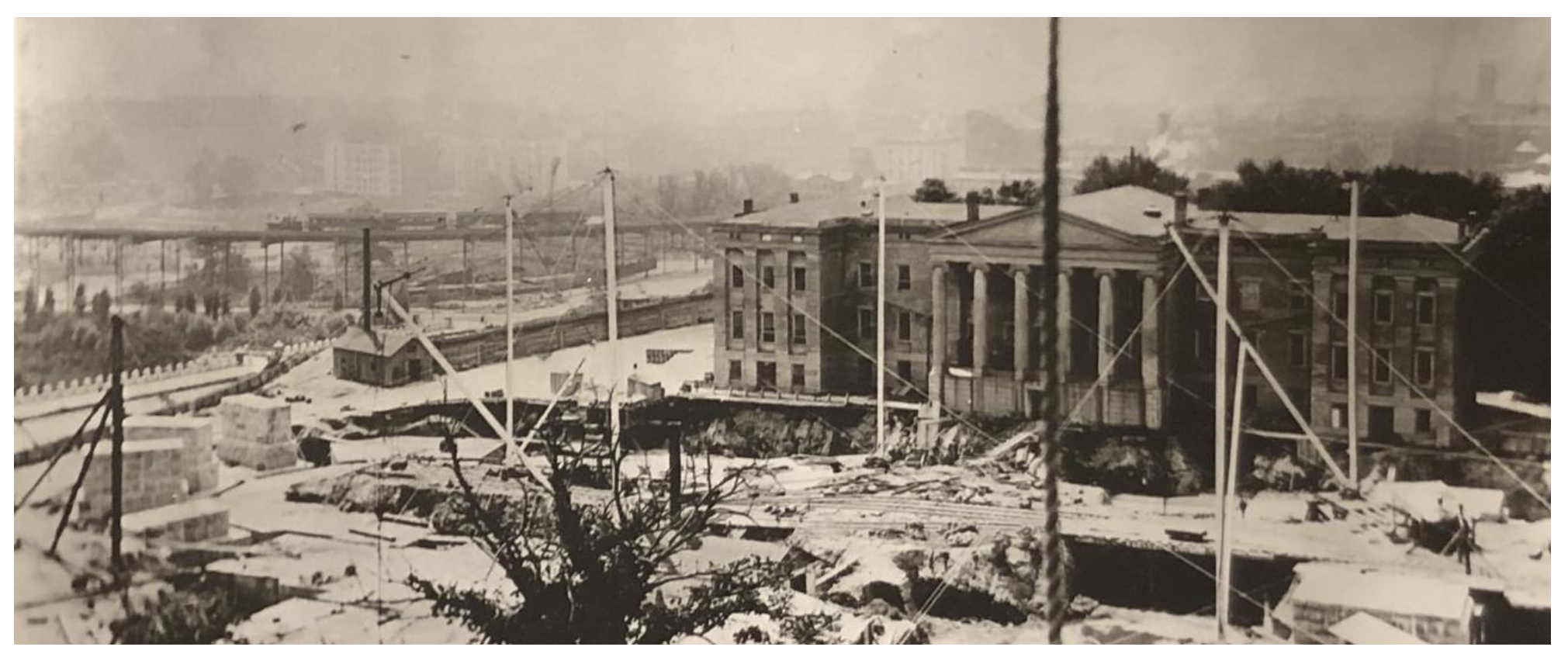
Welcome to another installment in the Rag’s Historical Photo Challenge. The image above was taken somewhere on the Upper West Side, sometime in the past. Can you figure out where, when, and what it shows? Look closely; this week’s challenge photo, like the others in the series, includes clues that will help you identify the scene, if you’re a dedicated UWS history sleuth. And even if you don’t recognize the picture—not to worry! Come back in two weeks and I’ll decode it, show you the clues that help identify it, and—best of all—tell you a story the image unlocks, because this column isn’t just a test of your neighborhood knowledge; it’s also a rolling celebration of the people, buildings and events that wove the tapestry of the Upper West Side.
Ready? If you think you know where and when the photo was taken and what it shows, post your answer as a comment on this column.
Solution to Historical Photo Challenge #23
Subject: The 95th Street Market or Astor Market
Location: West side of Broadway between 94th and 95th Streets
Date: 1915
Image Source: New York Public Library
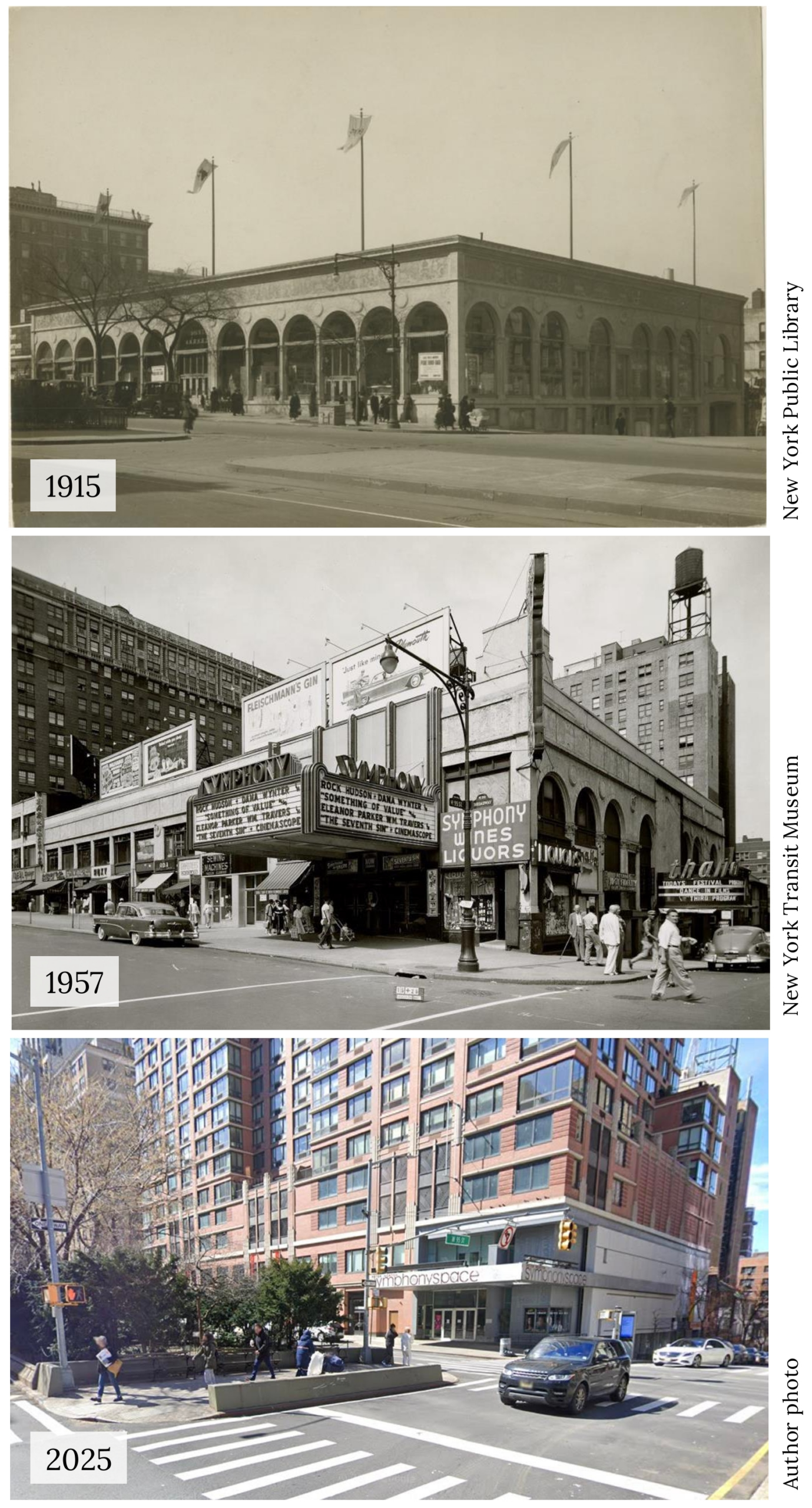
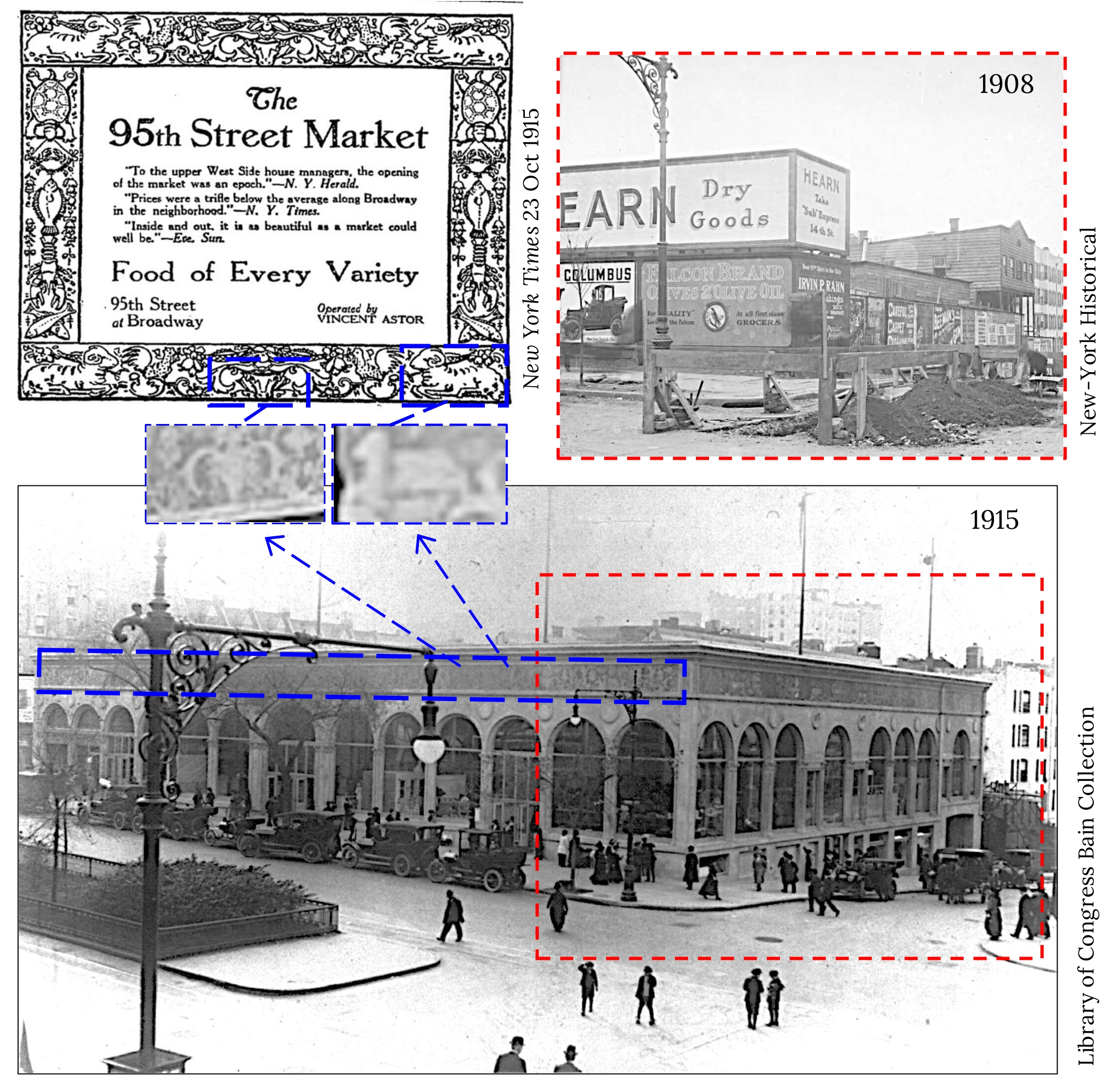
Clues: The photo showed a large but low building running along what looks like a major thoroughfare on the Upper West Side, probably Broadway. The cross-street slopes noticeably down to the right, which hints that we’re looking west towards the Hudson. That probably wasn’t enough to identify the building unless you remember Symphony Space before 2001, when it sold its air rights to a developer and was incorporated into the new Lyric apartment building. In its latter years as a standalone structure, the part of Symphony Space that faced West 95th Street still contained original arches from the building’s construction in 1915, although a decorative frieze above the arches appears to have been lost much earlier. The name “95th Street Market” is visible above the mid-block front entrance, but difficult to make out.
The rest of the story: The short-lived Astor Market is a well-known piece of Upper West Side history. Short version: Extremely rich guy lavishes money and attention on a pet project that only lasts a couple of years, then the building languishes for decades before being reborn as a theater space that becomes a beloved neighborhood cultural center. Let’s unpack the story a bit more, because this was a handsome building and a solid idea that was ahead of its time, at least in America: an indoor food market with independent vendors.
Vincent Astor was born to truly fabulous wealth and came into his full fortune—more than $2 billion in 21st century dollars—at the age of just 20 through the death of his father on the Titanic. Vincent grew into a more interesting and thoughtful mogul than his car-happy Harvard-dropout youth would have predicted. One interest, surprisingly, was food distribution. Astor served on Mayor John Purroy Mitchel’s Citizens’ Committee on Open Markets, which tackled the non-trivial issue of getting produce from farm to table in an era when refrigeration and trucking were in their infancy, and the supermarket had not been born. New York City had a history of large public markets, such as Essex or Washington Street Market, but they were outdoor, and none was on the Upper West Side. Astor conceived a plan to build an indoor market, on his own property and at his own expense, between 94th and 95th Streets on Broadway. He was simultaneously diving into other ambitious real estate development projects, such as Astor Court on Broadway at 90th Street. The idea behind his 95th Street Market was a collection of purveyors selling fish and poultry, baked goods and liquor, ice cream, fruit and flowers. They were arranged as individual booths, so the market brought together what had previously been separate shops but left them as separate businesses—what we’d now recognize as a food hall. The building was purpose-built with an emphasis on clean and sanitary conditions-–”Flies Flee in Despair” read a newspaper headline about its opening. The market lasted barely two years before being sold by Astor and turned into a skating rink upstairs and a restaurant downstairs. Stories of its demise suggest that Astor misjudged the willingness of consumers of that era to travel even a short distance to buy foodstuffs. Astor himself could have operated the market at a loss indefinitely, but perhaps his shallow-pocketed vendors gave up and he couldn’t replace them.
…and that’s the story behind the mystery image. Now scroll back to the top of the column and take on your next challenge, Sherlockians! If you’ve missed any columns in this series,If you’ve missed any pictures in this series, here is the complete collection. All photos used by permission.
About the author: Rob Garber has lived on the Upper West Side since the late 20th century and is a member of the Bloomingdale Neighborhood History Group. To learn more, visit their website at upperwestsidehistory.org. All photos in Upper West Side Historical Photo Challenge are used by permission.
Subscribe to West Side Rag’s FREE email newsletter here. And you can Support the Rag here.



I do believe that is the Leake and Watts Orphan Asylum on Amsterdam Avenue and 112th Street, a picture taken around the time the Cathedral of St. John the Divine was being planned/built. They preserved the structure. There is a Wikipedia article titled Leake and Watts Services.
My guess: W 110/Amsterdam, St. John the Divine during construction. I think that’s the 9th avenue el curving towards 8th avenue in the background
Leake and Watts Orphan Asylum. A portion of which is still visible at Saint John the Devine.
The construction site of St John the Divine in 1895. The building shown here is the Leake and Watson Orphan Asylum, purchased for the cathedral in 1887.
Construction site for St. John the Divine? (with suicide curve in the distance)
without checking anything online, I am thinking the columns look like the south side of St. John the Divine.
The Leake & Watts Orphan Asylum, designed by Ithiel Town and built in 1843 on the current site of the Cathedral Close of the Cathedral of Saint John the Divine.
I am actually more intrigued by the tower in the upper right corner of the picture. What was that?
Leake and Watts Orphan Asylum with early construction underway for St. John the Divine, probably around 1893
Re the 1957 photo showing the Symphony and Thalia Theaters, two years later (1959) the small awning directly next to the Symphony Theater would become the original location of Sal & Carmine’s Pizza.
I believe the commenters who place this as Amsterdam/110-112 streets.
What’s instructive however is that both Google AI and Chatgpt, when asked, confidently gave total crap answers about the West Side Highway.
I don’t know, they may be on to something. Those massive pylons in the left foreground don’t look like part of any building construction, to me. They seem like either roadway/ramp or bridge supports of some sort.
Is this one AI too?
The location is fairly easy to establish as the EL is curving onto Columbus Avenue, but what the building was, who knows?
Looks like it could be the Leake and Watts Orphan Asylum (later partially demolished and incorporated into the close of Cathedral of St John the Divine.) If correct, this was probably taken in the early 1890s when the construction of the Cathedral first began.