

By Scott Etkin
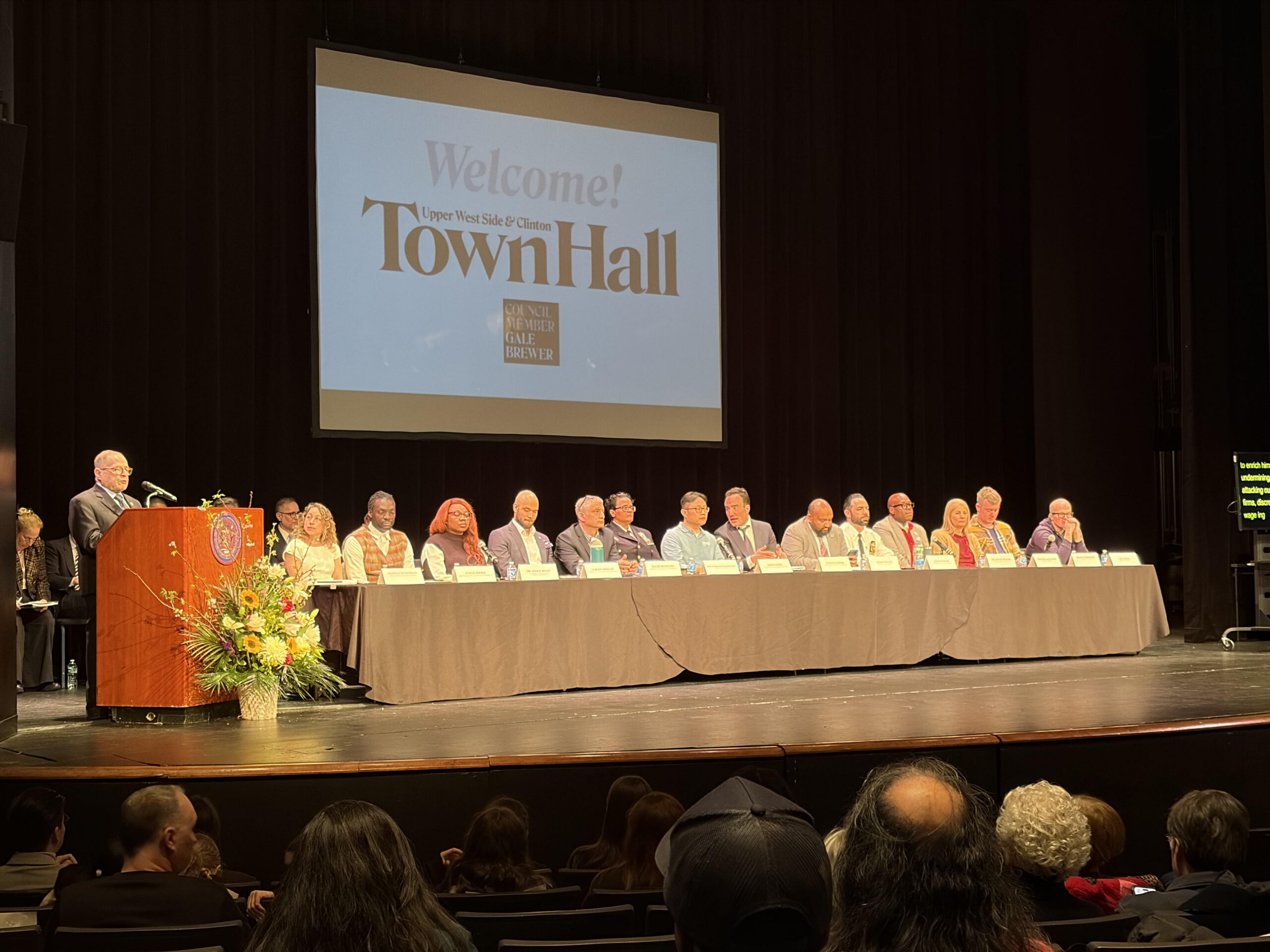
The town hall hosted by City Councilmember Gale Brewer on Monday night covered well-trodden ground for those who follow top concerns on the Upper West Side – e-bikes, homelessness, and dirty streets, to name a few.
But there was an element of novelty. This was the first town hall Brewer has convened since last November’s city elections, so while the agenda featured familiar elected officials, some have moved jobs and have served just months in their latest roles in government. The all-Democrat lineup of speakers (only one of whom is up for election this year) each spoke for a few minutes – taking the opportunity to tout their policy records and progress on topics like healthcare, and to comment on timely issues before the Q&A began.
City Councilmember Julie Menin, who was named speaker of the City Council in January, was first to address the session, held in a partly full auditorium at John Jay College. Menin focused largely on bringing down healthcare costs through price transparency. She mentioned a database, created by the NYC Department of Health, that allows people to compare the price of procedures across hospitals; the database shows that the same procedure can vary in cost by tens of thousands of dollars, depending on the location.
“It’s shameful that some New York City hospitals are overcharging,” Menin said. Now, she said, she plans to bring the same price transparency to health insurance, since New Yorkers pay more than the national average.
Rep. Jerrold Nadler, who is retiring this year after representing the Upper West Side in Congress for more than three decades, spoke briefly about his efforts to push back against President Trump and demand more accountability from his administration. While the race to succeed Nadler was not mentioned at the event, there was perhaps a symbolic moment when Micah Lasher, the State Assemblymember who is running for Nadler’s seat (and has received Nadler’s endorsement), followed him on the agenda.
Lasher continued on Nadler’s theme of combating Trump administration policies. For example, he mentioned legislation expected to become law in New York state this year that would empower the state’s health officials to make vaccine recommendations when Health and Human Services Secretary Robert F. Kennedy, Jr.’s Centers for Disease Control fails to do so.
A familiar face who appeared under a new designation was Brad Hoylman-Sigal, the former state senator who was recently elected Manhattan Borough President. Hoylman-Sigal said he spent the earlier part of the day in New Jersey testifying on behalf of the Gateway Program, a train infrastructure project that connects New Jersey with midtown Manhattan. Last month, the Trump administration released funds it had withheld from the construction project, after the president’s move was blocked by a federal judge.
Hoylman-Sigal also said that he has decided to allocate the entirety of this year’s Manhattan capital grants to arts and cultural institutions, which have been “struggling mightily under this federal administration.”
Former Manhattan Borough President Mark Levine, who took office as the city’s Comptroller this year, addressed the recent budget-related news that three ratings agencies have downgraded New York City’s credit outlook from stable to negative.
This downgrade is rare, he said, with previous instances triggered by the COVID pandemic and the 2008 financial crisis, and its timing is unusual given that the city’s economy and tax revenue are growing.
Still, Levine said that the city’s budget is “out of whack” and faces a “structural deficit” that he said would be addressed by finding efficiencies and curbing unsustainable levels of spending for certain programs. One example is CityFHEPS, a rental assistance program that has been growing at 4% per month.
The rise in spending for CityFHEPS reflects the city’s housing affordability crisis – as Levine noted earlier in his remarks, the median rent in Manhattan has passed $5,000 per month. This is “pricing out not just low-income families, but social workers, and teachers, and more.”
The Q&A section of the event lacked the colorful moments you might expect from a crowd of people passionate enough to spend their Monday night at a town hall. That’s because rather than hand a microphone over to attendees to voice their questions, staff from Brewer’s office collected questions from audience members via written note cards.
Brewer relayed the questions to representatives from ten city agencies assembled on stage, sometimes adding her own views to their responses. (A few people in the crowd shouted out questions at various points, but Brewer said they weren’t taking them.)
The questions rarely had simple answers. In response to one about homeless encampments at various sites, such as Broadway between West 74th and 75th streets, the city’s new Department of Social Services Commissioner Erin Dalton described how representatives from the Department of Homeless Services aim to build relationships with people on the street, who sometimes refuse their services. After saying that she objected to the term “sweeps,” used to refer to removing homeless people from the streets, Dalton acknowledged that at a certain point the homeless would not be allowed to stay on the streets.
Brewer was more direct: “They’ve really got to go,” she said.
E-bike safety for pedestrians was another main topic of conversation. Danielle Zuckerman, Manhattan Commissioner from the city’s Department of Transportation, spoke about the agency’s efforts to build wide bike lanes and get delivery workers to take an online safety training course.
These comments received a tepid response from the audience, but there was applause when Community Board 5 Chair Bradley Sherburne returned to the issue and mentioned enforcement, which is handled by NYPD. There was more applause when Brewer talked about putting “some onus on the [delivery] apps … that make them go too fast.”
On a wide range of topics that were discussed – from the pollution caused by food vendors using diesel generators, to broken street lights, to rats at restaurant sheds – the shared message from the city agencies is the importance of calling 311. Using the city’s hotline to report a specific issue is often the fastest way for a representative from the relevant agency to do an inspection and issue a summons.
Subscribe to West Side Rag’s FREE email newsletter here. And you can Support the Rag here.





There’s a new lady walking around the UWS 70s and 80s barefoot all day and in constant loops.
As long as she’s not feeding the pigeons….
I watched a man grooming his very large, shedding dog in Verdi Square this weekend. Was fun watching the hairballs go everywhere (not!)
Can’t let the people actually speak that says it all.
Silencing actual live people is the Democratic party’s MO so they can later claim to speak for “American people.”
To sum it up … the town hall was a dud.
Controlling the voices of the people…
That’s what they want!
Please work on crime, arresting and holding perpetrators, and working on dirty streets with paper and garbage everywhere.
Too many officials, too many words, too little actually being done.
“Brewer was more direct: ‘They’ve really got to go,’ she said. ”
That’s rich coming from a career politican who has been welcoming homeless to the neighbrhood for the past 25 years.
In fairness, it is easier to have homeless people in a shelter on the UWS where there are people willing to advocate for them, albeit smugly, than to have them in parts of the Bronx where others are hostile to them or on Staten Island where others are very hostile towards them.
I actually spoke to her regarding this about 2 years ago. She wasn’t “direct” at all.
She is unbelievably hypocritical.
Looks like an SNL (Saturday Night Live ) skit.
re: hospital data base does not help the average person.
The article mentioned a hospital cost data base which showed differences of tens of thousand for similar procedures. Past experience has shown that low cost hospitals look at these so called transparent data bases and then raise their charges to be the similar to the high cost hospitals.
Most of the “answers” are actually quite simple. And can be implemented in days. They just require people who aren’t lobotomized into some woke nonsense that just serves to conceal their unfulfilled political ambitions, like this coterie of self-serving careerists and “advocates.”
Eliminate e-bikes. Very simple. Heaven forbid people can only order food from places close to their home. Or get off their backsides and go pick up food (Yes, I know some people can’t but the vast majority can). They will survive. People did it for decades and didn’t complain.