By Rob Garber for the Bloomingdale Neighborhood History Group
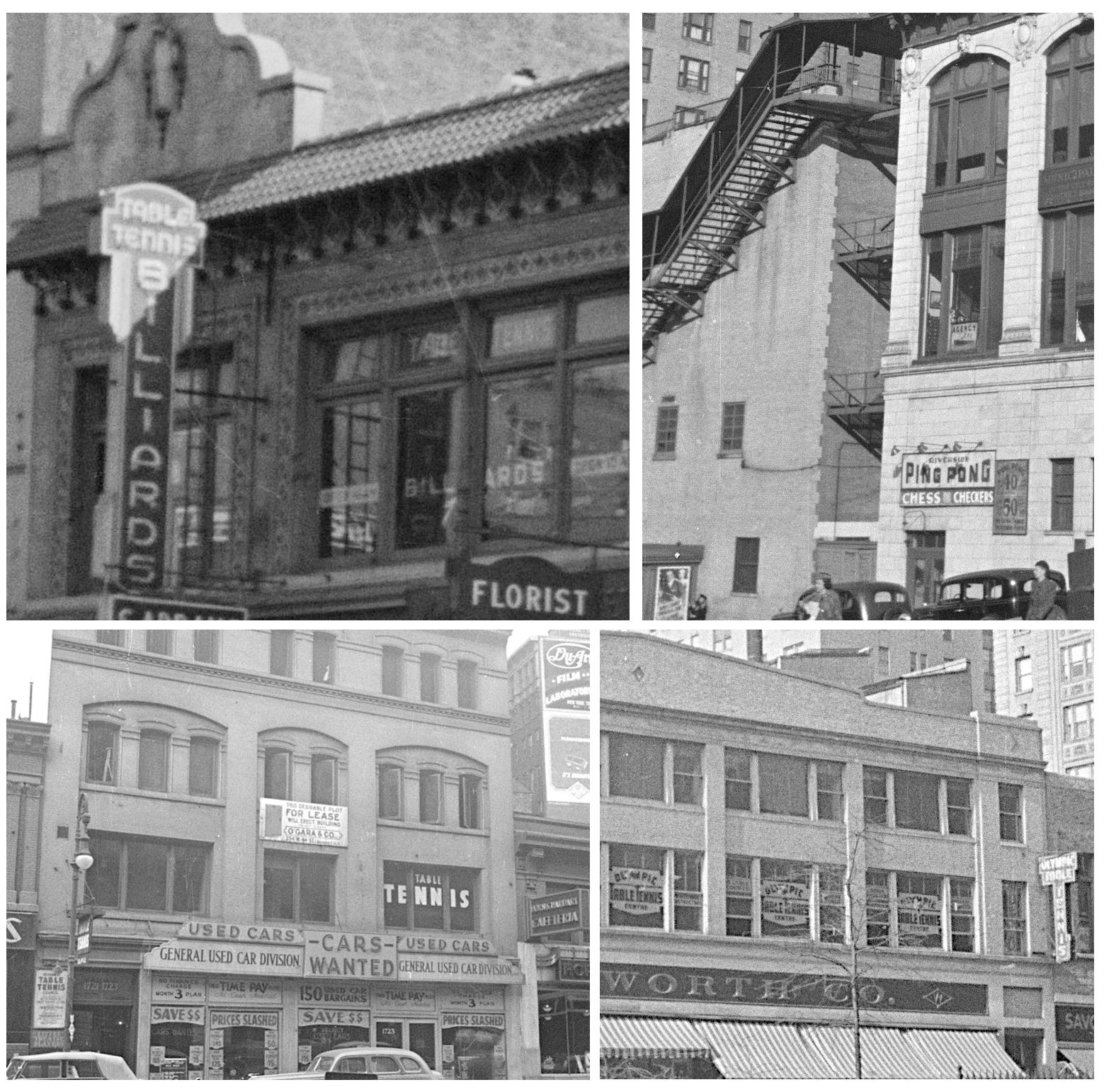
Welcome to another installment in the Rag’s Historical Photo Challenge. In honor of the UWS’s own Marty Reisman, table tennis legend and inspiration for the movie “Marty Supreme,“ here are images of four ping pong emporiums. How many can you identify? Post your identifications to the comments section, then check in to see what your neighbors have to say and come back two weeks from now when the solutions will be posted, you’ll learn the stories behind the images, and a new UWS Historical Photo Challenge will be presented.
Solution to Historical Photo Challenge No. 16
Subject: Billboard blight on Riverside Drive
Location: Riverside Drive looking northeast from West 94th Street
Year: 1913
Image Source: Report of the Mayor’s Billboard Advertising Commission of the City of New York
Clues: Last week’s challenge featured two photographs. Together, they present several clues that suggest their location. If you didn’t recognize the façade of 244 Riverside Drive on the SE corner of West 97th Street in the top photo, then the lower photo, showing the backside of a fence supported by props, might be the key. At its top center you can see the exuberant cornice of The Peter Stuyvesant at 258 Riverside Drive, now alas removed. The tops of buildings sticking up from 96th Street in the upper photo complete the identification—the photographer was standing on the short 96th Street viaduct, now sometimes called Riverside Bridge. Designed by Carrère & Hastings, the viaduct was adorned with ornate railings and splendid lampposts, all stolen for the value of their bronze in the mid-1970s. But none of this is the reason for challenging you with these two photos…
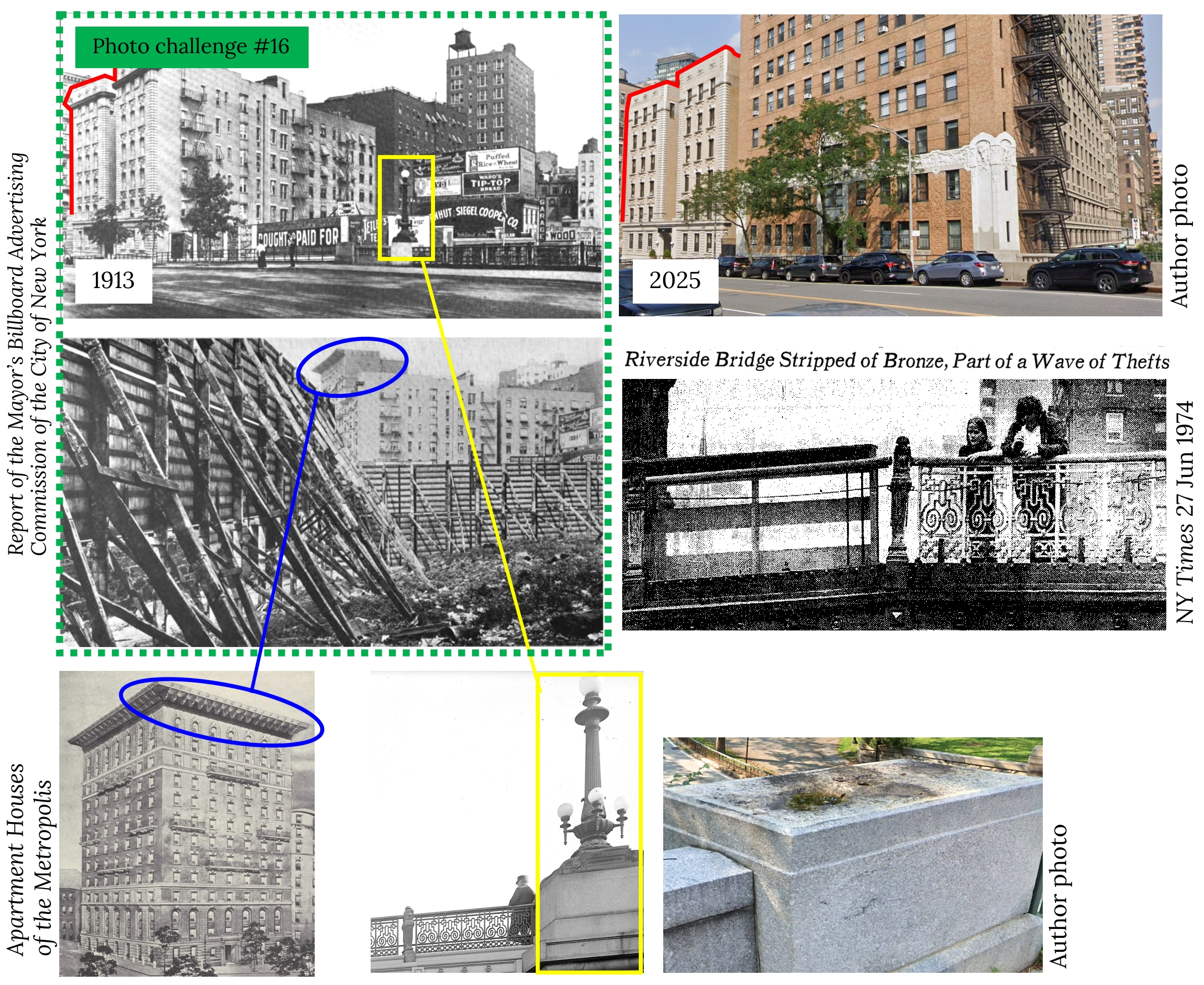
The rest of the story: … these photos were taken to illustrate a turn of the century billboard blight. A surprising amount of Manhattan real estate was still held in an undeveloped state in the 1910s, waiting for the property to appreciate enough to either sell it or build on it. While it was empty, property owners erected fences, partly to keep squatters off but also to generate income by renting it as ad space. Everything from vaudeville shows to beer was advertised. And one row of ads wasn’t enough—”double deckers” were common and “triple deckers” were a real eyesore. Much of this vacant land was in Upper Manhattan, but it could also be found in some surprising places, including right next door to Andrew Carnegie’s mansion on Fifth Avenue.
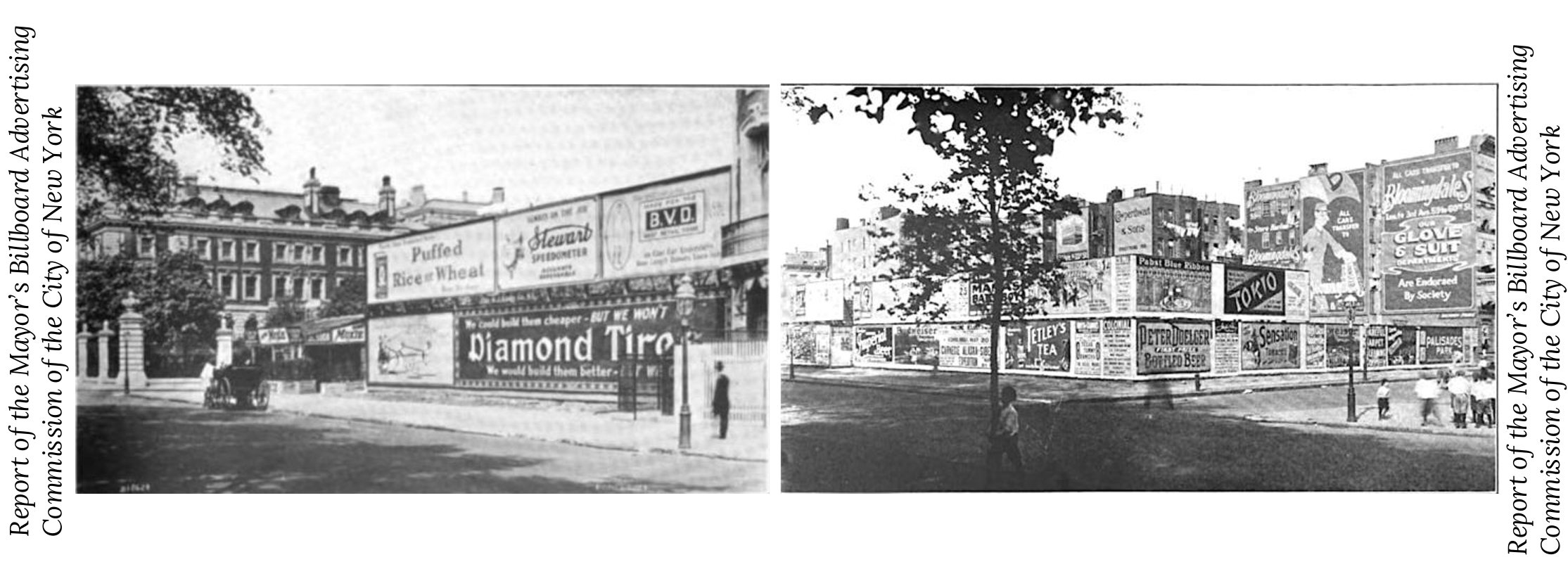
An attempt was made to rein in the billboards through the work of Mayor William Gaynor’s Commission on Billboard Advertising. The commission’s recommendations were not enacted but did become part of the influential City Beautiful movement, which ultimately increased awareness of urban aesthetic considerations and historic preservation. Thanks to such efforts, the scourge of outdoor advertising has been vanquished from the Upper West Side. Wait, what?
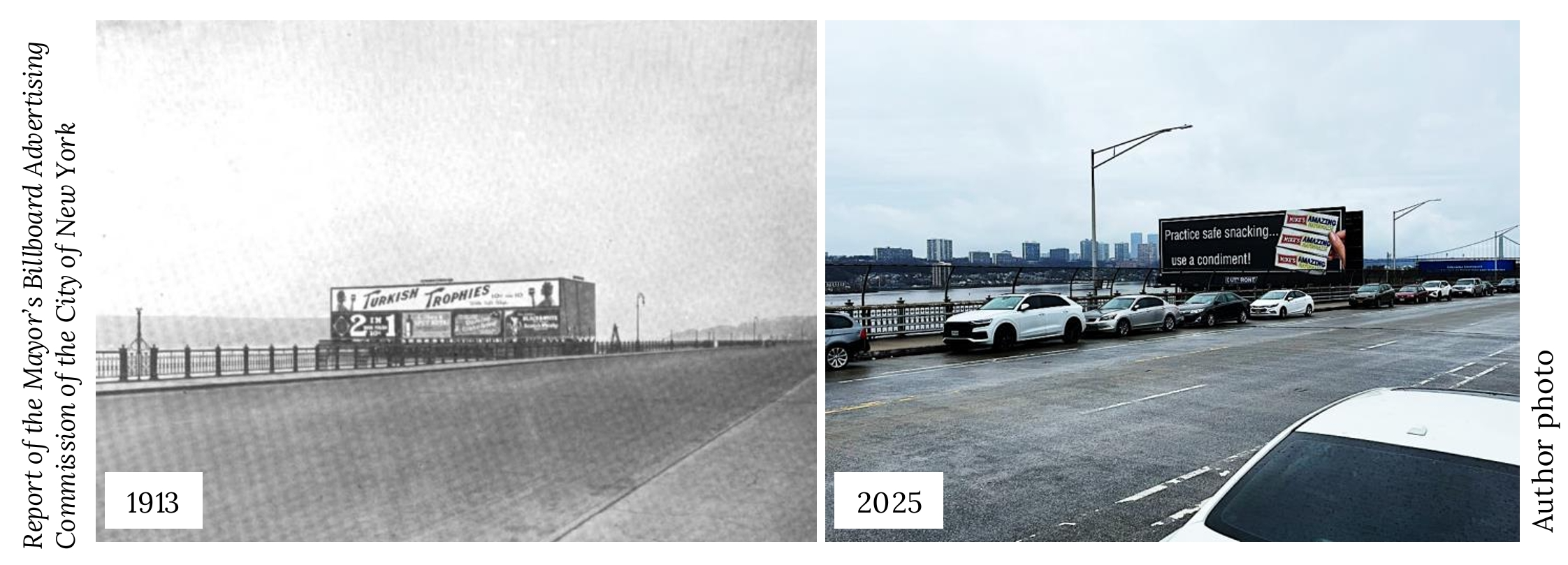
Shoutout to readers: This one wasn’t much of a challenge—many Rag readers recognized the 96th Street bridge. Anthony Bellov added some commentary on the Cliff Dwelling building; he and Alex and Tom Adams homed in correctly on the date as the mid-1910s.
…and that’s the story behind the mystery image. Now scroll back to the top of the column and take on your next challenge, Sherlockians! If you’ve missed any pictures in this series, here is the complete collection.
About the author: Rob Garber has lived on the Upper West Side since the late 20th century and is a member of the Bloomingdale Neighborhood History Group. To learn more, visit their website at upperwestsidehistory.org. All photos in Upper West Side Historical Photo Challenge are used by permission.
Subscribe to West Side Rag’s FREE email newsletter here. And you can Support the Rag here.



79th and Broadway, northeast side?
Going clockwise from top left: 110th and Broadway, north east corner.
Riverside Theatre
The Woolworths that is now Equinox on Broadway between 91st and 92nd.
Ok, the 4th is a mystery
I thought there was just a Woolworths on 79th? Where the PC Richards is now.
I could have sworn the Equinox space on 91st had been a Key Foods? Or maybe it had been a OTB. I know both were right there in the low 90s.
But this picture of Woolworths, it does look like the place where the Petco is.
Agree on no. 1. No. 4 address is visible: 1723.
Bottom right photo is NE corner of 79th St and Broadway
That Woolworths was on the corner. This clearly show a building to the right.
Top left: SE corner of 79th & Broadway
Bottom right: East side of Broadway, between 79th and 80th (and where I got fish for my short-lived aquarium, live tiny worms for my chameleons, and my very first rock and roll 45s and LPs!)
Photo #17 is the east side of Broadway between 79th and 80th Street. Sometime after this photo was taken, the “car” place next to Woolworth’s became Circuit City. As well, I think when the billiards place closed, it became a rug and carpet store (or that may have been above Circuit City).
My father (who was something of a pool shark) taught me how to play pool at this pool hall, and I became good enough to play in the junior high school championships. (I was then at the old I.S. 44 on 77th Street.) Never kept it up, though I remain a fairly good player to this day.
I also remember the lo-oo-ong lunch counter at Woolworth’s, and that they sold some pets (particularly birds) downstairs.
Great memories! Thanks!
Photo #17 is the east side of Broadway between 79th and 80th Street. Some years after this photo was taken, the car place became Circuit City. Woolworth’s became Filene’s, and then DSW, and is now P.C. Richards.
My father (something of a pool shark) taught me to play pool in this pool hall, and I became good enough to play in the junior high school championships (I was at the old I.S. 44 on 77th Street at the time.) Didn’t keep up with it, but I’m still a fairly good pool player.
I remember the lo-oo-ong lunch counter at Woolworth’s, and that they sold some pets (mostly birds) downstairs.
Great memories! Thanks for posting!
The Woolworths must be 79th street and Broadway. The others I think are 77th and Amsterdam.
Upper Left – Amsterdam Av and 76 or 77th Street. Best pool hall in that neighborhood.
Upper Right – Riverside Table Tennis – 96th and Broadway – next to the movie theater. Marty Reisman supposedly played there (and maybe ran it at one point).
Lower left – 55th and Bway – Premier apt there now; was a Horn & Hardart Automat next door.
Lower right – 79th and Bway – above the Woolworth store.
Lower left — Broadway near 104th St (if my sleuthing on Horn & Hardart is accurate).
Lower right — 79th and Broadway., where Woolworth’s used to be.
Ping pong venues:
Upper left, W. 82nd St, N side between Amst/Bway.
Upper right, W. 79th St., N. side, near Bway.
Lower right, W. 79th St., at Bway, N. side.
Lower Left, W. 95th and Bway, East side, across from Symphony Space.
Top Right photo is Looking North West of the NW Corner of 96th and Broadway. The staircase is the fire exit to the Riverside Theater, one of 2 movie theaters in the block North of 96th on the West Side of Broadway. (now that out-of-place orange building). I remember seeing films at the Riverside– and when it collapsed c.1974. This photo is from the 1920s or Early 1930s. In my day there was a Chess place upstairs called Chess City, facing Broadway, but I couldn’t say what the continuity might be with this photo, unlike today, places used to hang on a lot longer than they do now. In 1974 I saw Boris Spassky there, play 40 People at once. They had the tables arranged in a circle with him on the inside moving from board to board (Somewhere I have pictures). Chess City later moved further uptown on Broadway around 100th Street, maybe, also upstairs, but only hung on a little while longer. This was the period of seismic transition on the UWS.
I do not remember ping pong at this location, I’m sure it had moved on, however, there was, later, a ping pong place just across 96th Street next to the NYC Transit Substation- (now 266 W. 96th Street) into the early 1980s. We used to play there after school.
The Bottom Right is 2465 Broadway (Still there) Now it’s some kind of Gym with that new monstrosity of a building hanging over it.
(This is not to be confused with the Woolworth’s at 2222 Broadway (& 79th Street) which also had a billiard hall above it). In the bottom right of the photo you can see 251 West 92nd Street in the top right corner.
The other 2 I don’t recognize off hand– Or would have to study a bit more.
Broadway used to have a lot of these low buildings with stores below and some kind of Pool Hall or Dance Studio above.
Though Stuyvesant’s name somehow got attached to one of NYC’s best high schools as well as Stuyvesant Town, I don’t know why an apartment building would want his name associated with it—a man who significantly increased the slave trade in New Amsterdam and was so widely disliked by the Dutch citizens he ruled that they welcomed the British without a fight. I guess we should be grateful for the name change to New York that followed the surrender but it seems like the apartment developers could have picked a more honorable namesake than Peg Leg Pete’s. Just my opinion.
These brought back some memories growing up in the neighborhood. Best guesses, top left, going clockwise: pool hall and table tennis, 86th & Broadway near Tip Toe Inn and Loft’s Candy; Marty Reisman’s downstairs ping pong place, off the NW corner of 96th & Broadway, where I played as a kid and watched my father volley with Marty; table tennis place above the old Woolworths on 91st & Broadway; and another TT place between 54th and 55th on Broadway, next to what was the Hotsy Totsy Club. Missing is another pool hall upstairs on the SW corner of 96th & Broadway, where a friend and I, playing hooky, watched a fight break out, with thrown pool balls and broken cue sticks.
• Bottom right: the Broadway Courts (AKA “Lawrence’s” after Herwald Lawrence), at 1721 Broadway between 54 & 55th Streets. (A tad outside UWS neighborhood, eh, Rob?) Earlier, the site of notorious speakeasy the Hotsy Totsy Club, of Legs Diamond fame. In the 1930s this was home to the New York Table Tennis Association.
• Upper right: Duncan’s Club at 2555 Broadway (96th Street)?
(Continued from above)
Closer inspection puts the bottom left image as 1721-1723 Broadway. As some have pointed out. You can see the DuArt Building in the background on 55th Street (Still there and still in Business) As they have been for 100 Years. I peg the photo as depression era.
I Concur with Gary Dennis about 110th & Broadway for the Bottom Left– Amazed on how you got that with so little to go on. It is indeed the NE Corner, no traces remain of this one. So we might expect the photo to go back a ways.
My guess for Woolworth’s was initially 79th and Bway. But that Woolworth’s was on the corner and this photo shows a building to the right. So I would have to agree with those who place this at 91st street, but I don’t recall that space.
Yes, the photo on the lower right is definitely the west side of Broadway between 91st and 92nd. I’m puzzled that many are identifying it as Broadway at 79th—the architectural details don’t match up.
Marty Riessemans place 96th off bway!
Upper right panel is definitely Broadway & W. 86th. Fans of the early 70’s film THE SEVEN UPS will recognize that outer fire escape from the extended car chase sequence. Driving westward, 86th slopes downward with each passing avenue. The cops chasing the villans in the film speed past that intersection in a great POV shot where you can see that set of buildings to the right of the screen.
It’s be great if you also showed our current ping pong parlors on 99th and 100th.