


By Rob Garber for the Bloomingdale Neighborhood History Group
Welcome to another installment in the Rag’s Historical Photo Challenge. The images above were taken somewhere on the Upper West Side, sometime in the past. Can you figure out where, when, and what they show? Look closely; this week’s challenge photos, like the others in the series, include clues that will help you identify the scene, if you’re a dedicated UWS history sleuth. And even if you don’t recognize the pictures—not to worry! Come back in two weeks and I’ll decode them, show you the clues that help identify them, and—best of all—tell you a story the image unlocks, because this column isn’t just a test of your neighborhood knowledge; it’s also a rolling celebration of the people, buildings and events that wove the tapestry of the Upper West Side.
Ready? If you think you know where and when the photos were taken and what they show, post your answer as a comment on this column.
Solution to Historical Photo Challenge #15
Subject: Schwab Mansion and Ansonia Hotel
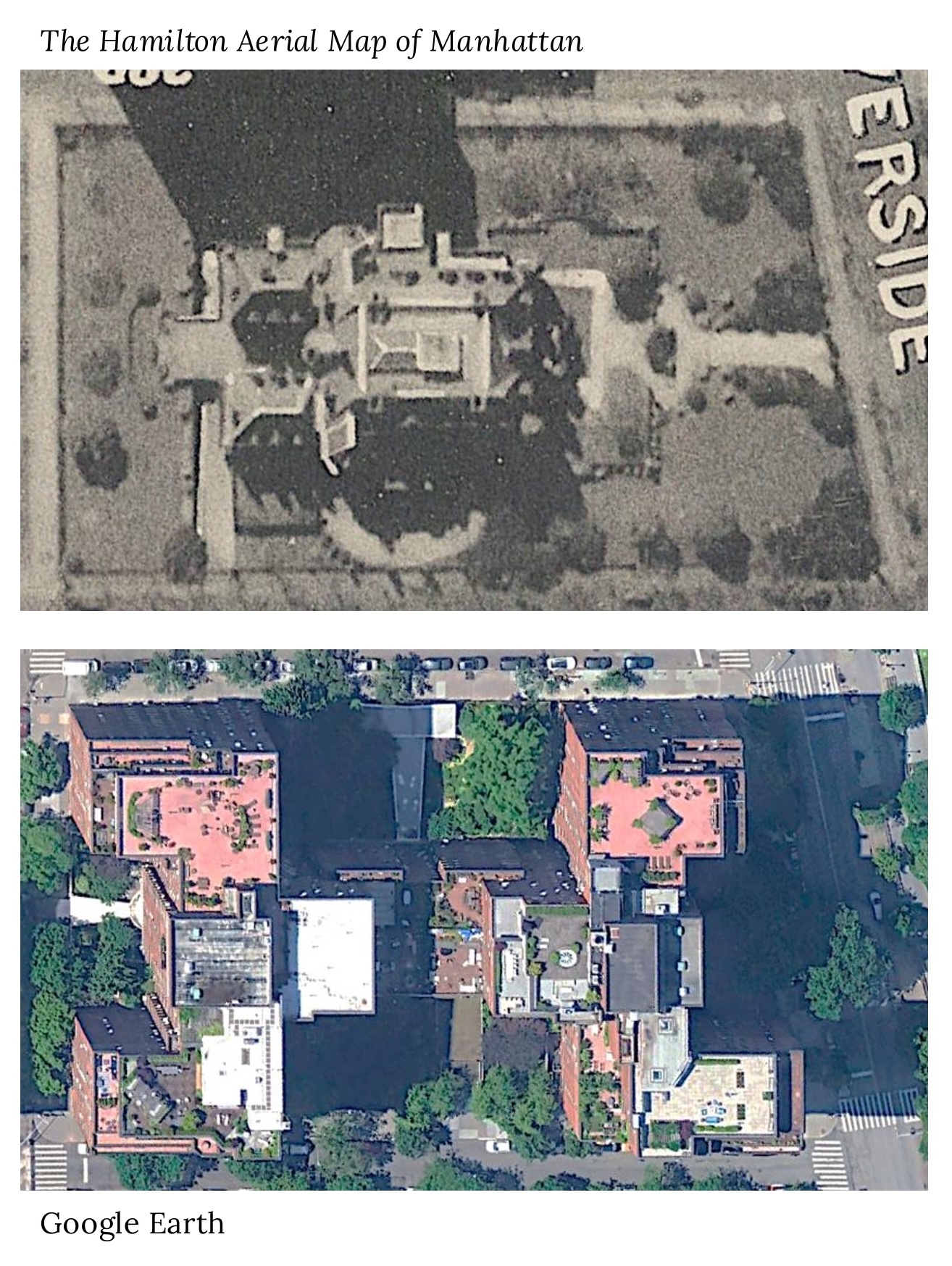
Location: West 73rd – 74th Streets from Riverside Drive to Broadway
Year: September 1909
Source: Library of Congress LC-DIG-det-4a16123
Clues: Both of these extraordinary buildings are iconic and will be recognized by even casual UWS history buffs, but this view, superimposing Schwab in front of the Ansonia as seen from a vantage point in the Hudson River, is unusual. The crowds in Riverside Park and the signal flags on the ship’s stays are clues that the photo was taken during the Hudson-Fulton Centennial Celebration in 1909, which included a naval ship parade. Today, the Ansonia is hidden from the river by Schwab House, the 19-story red brick complex that was erected in the 1950s on the site of the former Schwab mansion.
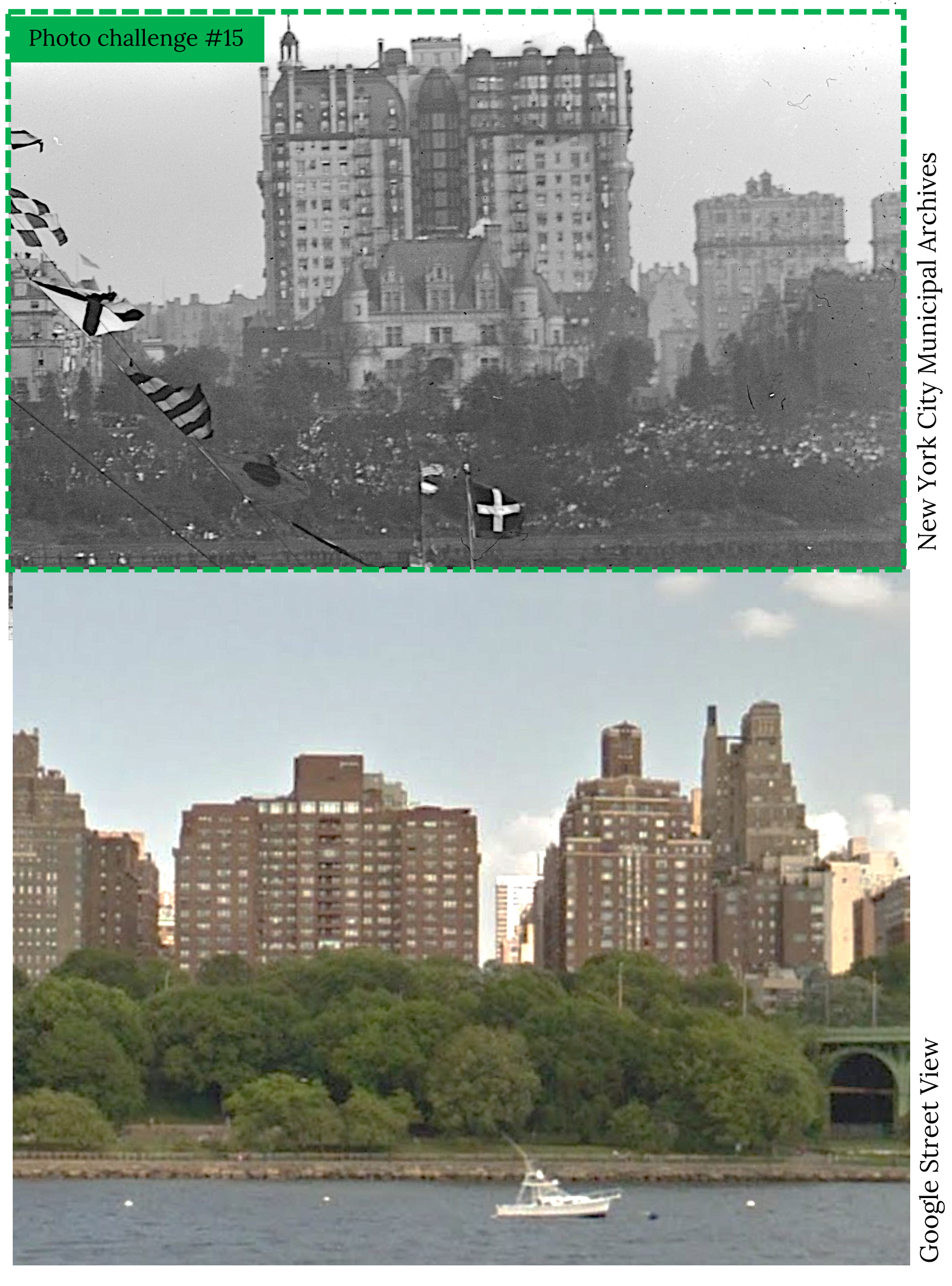
The rest of the story: The Ansonia Hotel on Broadway between West 73rd and 74th Streets and the Schwab Mansion, 800 feet away facing Riverside Drive, were late Gilded Age symbols of wealth. Both were constructed between 1899 and 1906, just as the subway extended to the Upper West Side and changed its character forever. The architecture of the two fabulous piles has been well described elsewhere; what about the personalities behind them? The Ansonia, which has undergone many internal changes but whose exterior still reigns mostly unaltered in complacent stateliness over the heart of the Upper West Side, was the idea of William Earl Dodge Stokes, heir to a fortune in mining and banking who put his energy into real estate development. As it neared completion, Charles M. Schwab—no relation to discount brokerage innovator Charles R. Schwab—bought an entire block on Riverside Drive and proceeded to order up the largest mansion in America, modeled after a French chateau. As if to prove that money can’t buy happiness, both Stokes and Schwab lived private lives that were less than admirable. Stokes twice married women less than half his age, was shot by one of his lovers, and was accused in a divorce suit of keeping dozens of chickens in his apartment. Schwab, in apparent contrast, was an outgoing, glad-handing American success story. Uneducated yet manically hard-working, he caught the eye of Andrew Carnegie and soared to wealth the old-fashioned way: on the backs of steelworkers. His hyper-ostentatious mansion on Riverside Drive left journalists gasping for adjectives, and its bedroom count (75? 90?) was even greater than that in Schwab’s other mansion on his 1,000-acre estate in Pennsylvania. But look at the 1920 census record for 21 Riverside Drive: Charlie, his wife Eurana, and 20 servants. It reads like a scene out of “Citizen Kane.“

Charles Schwab gambled and yachted his way through the Roaring Twenties, but unlike the Ansonia, Schwab’s mansion barely outlived Schwab. Hammered by the Depression, he lost his chateau and died bankrupt in a one-room apartment. The mansion was offered to and rejected by the city of New York for use as the mayor’s home—it was hardly Fiorello LaGuardia’s style—and razed in 1948. Today, 2,000 people live in the Schwab House apartment complex, on the site where once dwelt the Schwabs and their servants. Sic transit gloria mundi!
Shoutout to readers: Frances Bernstein shared a splendid memory of going into the Schwab mansion just before it was torn down! DonB accurately speculated, and Steve D agreed, that the photo was taken during the Hudson-Fulton Centennial Celebration and correctly based his guess on the large crowds gathered on the banks of the river. Mike UWS added some nice architectural observations. I can see I’ve lulled you UWS historians into a sense of complacency with easy-to-recognize images like the Ansonia/Schwab combo. Don’t think they’re all going to be this easy!
…and that’s the story behind the mystery image. Now scroll back to the top of the column and take on your next challenge, Sherlockians! If you’ve missed any pictures in this series, here is the complete collection.
About the author: Rob Garber has lived on the Upper West Side since the late 20th century and is a member of the Bloomingdale Neighborhood History Group. To learn more, visit their website at upperwestsidehistory.org. All photos in Upper West Side Historical Photo Challenge are used by permission.
Subscribe to West Side Rag’s FREE email newsletter here. And you can Support the Rag here.



Riverside Drive at 96th St looking Northeast
That is the construction site for the Cliff Dwelling building – at 243 Riverside (high above 96th Street). FABULOUS photos! What clued me in was the torchiere on the bridge spanning 96th Street. There were once four of them – the plinths are still there – they were stolen right off their bases one night around 1980, probably for the scrap value of the bronze. SAD
Cliff Dwelling was built in 1914-1916 and designed by Herman Lee Meader – absolutely unique references to Mayan, Aztec and Southwestern motifs on the facade, The small units were initially built without kitchens but now it’s a Co-op and many units have been combined.
Of particular note are the brick swastikas high up on the facade – this is pre-Nazi and they were symbols of luck and peace back in early times. I like to point them out to my out-of-town friends as I lead them around Bloomingdale and watch them succumb in awe to our gorgeous neighborhood.
I’ll say it again – FABULOUS PHOTOS!!!
Anthony Bellov
If you try to look at that building on Google Maps just the top is blocked from view. Maybe that’s why.
Looks like Riverside Drive as it passes over 96th Street.
Excellent article!
I was going to also say 96th street and I left Manhattan in 1978, though I’d been back a few times since then.
Riverside Drive passing over 96th Street.
Construction of that strange elevated schoolyard/playground at 96th and Riverside?
I’m on the 96th and Riverside bandwagon, as well. For me the clues I see are the convex shape of the overpass and the sign for the Garage on the street below… back then a Garage was a place that fixed cars and sold gasoline, more than a place to park cars. 96th between West End and the river is the only spot I can think of that still has an old gas station on an east/west street on the UWS, much less all of Manhattan.
I walk this every day! It’s the Riverside Drive overpass over 96th (looking north and east). (The garage may still be there?). Given that the Siegel Cooper co went bankrupt before 1920, and the Cliff Dwelling apartment building was built in around 1914, I’m going to guess 1915 or so.
That is a photo of the bridge on Riverdide Drive above the 96st entrance to the west side highway
I believe the photo is of the short bridge over the westside highway at 96th street and riverside drive
Polo Fields
Upper picture: Riverside Drive (where it crosses the foot of W. 96th Street on a bridge) in the foreground, looking northeast toward Broadway. Building with the water tank on top is on the NE corner of 96th Street and WEA. The building I live in, 243 RSD (north corner of RSD & 96th Street) hadn’t been built yet, so I would guess the photograph was taken before 1917.
That’s Riverside Drive looking northeast from the southern end of the bridge/overpass at 96th Street. The building on the upper right, on the corner of 97th, is now blocked on the southern side. One of the torchieres was mysteriously stolen, I believe.
No question that it is the overpass of RSD over 96th Street. The garage is still there.
Upper photo location is near my house on Riverside Dr. It is Riverside Drive and the Drive overpass above West 96th St. that leads to the West Side highway. Building on the left features Aztec design and is still there. Billboards are gone.
It’s the DillPickleBall stadium where all games are played in reverse, so the walls are reversed.