


By Ellen Jovin
Visitors at my pop-up grammar advice stand often bring up long-ago language incidents and experiences—things that happened decades earlier in the classroom or around the family dinner table. Grammar nostalgia is real.
Some visitors want to know why sentence diagramming isn’t taught anymore. By sentence diagramming, they mean this:
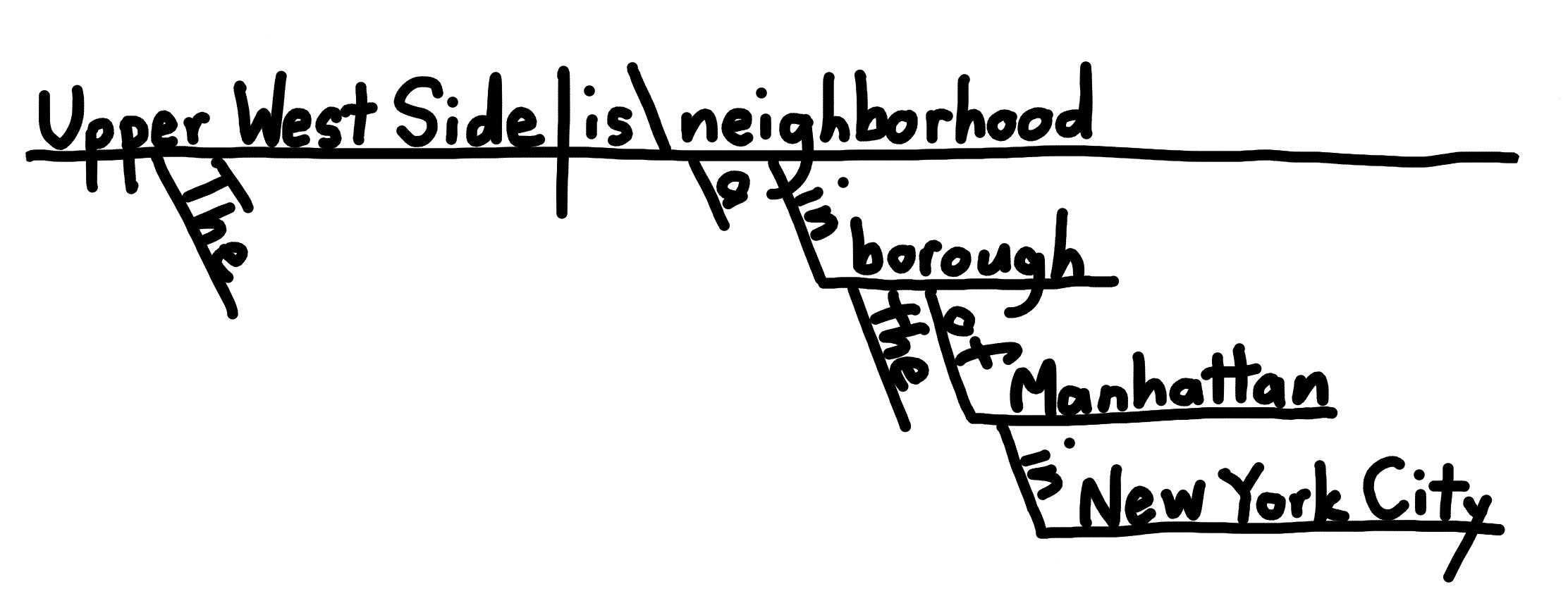
You are looking at a diagram of the sentence “The Upper West Side is a neighborhood in the borough of Manhattan in New York City.” There are different kinds of language-related diagrams—for example, syntax trees in linguistics. But when people bring up diagramming with me, they almost always mean the approach shown here, which was developed and popularized by Brooklyn professors Alonzo Reed and Brainerd Kellogg in the 1870s.
A full century later, on the other side of the country, I was taught to draw these same diagrams in my eighth grade English class.
You typically start with a simple subject plus verb. Let’s do “Neologisms proliferated.”

First you draw a horizontal line. You can draw it freestyle or use a ruler. (I never used rulers.) The subject goes on the left and the verb on the right, with a vertical line separating them.
I found this method mesmerizing from the moment I first encountered it. Throughout eighth grade, I looked forward to every new element we learned how to diagram.
Adjectives, adverbs, and prepositional phrases were all added under the things they modified.
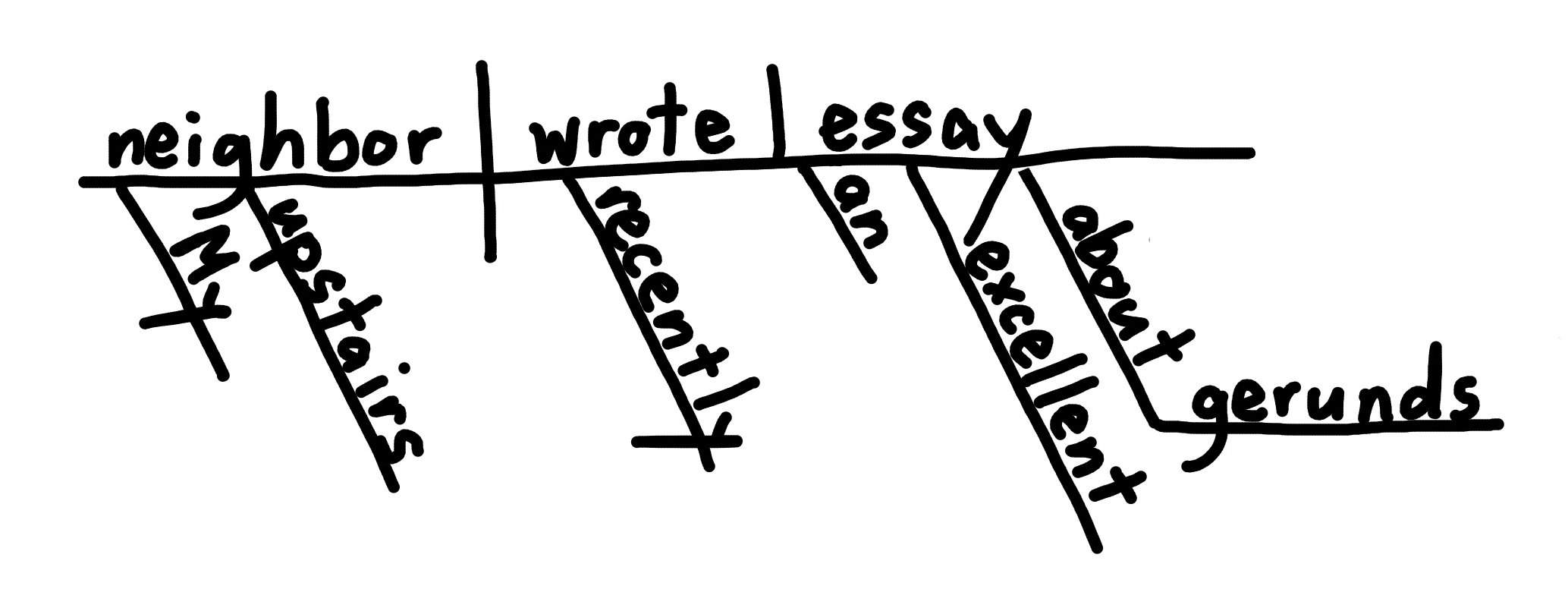
The diagram above is of the sentence “My upstairs neighbor recently wrote an excellent essay about gerunds.” In the diagram above, “My” and “upstairs” go under the subject “neighbor.” “Recently” is an adverb modifying the verb “wrote.” “An,” “excellent,” and the prepositional phrase “about gerunds” all get stashed under “essay,” which is the direct object of “wrote.”
Note the difference between the longer vertical line separating the subject and verb and the shorter vertical line separating the verb and direct object. It was easy to space out and put the wrong kind of line.
Recently at a Massachusetts screening of Rebel with a Clause, I met the author of the 2006 book “Sister Bernadette’s Barking Dog: The Quirky History and Lost Art of Diagramming Sentences.” Her name is Kitty Burns Florey, and Sister Bernadette was the nun who taught her to diagram. I bought Kitty’s book the second it came out almost 20 years ago and consumed it in one big grammar gulp. Running into Kitty is like my version of running into Britney Spears.
“I’ve written 17 novels, but that’s the book that got the most attention and outsold them all,” Kitty told me.
See what I mean? Grammar nostalgia is real.
Back in 1979, pretty much every compound structure was a thrill to me. As an eighth-grade diagrammer, I adored compound sentences, compound subjects, compound verbs, compound objects, compound everything.
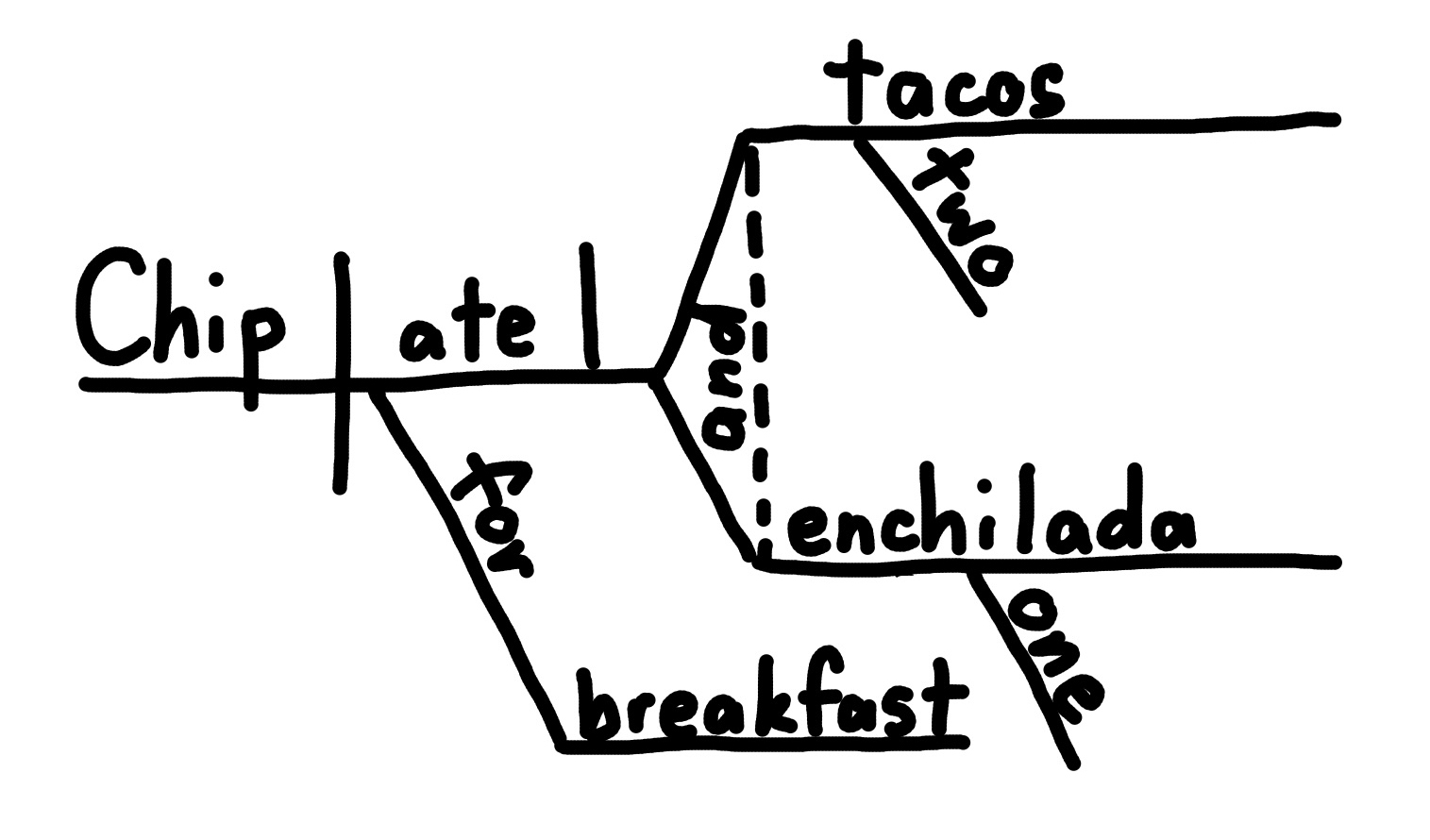
This diagram about Chip and his food consumption shows a compound direct object consisting of two tacos and one enchilada.
Compound elements always involved at least some dotted lines, and dotted lines looked technical and scientific, and that made my 13-year-old self feel very grown up.
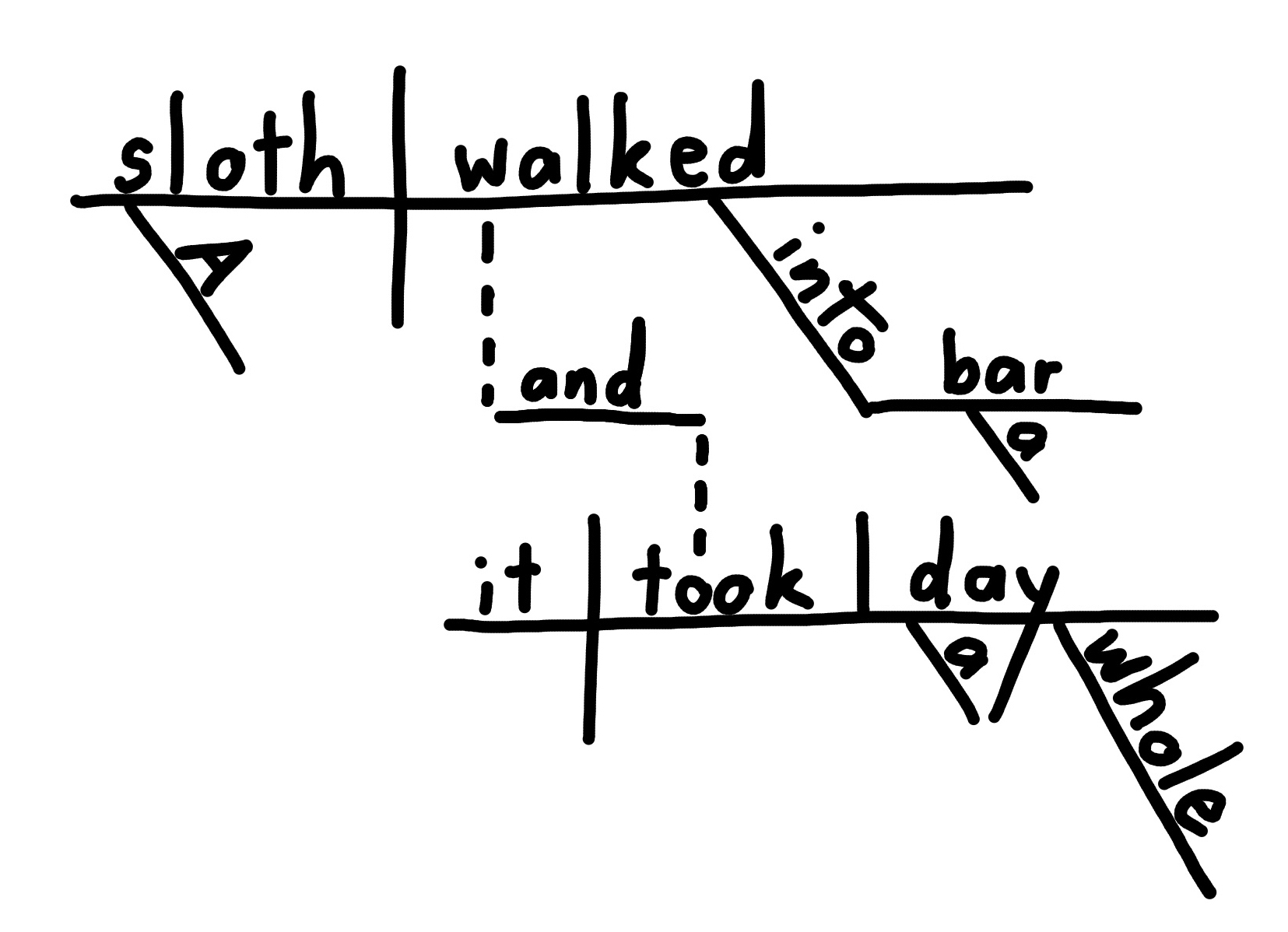
This diagram above is of a compound sentence. Two independent clauses (“A sloth walked into a bar” and “it took a whole day”) are combined with the coordinating conjunction “and.” The sentence is only 12 words long, but the diagram makes it feel fancy.
About a decade after I graduated from high school, I wrote to the English department at my old school to ask if they still taught diagramming. A teacher whose name I didn’t recognize wrote back to say they did not. At first I was shocked. Then I got over it. There are all kinds of ways to become sophisticated users of language. Sentence diagramming was an instructional method with long legs and endurance, but it is now mostly defunct in education, and that’s OK.
Occasionally people tell me that diagramming helps them write more clearly. I am skeptical of such claims. I will require video evidence that people writing an essay or an email suddenly stop, get out a piece of paper, diagram a sentence, and then go back to writing—except more clearly this time, because they have just diagrammed. However, I do find grammar knowledge valuable, empowering, and fun. I use that knowledge regularly as I write.
It’s also important to excite kids about language, and I was excited by diagramming. A friend who had a different experience with it, on the other hand, posts vomit emojis whenever I mention diagramming online.
I know of two schools in New York City that currently teach diagramming, and I find the students there to be unusually knowledgeable about grammar. While I am no diagramming activist and don’t have an opinion about how best to teach grammar to young people, I am unenthusiastic about skipping explicit grammar instruction in favor of grammar by osmosis.
In case you are in the mood for more grammar flashbacks, I have three diagramming videos on my YouTube channel.
If you’ve had enough, no problem, because there’s no homework at this grammar column!
Ellen Jovin is the author of the national bestseller Rebel with a Clause and the subject of a new grammar docu-comedy by Brandt Johnson, also called Rebel with a Clause, which is playing in select theaters around the country.
Subscribe to West Side Rag’s FREE email newsletter here. And you can Support the Rag here.





Thank you, Ellen Jovin. Even though sentence diagramming is mosty a thing of the past, you and your lessons are a treasure in the present1 Carol Ardman
Thank you, Carol!
In the late 1950s diagramming was not used in the public school system in Maplewood, New Jersey
Nuns taught me sentence diagramming too and we had to do it a lot, over several grades. I had an affinity for grammar and it has served me well. I’ve published three books of literary poetry and I worked as a a book editor for many years. The only down side for a grammarian is suffering constant cringing when encountering wretched grammar and spelling and verbal misuse when reading online. Does no one know the difference between “lose” and “loose”? Can no one feel embarrassment when their participles are dangling?
I’m with you, Cathy! My mind boggles when trying to decipher who is saying what to whom. And don’t get me started trying to figure out what app was used to translate some foreign language into English – because the words I’m reading don’t have even a remote connection to the intended meaning of the sentence they’re being used in.
Thank you, Ellen!! But I’m with your friend: 🤮🤮🤮🤮🤮🤮🤮
lol
Diagramming activists! Let’s mobilize!
Never understood the benefit of diagrams. Looking at them independently, they are not helpful in determining how the sentence should be properly read. For example, in the “Chip” example above, the positioning of the first extension under “ate” suggests the sentence should read: Chip for breakfast ate . . . Awkward.
It is “For breakfast Chip ate”. #perpsective
great, now I want two tacos and one enchilada for breakfast. thanks. 😩
Back in the early 60’s I learned how to diagram sentences in my Catholic elementary school. They started teaching it somewhere around 3rd or 4th grade. I loved it! It really taught me how to construct a sentence 🙂
Same here! Exactly! I loved sentence diagramming and, it was one of the few things I loved about being taught by nuns!
My 5th grade teacher, Miss Chase, was a big proponent of diagramming sentences. When she would announce a diagramming session, many of my classmates would grown. I would silently cheer. It seemed so logical to me. Of course that was 67 years ago. I’m not sure how I proficient I would be at diagramming today, but I firmly believe it gave me a grammatical foundation that has served me well throughout my adult life.
Great to see some diagramming (which we weren’t taught in elementary or H.S.) I did take a “Symbolic Logic” class in the Linguistics Dept. in college of which this reminded me. Keep up your enthusiasm Ellen!
I went to Catholic grade school and high school in the Bronx in the 1950s and 1960s, and diagramming sentences was how we learned grammar. I loved this process. I firmly believe that it’s what helped me become a professional copywriter and then editor of other writers’ work. I also had 4 years of Latin and 3 of French in high school, as well as French in college, and the ability to “deconstruct” a sentence into its various parts helped me to be good in foreign languages as well. I started studying Italian after age 50 and find I continue to analyze sentence structure to this day. I still have my high school grammar textbook, called “English Sentences,” which I took with me to every job I held throughout my career. I remember vividly the first sentence the book diagrammed which became iconic in our classroom—“The bird sings sweetly.” I truly believe students would benefit today from understanding how to diagram a sentence. Thank you for a wonderful article.
I love this. Just went and bought “Sister Bernadette’s Barking Dog: The Quirky History and Lost Art of Diagramming Sentences.” It will go right next to your book and one day they will both get read.
😄
This group might enjoy Wordhunter by Stella Sands (Harper), a detective story that features a forensic linguist. As I recall, every chapter includes a sentence diagram! (Disclosure: I proofread an early pass. How could I not accept the job?)
This group might enjoy Wordhunter by Stella Sands (Harper), a detective novel featuring a forensic linguist. Every chapter includes a diagrammed sentence! (Disclosure: I proofread an early pass. First learned to diagram sentences in eighth grade in Maryland. College course on Structure of the English Language covered several approaches to diagrammmng.)