


By Eric Schwartzman
Zabar’s is a full-contact sport. You can’t shop there without bumping into someone and overhearing opinions about Alfonso olives or pickled herring.
It’s 8:55 a.m. on Wednesday morning, and the place is already humming. A customer is mid sentence with a deli guy, and the maintenance man from the air conditioning company barks, “Who called for AC service?” Next, an older couple from the neighborhood chimes in, “Who can help me get our deli platters out to the cab?” Cold cases are being restocked with cole slaw and horseradish, bearing the bright orange Zabar’s logo.
And yet, this morning, it’s not exactly business as usual. Saul Zabar, the man behind the Jerusalem of delicatessens, died Tuesday at the age of 97. He hadn’t been coming in regularly for some time. But it still felt like something was missing. The store’s rhythm hasn’t changed, but its pulse feels different.
A New York Times obituary chronicled Saul Zabar’s life, explaining how he left college and returned to the family business after his father’s death, and how he and his brother grew a narrow counter into an institution revered by Jews and gentiles alike. In contrast to the Times biography, this is the story of what he leaves behind: a full-fledged department store with the heart of a family deli.
Front-end manager Ken Hom answers questions from three directions at once, yet never loses his place in the story he tells about Saul. Hom, who has worked at Zabar’s since 1985, said Saul’s primary focus was the fish and the coffee. “He was completely hands-on. He developed recipes and kept tasting until it was right.” Zabar’s Blend, the house coffee still roasted in bulk each week, was developed under Saul’s watch and remains true to his formula. The store still roasts about 8,000 pounds of coffee beans a week.
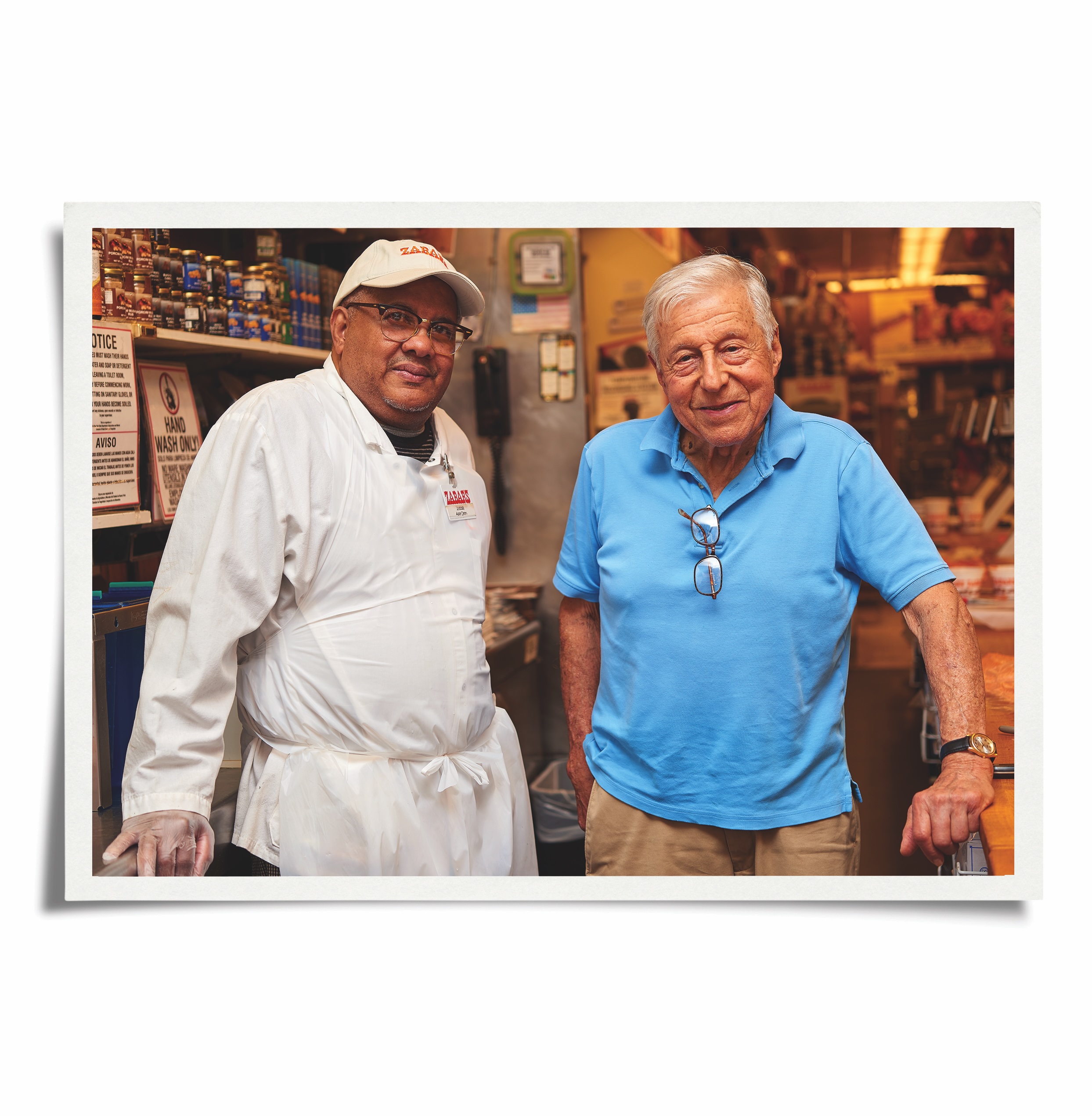
At the appetizing counter, Tomas Rodriguez, 40 years on the job and more than 30 working alongside Saul, described what it takes to carve and lift perfect slices of Nova Scotia off of a filet. “Good knife, good salmon, good hands,” he says. Rodriguez keeps several knives close—one for Nova, a serrated knife for sable, and another knife for sturgeon. The fish counter’s output is steady. Zabar’s sells roughly 1,000 lbs of salmon a week, and about 100 lbs of sturgeon.
Juan Gil, who manages the coffee department, remembered Saul as a boss who listened. “He was excellent with employees,” Gil said. “You could talk to him about anything. He listened like family.” According to Hom, Saul found the right people, put them in charge, and then walked the floor every day in his prime, as often as he could, to make sure his principles were upheld. He practiced the kind of grace that Dale Carnegie preached.
It isn’t only the products that carry tradition here; it’s the sound of the place. Even the staff who didn’t grow up Jewish, speak with that unmistakable Upper West Side inflection. Ken Hom has it, and so does a Puerto Rican meat-counter guy who speaks with a Yiddish-style intonation. At Zabar’s, the accent and basic Jewish fluency come with the job, and the constant banter makes shopping there engaging on every level—emotional, intellectual, and physical—as the smell of fish, fresh bagels, and coffee infuses the air. It’s an appreciation for quality that brings everyone together, a quiet understanding that anyone shopping here shares the same reverence for good deli. Just being there makes you a member of the club.
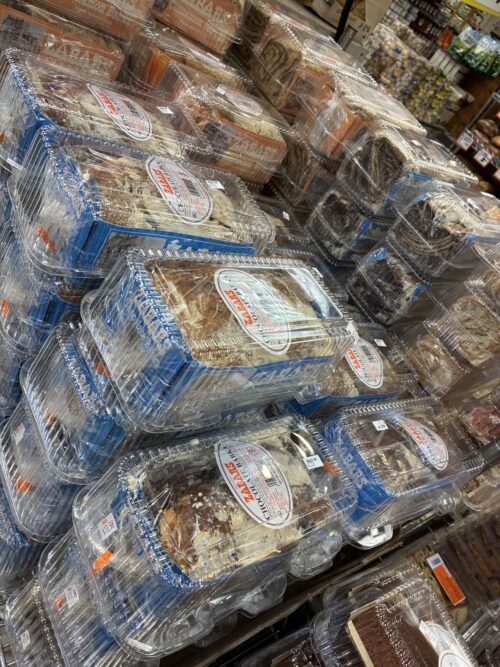
And then, of course, there’s the chocolate babka, legendary coast to coast. Designer Jonathan Fong in Los Angeles says, “That stuff is like gold.” He stashes a loaf in his carry-on whenever he flies home. The chocolate spirals running through the sweet dough are every bit as much a signature of this culinary landmark as the bright, chunky orange logo reminiscent of sliced salmon. In a store known for smoked fish, the babka is proof that Zabar’s consistency extends to every corner of the delicatessen.
On the Upper West Side, Jewish deli owners are real machers [important, influential people]. Gary Greengrass is a third-generation deli owner at Barney Greengrass, established in 1908 by his grandfather. Ira Goller took over Murray’s Sturgeon Shop from the Matusow brothers in 1990, who bought it from fishmonger Murray Bernstein, who opened his doors in 1946. As keepers of a 100-year-old culinary tradition that has nearly vanished everywhere else, both men spoke kindly about Saul Zabar.
Repeatedly interrupted by counter staff between answers, Gary Greengrass said Saul was, “an iconic person on the West Side” with a “huge impact.” His key to success was, “Stick to what you know… stay in your lane.” He admired how Zabar’s grew but never lost its center, which remains smoked fish.
On Broadway at Murray’s, Goller said, “The proof is in the success.” Goller runs his business by the same rule: taste everything, send back what isn’t right, and trust that the customers will notice. “Everything here has a fan base, or it wouldn’t be here,” he said.
We owe a debt of gratitude to the next generation for keeping Zabar’s what it has always been. Saul’s children, Aaron and Ann Zabar, have taken the reins, carrying forward the rhythm their father built. For those of us who rely on the place, that continuity matters. It means New Yorkers who know from gefilte fish can still walk in an hour before a holiday—Passover, Rosh Hashanah, take your pick—and leave with everything they need, wrapped, labeled, and ready. You don’t have to lift a finger. The miracle of Zabar’s is that after 90 years, it still works exactly as it should.
Delicatessens cannot survive on likes, comments, and followers. They need real customers to show up and take a number. At the deli, evidence of quality is measured by actual consumption, rather than just clicks. On a weekend morning, you can wait as long as an hour to get fresh sliced Nova Scotia smoked salmon. That wait is the real vote of confidence. It’s not an algorithm; it’s a covenant between customers and consistency.

If a business grows from a single counter into an institution, it’s because the product holds up, day after day, decade after decade. That is Saul Zabar’s legacy: a standard that has been holding up 365 days a year. The crowd still leans and reaches, the counters still hum, and the line still moves—proof that Saul Zabar’s standards hold.
Eric Schwartzman is an author, journalist, and marketing consultant who recently relocated to the Upper West Side from Santa Monica, California. His work appears in Fast Company where he writes about how technology changes popular perception. His website is https://www.ericschwartzman.com/
Subscribe to West Side Rag’s FREE email newsletter here. And you can Support the Rag here.




Here, here!
That’s “hear, hear”!
LOL. While you are technically correct, I think BOTH actually apply in this case! 😉
Very well written. Thanks. You captured the essence of the store and the man.
I hope all of these stores last forever. They are the true essence of what this neighborhood is all about, as shiny buildings for the super wealthy and chains stores go up around them (and I am actually one who likes chains, but only mixed in with the locals).
I am very sad and, as an UWSer, profoundly grateful to Mr, Zabar and his family for their contributions to our community’s quality of life. Well done, Mr. Zabar. You created a well-earned and honorable legacy. Rest in peace.
Zabar’s babka is made by Green’s Bakery in Brooklyn and is available at dozens of different stores.
Well, aren’t you the kind-hearted pedant!
My sincere condolences. Saul Zabar made a vision a reality. Zabars is the voice and face of the upper West Side.🙏
Coffee straight from the roaster is not going to smell like anything but burnt grass. I’ve been roasting my own green beans at home for over two decades, so I know. Roasted coffee beans are not going to smell like roasted coffee until at least 24 to 48 hours after they’ve had the chance to expel their own CO₂ and then become aromatic.
Such an appropriate comment. I take it your friends never ask you to write their eulogies.
😂
Exceptional story on an iconic New Yorker. Thank you.
Beautifully written piece about a Westside legend. Thanks
Thank you for giving us this taste.
With lox and knishes to all.
Wonderfully written. Thank you Eric Schwartzman. You just relocated from LA? You captured everything ….the whole soul of Zabars, the exceptional deli guys, and how important Zabars is to the UWS. Sadly, the neighborhood is in a very down period. More empty stores than most parts of the city. Nothing to look at here but lots to eat which doesn’t really satisfy shoppers or anyone needing a lightbulb after 8pm. We lived in LA; enjoy NY!
And yet its never been as expensive. to live here A demoralizing combination.
For any who don’t believe, stop in the store a day before Rosh Hoshana or Passover. The lines at the deli counter are 5 or 6 deep and every register is going full speed.
Kudos to you, Mr. Schwartzman, for a beautifully written tribute to Saul Zabar and his iconic store. The photo selection is superb as well. Back in 1972, I had just moved to West End Avenue & 84th Street. After unpacking everything, I went out to pick up a few grocery items. The closest store was Zabars, which at that time had a single storefront, I remember saying to myself, while shopping: “Wow! They have nice grocery stores on the Upper West Side.”
One I do not miss is Williams BBQ, which killed my 100-year-old great-aunt by selling her a turkey laced with salmonella.
Yes. When I lived in other cities Zabar’s was what I missed about NY & my mother would mail me Zabar’s coffee. .