

 By Ellen Jovin
Investigate any number of grammar arguments going on this very second around the Upper West Side and you may find the word “that” at the heart of them. Where “that” goes, furor often follows.
People argue over whether a “that” should be a “who.” Or whether it can be a “which.” Or whether multiple consecutive “that”s are acceptable. Or sometimes whether a “that” should be there at all. “That” is picked on, and it isn’t fair. It deserves better.
Before we address these various grammar kerfuffles, let’s take a moment to admire the impressive ambition and versatility of “that”:
- demonstrative pronoun: That is a pointless edit.
- demonstrative adjective: That comma omission is unacceptable.
- conjunction: I feel that your capitalization is out of control.
- relative pronoun: The edit that you made caused two dangling modifiers.
- adverb: Your punctuation T-shirt is not that stylish.
This grammar versatility increases the likelihood of “that” pileups. Two in a row are common, and people often dislike word duplication.
I personally don’t mind the double “that” in “I doubt that that punctuation-free lifestyle will please them for long.” The first one is a conjunction, and the second is a demonstrative adjective. If you delete the conjunction to avoid repetition, it is possible a reader will misread your remaining “that” as the conjunction on the first go-through. Not a big deal, but it happens.
Sometimes an actually helpful “that” is deleted for the sake of word count. While I believe in economy of language, word count isn’t everything.
Please read this:
We didn’t believe Robin
would lie.
For that tiny dot of time it took you to return to the left margin, did you think Robin was a liar? Adding a “that”—“We didn’t believe that Robin would lie”— makes even temporary ruination of Robin’s reputation impossible.
Another thing people are definitely arguing about somewhere on the Upper West Side right now is whether “that” can be used for people. Merriam-Webster says, “The notion that ‘that’ should not be used to refer to persons is without foundation; such use is entirely standard.”
I tend to use “who” with people in writing, but a New Yorker article about a show called Bum Bum Train includes an utterly typical example of a human “that” in its second sentence: “The illuminated sign, and the handful of nervous-looking people that gather outside four evenings a week, are the only clues that there’s something odd going on.”
In A Star Is Born, Judy Garland sang “The Man That Got Away”—not “The Man Who Got Away.”
There’s an endless supply of such examples out there, but it’s time to move on to “that” versus “which.” In which of the two sentences below are some grammar books saved from destruction?
- The grammar geek discarded the grammar books that were out of date.
- The grammar geek discarded the grammar books, which were out of date.
If you chose the first one, you are right. “That” is a restrictive relative pronoun there—it restricts or limits. In the second version, all the books are tossed. The “which” is a nonrestrictive relative pronoun; “which were out of date” describes but doesn’t limit the category of grammar books.
Here’s another version:
- The grammar geek discarded the grammar books which were out of date.
The meaning of this sentence is equivalent to the first sentence above, with “that”—not the second sentence with the comma plus “which.” The lack of punctuation matters more than word choice as an indicator of restrictiveness.
Many American English speakers would object to this third version, and I wouldn’t write it myself, but “which” has an illustrious history of being used in “that”-like ways.
In fourth grade, I memorized the Declaration of Independence, which uses a “which” restrictively by its nineteenth word: “When in the Course of human events, it becomes necessary for one people to dissolve the political bands which have connected them with another…”
I also read a lot of English novels as a child. English novels are awash in restrictive “which”s. Here are two in a single sentence from Mrs. Dalloway: “The violent explosion which made Mrs. Dalloway jump and Miss Pym go to the window and apologise came from a motor car which had drawn to the side of the pavement precisely opposite Mulberry’s shop window.”
And now I have a grammar confession. I have never admitted this publicly, but I am pretty sure that in the early 1990s, I changed some “that”s in student papers to “which”s. I hope I’m wrong about this, but if I’m not, I apologize to affected students for that ridiculousness. I would have been operating under the influence of English novels, which just goes to show you the kind of mischief that can ensue from excessive novel reading.
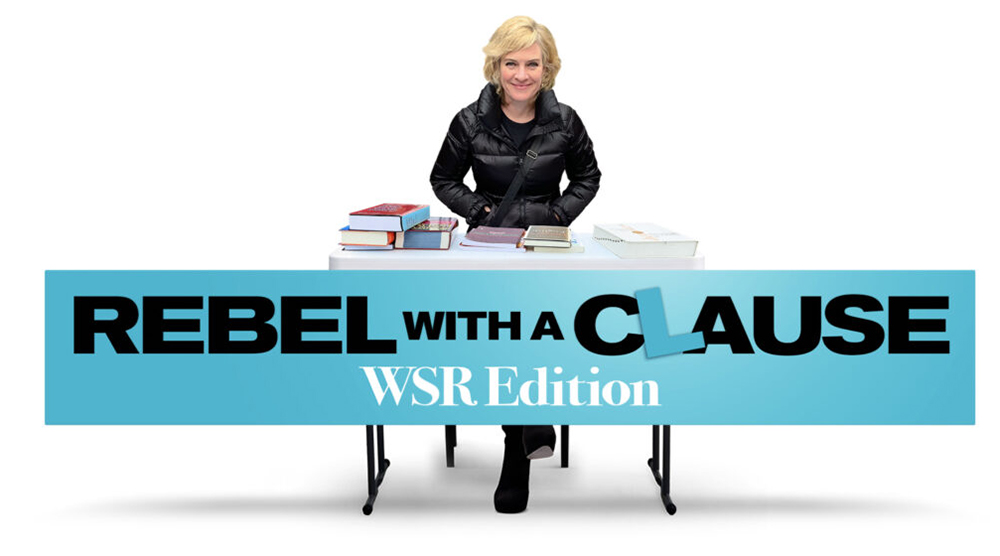
Ellen Jovin is the author of the national bestseller Rebel with a Clause and the subject of a new docu-comedy by Brandt Johnson, also called Rebel with a Clause, which is currently in residence at New Plaza Cinema on the Upper West Side and playing at theaters around the country. You’ll find a complete collection of her columns for the WSR — HERE.
Subscribe to West Side Rag’s FREE email newsletter here. And you can Support the Rag here.





On the test, John, where Judy had “had”, had had “had had”; “had had” had had the teacher’s approval.
Hah, and don’t even get me started on the version where the students’ names are (ludicrously) “Had” and “Had Had”!
very informative – in the that/which examples, what is the grammatical reason # 3 is an improper use of which? Is it because # 3 might still convey (ambiguously) the meaning of # 2?
I don’t consider it improper, but modern American English speakers aren’t so accustomed to it. If you see a “which” without a preceding comma in the wild here, yes, it is sometimes hard here to tell which meaning the writer intended—restrictive or nonrestrictive. Sticking to “which” for nonrestrictive and “that” for restrictive makes life easier. In business writing in New York, by the way, many comma-free “which”s are meant nonrestrictively, but people just neglect the commas. In some of those cases it is often genuinely difficult to know what the writer meant, and it can really make a difference.
thank you, your style and humor make this fun!
Ellen—brilliant essay about a subject that/which I have only learned to truly appreciate after several decades of tentative and grudging interest. For what it’s worth, your erudition+wit+humor+style are… just perfect! Please accept me into your fanboy ranks!
I am honored. Thank you, Will.
Thank you!
On the subject of “that” and “cat” – fun 1960s Disney movie That Darn Cat with Hayley Mills.
(not the remake)
As a long-time member of the grammar police (I majored in English through four years of high school and six years of college), the only thing I will always disagree with is the use of “that” when talking about people. It is “the people who”; e.g., “I don’t like people who…” not “I don’t like people that…” “That” should NEVER be used regarding people.
No one will ever convince me otherwise.
I agree with who.
Well, at least you avoided the Oxford coma issue, or is that for the next article?
Did it in the first column! 😀
In the second paragraph, the author refers to multiple consecutive “that’s”. Shouldn’t that be be plural “thats”’ and not possesssive?
Do you mean “that”s? It’s not an apostrophe—those are quotation marks. It’s a convention, not very attractive, for making words used as words plural. I did it elsewhere in the piece as well.
Can we discuss “feel” next, please, and how often it’s used inappropriately when “think” or “believe” are what should be employed instead?
[As in:
conjunction: I feel that your capitalization is out of control.]
I know that strictly speaking the matter is one of English language usage and not grammar, but it says so much about how people think–and how feelings are all-too-often conflated with (and confused for) thoughts, beliefs and facts.
Do you feel it’s wrong in that sample sentence? 😀
I admit that as a language geek, I enjoyed that.
i will pay for subs. where do i sign up
should be on website. support no help….
jwilliams
jfidelio15@aol.com