

By Michael McDowell
If you stand near Wollman Rink at the southern end of Central Park at 7 p.m., when New Yorkers throw open their windows and applaud the health care and other essential workers who’ve been tending to the sick and keeping the city running, the aural sensation—surround-sound applause—is comparable to what a performer must experience on stage at Carnegie Hall, the Met, or Madison Square Garden.
The profusion of cheers, hoots, and hollers; the chorus of pots and pans; the honking of horns and fluttering of sirens—the occasional vuvuzela—all floating above a roar of applause, are more than a communication of profound gratitude: they are a reminder, for each and every one of us who has remained in Manhattan, that we are not alone. That our neighbors and friends are still out there.
What follows this daily celebration is silence. I hear it every night. It is the sound of an overwhelming absence, punctuated occasionally by the wail of an ambulance or the crash of a garbage truck hurtling down a lonely avenue.
Streets are empty. The momentary presence of an airplane is almost an event. Beginning last week, overnight service on the New York City subway was suspended for the first time in 115 years, bringing to an end the final rumbling reminder of the way things used to be.
Some neighborhoods are quieter than others. On a recent weeknight, a man on roller-skis glided down the middle of Columbus Avenue, on the Upper West Side. Near 83rd Street, he cast a quizzical glance at a group of men in folding chairs arranged a safe distance apart on the sidewalk, their bawdy Spanish rising above a recording of Celia Cruz and Johnny Pacheco’s “Cúcala”. The skier continued making his way downtown, disregarding a near meaningless series of red lights. The men laughed.
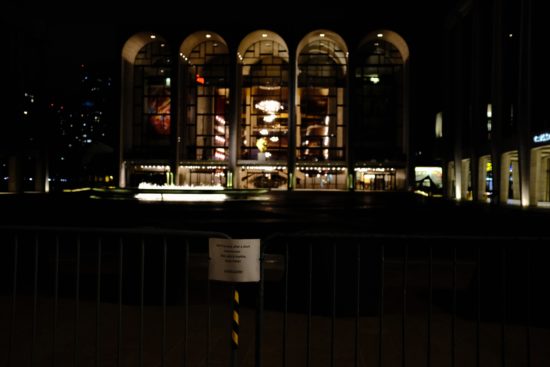
Nearby, a lone security guard patrolled the perimeter of Lincoln Center, which is barricaded, its fountain subdued and inaccessible. Weeks earlier, the Metropolitan Opera had laid off its orchestra.
Across Central Park, Madison Avenue is sepulchral, illuminated apartments the only indication of a human presence. Dusty letters are strewn across the parquet floors of empty boutiques. Sidewalks accumulate evidence of their disuse.
Fifth Avenue is entirely deserted. Solitary doormen in face masks observe ambulances traveling uptown on Fifth against traffic toward Mount Sinai. Once they pass the 65th Street Traverse, the ambulances often shut off their sirens, the glittering red of their lights collecting momentarily in treetops.
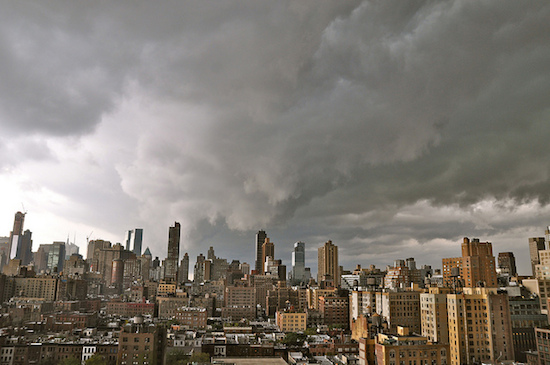
Glimpsed from Central Park, the Empire State Building continues to be lit in the pulsing red of a beating heart. On rainy nights, which have been frequent lately, the red glow radiates through thick clouds, and is particularly ominous.
It isn’t altogether so surprising that Midtown is deserted. But the hush of its empty canyons on these pandemic nights is far beyond that of the brief stillness of New Year’s Day, or of Christmas. Pausing to listen, one can hear the skyscrapers emit a faint hum, as if murmuring to one another, like trees in a breezy grove. Empty buses flicker in the distance, and emerge gradually, like the headlights of an approaching car on a rural highway.
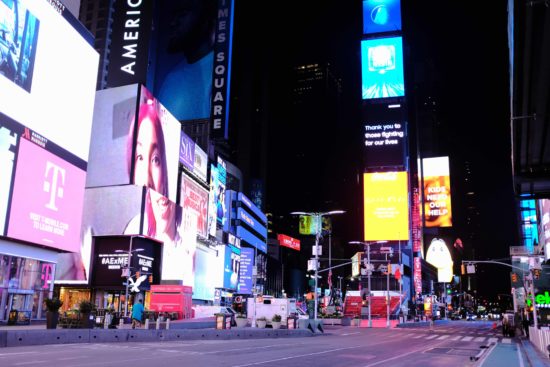
In Times Square, a lone musician busked. A man took selfies in the middle of Seventh Avenue. Video advertisements played to an empty house, enveloping a few teenagers occupying otherwise empty picnic areas in a weird phosphorescence.
Toward 34th Street, homeless men and women appeared in the darkness. Some stood in line near vans, where hot meals were being handed out. Others were camped in front of stores and restaurants that may never reopen. Forlorn streetlights blew in the wind.
In Union Square, a mask has been affixed to the statue of Mohandas Gandhi.
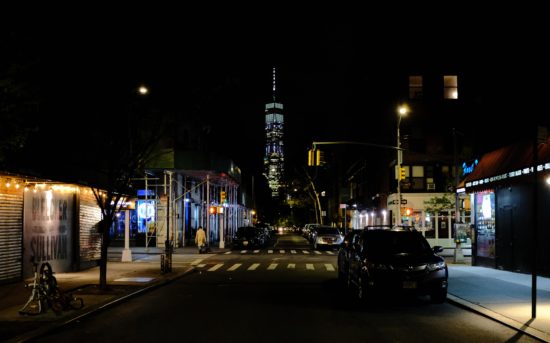
More than anywhere else, downtown is an empty theater experienced from the inside of the set. Rubbish is audible as it blows along an abandoned Bleecker Street. Signs creak. Banners wrinkle.
The presence of other solitary walkers, rather than reassurance, induces dread. Parts of the Village, more than anywhere else, feel post-apocalyptic, and it is in the Village that the reality of New York is made most vivid. This place is nothing—nothing—without its people. It is a husk, it is a shell, it is a ruin.
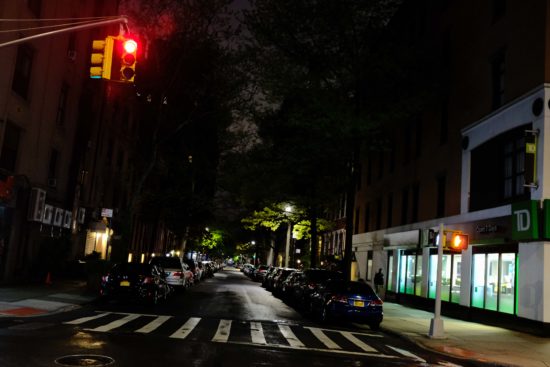
There are, of course, many other parts of Manhattan, and many other parts of New York City. But the pandemic has enforced a localism, for those of us who are not essential workers, and any walk beyond the borders of one’s own neighborhood is a voyeuristic expedition. What’s the purpose of doing something so frivolous, after all? New York City is the epicenter of a global pandemic.
But it’s important to see it, to hear it, and to bear witness. What the city is experiencing is the result of the decisions of the representatives we entrusted to protect us, decisions that were made at the local level, the state level, and the federal level.
People may say that this was unpredictable. It wasn’t. They will say that they did the best that they could. They did not. Cities just as large, just as complicated, and just as chaotic have fared far better than New York.
By the time you read this, more than 20,000 New Yorkers will have died from COVID-19, out of nearly 200,000 confirmed cases.
In late March, Molly Jong-Fast wrote a compelling account of her decision to remain in New York City—for one with the good fortune to have such a choice—as it became clear that New Yorkers were about to experience a catastrophe unlike any other in living memory.
“What I’m mostly struck by is the newfound silence of New York,” Jong-Fast wrote.
In May, with spring flowers fading into the iridescent green of early summer, that silence is no longer newfound.
Until you are sick, or until someone you love is sick, an urban pandemic is a quiet affair, characterized by its silence.
At night, it’s the only thing you hear.




Beautiful if haunting essay. Elicits the familiar silence of a lonely emptiness in our now sad City. Brought a tear.
“What I’m mostly struck by is the newfound silence of New York.”
This is so true. I always have my window open and sometimes forget that it is because of the silence. A few days ago, a truck was in my street and reversed making the loud noise you all know. I jumped. Totally forgot that noise. I guess I became a country girl in the last 10 weeks.
It’s always 83rd St. between Columbus and Amsterdam.:) What are we gonna do about that block?
What do you mean (about 83rd Street)? I have friends on that block and am curious.
So beautifully expressed. Was particularly struck by the truth in paragraph 2 where he refers to the cheers and noise of 7 PM followed by utter silence. I’m struck by this every single night.
Beautifully written by Michael McDowell. I plan on printing it..not sure why but it will become a memory.
This was so very moving. So poetic. So true.
Exquisite essay – worthy of republication in the New Yorker. Thank you, Michael McDowell.
Michael, you captured our city at this jarring time so well.
I look forward to reading any further essays you write about how the city reawakens.
This is beautiful, but also helpful.
Too many writers have compared this to 9/11, which invoked a come-back spirit in one-tenth the time now.
(And please, if anyone mentions 2008 or Sandy again I will vomit.)
The “silence” is symbolic, in ways we are only beginning to understand. But to me it is not about breaking it by marching on City Hall with machine guns, but how we re-enter NYC society circa September.
If we can be, at that time, the noisy (but masked) selves we were in Dec 2019 or so, we will show our much-needed NYC spirit once again. With many miles yet to go…
This is such a well written piece capturing the essence of NY City in a way only New Yorkers who have been through challenges together can appreciate. We are a busy city always on our way somewhere as fast as we can, but sheltering has given us a rare opportunity to sit, be still, listen to the silence and offer a prayer for each other.
To GG: I live in the community that is West 83rd St, what may I ask do you mean by “it’s always 83rdSt, and what are we going to do about it?”
Just walk a block over to the 20th Precinct and ask them about it.
Or search through the articles on this site. This block has been a hot bed of crime and violence for years. Drug arrests, a home invasion robbery, prostitution and even a murder all within the last year or so.
And all across from a elementary school…such a shame.:(
I lived on that block about 7 years ago and my apartment was broken into. I never before thought about it being a particularly unsafe block, but maybe you’re right.
Well written piece. But I must add that I actually like the quiet for a change.
GG, “a hotbed of crime”? Because Hispanic men are sitting on the sidewalk and talking to each other. I am certain the writer did not intend to pick out 83rd Street for that reason. It was mentioned because Latino men sitting on chairs on the sidewalk is part of this city. It was part of the UWS before gentrification took over. Those men likely have lived on 83rd St a long time. I lived on 85th and Columbus from 1978-1998. 83rd was always a sad block. The fire department, the post office and garages. Not a block many people would chose to live on. And yes, it had its fair share of problems, but so did many blocks on the UWS. The writer included 83rd because it is a part of New York, not to prompt people to sat “what are we going to do about that block”.
This was a beautiful piece of writing start to finish.
Thank you for capturing in words what it is like now living in NYC on the UWS. The silences are long. The quiet is deafening. The 7 pm Clap surrounds you and lifts you up every night to remind you in the silence that you are not alone. I hope to someday meet the people across the street I see every day at 7 pm as we Clap to say — we did it. We made it through to the other side. Some day we will get there.
I strongly recommend Spike Lee’s recent 8mm travel doc through the silence. It is a moving complement to this wonderful writing.
https://www.youtube.com/watch?v=HRRvhO0Chg4
Spike Lee did a terrific job. What I would like to see, or rather hear, is Liza Minnelli’s version of New York, New York being used for once. Nothing wrong with Frank, but, listen to Liza and tell me she isn’t belting it out like New Yorkers do.
Wonderful piece of work, Michael. Thank you.
A stirring piece. It makes me long just to be back to bear witness.
Barbara B, thank you, as those of us who were raised on 83rd St, we realize that there are issues with every block in the city, I attended PS9 on West End, and was one of the first students to attend the new building on 83rd St, have raised my son on that street and he’s now 35, I live in a building owned by the church I’ve attended since 1988 providing Day Care for many in this neighborhood. So again I ask, what is it you want done about our block?
A beautifully poignant essay. Thank you.