By Alexia Massoud
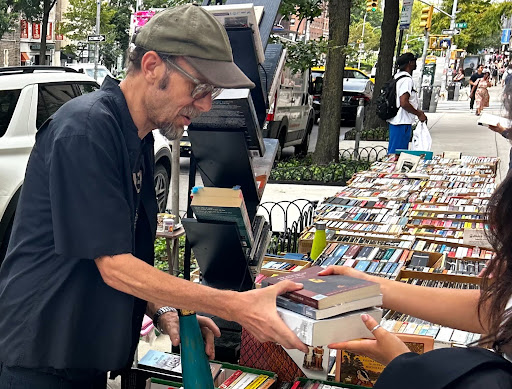
The buzz on Broadway never stops; everyone is walking — or likely rushing — somewhere, be it class, work, or the subway at 116th Street. But for a few minutes on a busy day, Paul Olson’s used-book table serves as an escape for readers to stop and browse — and, if they’re lucky, walk away with a $4 copy of a great read in good condition.
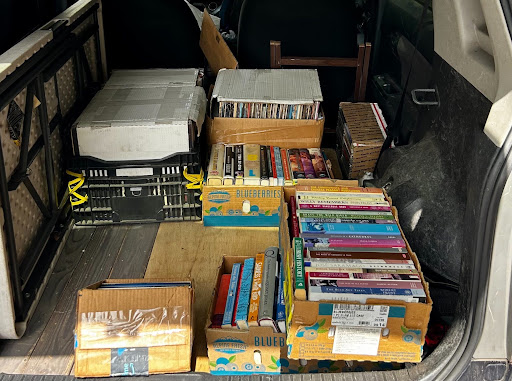
In between Columbia Climate School and University Hardware & Housewares, between 113th and 114th Streets, Olson sets up shop on clear-sky days when school is in session. He displays over 20 cardboard boxes filled with books left behind or donated by people, as well as some vinyl records. Many are brand new, still in original packaging.
“There’s nothing I’d rather do than this,” Olson said. “I can have real conversations about everything under the sun through selling books.”
That wasn’t the original plan, though.
Olson, 55, moved to New York 30 years ago after dropping out of college in Utah. In the East Village, he used to scavenge for things like trinkets, candleholders, magazines, VHS tapes, books, Rubik’s cubes, toys, and used clothes to ultimately sell and “find a new home for them.” He stayed away from electronic equipment, though, to avoid being arrested for peddling without a license — which is a misdemeanor.
“But books, you could sell, as long as they’re on a table,” Olson said. “You don’t get arrested for selling books because the First Amendment allows you to distribute in a printed manner.”
A vendor license is not required to sell newspapers, periodicals, books, pamphlets, or other written material, or artwork such as paintings, photographs, prints, and sculptures, according to the New York City Department of Consumer and Worker Protection. Different rules apply to selling food and selling from a garage or private property.
And that’s what Olson started doing, selling books — aside from his other job, which is catering.
For more than five years, Olson has lugged boxes full of books he’s gathered over the years from donations and websites like AbeBooks or Alibris to the Upper West Side.
Unloading them from the trunk of his car, he sets up on Broadway weekdays from mid-morning to nighttime — if there is no rain — and at the Morningside Farmers Market on Saturdays from 9 a.m. to 2 p.m.
“I love the farmers market because it’s the bringing together of Columbia, Morningside Heights, and Spanish Harlem,” he said. “With all that cultural mélange, I sell a lot of stuff and talk to a lot of people, so I can engage with the communities.”
Chris Lee, a Columbia alumna who was in the area, stopped by Olson’s table one recent morning and spent over $40 on books to complete a reading list she has compiled for herself. She said she likes buying used volumes because the books then get a new reader instead of gathering dust on a shelf.
“I like to, for a lack of a better word, abuse the book, with annotations and highlighting,” Lee said. “I like it when it’s used because it’s read through, it wants to be annotated, and I don’t have to treat it so nicely.”
Olson laughed and agreed, adding that he feels he’s giving the books “new life” as he saves them from the rats and landfills.
Olson’s sales for specific books have gone up because social media has popularized the challenging reads, like Cervantes’ “Don Quixote” and Dumas’ “The Count of Monte Cristo,” he said. “People really like to flex their reads on social media to show off their bookstack and all the books they read at the end of the year.”
Profits can be as high as $200-$300 per hour at the farmers market, where the foot traffic is “incredible.” Otherwise, on Broadway, Olson sells about two or three boxes of books in a day. But all of that money gets reinvested into the business because he’s a “book hoarder” and wants his customers to come back, he said.
“There are so many good books we have not read, and when we look at this table, we realize it,” he said. “And it’s really humbling.”
Hissam Effendi, a mechanical engineering student at Columbia, said he stopped at the book table because he hadn’t read in a while and could use a book. He purchased the Hubert J. Selby novel, “Requiem for a Dream,” for $12 after Olson gave him a 10-minute spiel about the story. The novel was adapted for a film of the same name in 2000.
“I want to get into the habit of reading books before I watch the films that inspire them,” Effendi said. “I’m big into films, and I want to be able to form my own opinion of them.”
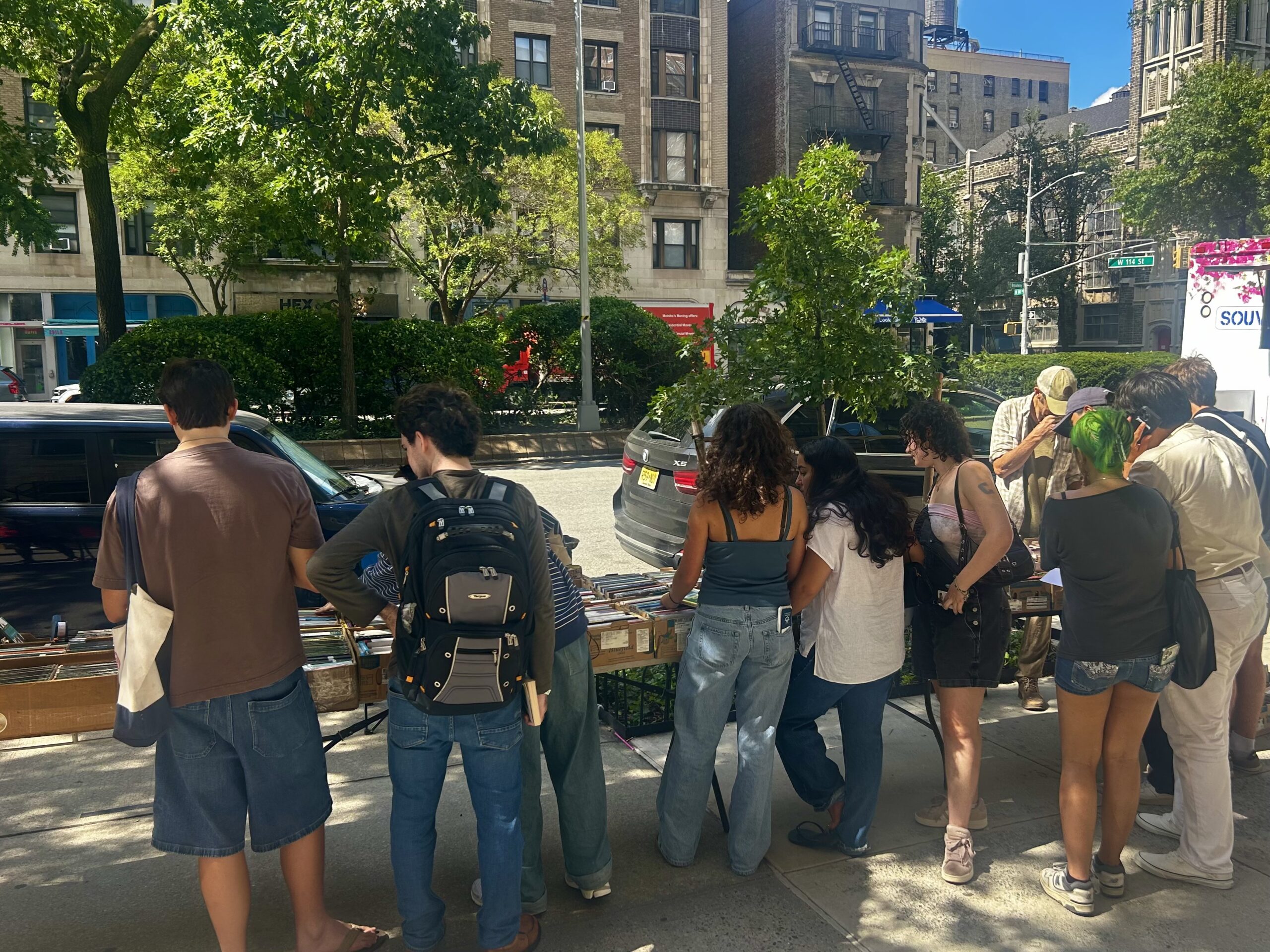
From Hannah Arendt to René Girard and Fyodor Dostoevsky, Olson has a book for every crowd: students, professors, readers, and even those who are just starting on their book journeys. What sets him apart are personalized recommendations, because he’s gone through many of the volumes himself, he said.
An avid reader since childhood, having earned second place in a reading competition in the fourth grade with 137 books, Olson figured his love for reading could be a service to others.
“I like helping train people to not keep looking at their phones, and instead, pick up their books,” Olson said.
With our declining attention spans of 47 seconds on any screen, according to Gloria Mark, author of “Attention Span: A Groundbreaking Way to Restore Balance, Happiness and Productivity,” that may just be true.
You can find Olson on Instagram @umbrellahouse_books.
Subscribe to West Side Rag’s FREE email newsletter here. And you can Support the Rag here.






Love this article . Recycling books from one reader to another is sharing knowledge from who can pay more to who can afford less to the point of donation as it goes on depreciation.. This is giving real access to education regardless of financial status. Let’s boost this business!!!
I stopped by his table for the first time the other day looking for a book by the artist/writer David Wojnarowicz. He had never heard of him and walked away somewhat dismissively. Then I asked if his books were arranged in some particular way and he said they were arranged by color which was not the case and a weird response. I got a decidedly unfriendly vibe overall. A pity because I live nearby and enjoy buying books on the street.
He’s a random bookseller with random books. He’s not a librarian nor has a book catalog. His time is spent selling books about anything to whomever wants to buy. If he’s familiar with an author or a subject, he’ll assist you better, but don’t expect him to know every author or subject there is. I’m happy he’s there. I rather buy from him than online, especially since I love discovering an odd book.
This is amazing, I’m all for recycling books and making them available to everyone!
I’m going back a few years, but I’m curious if anyone knows why the booksellers on Broadway btwn 72nd and 73rd were harassed by the police for years on end? I once donated several bags of books to the whole group, but everything was confiscated by the end of the day. I always wondered if they were donated or just tossed out in the trash.
Think the Chase Bank objected to the optics
Thanks, that’s a possibility I hadn’t thought of.
You’ve got to be kidding. Kurt the bookseller was a criminal who would attack people at random, throw things, threaten people, behave in a psychotic, dangerous manner, and leave his tables out 24/7, rain or shine, which is illegal, and it was infested with rats, trash, roaches, and everything else. He was not educated about books or any of the other stuff he sold. He didn’t read. He would pay other homeless folks to man an illegal sprawl of tables that ran the entire block. A vendor of anything can only have one, six-foot table. The man described in this article is a reader. Kurt was a neighborhood menace and the people in the area used to pressure the police to have him removed, but because of the First Amendment nature of what he was hawking they could only do so much. The Police were hardly “harassing” him. The City tried to deal with Kurt, but he would sue, threaten, and harass everyone in the area, and especially the shops who paid a fortune to be on the block. Thank God his garbage sprawl is gone.
I can attest to that. I used to work in the Ansonia back then. He was a huge problem. In addition to the above, he would hang some sort of clothing all over the scaffolding that was there at the time. The police had to deal with him almost daily, and he certainly didn’t help the businesses in the Ansonia.
That guy was a complete disaster and was really obnoxious. He always left his stuff on the sidewalk overnight which isn’t permitted. Good riddance.
During the time I lived there a group of 4-5 men ran the tables. I understood that they had formerly been homeless and worked in shifts, and the man who did the chalk drawings often brought them food. At one point, I thought I should ask their names, but they all said they were named Robert, so I guess that was a joke. I didn’t know about them leaving books out overnight.
The book vendor who used to set up on Columbus in front of 67Wine is gone. Hope this guy stays awhile.
What happened to him always thinks about him when I pass by. He was there since I was a kid!
Shout out to memory of Dave, who sold books on same side of street, but passed during Covid.
People should donate their used or already read books to him.
On the topic of street booksellers of the upper west side, anybody remember Enrico Adelman?
https://www.annarahmanan.com/enrico-adelman-sells-signed-philip-roth-books-in-new-york-city/
Keep up the good work, Mr. Olsen.
As noted, “Many are brand new, still in original packaging.” This is true and it troubles me. I don’t know what is the explanation for this — and l don’t ask.
I love finding a desired used book, but as a matter of personal choice l avoid buying new-looking books on the street.
Sometimes people in the business — authors, agents, publicists — get books when or even before they are released. They can’t keep them all.
Someone in 4th grade read more than 137 books?
My wife and I donate our no longer needed books to St Agnes Library for their book sales. Can’t imagine donating books to this guy who turns around and sells them. Rather have the money go to help NYPL
Thankfully the Columbia University students still read.