 By Rob Garber for the Bloomingdale Neighborhood History Group
Welcome to another installment in the Rag’s Historical Photo Challenge. The image above was taken somewhere on the Upper West Side, sometime in the past. Can you figure out where, when, and what it shows? Look closely; this week’s challenge photo, like the others in the series, includes clues that will help you identify the scene, if you’re a dedicated UWS history sleuth. And even if you don’t recognize the picture—not to worry! Come back in two weeks and I’ll decode it, show you the clues that help identify it, and—best of all—tell you a story the image unlocks, because this column isn’t just a test of your neighborhood knowledge; it’s also a rolling celebration of the people, buildings and events that wove the tapestry of the Upper West Side.
Ready? If you think you know where and when the photo was taken and what it shows, post your answer as a comment on this column.
Solution to History Photo Challenge No. 34
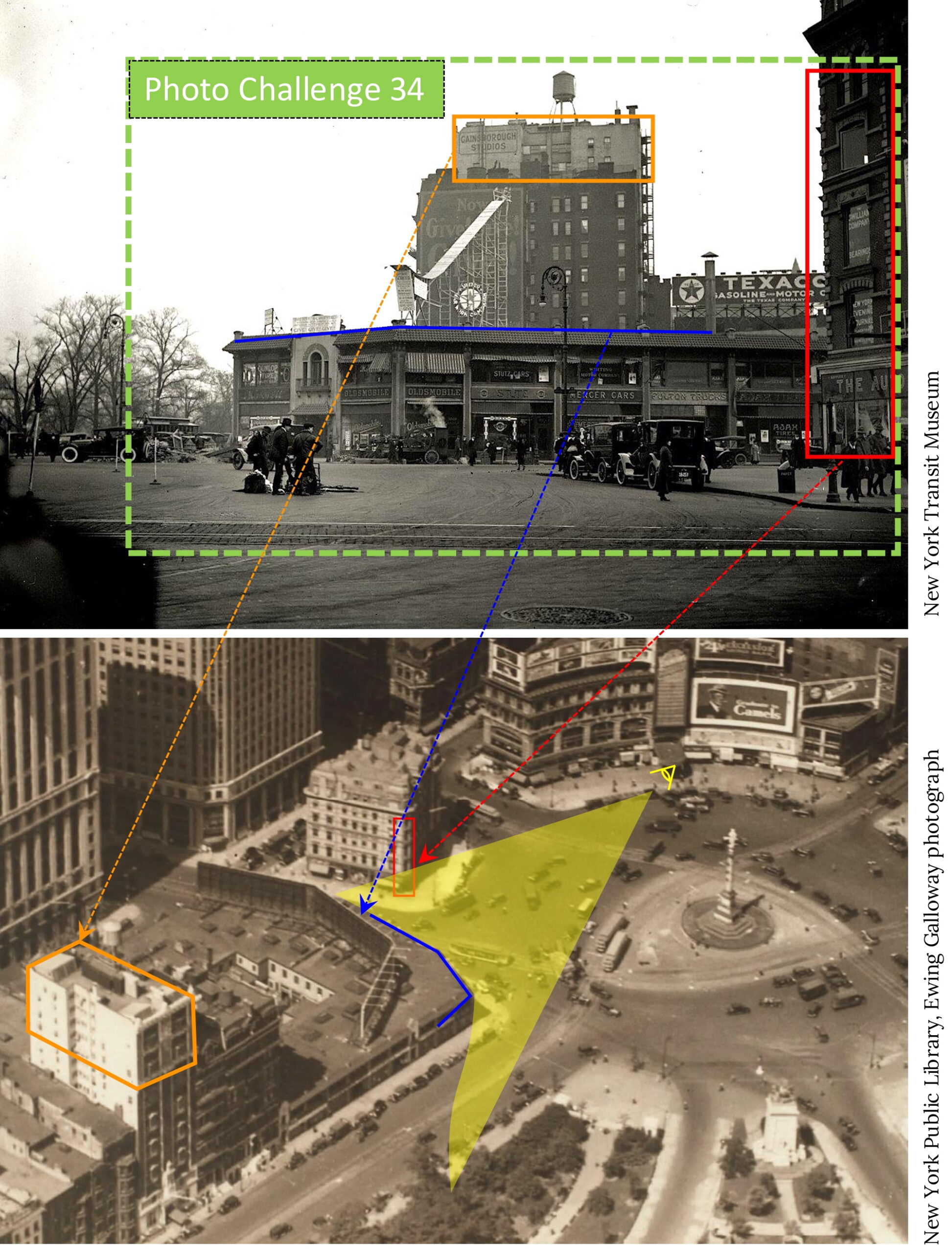
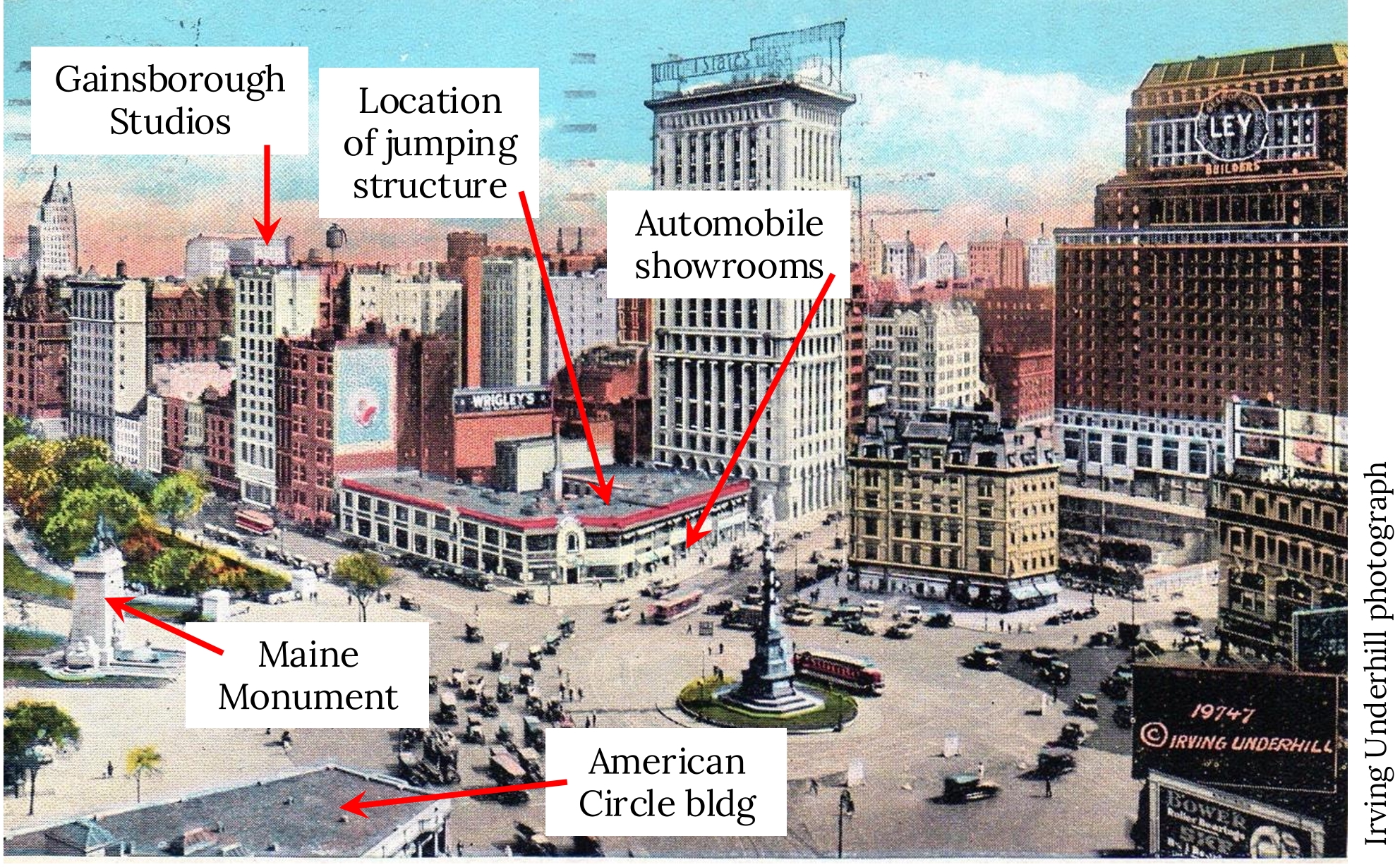
Location: Southeast corner of Columbus Circle
Date: November 1918
Image Source: New York Transit Museum
Clues: The only building in the photo that is still standing is the one right in the middle, in the background. It’s clearly labeled “Gainsborough Studios,” the splendid artists’ co-op at 222 Central Park South. This tells us we’re looking east across the open southern expanse of Columbus Circle. The trees to the left are at the edge of Central Park. The car, truck and tire signs on the two-story structure in the middle of the photo also hint that this is part of Automobile Row, which ran up Broadway from around Times Square to the low 70s. There’s a bit of a red herring visible in a window of the building to the far right, which occupied the lot where the Museum of Arts & Design now stands at 2 Columbus Circle: it says “New York Evening Journal.” The Evening Journal was a William Randolph Hearst rag. But starting in the late 1910s, his main newspaper offices were in the American Circle building on the north side of the Circle, not here on the south side. So technically, most of what the photo depicts is a couple of hundred feet beyond the edge of the Upper West Side. [Side note: Hearst tried to buy up much of the property around Columbus Circle and even hoped the city would name it after him, a la Times Square and Herald Square. He led the campaign to build the Maine Monument in the corner of Central Park (thus Hearst’s probably apocryphal line to artist Frederic Remington: “You furnish the pictures, I’ll furnish the war”?]. Anyhoo, what was the giant ski jump in the center of the image all about?
The rest of the story: Remember Looney Tunes cartoons where someone would high dive into a bucket of water? There was a version of that stunt which actually took place! On November 27, 1918 one Augustus Schreyer Meixell—better known as Daredevil Schreyer—rode his bicycle down a ski jump-style ramp built on a roof at the southeastern corner of Columbus Circle, pushed his bike aside as he lifted off from the foot of the ramp, soared more than 100 feet through the air, and landed in a shallow tank of water. Though the stunt only lasted a few seconds, it was stupendous and dangerous. Schreyer performed the act over and over—he claimed to have done it more than 2,000 times!—around the US and in Europe, each time building a custom version of his ramp.
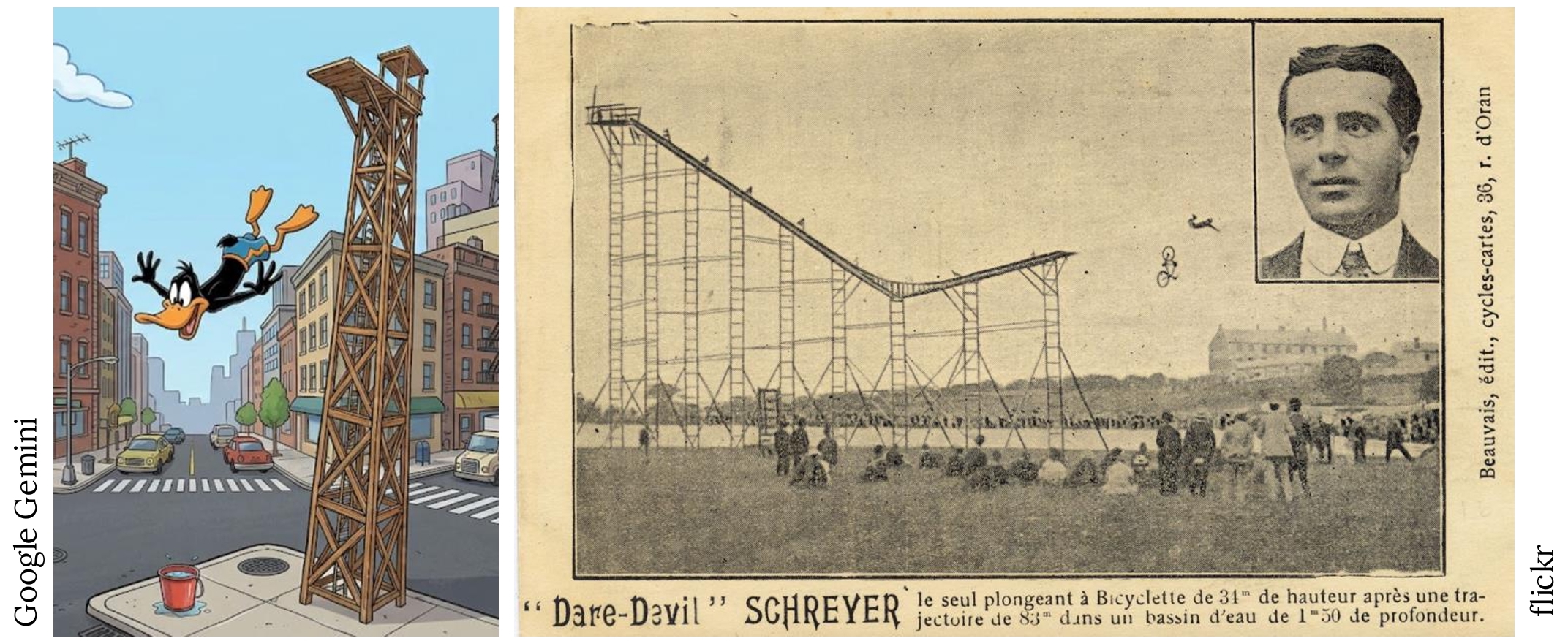 A number of photographs exist of Schreyer’s ramps, but his 1918 Columbus Circle leap appears to be the only one constructed on the top of a building. His act was unique among the stunt performances of his era, and Schreyer was well paid for it—but at Columbus Circle he donated his services to help raise money for the war effort.
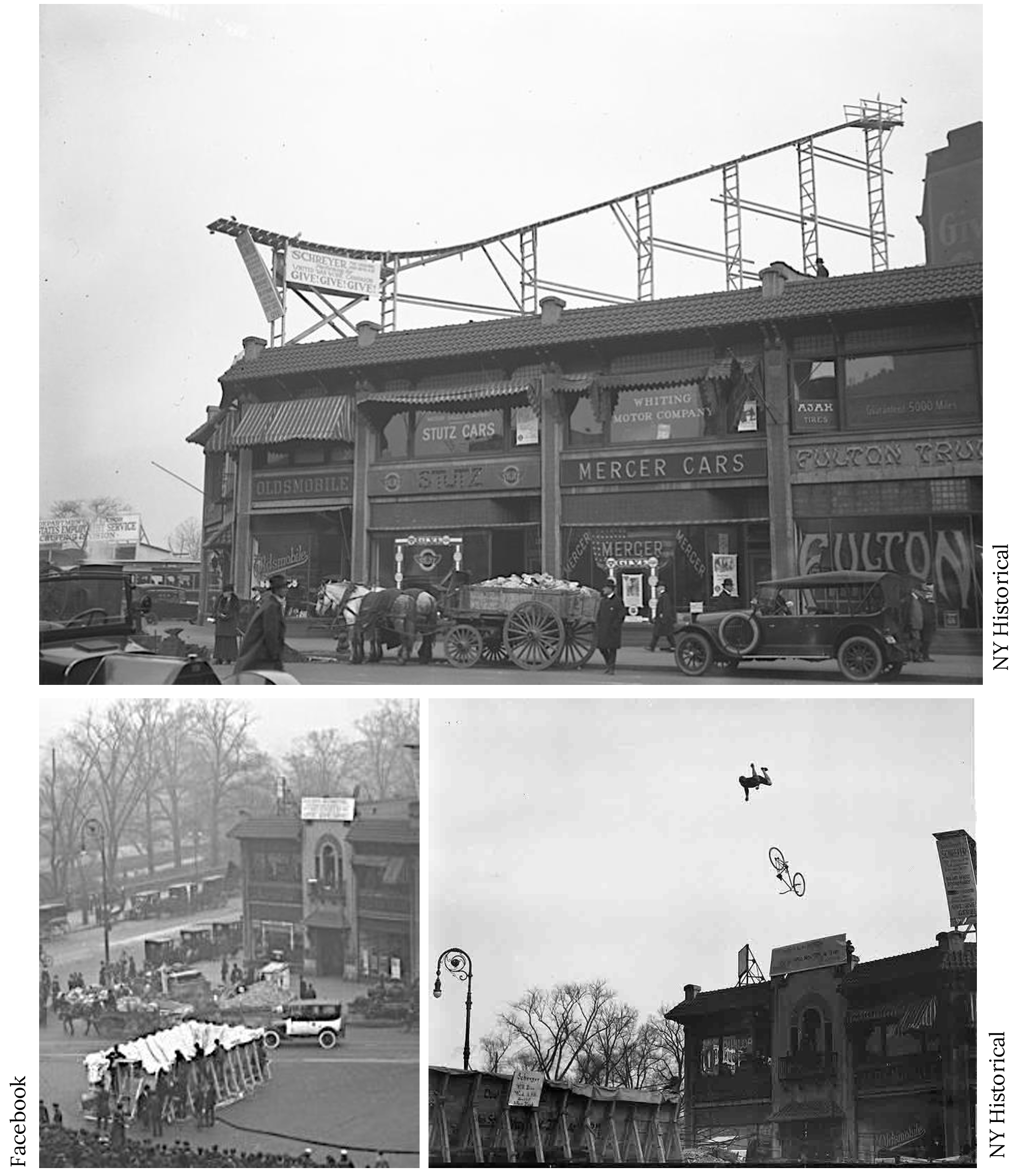
From the available photos, I estimate that Schreyer’s landing tank was perhaps 30 feet long and 10 feet wide–large enough to give him a bit of a margin of error—he said from the comfort of his armchair. But it looks awfully shallow! Newspaper accounts said the tank was 3 or 4 feet deep. I asked Google’s Gemini AI to review all known descriptions and images of Schreyer’s apparatus and estimate the height from which he free fell into the water. The answer was 45 to 60 feet. I then asked how deep an adult male would plunge into water from those heights in three landing modes: swan dive, cannonball, or bellyflop. With an impact velocity estimated at 41 mph, the swan dive was out of the question; a diver would penetrate 33 to 50 feet in that position. A cannonball was possible—penetration of 3 to 4 feet—and likely to cause injury (“bruising, spinal compression, severe shock”). A bellyflop, as we all know, stops you immediately (1 to 2 feet penetration even from 45 to 60 feet) but would result in “severe trauma.” So how did Daredevil Schreyer do it?
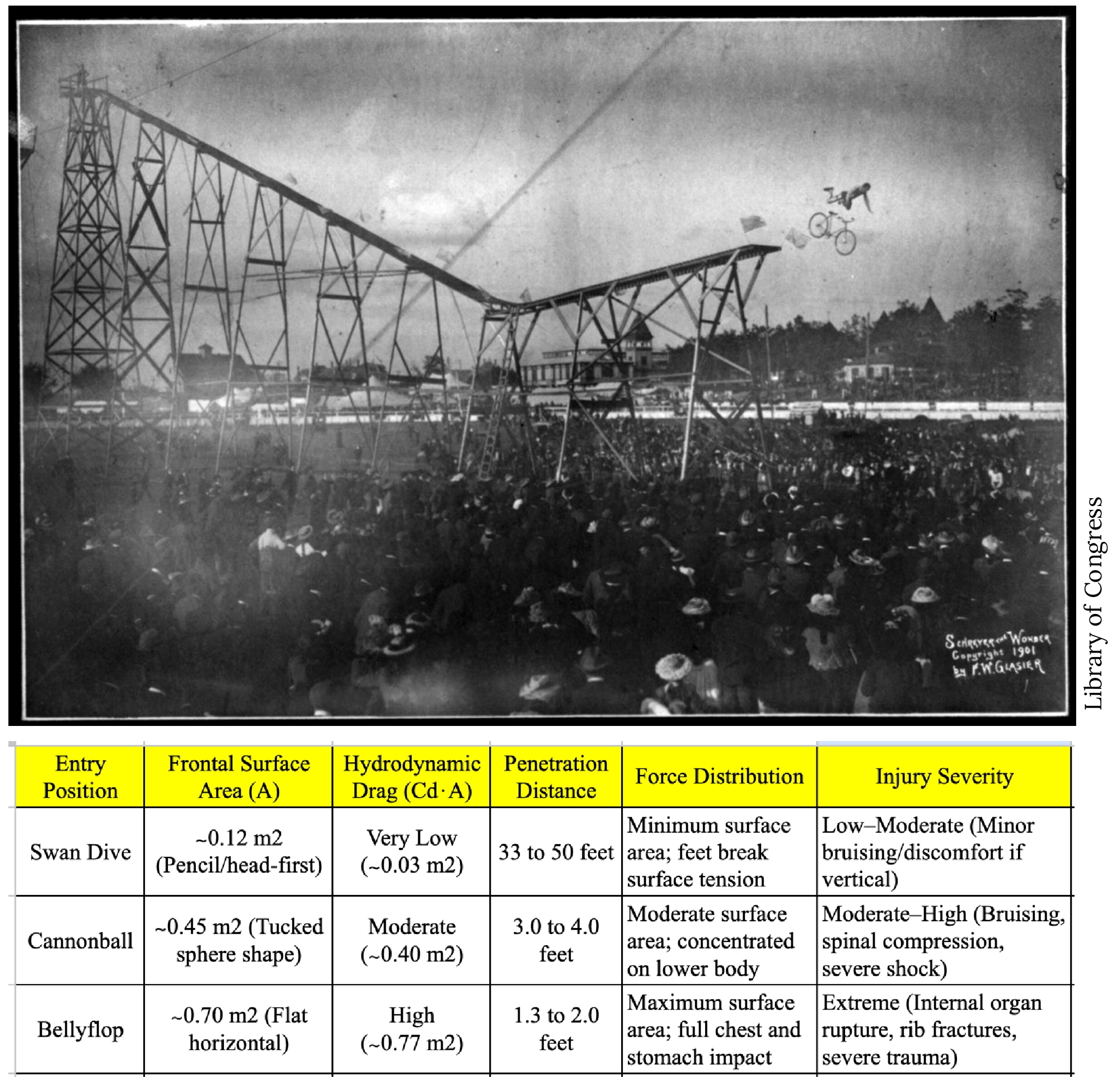
Newspaper articles about his act are vague on exactly how he entered the water (“head first” was one description), but the Philadelphia Times noted a mishap in 1902 with Schreyer “landing on his stomach and losing his wind,” requiring a quick rescue to prevent him from drowning. Photos of Schreyer in mid-jump show pretty clearly that he wasn’t wearing protective or padded clothing. So he must have used an entry posture that stopped him abruptly without causing too much damage, and worked many hundreds of times—any divers out there with ideas?
As impressive as Schreyer’s stunt itself was the fact that he was still doing it when he was nearly 50 years old. On May 25, 1919, he performed it at Van Cortlandt Park in the Bronx before an estimated 20,000 spectators including his wife and infant son. Schreyer hit the side of the water tank, sustained a fractured skull and other injuries, and died five days later. It was presumed to be a miscalculation in his trajectory, because “Only the tips of his fingers reached the water in the tank. His body struck its rim,” according to an article in The New York Tribune on May 31, 1919. But a year later, a trial in a New Jersey court over bank fraud suggested that Schreyer was implicated in the embezzlement and may have deliberately hit the tank as a form of suicide (“Say Bank Thefts Drove Schreyer To Kill Self”—The Jersey Journal, 27 Oct 1920).
…and that’s the story behind the image in the last challenge. Now scroll back to the top of the column and take on your next one, Sherlockians! If you’ve missed any pictures in this series, you can find the complete set on my author page. All photos in the Upper West Side Historical Photo Challenges used with permission.
About the author: Rob Garber has lived on the Upper West Side since the late 20th century and is a member of the Bloomingdale Neighborhood History Group. To learn more, visit their website at upperwestsidehistory.org.
Subscribe to West Side Rag’s FREE email newsletter here. And you can Support the Rag here.




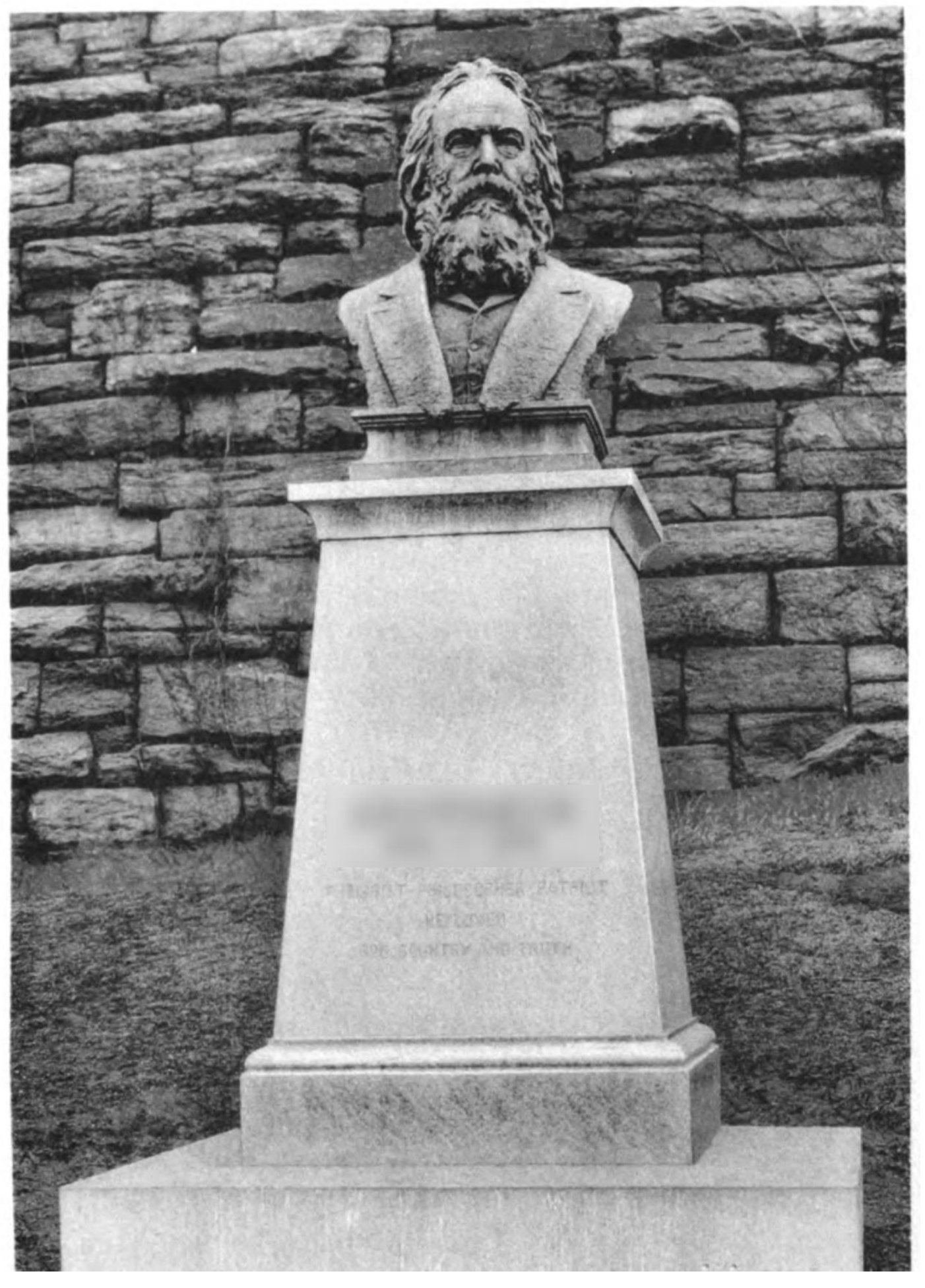
This is the bust of Orestes Brownson, activist, preacher, labor organizer, and writer. An early proponent of Multiculturalism, he was also credited with coining the term “Americanization”. The bust stood near the bottom of the staircase leading down from 103rd Street and Riverside Drive.
Here’s a surprisingly interesting article from 1910 NYT covering the unveiling.
https://www.nytimes.com/1910/11/25/archives/plans-a-river-side-like-roman-gallery-commissioner-stover-announces.html?unlocked_article_code=1.AFE.YHqB.7_QTc9kCMUuL&smid=url-share
Apparently, it is now owned by Fordham University in the Bronx.
This is a statue of Karl Marx when he was a visiting professor at Columbia. It was erected near the 116 Street entrance to honor Marx for converting his students and all future students to communism
Nice try but nope.
The inscription is BROWNSON, 1803-1876, PUBLICIST-PHILOSOPHER-PATRIOT, HE LOVED GOD, COUNTRY AND TRUTH
In “Fordham: A History and Memoir” by Raymond A. Schroth, S.J., Brownson’s life is described. He “moved from one religion to another as a young man; he was a Presbyterian, a Universalist minister, and by 1830, a ‘freethinker.’ He became a charter member of the Transcendentalist Club and was simultaneously at home in two worlds—that of the most brilliant New England intelligentsia and that of the Boston working class whose cause he had embraced as a social and religious reformer.”
Father Schroth says that upon Brownson’s conversion to Catholicism, “American Catholicism had in its stable a formidable philosopher, apologist, journalist, and polemicist—what today we would call a public intellectual.”
The Fordham Jesuits awarded him the school’s first honorary degree in 1850 and he gave the graduation address in 1856.
Interesting.
https://collections.mcny.org/asset-management/2F3HRGC76PC?FR_=1&W=1385&H=758
Photo #35 Henry Wadsworth Longfellow .
Hall of Fame for Great Americans in the Bronx