

By Scott Etkin
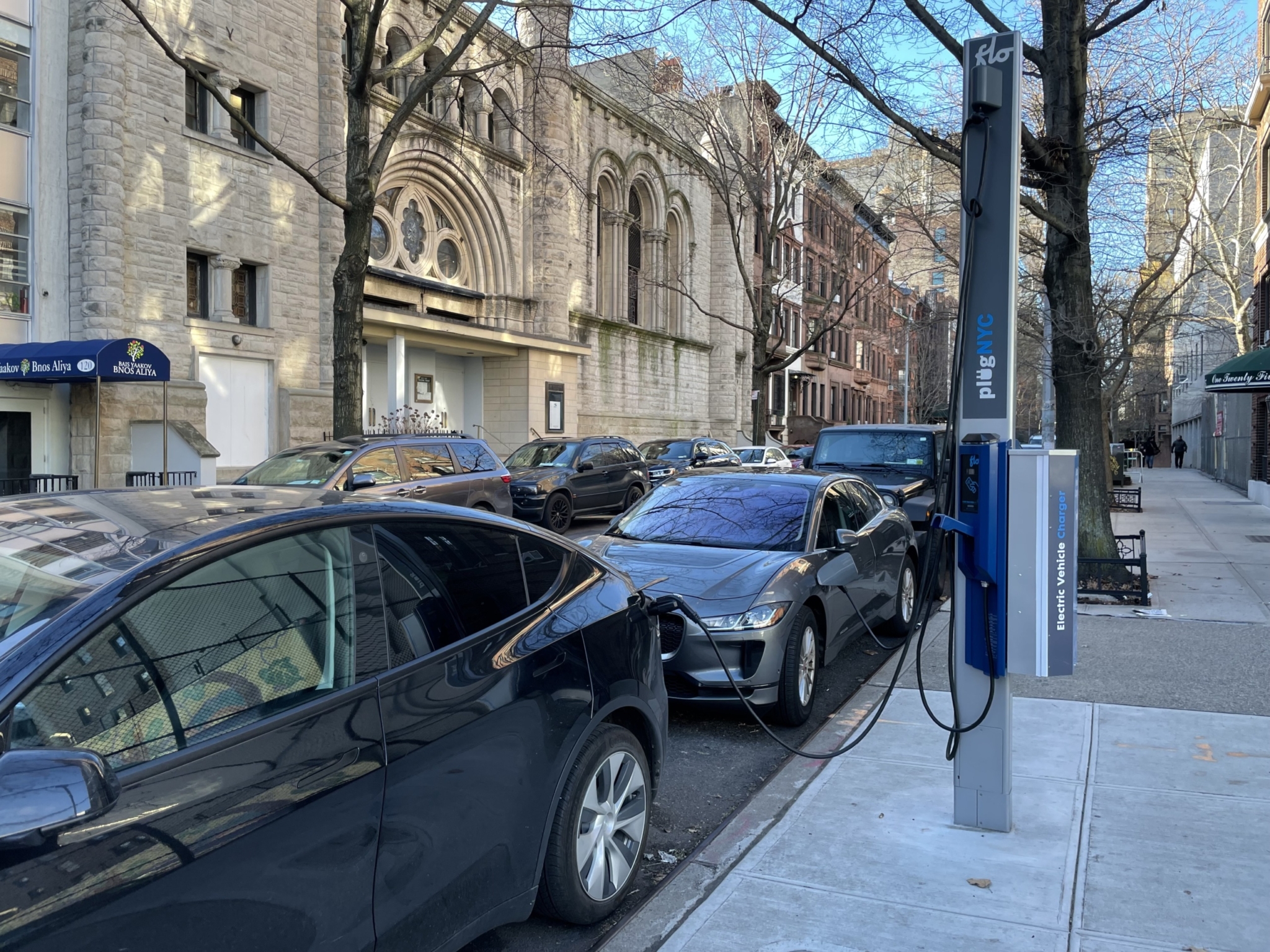
As part of an expansion of the NYC Department of Transportation’s (DOT) network of curbside electric-vehicle chargers, the agency has proposed seven new locations on the Upper West Side.
The city currently has 88 curbside charging points, which are contracted in partnership with ConEdison, including three already on the UWS. The DOT plans to bring that number to nearly 700 charging stations city-wide over the next three years, according to an announcement in August.
The new proposed locations in the neighborhood are:
- 2 West 73rd Street (Central Park West)
- 229 West 74th Street (Broadway)
- 215 West 76th Street (Broadway)
- 222 West 83rd Street (Broadway)
- 102 West 95th Street (Columbus Avenue)
- 13 West 106th Street (Central Park West)
- 200 West 106th Street (Amsterdam Avenue)
The DOT is looking for feedback from locals on the newly proposed sites. Community members have until the end of September to add their comments, either for or against the proposed locations, through an online portal – HERE. As of September 8, there are 132 comments posted.
The Upper West Side’s existing curbside EV charging stations are located at West 76th Street between Amsterdam and Columbus avenues, West 84th Street between Amsterdam and Columbus avenues, and West 93rd Street between Central Park West and Columbus Avenue. All three stations were installed in 2021.
Similar to the existing stations, the new docks are Level 2 chargers, which provide up to 20 miles of range per hour of charging, and will have two plugs per station. The chargers are only compatible with electric cars, not e-bikes.
Since these original chargers were installed in 2021, the number of electric vehicles in the neighborhood has increased. Over the past four years, more than 1,600 electric vehicles have been registered on the UWS. EVs account for 8.3% of new vehicle registrations in New York City, according to the DOT.
In 2023, a DOT study found that the Upper West Side’s EV chargers are among the most-used in the city. According to the report, EV adoption rate on the Upper West Side is “at the minimum, twice as high as the citywide average.”
Subscribe to West Side Rag’s FREE email newsletter here. And you can Support the Rag here.





“Since these original chargers were installed in 2021, the number of electric vehicles in the neighborhood has increased. ” What evidence is there that one has impacted the other as this statement infers?
“The DOT is looking for feedback from locals on the newly proposed sites” Does anyone at this point believe this? When has the DOT or CB7 listened to what the actual community wants?
You mean “as this statement implies” not “as this statement infers”. Drives me crazy when people confuse the two. Also, “When has the DOT of CB7 listened” to what the actual community wants?” The answer to that question is: “Never”.
I read that as a statement of fact, not implied causation. (It might be provided as background on why more chargers would be useful, but again, not causal.)
It was a clear, simple statement of fact. And it doesn’t imply causation.
Indeed, the inference one could draw instead is: if there are more electric vehicles than before, there’s more need for chargers.
The notion “that one has impacted the other” was inferred by you. I see no such implication in the reporting of fact.
I have no particular insight into DOT’s “objectives” but your comments in this regard do make clear where you are coming from…
CB7 is its own self-congratulatory echo chamber that accomplishes little more than agreeing with itself while shutting out most dissent. And their “symbolic vote” was comedic legend. Maybe they’ll have a symbolic vote on these charging stations. I for one, vote “nay” on anything south of 86th St. You have plenty of empty storefronts north of 86th., which means the area is perfect for charging stations without disrupting much business or traffic.
People think that “listening to the community” means giving them whatever they personally want. It should listen to the city as a whole that democratically elected the mayor who controls the DOT. Nobody voted for CB7.
So community boards should be elected? That’s not the worst idea!
Id prefer to eliminate them altogether. Neighborhoods aren’t islands, the decisions they make affect lots of people who work but don’t live there, people who commute through them, etc. The city should make decisions.
Yes which is part of why what urbanists tend to push are bad.
How are the users of these charging stations being “charged?” They’re not being offered for free I hope. But having lived in this city for over 30 years, I wouldn’t be surprised if this was just another revenue-generating opportunity spurned and left for peregrinating taxpayers to bear.
At a charging station a user typically enters their details with an app or on-screen payment system ( tapping their credit card) and are charged a fee based on how long your car is plugged in, which helps encourage turnover in busy parking spots..
The charging stations in NYC — PLUG nyc — are “owned” by the DOT in collaboration with Con-Ed and are managed by a company called FLO which makes and services charging stations nationwide.
In NYC the fee is a flat rate of $2.50 per hour and $1.00 perhour overnight (9PM – 6AM) Depending on you make of electric vehicle, an hour of charging (level 2) will give you anywhere from 20 – 40 miles of driving. Charging “at home” would cost considerably less but in Manhattan that is generally not an option.
So it effectively provides very cheap overnight curb parking with charging included, assuming there’s no separate parking charge or restriction.
Park away.
Hooray parking spots for Teslas. Is anyone going to buy an EV because there’s a public charging station on the corner?
Definitely me. A total game changer.
Maybe
Purchasing an electric vehicle when you live in Manhattan is a … choice. You’re certainly setting yourself up for quite the challenge. I have to assume that many if not all of these folks have more reliable access to chargers elsewhere.
It’s a choice I’ve made for 4 years, and I love it, though I’ll love it a lot more when there are more chargers available, because that is a challenge the city can easily overcome. We cannot afford to pay for a private parking space or garage with access to charging. WE do street parking and move for the street sweepers like everyone else.
We mostly use them when we want a full charge before leaving on a trip to Boston or Philly, but otherwise we have no need to charge often when we use it for short trips.
But when we do want to use one of these public chargers it is sometimes impossible because so many EVs are competing for 2 plugs in a 20 block radius. There is an app where you can get an alert when one opens, and even if you immediately jump in your car and head over, someone often pulls in right before you.
That is IF someone isn’t parked there illegally already in a gas powered car.
I don’t know what percentage of cars in Manhattan belong to people who live in Manhattan though. Tourists, commuters maybe
There are more public chargers than gas stations in the Upper West Side. If you include the chargers within garages, there are many more places to charge EVs than there are gas stations.
Not to state the obvious, but gas stations and ev chargers are different, for many reasons.
One difference is EV chargers don’t leach toxic fumes into the air and water.
Are you familiar with the concept of throughput?
I’m someone who would buy an EV, but can’t unless the charging infrastructure exists. I don’t have a garage or a second home. But if there were more public chargers, I could and would buy an EV.
(And yes, users pay for electricity at public chargers)
Yes to these chargers. In many areas of London this type of thing aready exists at streetlight poles (Level 2 chargers) so there is not need to have so much “dedicated spaces” unless they were true Level 3 chargers (which can charge about a rate of ~ 200 miles per hour)
Those chargers would need to be much faster than these. 20 miles of range for an hour of charging. So even if you have a seconf home you’d need your car to be plugged into one of these all day or all night to get there.
I don’t have a car, electric or gas, so I’m not familiar with the EV charging process.
I assume it takes some time to charge an EV. If these charging stations are going to pepper the neighborhood, how long does it take to charge one car? And who makes sure a car isn’t just parked there after it’s finished charging? I can already anticipate some heated arguments.
Also, for the proponents of Open Streets and bicycles for all – gas cars are bad, but EVs charging all over the neighborhood are good?
I live in the neighborhood and use these chargers, and most people who use these do to (takes 12 hours for a full charge so not convenient just to pop by).
So when I go charge there I open up another spot on the street, so you are more than welcome to take it!
We get charged if we leave it plugged in, so we don’t do that either! Never had or seen any arguments in all the times I’ve charged there. But I have seen it blocked by gas cars parked there illegally.
And yes to open streets and bikes too!
I don’t believe this is happening! Corporations are grabbing more PUBLIC space! Let the EV companies buy/rent buildings to supply their form of “gas.” This is a crazy and predatory action. Just like Amazon, setting up their factory floors on our public streets.
What corporation are you talking about? The city is putting these in, they are public
Love this! Much needed, and long overdue. NYC starting to catch up to the needs of its residents. Keep it going!
Level 2 chargers = 10 to 40 miles of range/hour. NYC should be installing Level 3, because Level 3 = 180 to 240 miles of range/hour.
ConEd has trouble keeping up with the electricity demand on hot summer days as it is.
We need nuclear power plants.
The problem might be that, with parking scarce, those charging slots will be taken by gas-powered cars that just need a place to park.
And why shouldn’t they? Its public space.
Can anyone explain why these are level 2 chargers? Today’s public fast-chargers can fill in 30 minutes what would take these Level 2 chargers 12+ hours . That’s 2 cars per day each, for 1,600 vehicles on the UWS. Seems more a token gesture and a waste of curb space.
This is what I don’t understand. We’ve had plenty of power disruptions and warnings to conserve electricity during heat waves even without widespread EV use. Now the city wants to fill neighborhoods with charging stations and just hope everyone charges off-peak? What happens when thousands more people have EVs, especially those who depend on their cars for work and can’t simply wait until the grid is less stressed? Shouldn’t we improve the infrastructure first before jumping ahead with all these charging stations?
Before wasting any more $$$$ on these perhaps figure out how to keep the existing ones in service? 9 times out of 10 they are broken and even more often the copy wire in the hose is ripped out
Also EV are not supposed to part there all day only when charging EV owners view it as their free parking