

By Charlotte Robertson
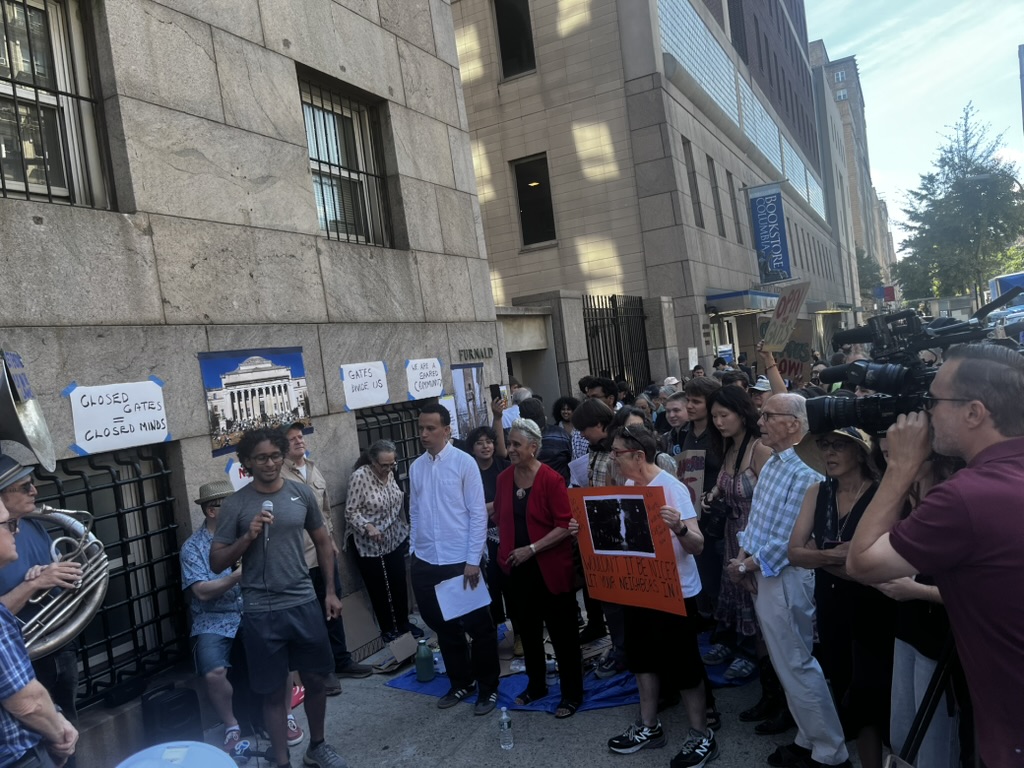
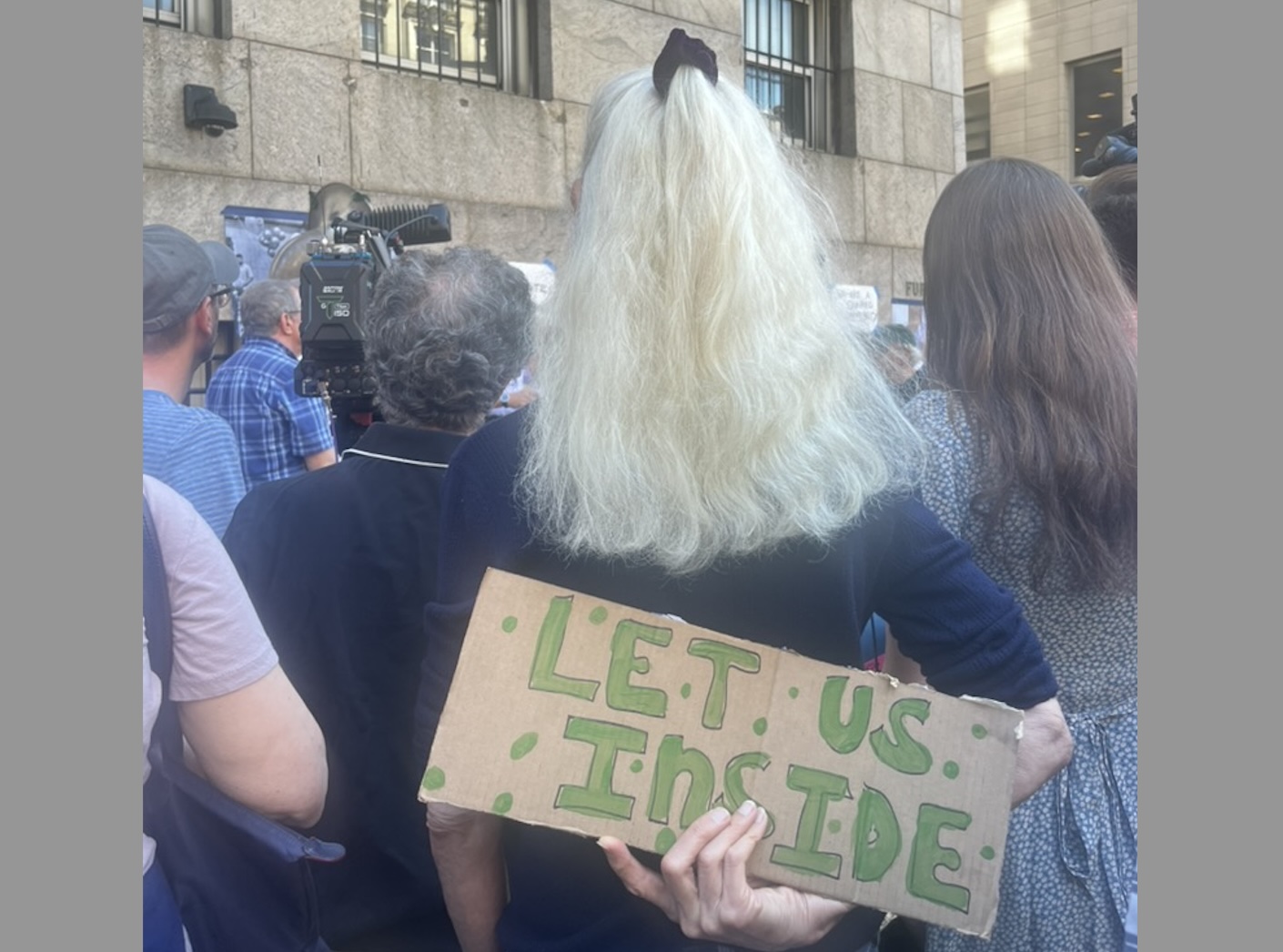
On Tuesday, a gathering made up of roughly 250 locals, community members, students, professors, and faculty gathered at the corner of Broadway and West 115th Street, demanding that Columbia University open its campus gates to the public.
It is the fifth rally of its kind since 2025 to be organized by the Morningside Heights Community Coalition. Dan McSweeney, MHCC’s program director, has been dedicated to community organizing since 2005 and has been instrumental in coordinating the rallies outside of Columbia; this one, he told West Side Rag, felt different.
“We had hundreds of people exposed to the messaging,” he explained. With the first day of the 2026-27 school year in full swing, Columbia students walking to and from the gates were forced to face their locked-out neighbors. Several of these students stopped, filmed, and cheered in support of the rally.
Columbia is now entering its third year of a closed Morningside Heights campus, which, as many of Tuesday’s demonstrators say, violates the 1953 easement agreement between the University and the City of New York, that states College Walk should remain open to the public. Following campus protests in the spring of 2024 related to the Gaza War, the University closed the campus to all but those in possession of Columbia ID cards, which are scanned by security guards at the front gates before entering.
On September 7 of this year, the new University President Jennifer Mnookin sent an email to Columbia students, permitting them to bring limited family members onto campus with private QR codes. She also announced the formation of a new committee, which aims to “explore” the University’s relationship to the neighborhood and the safety risks of reopening the campus.
“I served on one of these committees two years ago,” said Emerson Ellenwood, class of 2028 and College Student Council VP of Finance, in a speech. “We don’t need another committee. We need a commitment.”
“President Mnookin’s announcement was pretty disappointing,” Professor of Mathematics Michael Thaddeus told West Side Rag. “It seemed like a pretty modest step. Still, it’s a step in the right direction.”
Thaddeus has been active in University politics for several years, gaining notoriety in 2022 after publishing an investigative analysis of Columbia’s U.S. News ranking. He has been outspoken about freedom of speech on campus, including the University’s 2025 capitulations to President Donald Trump. In a speech at the rally, he highlighted that the opposition to opening Columbia’s gates has been largely anonymous. “I feel it is very difficult to tell who supports the lockdown,” he told West Side Rag. “No one has publicly stepped forward and named what the public security concerns are.”
For five semesters, four different Columbia University presidents have claimed an open campus poses risk to students.
“I know that safety and campus access are not at odds,” said Darializa Avila Chevalier, Democratic nominee for Congress in the 13th Congressional District, in a speech during the protest. “Safety comes from knowing your neighbors.”
An alumnae herself, Chevalier continued that she initially chose Columbia because of the school’s reputation as “the activist Ivy,” and that her experience as an undergraduate was shaped by a “culture of rebelliousness that has pushed me to speak truth to power.” She added: “It is critical that the people who actually built this neighborhood are not locked out of their front yard.”
McSweeney also said he was fed up with the University’s claims of safety concerns, mentioning that multiple students have been detained by ICE agents since the campus’ closure. “If ICE wants to enter the campus, security contracts are not going to stop them.”
The closure of Columbia’s gates is a logistical challenge for Upper West Siders, blocking access to the 1 train on 110th and 116th Street. Beyond that, many find the closure of the gates to be symbolic, suggesting that the physical divide creates an “othering” of the non-Columbia community; such is the belief of Eli Northrup, Democratic nominee for New York Assembly District 69.
“The neighborhood and our sense of togetherness have suffered,” he said. Adding that the Class of 2027, now seniors, are the only students at Columbia to have experienced an open campus, he argued that the longer the University waits to open the gates, the harder reparation will be: “This is not normal.”
For decades, Columbia’s campus has functioned as a public gathering space for families. “I learned to walk on these steps,” shared one current student, who grew up a couple of blocks from the school.
Manhattan Borough President Brad Hoylman-Sigal said that public access to the campus motivates the next generation of students: “Columbia’s campus is an inspiration to young people who want to achieve the best in higher education.” Chair of Community Board 9 Victor Edward agreed: “If you can see it, you can be it.”
In between speeches, a musical trio with a drum, a tuba and a trumpet performed playful tunes followed by the simple chant: “Open the gates!”
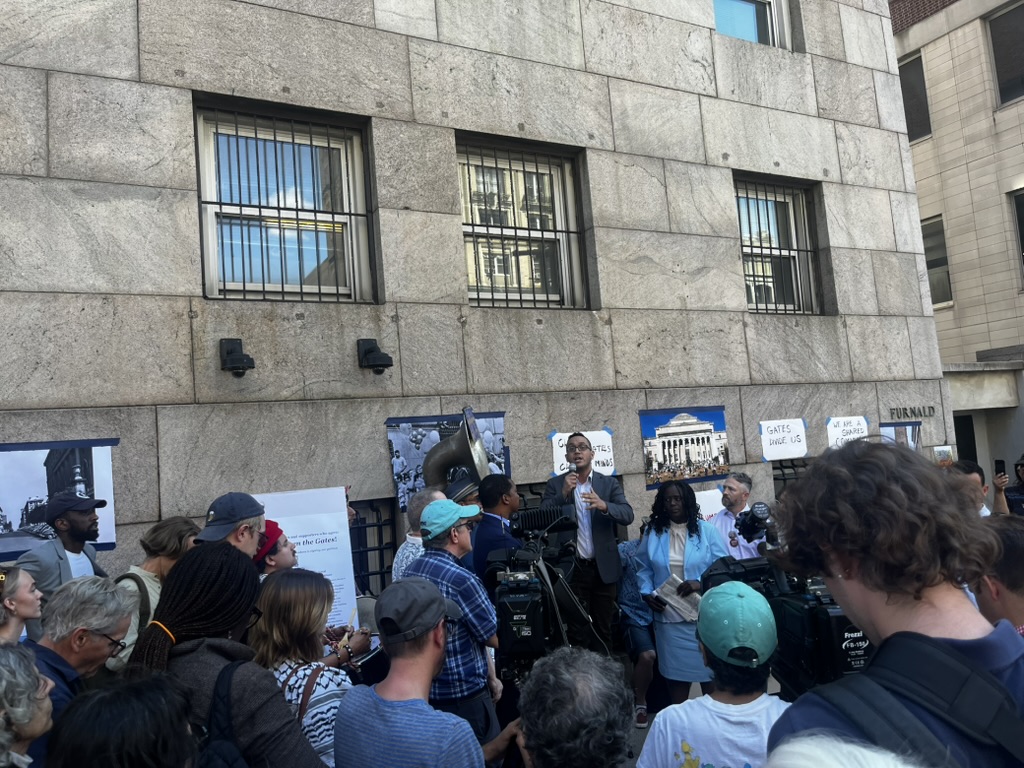
The closure of the gates does not only harm the Upper West Side, Assistant Professor Blake Turner, representing the anti-fascist grassroots nonprofit CU Stands Up, said. He asked during the protest, “When outsiders are deemed ‘too dangerous’ without extensive vetting — what do students learn from this?”
Turner added that students, when isolated from the public, are robbed of the opportunity to experience New York’s diversity: “Students are only sampling the city.”
McSweeney said that in addition to its size, this rally was unique from others because of newfound governmental support for neighborhood residents.
On Thursday, September 3, Rachel Moston, an attorney for Mayor Zohran Mamdani’s Law Department, submitted a letter to the New York Supreme Court in support of reopening Columbia’s gates. Backing from the mayor pushes awareness of the issue, McSweeney contended: “I don’t want to say there’s universal support now, because there are people who don’t mind the gates being closed, but they are in the minority…If Columbia continues to pursue a closed campus, it is to service a minority perspective that does not resonate with the community.”
Thaddeus pointed out the political diversity of elected officials present at the rally. “There’s a broad spectrum of people that support this,” he said. “There were people there who endorsed Mamdani and who endorsed Cuomo.”
When asked about Columbia’s future relationship with Morningside Heights, if the gates were to open, McSweeney had an immediate answer: appoint community members to the University Senate. The Senate was created in 1968 in response to student protests over the University’s plans to build a gym on public land in Morningside Park, and about the Vietnam War. According to McSweeney, community members were included in the Senate’s initial organization. “They think it’s some radical idea,” he said, of including Morningside Heights neighbors on to the Senate. “It’s really not.”
Internal University repairs, according to Thaddeus, start with amnesty for students involved in protests over the past three years. “Some of them have been severely punished,” he said. He added that faculty and students who took part in yesterday’s rally were excited by the neighborhood’s involvement. “We’re very much aligned with them.”
Litigation about Columbia’s gates remains pending.
Subscribe to West Side Rag’s FREE email newsletter here. And you can Support the Rag here.




Keep it closed. The neighborhood has been much more peaceful since they closed the gates.
You’re kidding. Columbia’s neglect for the surrounding area is palpable: rents jacked up in CU owned buildings, trash all over the sidewalks, students ordering nonstop delivery. Further down the UWS, businesses contribute to trash cleanup efforts by BIDS (problematic since it also takes onus off the city to provide basic public services). That’s not even taking into account the ~$200 million in tax breaks Columbia receives every year, the 1A crackdown and the university’s increasingly uncomfortable ties with Israel.
Lols. The University and its population are the backbone and the entire financial engine to the UWS, Morningside Heights, West Harlem. The place would be destitute without them. Fifty thousand students and employees spending tens of millions of dollars per day on local business keep the area alive. Columbia generates way more in commerce and expense than they receive. Not even including all the free education, lectures, healthcare etc. they provide the neighborhood.
Hate to say it – but you genuinely don’t know what you’re talking about. The neighborhood has a stable population of long-term residents, many of whom with little to do with Columbia for those living outside those CU-owned buildings WHICH ARE NOT GENERATING REAL ESTATE TAX REVENUE.
And what healthcare does Columbia provide??? Saint Luke’s is a Mount Sianai hospital, Columbia Pres is in Washington Heights.
Columbia has 40k odd students & employees. Nice to see there are coordinated talking points for the non-local trolls though
What does any of this have to do with the neighborhood being more peaceful since the gates were closed?
Those darn students ordering nonstop delivery
Right? How dare they support local businesses. Geez. . .
DoorDash/UberEasts/5 Guys/Chipotle/the new Chinese chains…real ‘local businesses’ huh
Not sure why all these people need access to Columbia’s private campus. Anyone who is affiliated or lives in the neighborhood already has access. So this is just plain belligerence. Why do I need access to Morgan Stanley’s or anybody else’s campus?
Because it is a NYC Street and that is the deal. Columbia should be sued.
Almost every college campus is open to the public. The buildings are closed off but you can walk around the grounds. Look at Harvard. Most campuses are not in the center of a city so you probably wouldn’t go to hang out but it doesn’t mean you cant
Not true that “anyone who lives in the neighborhood already has access”.
Only neighborhood residents who live between 103rd and 135th Streets may have access if they submit a “campus access form” in advance: https://neighbors.columbia.edu/content/campus-access-form-neighbors
Why would someone who lives more than twenty blocks away need to “cross” campus??
Ask Columbia if you can’t fathom why.
Or read the WSR comments below for an explanation that might satisfy you.
Those who live in the neighborhood for the most part DO NOT have access, with exceptions so few as to be virtually meaningless.
Not sure why. You just need to go online or call and get access. It is very easy.
It’s not the access to the campus as such as access to College Walk to be able to walk from Broadway to Amsterdam at 116th St (right where the subway station is btw) without having to make an 8 block detour which is at best time consuming and at worst a possibly insurmountable physical burden on those who are physically challenged. Remember that College Walk is a public street the City ceded to Columbia in return for public access.
what?! it isn’t their private property. The city — OUR city — has a longstanding agreement with Columbia to keep 116th open. It’s a public thoroughfare! Complete nonsense that it is theirs to do with as they want.
You obviously haven’t read up on the issue. There was never a legally binding agreement. Just a suggestion by the Manhattan borough president in a letter from 1953 after the city turned over the property to the school. He suggested an official arrangement. Never happened. It’s still private property owned by Columbia, not the city, and they can do what they want with it. Accept reality and move on.
Just an agreement. Its not in perpetuity. That’s their property.
It’s still private property. The owner has the right to deny unrestricted public access. They maintain it and perform the clean up after public use.
The explicit text of the executed agreement specifies that the City retained an easement “over the proposed pedestrian walk” to guarantee “free and unhampered access” for municipal operations—specifically for the Fire Department, police, and other city services responsible for public infrastructure, utilities, and emergency response. I don’t detect a lack of clarity in this and I’m not especially fond of Columbia.
There’s an easement on my property too, as that’s standard. It doesn’t mean public access. I can still deny access to the easement since it’s my property.
What “executed agreement?” The letter? Not legally binding. The letter written by the Manhattan borough president in ’53 encouraged an official agreement between the university and the city. It never happened . And where are you getting your quotes? Not from the original document. There is no such wording in the letter.
Correct. The general public does not get access, only the City for services.
Because Columbua agreed in 1953. If Morgan Stanley agreed to have a privately owned public space you’d have access to that too.
If they lkfe in the neighborhood, how do they have access to the campus if the gates are closed?
Yeah but they don’t pay their fair share property taxes . Go research it. Also NYU.
They generate 1.3 billion in commerce for the city each year.
Great. They should also pay their fair share of taxes. They own a lot of land in Manhattan.
Why does this bother you? Why is it your problem? The Morgan Stanley comparison makes absolutely no sense. The “plain belligerence” seems to be on your part.
Columbia made a deal that they could have this super block in exchange for letting people walk through. Many people moved into apartments near campus assuming they could walk through, particularly those who live on the east side and need to walk across to the subway. The additional distance to walk around is not trivial.
There is no compelling reason why it should be closed. It really isn’t that hard. Just create strict rules about behavior on campus and enforce them. Very simple.
The “agreement” that everyone keeps blubbering about was never legally binding. Access was merely a suggestion in a letter written in ’53 by borough president Robert Wagner after the city turned over the property to Columbia. He suggested that the city and university “consummate” an official agreement. They never did. And because it’s private property, Columbia can do what it wants. That being said, Columbia tends to cave to organized whining, so you’ll probably get your way in the end.
Very simple response: open the gates. Have those officers currently working at the gates patrolling campus, adding more safety – no budgetary impact. Post signs all over the place that non-students loitering on campus, as well as those protesting in any way, shape, or form that is remotely threatening to others, will be kicked out immediately. Then enforce that.
Get Officer Krupke to tell people who shouldn’t be there to move along. Inevitably one of those people will be a minority and everyone will get all upset about racism. People need to chill out.
I believe in freedom of speech. I also believe that some of the protestors went way too far and should have dealt with consequences for their actions.
“For decades, Columbia’s campus has functioned as a public gathering space for families. “I learned to walk on these steps,” shared one current student, who grew up a couple of blocks from the school.” Isn’t this what parks and playgrounds are for? I honestly don’t know of anyone growing up who went to college campuses, any college campus. for this purpose.
I grew up, learned to walk and ride my bike on the flat surfaces (we lived on a steep hill), and used the library at the university where my father taught and was an administrator (on the west coast, a R1 research institution). As did many of my friends, some of whom were ‘faculty brats’ like me, others just lived in the neighborhod. College campuses are part of the neighborhood they inabit. I now live 5 blocks from the CU campus and find not being able to cross east to west (and vice versa) very problematic, especially in the heat and cold…. going the extra 6 or 8 or 10 blocks can be dangerous for people with limited mobility.
Sorry people, you are paying the price for your actions. Go to Riverside Park, Morningside Park, Sakura Park. Central Park, St. Nicholas Park., Cathedral Park to name a few. You don’t need access to a private academic campus where there are already fifty thousand students, faculty, and staff that are paying to be there.
Who is ‘you?’ The entire neighborhood? Columbia’s politics have nothing to do with someone who lives on one end of the neighborhood and wants to travel west east without walking hundreds of meters out of their way? Your elderly neighbors are “paying the price”? You live in a society
That is correct. they don’t support Columbia, they don’t pay Columbia, and they did not try to stop all the outside protestors and agitators. everyone needs to take responsibility for poor behavior. One guy had a bomb in his shoe at an airport, and forever everyone must now take off their shoes. There is cost for poor behavior.
I’m the original Jane.
You don’t have to take your shoes off anymore. That changed about a year ago.
Point of correction: EVERY New Yorker technically subsidizes Columbia thanks to that massive tax break. So yes, the neighborhood DOES prop up CU
What was the poor behavior? Protesting a genocide? Getting attacked by the NYPD, who, if you’ll remember, discharged a round accidentally during the paramiitary-style raid that could’ve serious killed someone?
Comparing a protest encampment to an attempted act of mass murder speaks volumes
Harassing Jewish students, disrupting classes, damaging school property and assaulting school employees!
Yes, this right here is the issue. You’re entitled to your own political views but you’re not entitled to disrupt the campus life and education of students paying to attend a university (on private property no less). If you feel you simply must protest, do so elsewhere. Columbia has no obligation to host your nonsense.
Once again – Columbia does not own 116th street. It’s public property. That’s the issue at play here. But if you want to live in a society where only certain people have the right to free movement and speech, there are direct flights to Israel every day.
What is the City and neighborhood going to contribute to Columbia if they open? How much are they going to pay to maintain the grounds? City parks get budgets. How much are they going to pay for security?
People need to have access to get to/ from the subway to the hospital – instead of walking around the campus.
And especially a problem when there are “open streets” for restaurant street dining on Amsterdam forcing detours of the M11.
Northbound that means a detour on Broadway to 120th.
The hospital is south of the campus. Nice try.
“I know that safety and campus access are not at odds,” said one of the people to blame for the gates being closed in the first place who somehow may end up representing the area in Congress and who followed with a hackneyed platitude – “Safety comes from knowing your neighbors.” – as if Columbia’s neighbors were actually the problem.
The solution is to make Columbia University pay their fair share of property taxes removed all those tax break they get. they can keep their gates closed.
That will hurt the students more. Tuition will increase.
The foreign masters students who provide the bulk of tuition profit won’t care they’re loaded and want that easy Ivy degree
That doesn’t solve the issue of access to 116th st bet Broadway & Amsterdam, otherwise known as College Walk. The forced detours around campus is the real hardship for the neighborhood. They can seal their campus but return that block of 116th back to the city.
This is absolutely the key point. Open College Walk/West 116th Street to the public. People need unimpeded access to the subways and busses ai 116th Street.
Responding to some of the comments; Campuses all over the world are public spaces. Columbia is unique among major universities in the United States in closing its gates.
Columbia campus is located in the middle of the neighborhood and is more accessible than the parks for people with limited mobility.
The campus has been open for more than 70 years. We’re not asking for anything new.
Historically, Columbia’s gates have been open and were only closed after the events of the last few years. Columbia is unique in the high level of discord experienced over the past couple of years so comparing it to other major universities is not relevant. What you are asking is for many of us to risk our physical safety and mental well-being and that is a lot to ask at this time. I am not sure how you are so ignorant of the moment we are living in but it comes across as callous and selfish.
I doubt the majority are locals. The protest groups want back in – they have said as much. Keep it closed for now. Locals can get a pass to get through, as can alumni.
Columbia received an easement from the city to use 116th Street for its purposes, and in return agreed to allow pedestrian access. If CU no longer wishes to abide by that arrangement, the City can take its street back; tear down the gates and upon the street to traffic.
Wrong. They never officially agreed. The Manhattan borough president wrote a letter in ’53 suggesting that the city and university come to an official agreement . Well…it never happened, so Columbia can do what it wants. But don’t cry in your soup for too long. They’ll probably re-open it again soon.
Every statement you said is incorrect. Columbia purchased the land from the City. In exchange they gave the City an easement for access for utilities, maintenance etc. The public has never been granted or guaranteed access. Columbia has just been generous all these years.
“ 237 House members, including 33 Democrats, voted to strip federal funding from universities where students speak out against the Israeli government.
This is an assault on the First Amendment. We need to stand with students with the courage to call out the genocide in Gaza.”
Courageous? You mean the people wearing masks and whining that they might face consequences for their actions?
The ones who complained that they weren’t getting free food?
Yeah. Such courage.
I’m disappointed, WSR. This is easily fact checked https://www.congress.gov/bill/119th-congress/house-bill/4795
You’d rather publish an inaccurate comment than post one from a commenter you simply don’t like? Doesn’t really feel like responsible journalism
This is inaccurate. HR 4795 relates to boycott and sanctions activity specifically. It is not written as a general ban on individual professors, students, or employees criticizing Israel
The House voted against federal funding for universities which choose to boycott Israel.
No college is being withheld funding for speaking out against Israel.
This is a big difference from what you’re writing. Don’t spread lies you know are false.
And the keffiyeh wearing thugs who disrupted classes at Columbia, damaged property, assaulted faculty and threatened students did not act with “courage”.
Incidentally, these hate filled protests which you support occurred just after the October 7th massacre before Israel even retaliated.
Well, first one must understand what the word “genocide” means.
I’m all for first amendment rights – but I also know that informed opinions are far superior to uninformed ones.
No, it isn’t. Speak all you want about the “genocide” nonsense. We just don’t have to subsidize you for it.
So is there an easement or isn’t there an easement? If there is an easement, Columbia has no right to close it, and the city should be enforcing the public right of way. If there is not an easement, then the community can put pressure on the university, but it is ultimately the university’s decision.
The City has an easement for utilities, maintenance. That does not mean the general public.
I totally agree with opening the Gates ASAP – it also creates a safety hazard for older people for now have to walk all the way around to get to various places and makes Columbia an “Island Unto Itself!”
When Covid first started, my entire family spent months on that campus having picnics with the neighborhood Families all hours of the day. We lived on 127th St. I have no idea what we would have done if those gates were closed during that time we literally spent more time having picnics on that campus then in our own apartment.
You may have noticed that there are parks in the area.
The campus should be open. There’s really no excuse and no need for a task force to look at this. I’m a Columbia graduate and live close by. The process for getting ID was ridiculous. And if you’re a graduate visiting from afar, who just wants to walk around to relive your time there, why should you have to get an ID? Or just someone who wants to look at a major New York City institution?
I remember walking around the campus during the height of Covid and it was really a solace to be there. Now most neighbors are shut out.
The campus was open for decades without a problem, and the decision to close the gates for years is a total overreaction to the brief moment when there were protests a few years ago. It’s time to open the gates.
+1000… I went to Barnard and spent four years being a student at Columbia. I would so love to take my partner around campus and show him the place that meant so much to me for so many years, but this has been impossible for the entirety of our relationship. BC alumnae have even less rights to visit CU campus even though we also went to school there and have a Columbia degree. It makes absolutely no sense and I just can’t wait till it’s open again!
Take a quick look at how much of Morningside Heights is now the property of Columbia University vs. what is locked behind the gates. How are they able to keep the large percentage of CU property safe without being behind a gate? CU’s argument is disingenuous and there are clearly other ways to maintain safety & order without them claiming public property as their own. The map below (from their own website) is not current. They own more now. https://cufo.columbia.edu/sites/cufo.columbia.edu/files/content/morningsidemap_2015aug-7.pdf
Excellent report.
All the resident commies and other anarchists supporting a “re-opening” – when it was them that forced the closing in the first place – tells me everything I need to know about what should be done.
Rich, pretty rich, comrades.
“Resident commies”
Oh so you’re MAGA? Got it.
Anybody who supports these continued closures is a monumental coward.
It is perfectly acceptable for a private institution to curtail access.
Allowing people dressed like terrorists screaming about Gaza at this protest is exactly the reason the gates should stay closed. It’s unfortunate for the rest of the community who want to peacefully access the campus.
“dressed like terrorists?”
WSR, you’ve got to be kidding me
My nephew began college this week. He struck Columbia off his list back when all the protest nonsense was happening because he just wants to focus on his studies and settling into a new city. Sensible young man
Today the campus was packed with kids of all types and sizes doing their thing and getting to know each other. All best to your nephew. He probably would have had a good experience at Columbia, too.
It’s going to reopen, it’s been a ridiculously long time since the protests. In the meantime the entire world has begun to overwhelmingly side with Palestine. Israel lost the PR war and it’s just a matter of time before the non-westside residents who flock here whenever anything to do with Israel is published will have to move on.
All these comments and only one or two mention why it was closed. Loud, wealthy and committed the closure advocates are. Enter Mamdani.
Most of the people who support the campus lock down support open borders and protest against ICE
I thought it was a legal agreement. Could someone clarify whether Columbia is breaking the law or not? My extended family has 10 degrees from Columbia, and I am making many fewer donations to the the university than I did before the gates were locked. Yes, I have a pass because I live in the neighborhood, but I’m appalled at the way Columbia treats its neighbors. Thankfully, I don’t live in a Columbia building.