
By Charlotte Robertson
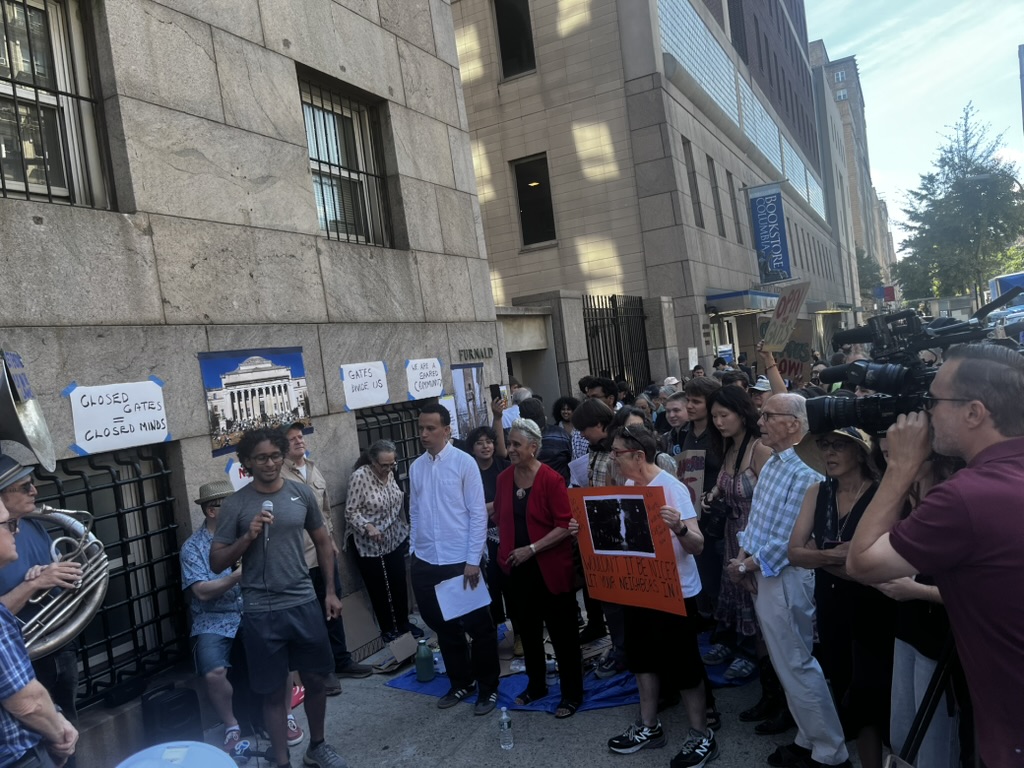
On Tuesday, a gathering made up of roughly 250 locals, community members, students, professors, and faculty gathered at the corner of Broadway and West 115th Street, demanding that Columbia University open its campus gates to the public.
It is the fifth rally of its kind since 2025 to be organized by the Morningside Heights Community Coalition. Dan McSweeney, MHCC’s program director, has been dedicated to community organizing since 2005 and has been instrumental in coordinating the rallies outside of Columbia; this one, he told West Side Rag, felt different.
“We had hundreds of people exposed to the messaging,” he explained. With the first day of the 2026-27 school year in full swing, Columbia students walking to and from the gates were forced to face their locked-out neighbors. Several of these students stopped, filmed, and cheered in support of the rally.
Columbia is now entering its third year of a closed Morningside Heights campus, which, as many of Tuesday’s demonstrators say, violates the 1953 easement agreement between the University and the City of New York, that states College Walk should remain open to the public. Following campus protests in the spring of 2024 related to the Gaza War, the University closed the campus to all but those in possession of Columbia ID cards, which are scanned by security guards at the front gates before entering.
On September 7 of this year, the new University President Jennifer Mnookin sent an email to Columbia students, permitting them to bring limited family members onto campus with private QR codes. She also announced the formation of a new committee, which aims to “explore” the University’s relationship to the neighborhood and the safety risks of reopening the campus.
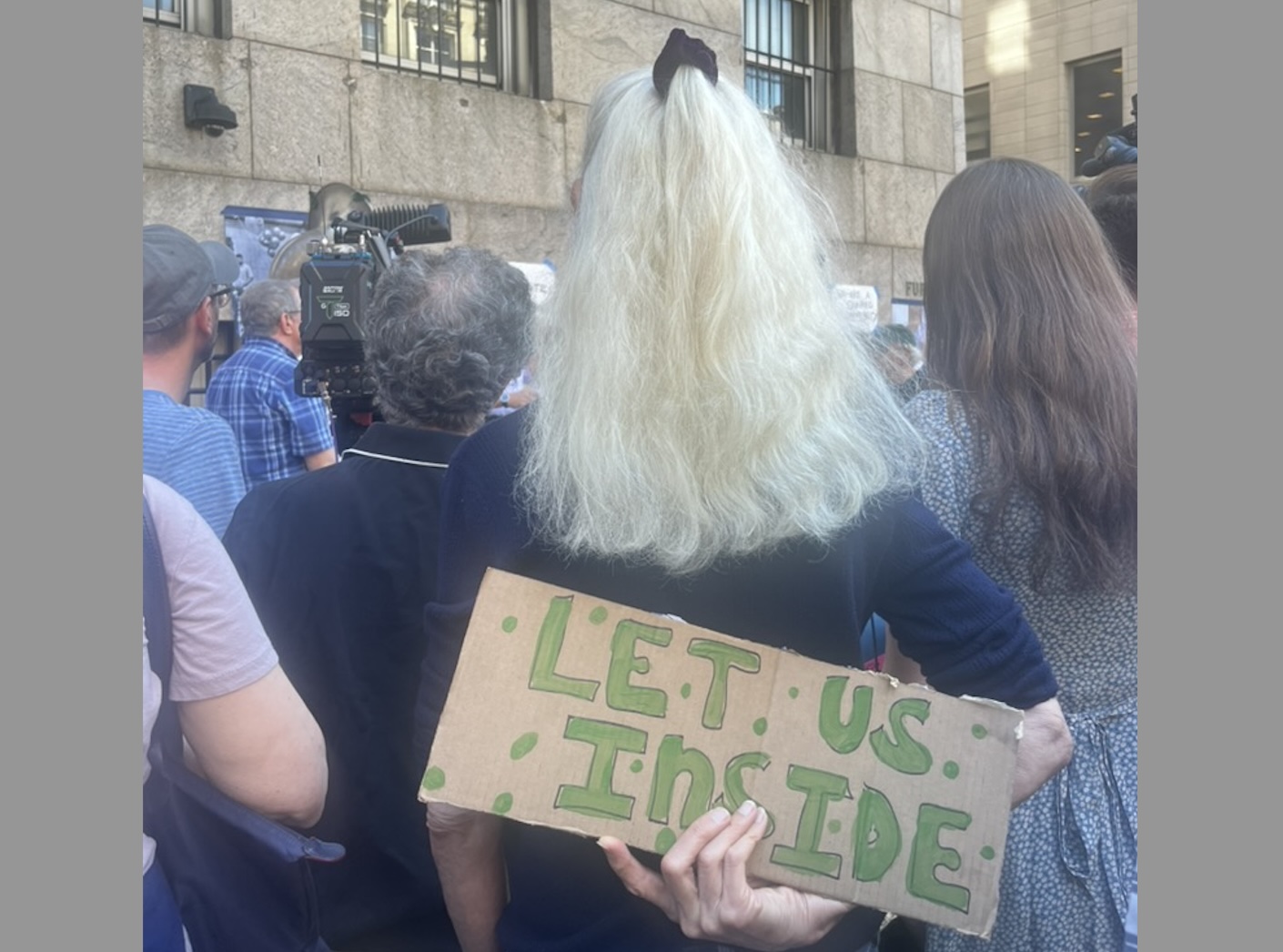
“I served on one of these committees two years ago,” said Emerson Ellenwood, class of 2028 and College Student Council VP of Finance, in a speech. “We don’t need another committee. We need a commitment.”
“President Mnookin’s announcement was pretty disappointing,” Professor of Mathematics Michael Thaddeus told West Side Rag. “It seemed like a pretty modest step. Still, it’s a step in the right direction.”
Thaddeus has been active in University politics for several years, gaining notoriety in 2022 after publishing an investigative analysis of Columbia’s U.S. News ranking. He has been outspoken about freedom of speech on campus, including the University’s 2025 capitulations to President Donald Trump. In a speech at the rally, he highlighted that the opposition to opening Columbia’s gates has been largely anonymous. “I feel it is very difficult to tell who supports the lockdown,” he told West Side Rag. “No one has publicly stepped forward and named what the public security concerns are.”
For five semesters, four different Columbia University presidents have claimed an open campus poses risk to students.
“I know that safety and campus access are not at odds,” said Darializa Avila Chevalier, Democratic nominee for Congress in the 13th Congressional District, in a speech during the protest. “Safety comes from knowing your neighbors.”
An alumnae herself, Chevalier continued that she initially chose Columbia because of the school’s reputation as “the activist Ivy,” and that her experience as an undergraduate was shaped by a “culture of rebelliousness that has pushed me to speak truth to power.” She added: “It is critical that the people who actually built this neighborhood are not locked out of their front yard.”
McSweeney also said he was fed up with the University’s claims of safety concerns, mentioning that multiple students have been detained by ICE agents since the campus’ closure. “If ICE wants to enter the campus, security contracts are not going to stop them.”
The closure of Columbia’s gates is a logistical challenge for Upper West Siders, blocking access to the 1 train on 110th and 116th Street. Beyond that, many find the closure of the gates to be symbolic, suggesting that the physical divide creates an “othering” of the non-Columbia community; such is the belief of Eli Northrup, Democratic nominee for New York Assembly District 69.
“The neighborhood and our sense of togetherness have suffered,” he said. Adding that the Class of 2027, now seniors, are the only students at Columbia to have experienced an open campus, he argued that the longer the University waits to open the gates, the harder reparation will be: “This is not normal.”
For decades, Columbia’s campus has functioned as a public gathering space for families. “I learned to walk on these steps,” shared one current student, who grew up a couple of blocks from the school.
Manhattan Borough President Brad Hoylman-Sigal said that public access to the campus motivates the next generation of students: “Columbia’s campus is an inspiration to young people who want to achieve the best in higher education.” Chair of Community Board 9 Victor Edward agreed: “If you can see it, you can be it.”
In between speeches, a musical trio with a drum, a tuba and a trumpet performed playful tunes followed by the simple chant: “Open the gates!”
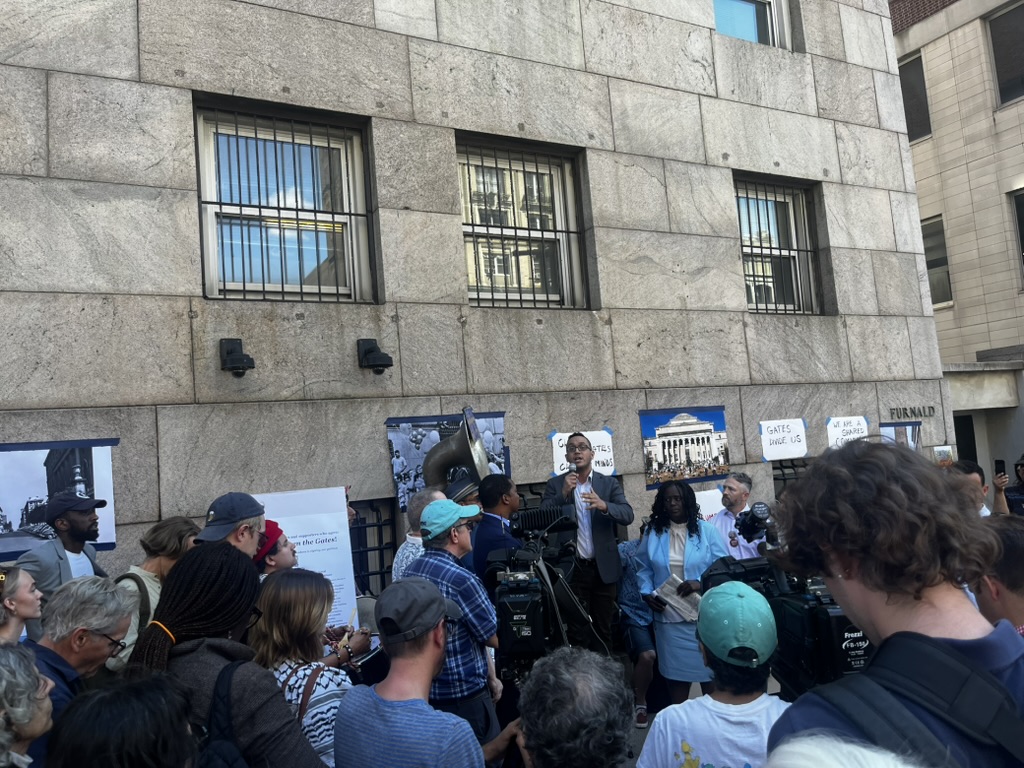
The closure of the gates does not only harm the Upper West Side, Assistant Professor Blake Turner, representing the anti-fascist grassroots nonprofit CU Stands Up, said. He asked during the protest, “When outsiders are deemed ‘too dangerous’ without extensive vetting — what do students learn from this?”
Turner added that students, when isolated from the public, are robbed of the opportunity to experience New York’s diversity: “Students are only sampling the city.”
McSweeney said that in addition to its size, this rally was unique from others because of newfound governmental support for neighborhood residents.
On Thursday, September 3, Rachel Moston, an attorney for Mayor Zohran Mamdani’s Law Department, submitted a letter to the New York Supreme Court in support of reopening Columbia’s gates. Backing from the mayor pushes awareness of the issue, McSweeney contended: “I don’t want to say there’s universal support now, because there are people who don’t mind the gates being closed, but they are in the minority…If Columbia continues to pursue a closed campus, it is to service a minority perspective that does not resonate with the community.”
Thaddeus pointed out the political diversity of elected officials present at the rally. “There’s a broad spectrum of people that support this,” he said. “There were people there who endorsed Mamdani and who endorsed Cuomo.”
When asked about Columbia’s future relationship with Morningside Heights, if the gates were to open, McSweeney had an immediate answer: appoint community members to the University Senate. The Senate was created in 1968 in response to student protests over the University’s plans to build a gym on public land in Morningside Park, and about the Vietnam War. According to McSweeney, community members were included in the Senate’s initial organization. “They think it’s some radical idea,” he said, of including Morningside Heights neighbors on to the Senate. “It’s really not.”
Internal University repairs, according to Thaddeus, start with amnesty for students involved in protests over the past three years. “Some of them have been severely punished,” he said. He added that faculty and students who took part in yesterday’s rally were excited by the neighborhood’s involvement. “We’re very much aligned with them.”
Litigation about Columbia’s gates remains pending.
Subscribe to West Side Rag’s FREE email newsletter here. And you can Support the Rag here.