

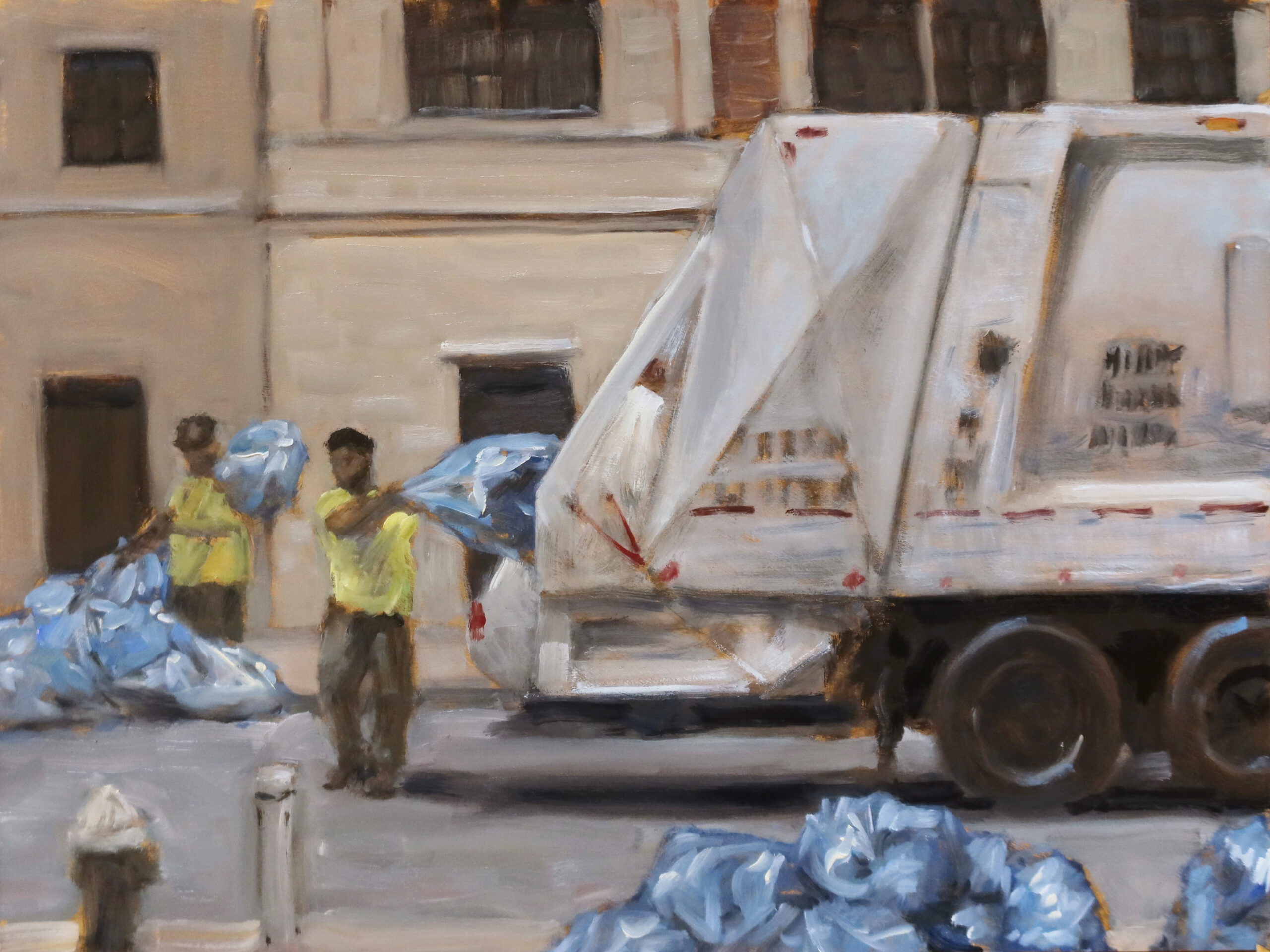
 Painting and essay by Robert Beck
Not to go full back-in-my-day on you, but in the pre-plastic era, trash cans were galvanized steel. Everybody had them. Part of the morning garbage-collection sonata was the clatter-crash of those cans being tossed back onto the yard or driveway, banging against each other and sometimes rolling into the street. Over time, they transformed from cylindrical to semi-oval to really bent up while the lids remained round, making it harder and harder to get them back on. When the bottoms rotted out or the handles broke, you got new cans.
It was simple. The kitchen garbage went in a paper grocery bag or maybe straight into the can, with anything else you wanted to get rid of. Anything. The inside of the can was pretty grody. You didn’t worry about recycling or hazardous materials. It was toxically convenient.
Some of the out-of-sight, out-of-mind crowd will disagree, but we are way better off with recycling, composting, clean water, and attention to hazardous materials. I grew up along a major river that was dead and disgusting until laws that controlled disposal were enacted. Now it’s beautiful again, and the people who oppose that kind of legislation are buying waterfront houses.
I have reflected over my adult lifetime on how society resembles our bodies. Look at a map, and it’s not hard to see the roads and railways as a giant circulatory system. I’ve watched the computer become critical to our everyday lives and act as a surrogate nervous system, and now it appears we are creating what, in somebody’s idea, is a thinking brain. It’s not clear where the people doing that get the authority to be the agent for the rest of us, but they are bringing with them all the scruples Free Enterprise requires. The cost in power generation, environmental damage, creative suppression, individuality, and loss of jobs is enormous, although some folks will do very well. If this is intelligence, it’s got a big mental health issue.
(Clears throat) Sorry, I got a little off-track there. Back to my society-as-a-body analogy. The role of digestive system is played by the Sanitation Department. We consume a tremendous amount of stuff, and it all has to go somewhere.
This painting depicts a small slice of that journey, but it’s where awareness of the process ends for most of us. Those piles of black and clear-blue bags on the sidewalks. The trucks blocking traffic. The manual labor (I wouldn’t make it to the end of the block). The removal part is in clear view, but then the bags are whisked away to … somewhere.
The recycling, I don’t know. The trash, maybe to an incinerator that makes steam and generates electricity. That would be nice. More likely it’s shipped by boat, train, or truck to an open pit in a foreign land, like Ohio, or a Carolina. Out of sight. Raise your hand if you know where that plastic take-out tub of potato salad in your fridge ended up —the one that was too old and disgusting to clean out for recycling, so you just dropped the whole thing in the trash. Me neither. But that reminds me; I have to pick up some more on the way home tonight.
Note: Before Robert Beck started West Side Canvas, his essays and paintings were featured in Weekend Column. See Robert Beck’s earlier columns here and here.
Subscribe to West Side Rag’s FREE email newsletter here. And you can Support the Rag here.




For a detailed description of where NYC trash goes and what happens to it read Manhattan Solid Waste Advisory Board’s excellent detailed description
https://www.manhattanswab.org/nyc-waste-exports
As for your dirty plastic potato salad container please rinse it out and toss in plastic recycling. Environmentally speaking, the amount of plastic that really gets recycled though is 6-9%. Want to be more on the pro planet side of things? Bring your glass or aluminum reusable container to the grocers and deli and ask them to fill it with ready made food of your choice.
I encourage the West Side Rag to offer more stories about residents efforts to make sustainable choices. After all, the earth doesn’t need perfection just people who care consistently.
While paper recycling is performed in Staten Island, “blue bin” materials like metals and hard plastics are taken to the Materials Recovery Facility in Sunset Park, Brooklyn, and organics are composted in Staten Island or taken to DEP’s digester eggs in Greenpoint, NYC spends close to $600 million a year sending our trash upstate or out of state. And the price is only going to go up as these areas tire of handling our waste. Clearly, we need to start reducing the amount of waste we produce. Meanwhile check out the trash tracker: https://tracknyctrash.com
Picking Up: On the Streets and Behind the Trucks with the Sanitation Workers of New York City is a great book about the men and women who keep our city clean.
“The Manhattan 7 garage serves the Upper West Side neighborhood, which is where I was working with Kurtz and Federici. Even though Kurtz had worked out of M7 for his entire career, he was still mildly incredulous that the district’s residents consistently threw away so much good stuff. Once we discovered a flimsy pair of black-and-gold women’s stretch pants by Armani. They were in good shape—no stains or tears, no odd smells—and still bore their tag. I went slack-jawed when I saw their price. “Guess,” I told Kurtz. From my face he deduced that they cost more than he might expect and aimed for the low hundreds. I shook my head. His bid rose. Finally, his own jaw dropped when I showed him the tag: $1,325. Yes, one thousand three hundred and twenty-five dollars. And we had found them in the trash.”
It’s quite sad that many people are not prepared to take the opportunity to act responsibly. In my apartment building I can see that people recycle but can’t be bothered to even separate into paper and plastics etc. in my humble opinion we should not only take the trouble to separate, there is no reason why able adults can’t break down boxes before disposal. It would make it easier for building janitors and also takes up way less room on the street and saves bags. We could have an extra bin for refund containers and bag them separately. This way the collectors won’t need to clutter up our side walks opening bags. Really. Is it such a big deal for able bodied people to make an effort for the future of our children’s world? I’m 75, not here to see the too distant future unfold but I can break a box to make streets more pleasant today.
Some people in my building won’t even compost, when the city and the building make it so very easy for them. The custodian tells me that when plastic bags with food waste break on the way down the chute, it makes a disgusting mess for him to deal with. Why can’t people be even a little considerate? Not to mention — here we can compost the things that only commercial composters can handle. It’s very easy to plan ahead, buy bamboo plates and flatware instead of paper, styrofoam or plastic, and even use reusable straws, coffee cups, and napkins. How hard is that?
I’ve never seen garbage look so good!
great painting. clean even. love the white truck and color pops of bags and shirts.
I bet you could even paint my closet to look good.
BRAVO.
Your Biggest Fan!!
Thank you, Carol. It’s been a while. Maybe see you soon. When is your show?
I am definitely not surprised that an artist and column writer would be solidly in the anti-AI camp.
I should hope so!!!
Here is the skinny, though there is one important caveat at the end:
“Most rigid plastics, glass bottles, metal cans, and cartons collected from the curb are transported to the massive material recovery facility in Sunset Park, Brooklyn. Inside the facility, conveyor belts, magnets, optical scanners, and human workers sort the items by material type. Once separated and baled into pure material streams, the items are sold to manufacturers to be turned into new products.
Mixed paper and flattened cardboard are hauled via truck, barge, or rail to the Pratt Industries Paper Mill located on Staten Island. The paper facility pulps and processes the collected paper and cardboard material to manufacture 100% recycled paper packaging products.”
One caveat. While hard plastic containers (from prepared foods, take-home, delivery, etc.) generally go in with rigid plastics, the City discovered that the optical scanner on the sorting machine does not “understand” black, so the black plastic ends up going down the regular garbage chute. In this regard, the City requests that hard black plastic containers be put in with regular garbage, to be sorted by hand at journey’s end.
Your caveat about the black plastic may be out of date. Last I heard, they had solved the problem of scanning the black. However I would avoid using or taking home black plastic to the degree possible anyway, for many reasons (e.g. desirability to plastic recyclers, health impacts, etc)
Thank you for that update! I had not read about it, but you are correct! Rigid black plastic can now be put with all rigid plastics of whatever color, or white.
NYC trash is sent elsewhere – sad for other communities, states and countries.
And it seems NYC life is predicated on creation of more and more trash – more Starbucks, more UberEats delivery, more Amazon delivery
Here’s one article:
https://gothamist.com/news/new-york-citys-trash-is-causing-a-stink-in-this-upstate-town
can we talk about rats crossing in front if you on the sidewalk at night though…
Amen to all this. I’ve been trying all my life to do the right thing with my trash, whatever that may be. I spend more than half my time not in NYC, so I’m facing challenges and opportunities not available to me in town, but it is still frustrating. I use plastic water bottles only to give water to the landscapers and delivery people who do the labor I can’t, or won’t. I compost. I recycle. But so much still ends up in the landfill: plastic containers with the wrong recycling numbers, plastic bags that aren’t #4, dirty paper, styrofoam food trays. But this isn’t something that individuals can do on our own; we need municipal and state regulations that make it easier to preserve our resources and environment.
You’ve shared a really a beautiful, sensitive painting, thank you.
You comment is appreciated
Lovely painting. But recycling on the micro level is masturbatory. This is common knowledge among anyone who’s actually in the industry, yet nobody ever wants to hear it.
The NYC Santitation workers work really hard. It’s appalling to read that, as Sharon commented, 6-9% gets recycled. And that’s more than the commercial garbage pick-up companies do; I have been reliably told that although commercial trash is separated by customers (e.g. Silver Moon Bakery), the carters just toss everything into landfills. It’s so discouraging.
Recently our big grey garbage bin was searched by Sanitation who found food waste. Voila! Our building got a huge fine. So beware you composting slackers out there.
Everything in one bag nice and neat. Sometimes I change and toss it in the corner bin
Comments from UWS Dad?
Thoughts on trash, waste?
Estimates indicate city dogs drop roughly 74 tons of waste each day, with some legislative reports suggesting higher totals of up to 500,000 pounds (250 tons) daily depending on the canine population count. Google to check figure/s.
And? What are you suggesting?
I APPRECIATE YOU, DSNY WORKERS! YOU ARE THE BEST! XOXOXOXOXO
The amount of virtue signaling here in the comments is unbelievable, nonetheless —
Given the “low” rate of recycling and the advancement of new technologies, isn’t it time we looked at single-stream garbage as an emerging technology that doesn’t turn us all into low-level sorters of garbage?
If we were to look at the amount of pollution and capital involved in the different routes of garbage pickup—general garbage, plastics, and paper products—and the enormous (union) workforce needed for all the thousands of extra trucks and collection plants, wouldn’t we be better off throwing it all into one bin and letting technology and newer “best practices” work their magic?
I know this is counterintuitive, but this Rubik’s Cube system—now with thousands of “Empire Bins” added to the mix—seems to be built around nothing more than protecting jobs, enriching haulers, suppressing “marginal” neighborhoods, and taxing homeowners.
Doesn’t ithe entire system need a radical rethink?
(Yes, reduce your footprint, and reuse what you can, are still good, and we could all possibly start there. Both of these are BEFORE things even get to the garbage stream.)
Is there a model of single stream garbage collection happening somewhere? I hope not. The problem with dumping stuff in landfills is that in decomposition they create methane, a lethal greenhouse gas. Read more here https://www.epa.gov/lmop/basic-information-about-landfill-gas#methane. Using methane for fuel is no better for the environment than gas guzzling cars or oil furnaces.
In NYC paper is repurposed at Pratt Industry, metal moves on to recyclers. Plastic with all its toxic chemicals should just be avoided. It breaks down to microplastics which are now in our bodies creating inflammation and disease. What’s so hard-?avoid plastic. Cut up our own fruit, carry glass or metal containers to the market, always carry a refillable drink bottle. Done and dusted! We can do this!
Such painterly technical excellence!