

By Scott Etkin
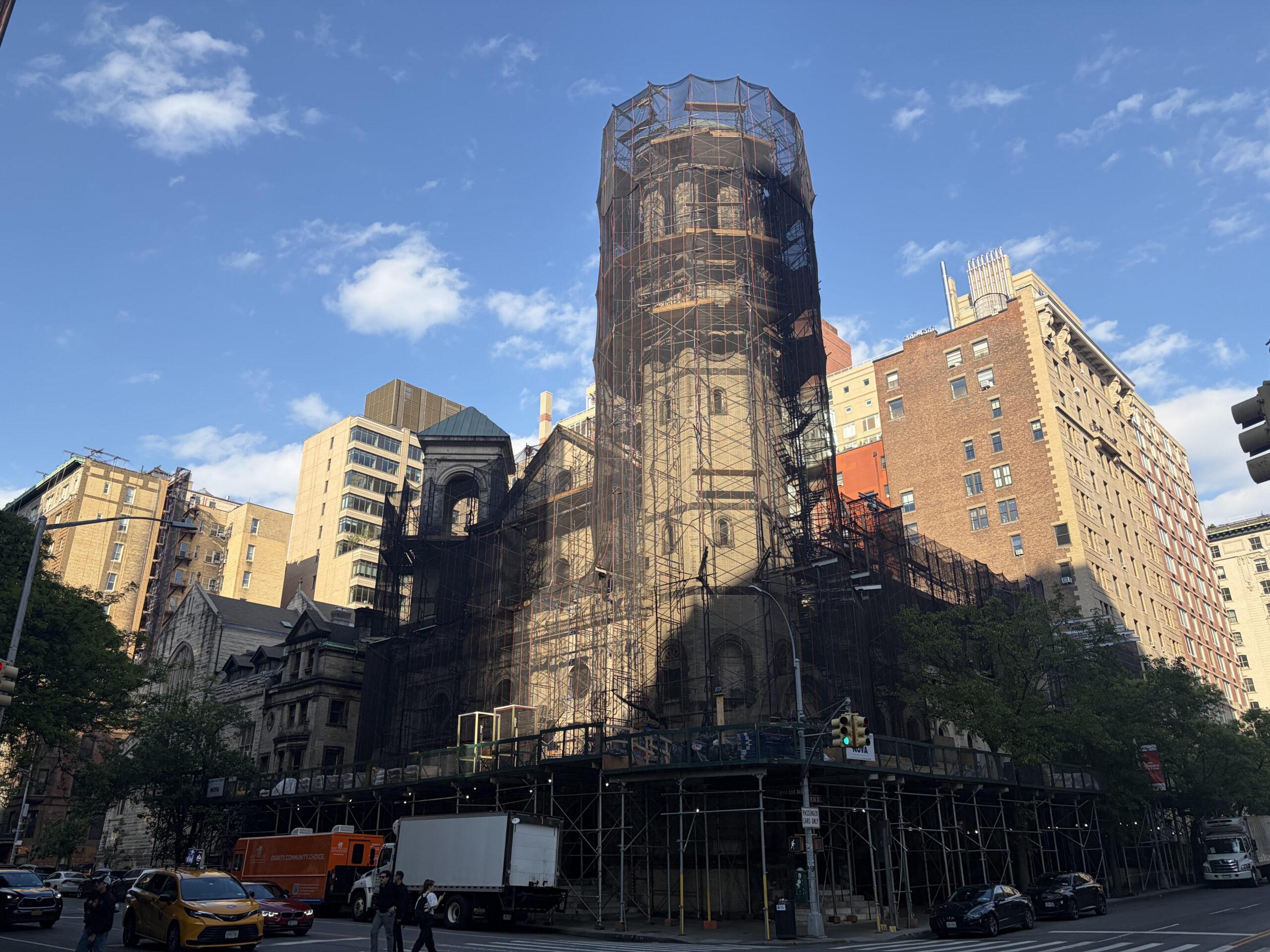
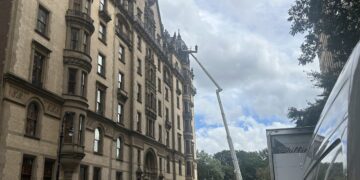
While plenty of large-scale sidewalk sheds are installed during routine repairs on the Upper West Side, one of the neighborhood’s most massive scaffolding structures is serving a higher purpose (so to speak) as part of the historic restoration of St. Paul & St. Andrew United Methodist Church at the corner of West 86th Street and West End Avenue.
The $5 million project is to replace the original roof, which dates back to 1897.
“It’s what’s known as a hundred-year roof. You know, which is great. But it’s not a 129-year roof. Therein lies the problem,” said the Rev. K Karpen, the church’s senior pastor, on a call with the Rag.
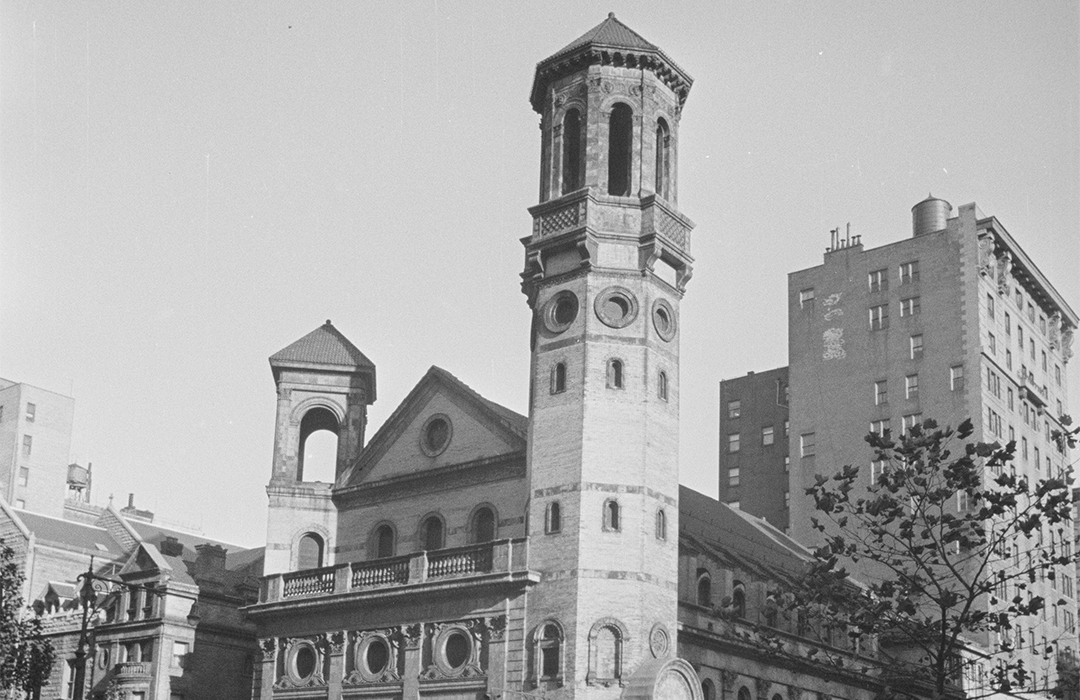
From inside the church, signs of the roof’s problems are hard to miss. “If you walk in the sanctuary and look up, you can see a lot of areas where the water has infiltrated and the paint is getting flaky, as well as occasional actual leaks that fall down,” said Karpen, who has helped lead the congregation for the past 40 years.
The roof restoration began in fall 2025 when workers took the existing roof down to its wood sheathing. They then checked the underlying material and rafters.“Underneath we found it to be pretty well intact,” said Karpen.
The next step involved adding a layer of plywood, which adds strength, then covering it with a breathable and watertight membrane.
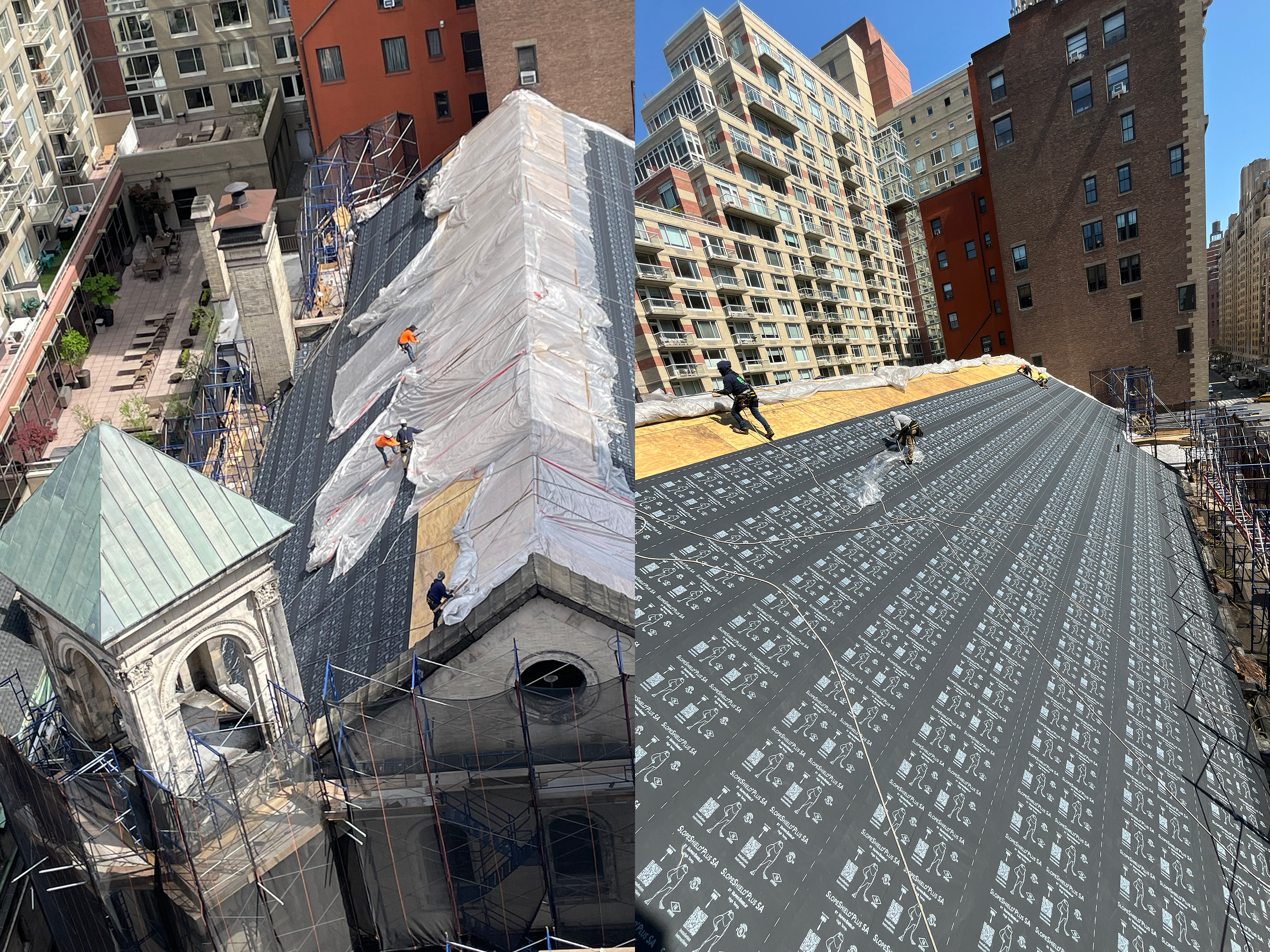
Finally comes the last and most notable part of the restoration: replacing tens of thousands of terra cotta tiles, known as Spanish tiles. The building was designated as an individual landmark by the New York City Landmarks Preservation Commission more than 40 years ago. This means that any restoration of the facade needs to adhere to the building’s original design and materials.
As a result, St. Paul & St. Andrew’s ordered 29,250 Spanish tiles from the only factory in North America that makes them, which happens to be in New Lexington, Ohio, according to Karpen. The tiles took a year to be delivered, and installation began July 16. The restoration is expected to be completed by early October.
All of this would have been impossible, of course, without a massive amount of scaffolding. The scaffolding, permitted in September 2025, covers the entirety of the building’s facades along West End Avenue and West 86th Street, and wraps around the taller of its two towers. This network of steel poles and netting is by now extremely familiar to the many people who use the church not only as a place of worship, but also for music and theater performances, after-school programs, food distributions, and Alcoholics Anonymous meetings.
Having a variety of partners who rent space in the building, including Goddard Riverside and the West Side Campaign Against Hunger, helps the church stay financially viable, according to the Rev. Andrea Steinkamp, another pastor. It’s also an important way that the church integrates with the surrounding community. “We’re virtually never closed,” she said.
The scaffolding-related engineering represents only half the challenge; the other half is financial. So far, the church has raised $4.9 million out of the total $5 million cost of the roof replacement.
Fundraising kicked off in October 2023 when the church received a $250,000 matching grant from the National Fund for Sacred Places, a program of Partners for Sacred Places in collaboration with the National Trust for Historic Preservation.
Since then, the campaign has received donations from current and former members of its congregation and neighbors. This includes a seven-figure donor and multiple six-figure donors. The church has also received a $45,000 donation from the New York Landmarks Conservancy, a historic preservation nonprofit.
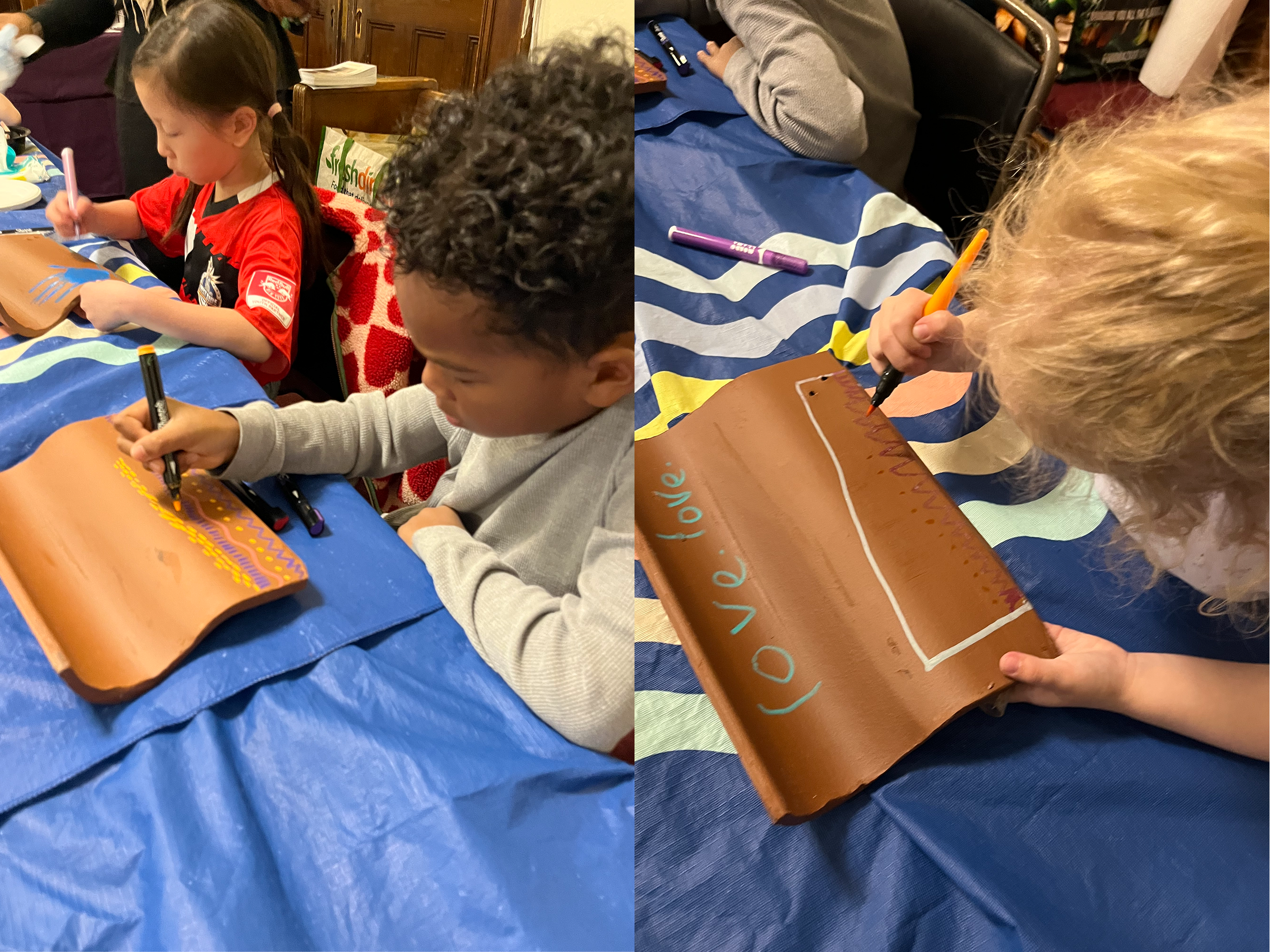
Earlier this year, the church set out to close the remaining gap in funds through a “Sponsor-a-Tile” campaign. At a blessing ceremony in May, donors wrote inscriptions – such as personal messages, signatures, prayers, and pictures – on hundreds of the aforementioned Spanish tiles from Ohio.
“We’ve had people who have given at every level to this campaign,” said Karpen. “What we wanted to do with this [Sponsor-a-Tile] campaign is say, ‘Hey, we’re almost there, and we are doing this amazing thing that really felt, I don’t know, maybe a little bit impossible.’”
It’s easy to imagine the building not making it to this point. In the late 1970s, when the congregation was down to 30 people, these remaining members sought to demolish the church and erect a new building with combined housing and worship space.
The plan was thwarted by the building’s landmark status. “The congregation petitioned the U.S. Supreme Court to ban landmarking of houses of worship as an infringement of First Amendment religious freedom protections, but the court declined to hear the case,” according to the National Fund for Sacred Places.
The congregation now has 130 people attending services on a typical Sunday, and it has many more partners in the neighborhood who use the building’s space.
“I’m glad we didn’t end up going down that route, because you don’t build these buildings again,” said Karpen. “They’re never going to get built again.”
Read more:
- UWS Shed Watch: A New Monthly Column from West Side Rag
- UWS Shed Watch: Many Sidewalk Sheds Are There for Mandatory Facade Inspections — Could That Change?
- UWS Shed Watch: Preserving the Upper West Side’s Historic Charm Takes Time – and Sidewalk Sheds
Subscribe to West Side Rag’s FREE email newsletter here. And you can Support the Rag here.



For the West Park people, note the roof replacement alone costs $5M, which is what the West Park arts org claims is all that’s needed for the entire church on 86th.
Clearly much more will be needed on 86th
It’s too bad they weren’t able to convert to a new church building plus housing back in the 1970s; that’s nearly 60 years of housing we’ve missed out on. Hopefully we don’t make this mistake again with West Park Presbyterian.
Most people don’t remember that. I was a member f the church at the time, and the rendering for the proposed building was beautiful. And the plan was also great: the church would have gotten the flower three floors of the building, with residences on the remaining 13 or 14 floors. There would have been a gorgeous corner entrance for the church, with a separate entrance for the residence on WEA. But, as usual, a group of locals – none of whom was a member of the church, or had probably even been inside it – petitioned the LPC to disallow the Hardship Application. So the plan was scuttled.
Just as other neighbors who do not care one whit about the congregation that actually uses the church are trying to do to West Park.
Wow I had no idea, thanks for sharing. History certainly repeats itself.
Gale should know better and I hope we make a different choice with West Park
It could have gone that way. But in the meantime the church and its building have served the community in so many meaningful ways (kudos, WSCAH) that probably outweigh the benefits of a residential building. And the neighborhood environment continues to benefit from the unique presence of the historic building. Thanks, Scott Etkin, for the detailed report. The UWS is big enough, and big-hearted enough, to contain housing, social and spiritual services. It’s not either-or.
With respect, I think that, with the lack of housing (for anyone but the wealthiest) being the #1 issue in NYC (since it touches on so many other issues) , we need housing more than we need an underused church building, no matter how “beautiful” it may be to some.
That said, at last SP&SA does have MAJOR programs that serve the community and beyond., and in retrospect it seems a good thing that they have remained, and been able to maintain both the church and its programs.
Not so with West Park. It does not have any such MAJOR programs. And even though it does have SOME programs for the community, those programs could even more easily be “transferred” to a new building than the ones at SP&SA.
Seems very likely the church would have continued to serve the community and work with wonderful local organizations like WSCAH even in a new church building that would have been developed. Housing plus worship space plus social services seems like a win-win to me.
That is exactly what was planned, and would have happened.
How much does it cost to sponsor a tile and how does one do so?
It’s $100 and there’s a web form (I’ll include a link here, not sure about West Side Rag policy on links in comments so hopefully it doesn’t get removed). Or if you wanted to pay cash I believe you can stop by in person and ask at the reception desk https://stpaulandstandrew.breezechms.com/form/roof-tiles
Once again, thanks to the LPC, a building that desperately needed repair but has limited resources, had to delay the work and struggle to raise tremendous funds to meet an unreasonable requirement—in this case buying tiles from the one vendor that would satisfy the LPC. The building provides numerous vital programs to the community and it would have better served all if they could have used the time, energy and resources to facilitate repairs with the best available and suitable tiles. Instead, the staff has been bogged down with a massive fundraising effort when a religious organization surely could make better use of the money and its time. Can anyone rein in the LPC???
I love this beautiful church and hope it gets preserved for the foreseeable future. Turn West Park into housing, and let this one stand as a church!
Like Solomon cutting the baby in half? lol. Actually, SP&SA is here to stay and, in retrospect, that seems a good thing. Not so with West Park. It is a building ready to collapse on itself. (It is interesting that no one ever talks about the INTERIOR work it needs in order to remain safe and usable. And none of the offers of “repair” money includes a single penny for interior repairs.)
West Park needs to go. The Presbytery (its owner) wants that, its congregation (the people who actually SHOULD have the final say, along with the Presbytery) wants it, and at least part of the neighborhood wants it. We need to end this farce already.
A world class city needs iconic churches like St Paul & St Andrew.
I hope union labor is being used.
How about looking into the shed at 575 west End ave at 88th at which wraps around the corner to 88th street. It has been up for a number of years, maybe 10 in my estimation. One of the lights under the shed shines into my window and I live in the next building over on 88th st. They refuse to do anything about it. I have complained to the super several times.
While St Paul & St Andrew replaces their roof, will they also have the funds to restore the porch on its South-facing door? For decades — perhaps 20 years — the porch’s roof over the door has been held up with ugly steel beams leveled out with now rotting chunks of 2×8 wood. I hope the UWR writes about that as well as the roof. And thank you and good luck to the church. It has always been my favorite church building on the UWS.
Richard, we’re hoping the tower and portico will be our next project, once we complete the roof. NYS has given us a grant for that, but it will have to be matched. Please help if you can!
Thank God for visionary leadership.
It’s actually the “National Fund for Sacred Places” not the “National Fund for Sacred Spaces”!
Thanks, fixed.