

By Tracy Zwick
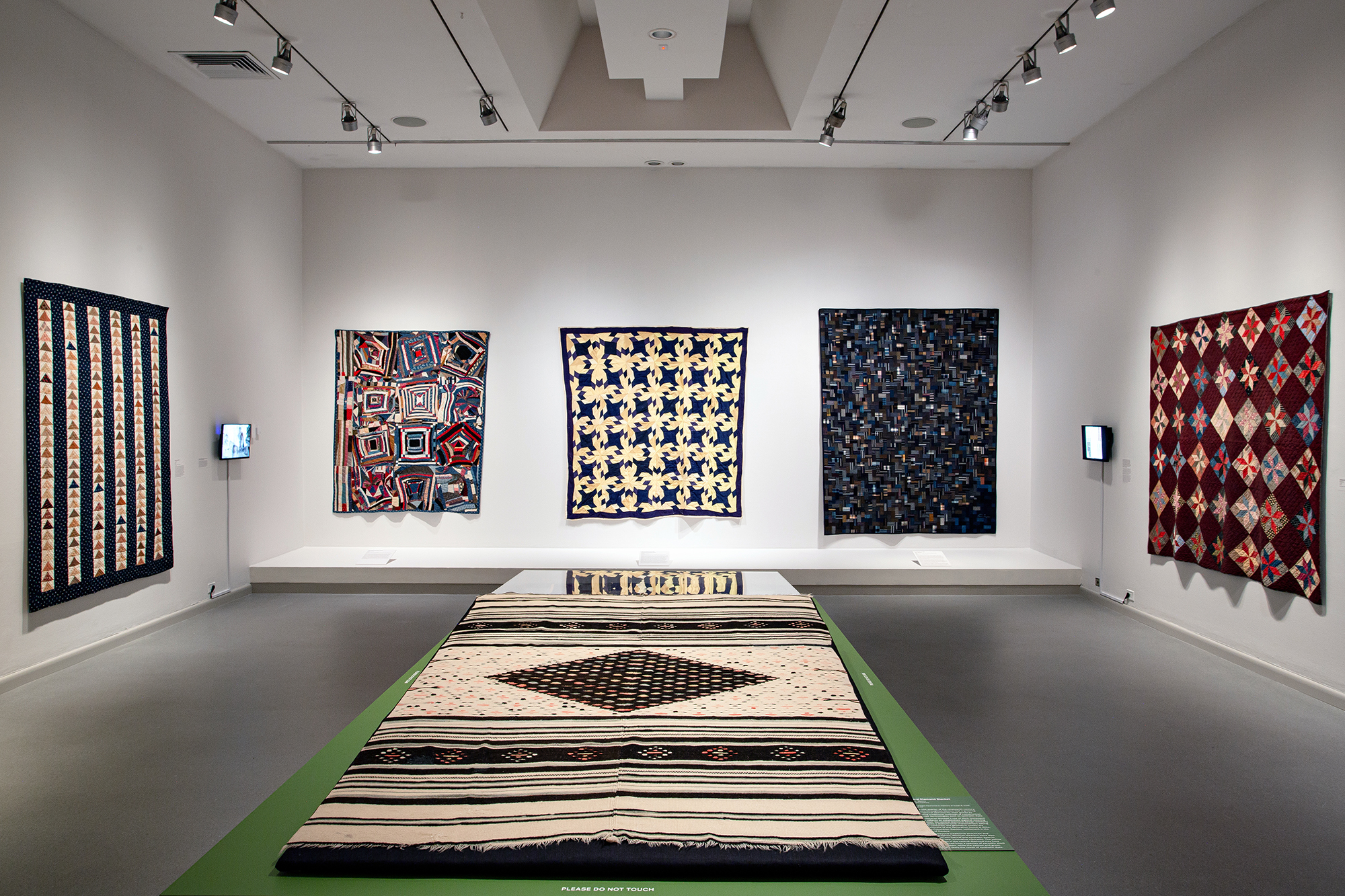
On a recent Monday at the American Folk Art Museum — currently wedged between construction scaffolding and the holiday bustle of Lincoln Center — the handful of galleries that house “An Ecology of Quilts: The Natural History of American Textiles” were quiet. The museum’s closed to the public on Mondays, but the show’s co-curator, Austin Losada, was there, standing before a blue-and-white “Pillar Print Wholecloth” quilt.
From a distance, this early 19th-century quilt seemed modest compared with the more obviously ambitious patchwork on display nearby. In just two principal colors, it features stacked architectural columns in vertical stripes surrounded by flowering vines and leaves. The design is rendered in indigo, against a soft cream background. Losada explained that the indigo was likely exotic, perhaps imported from India, and would’ve been expensive – even if it came from South Carolina, where the indigo crop was referred to as “blue gold.”
The soft, celestial blue of the floral lattice and grand architectural elements visitors see belies the grueling, dangerous labor that was required to harvest, process and render indigo usable for quilting. “The blue wouldn’t exist without the often brutal labor it took to cultivate indigo,” said Losada, nor would the cloth itself exist without cotton, a cash crop that built American wealth while obscuring the human cost behind it.
That juxtaposition — beauty that rests on a painful past — is the point of this show, which gathers just 30 quilts from the museum’s more than 600-piece collection. Losada and co-curator Emelie Gevalt hope visitors will see the exhibition as not just a collection of beautiful and useful objects, but as the products of global trade, land use, and the often uncredited hands that made them.
But this isn’t a lecture of a show. It’s a seductively edifying and quietly eye-popping exhibition. The quilts are like portals, transporting viewers into the imagined historical worlds from which they came.
Visitors familiar with quilting might recognize a black-and-yellow “Pinwheel Variation Quilt” by Malissia Pettway in a gallery dedicated to “Economy and Excess.” Pettway, a mid-20th century artist from Gee’s Bend, Alabama, belonged to a community of Black quilters whose work, rooted in the legacy of slavery, transformed a local craft into celebrated American art. Losada explained that Pettway may not have had access to enough fabric in the same shade of yellow to keep the design uniform. Look closely and you’ll see what Losada said were probably salvaged scraps in subtly variegated yellows, some of which he suggested could’ve come from a family member’s athletic garment.
Gee’s Bend quilters, including several in the Pettway family, often worked in the fields, walking to and from their labors with pencil and paper, jotting down things that caught their eye. They quilted with what was available, and that resourcefulness produced some of the most contemporary, innovative art of the last century. “An Ecology of Quilts” is the rare show that draws attention as much to the materials of production as the creators, and historical framing of the objects on view.
While the show includes mostly American artists, it weaves in a few international designs. “Ajiro Monyo” (1995), a herringbone-motif patchwork quilt in dark browns and blues, is a contemporary work by the Japanese artist Tomie Nagano – the only living artist represented in the show. The curators included it because it reinforces the “intense association between quilters and reusing scrap fabric to create something brilliant and new,” according to Losada. Nagano, who works in Massachusetts, scavenges and rescues antique Japanese fabrics, linking them to create a “sort of record of Japanese textile production in the 19th and 20th centuries,” Losada explained.
Though not a quilter himself, Losada, 28, speaks about these objects with the attention and zeal of an aficionado. His own favorite object in the show, and the one he’d take home if he could, is one a visitor could easily miss: the 19th-century “Tied Patchwork Quilt and Overshot Coverlet” from Virginia or Maryland, which looks — at first glance — like it might’ve been made from men’s flannel pajamas.
“It’s so me,” Losada smiled, pointing to the quilt’s humble jumble of squares and stripes, plaids and earth-toned solids. The quilt is reversible, patched on one side and backed with a woven coverlet on the other, a kind of 19th-century two-for-one. “It’s not perfect, and it’s not meant to be a show-stopper,” he said. He suspects it may have been made in the aftermath of the Civil War, when families repurposed whatever remained intact, “re-using family clothing and blankets – anything to create another patch.”
If you’d prefer a show-stopper, there’s one hanging a few steps away from Losada’s quilt: “Adam and Eve in the Garden of Eden,” a mid-19th-century quilt attributed to a member of the Sinclair family of Vermont. In it, Eve encounters a serpent, finds the apple, and hands it to Adam under a moonlit sky stitched with stars, the Garden rendered in folk-art florals. It appears simple enough from afar, classic yet folksy. But look closely at the off-white background to see white-on-white stitched hearts above the figures’ heads, and elaborate stitching throughout. Notice the slight pink outlining on the red central figures, and the reused bits of patterned fabric.
Returning to the “Pillar Print” quilt on the way out, Losada noted why columns made sense as a design motif in the early 1800s. “We were still a nascent republic,” he explained, “founding ourselves on progressive ideals oriented in the classical world.” The column is a “visual foundation” for such ideals. And yet the materials used to make most of these quilts had ecological and social consequences that aren’t often considered in museum settings.
According to Losada, An Ecology of Quilts is simply a “sampler platter” meant to encourage visitors to “think beyond dazzling surface pattern and the maker.” You can enjoy a taste of the show through March 1st. The American Folk Art Museum is always free.
Subscribe to West Side Rag’s FREE email newsletter here. And you can Support the Rag here.





So glad the museum reopened after it’s reno. It’s a true treasure of the UWS. And it’s free! (Though I always give a donation because it’s such a pleasure to visit.)
And the museum shop has wonderful gifts. The jewelry selection is really special.
Amazing! So glad to know about this. AFAM is an UWS gem.
Such an interesting and well written article, thank you! I visited the wonderful gift shop recently, but didn’t go inside the museum itself. Now, I will see this exhibit for sure.
I’m at a beautiful exhibit! Worth a visit just to see some amazing examples of Gee’s Bend quilts, if you’ve never seen them in person.
How wonderful that we have such a special, world-class collection across from Lincoln Center, and what a testament to the richness of our cultural life on the Upper West Side that some people don’t even know about it. AFAM would be a landmark & top destination in any smaller place. Great review!
Loved this exhibit! It’s definitely worth the trip.