

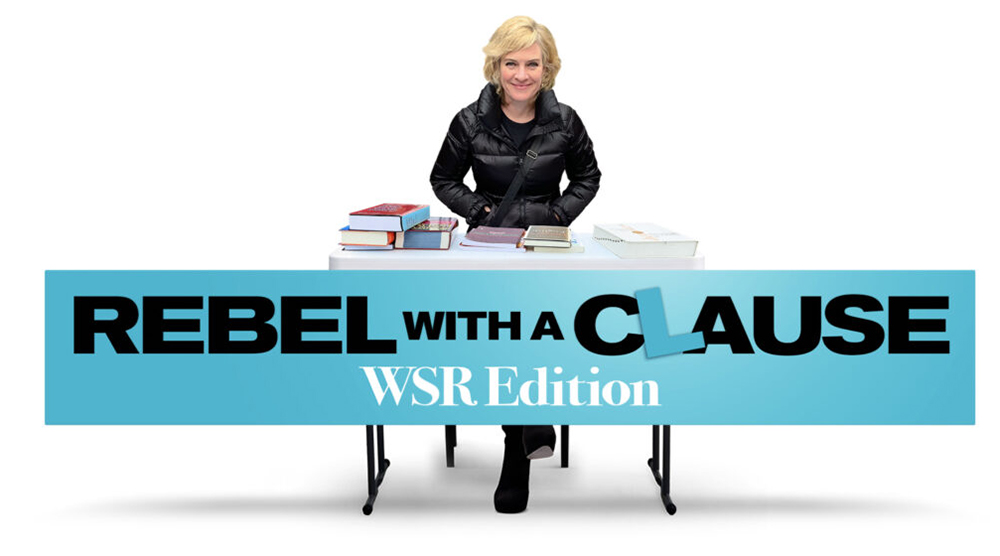
By Ellen Jovin
My husband Brandt and I are traveling around the U.S. right now screening his docu-comedy Rebel with a Clause, about my traveling pop-up grammar advice stand. This latest leg of our travels originated two weeks ago in Bozeman, Montana, where we showed the film at the Ellen Theatre (no relation), and continued on to theaters in Washington, Oregon, and now California.
When we are in person at a screening, we do a Q&A afterward. So far on this trip, people at three different Q&As have complained about “Have a good rest of your day.” This is new for me. Until now, I didn’t realize people were bugged by it. I say it. I even say it in the movie.
I’m sorry.
According to the results of a poll I subsequently posted on X last Sunday, 16.1% of respondents feel that “Have a good rest of your day” is irritating. Multiple people have now told me they detest it. Since I’m not emotionally attached to it, I’m probably going to stop saying “Have a good rest of your day” for the rest of my life. I’m not sure what I’ll replace it with, but ideally it will be pithy and uplifting.
On the road at movie screenings, I give out a brief grammar quiz I wrote. One question requires people to pick between “affected” and “effected” in the sentence “Rennie change in our punctuation policies.”
Many people put “affected.” Others argue that both are possible. They say it could mean Rennie influenced change in our punctuation policies.
I will happily abandon “Have a good rest of your day,” but I will not budge on “affected change.” You effect, or bring about, change. “Affected” is wrong there. Using that would be like saying “Rennie had an effect on change in our punctuation policies.” No one would say that. I have seen “affected change” in published reporting many times. Every single time, the writer has meant “effected change.”
Based on previous life experience, I’m guessing some readers would still argue that both options work. That’s OK. I see complaining and disagreeing about words as part of our social glue. What we agree on unites us. What we don’t agree on also often unites us—because it gets us talking and thinking. When it is not malicious, I enjoy linguistic debate. Expecting chronic total agreement about language from people who have lived wildly different lives across a very large planet is unrealistic.
In honor of National Punctuation Day, which was yesterday, let’s conclude with a punctuation debate. This is something I debate often, though mostly just with myself. In my opening paragraph, I wrote “my husband Brandt”—no commas. For most of my life with Brandt I have written “my husband, Brandt,” because I am not a polygamist and Brandt is my only husband. Brandt is what is known as a nonrestrictive appositive. Nonrestrictive appositives normally take commas. Please compare these two sentences:
- My friend Jim stole my sentence-diagramming book.
- My first-grade teacher, Mrs. Granstrom, was also the principal.
In the first case, Jim is an appositive. His name is another way to describe my friend. In the second case, Mrs. Granstrom is also an appositive. Her name is another way to describe my first-grade teacher.
But Jim gets no comma, and Mrs. Granstrom gets a pair of them. Jim is a restrictive appositive. Mrs. Granstrom is a nonrestrictive appositive. The name Jim limits, or restricts, the category of friends I have. (If you are preparing to argue that I might have only one friend, I would like to remind you that I have a grammar-advice stand and what better way to accumulate friends?)
Mrs. Granstrom’s name is removable. The idea is, I had only one first-grade teacher, and oh by the way, her name was Mrs. Granstrom. She gets commas.
Many people put commas around restrictive appositives. Don’t do that. Don’t punctuate Jim in the sentence above.
But there is a case that bothers me, and perhaps, punctilious punctuators, it has bothered some of you too. A spouse is usually the only spouse one has. Like Brandt, your spouse is probably a nonrestrictive appositive.
But don’t you mention your spouse a lot in writing? Do you really want to punctuate your spouse every time? It’s less weird to me if I use the whole name: “My husband, Brandt Johnson, toured with the Harlem Globetrotters.” That’s OK for me. But when it’s just a first name—“My husband, Brandt, toured with the Harlem Globetrotters”—I don’t like it.
I’ve done it, of course. I have placed many commas around nonrestrictive one-word appositives in my life, but I’m (almost) over it. It often feels pedantic, it slows down sentences, and who has time for that?
Have a good rest of your week!
Ellen Jovin is the author of the national bestseller Rebel with a Clause and the subject of a new docu-comedy by Brandt Johnson, also called Rebel with a Clause, which is currently in residence at New Plaza Cinema on the Upper West Side and playing at theaters around the country. You’ll find a complete collection of her columns for the WSR — HERE.
Subscribe to West Side Rag’s FREE email newsletter here. And you can Support the Rag here.





People don’t use bring and take correctly.
Stink, stank, stunk. Bring, brang, brung.
Now that you take it up, I bring it that this concerns you.
As a word and punctuation and grammar person myself, both personally and professionally, I absolutely loved this column. Will you be bringing your film to NYC? Or posting online? Would love to see it.
People today can barely speak, let alone write and it is so discouraging. Language is a way for us to connect, even if we have to agree to disagree at times. Language can bring comfort, peace in chaos and so much more to improve the quality of our daily lives.
And, hey: Have a good rest of the day. I have NO issue with that. Were someone to wish me that, I would be appreciative and not irritated. What has the world come to when a lovely greeting is met with such criticism?
To each his own.
The movie is showing at New Plaza Cinema on West 67th. I believe there is one more screening in September, and then they will add more dates in October.
“I would be appreciative” — ouch. There are less clumsy ways of saying this, I think.
Gee so glad you took the time to comment. Ta.
I hate when people address me in texts or email as “Hey!” even if they append my name. ” It feels over-familiar and rude. As my old Dad, who was a polymath in spite of his grade school education, used to say, “Hey is for horses.”
There should be have a comma between “write” and “and in the first sentence of the second paragraph. LOL. There should also technically be one between “chaos” and “and” in the second line of that paragraph, but that one seems more “voluntary.”
The Oxford comma is not mandatory.
Agreed, although not a fan of “rest of your…” construction. And to each his, her or their own.
Here is the story of a five-year-old who created a question ending with five prepositions in a row. They lived in a two-story house with the bedrooms on the second floor. One night, the child, whose father happened to be a linguist, asked his father to go back downstairs to fetch a book, and he specified which book he did not want. Dad, tired from a long day of lectures, erred and brought up the detested book. The child asked: What did you bring the book that I didn’t want to be read to out of up for?” Fortunately, the father was brave enough to let the world know of his child’s unwitting brilliancy.
You are missing the fact that the book was about Australia, so the actual sentence is “What did you bring that book that I don’t want to be read to from out of about ‘Down Under’ up for? LOL.
What about the use of an extra “of ” in a phrase like “how big (of) a car does he have?” It is just wrong! I almost despair of ever hearing it correctly anymore. Please excuse my punctuation because I’m in a hurry
Am so glad you brought this up. It’s my current bête noire as well, and most people aren’t even aware that it’s wrong.
I tend to wish people a lucky day. What’s “good”, anyway?
Ruby – You may be in Manhattan, but I note that you are using the British custom of putting the comma outside the closing quotation mark! 🙂
That or https://en.wikipedia.org/wiki/Quotation_marks_in_English#Logical_quotation . Its appeal among software people is nearly irresistible.
I don’t know why U.S. writers place the comma within quotation marks. I do it, as an editor I fix it, but it doesn’t make sense: the comma isn’t part of the quoted expression. Why, Ellen & co., why?
Maybe I can shed some light on the matter. My understanding is that it sprang from typographic concerns: punctuation (commas, periods, etc.) outside the quotation marks displays excessive visual separation — too much white space to the typographer’s eye. In contrast, commas on the inside appear “tucked in”. (As you can see, I’m with you in the logical quotation camp. One day it will be the norm….)
“Multiple people have now told me…” sounds off.
I would say “Numerous people…”.
Am I just off for thinking that “multiple” in this context is off?
Can we have a “multiplicity of people”?
“Many people” (or persons!) is by far the best choice, unless perhaps you had been counting them and could confidently say, e.g., “Twenty-three people”. “A lot of people” wouldn’t be so bad, either, though “Alot of people” would be horrible!
Hi Jane! “Numerous” wouldn’t have worked for this context. The people were plural but not plentiful. 😀
I don’t really understand the difference.
“Numerous” isn’t bad. Try “many people,” even “hundreds of people.” Which is more descriptive and accurate?
I am a serial abuser of Grammar, and there are many times I just go by “ear’ when I write. I’m clueless about the use of “that,” as in the sentence above, after the word times. Or maybe it should be “when.” My guess is (that) that class of words has a name. Is there a rule for when they must be used and when you can relax a little?
“Obligatory” and “optional” are the words for which you are searching. Among others, the use of “which” is often optional. An example of optional usage: “The book (which) I spoke about yesterday is no longer available.”
I think “the book (that) I spoke about” is better than “which.” “That” clearly refers to the specific book. I agree with you that the optional “that/which” in this case is dropped.
True. Generally speaking, the valid options are “, which” (note the comma), “that”, or “” (omitted).
“The book about which I spoke” — clear and correct.
That it is, though I might be tempted to write something like “The book I mentioned” to avoid the faint syntactic fussiness.
To wishes sent along the way—
“Have a good rest of your day.”
A charm, a cheer, a kindly spell,
To tilt the hours so they go well.
Yet some cry out, “How dare you say
My day was bad up to today!”
Yet blessings bloom for those who hear;
The doubters? They stay stuck right there.
So lift this toast, both bright and plain:
May good from now out still remain.
And if you grumble, fate won’t bend—
A wish ignored is doomed to end.
💕💕
Here’s to poetic license.
I agree with you 100% on effect and affect.
He “affected “ change means that he pretended to change. “Effected” change means that he made it happen. Depending on context, they’re both correct.
Thanks! I asked about “pretended” above.
People wouldn’t use “affected change” for “pretended to change.” With “affected” in the sense of “feigned,” the object of the verb is going to be something like nonchalance, indifference, cheerfulness, etc.
Or in other words, the object of the verb would be a property of, not something external to, our Rennie, correct?
Still … let us suppose change were taking place in our punctuation policies and Rennie influenced the nature of the change (maybe by analogy with velocity vs. acceleration): would it not then be valid to say that Rennie affected change? (Let my hypotheticals never not be accused of being far-fetched.)
lol
I love you, Ellen, fighter of lost causes…or clauses.
Aren’t lost clauses confined to heavily snowy Christmas mornings?
Thank you, Bruce.
I am one of those people who find “have a good rest of your day, night, weekend, summer, etc.” highly irritating. Why add “rest of?” It’s unnecessary and implies that the day is almost over when it isn’t. Simply saying “have a nice day” will suffice.
Sometimes it IS almost over. 😀
I’ve never cared for the “nice” in “Have a nice day” (for the usual reason), and to “Have a good day” I’ve often been known to respond, “Thanks, I will — maybe tomorrow!”
and to eliminate the ‘command’, ‘good day’ is traditional and without the need for change.
“Rest of” is irritating and unnecessary. “Have a nice day” will suffice.
Agreed. Just wish people would stop saying, “have a good one.” Good what? Cringeworthy.
I don’t know the difference between an appositive and a positive.
But I do see a pretty glaring error in the next to last sentence.
Just sayin’
Thank you, Sam. I’ve requested an update.
Next column, take on “Believe you me.” To me, it represents the cringiest grammar ever. And yesterday, for the first time in a very, very long time, I heard someone use the phrase “most best.” Ugh.
Am I alone in having been made slightly uncomfortable by the name of that lost 72nd Street restaurant “My Most Favorite Food”? I suppose it could have been worse (or, perversely, better) — Most Favoritest.
You are not alone.
It’s right up there with “the most unique….”
“Believe me, you!” makes a lot more sense.
Ellen–It’s great to see your success. I have seen you many times at the 72nd St Subway, and even asked a question once. You were very helpful. As far as the expression, “Have a good rest of your day”, goes, I think geography has a lot to do with it. As you can imagine, being in NYC, we might tend to use “Go f**k yourself” more often. 🙂 Whereas in Philly, the city of brotherly love, they’d be more prone to say, “Have a good rest of your cheesesteak.” See what I mean? Anyway, I tend to write the way I speak, so Grammarly is absolutely NOT on my computer. Thank you for all the help, and enjoy the peace and quiet of a sleeping puppy………….until it wakes up!
😄 Haha, thank you, Ed.
I’m in love. I have to get this book.
But please don’t tell me to have a great day, great evening, or great night, Try wonderful, lovely, or delightful, and I will.
Rock on, Ellen!
(P.S. Stop the constant use of ‘playbook’ in public discourse. It has become a tedious cliche.)
How about enjoy the rest of your day? What has lately made me absolutely insane is people using ‘like’ literally every other word!!! How & when did this start? If I’m walking near someone I have to listen to saying this, I either walk ahead or slow down. Robert Redford once said ‘whatever’ was his least favorite word- I think he would have added ‘like’ if he lived in NYC.
Didn’t “like” (in the obnoxious usage) begin as a Valleyism? That’s how I remember it.
I LOVED the movie.
Thank you, Roseann! I will tell the filmmaker!
Dear Ellen,
As a fellow user of the — dash even when writing without the aid of AI, do you worry that using it excessively will make someone think that you have written something with AI? At this point I minimize my use of the — dash so that people don’t think I’ve written something with AI
Sincerely,
A — minor — subject of your documentary.
The standard term is the “em dash”; using that instead of “—” may help persuade the AI analyzing your writing that you’re not an AI.
By the way, AI will eliminate us or we will eliminate AI; I see no middle ground.
Howdy, Sam! I definitely don’t worry about it. I refuse to let AI interfere with my punctuation rights. 😀 And I will back other people’s em dash rights too. Also, I just realized who you are! Your baby was a huge hit at the Roxie in San Francisco last night.
I loved the documentary. I don’t know why people would be irritated by your saying “have a good rest of your day.” It’s a harmless, well-meaning pleasantry.
“Pleasantry.” That’s the key word. In this chaotic world in which we live, can’t we just accept a simple pleasantry from someone? If a person is taking a moment to wish me well, I’m not going to analyze their comment to decide if I like the specific words they use. I am simply grateful someone is feeling kind enough to pass along a pleasantry to me.
Thank you, Eleanor!
“Multiple people have now told me”–ouch! “Multiple” means “containing many subparts.” A multiple homicide is a killing that involves many individual homicides. A multiple orgasm is an orgasm that comprises many distinct parts, each of which qualifies as an orgasm in its own right. A multiple-choice question is a question consisting of several possible answers. A multiple vitamin, or multi-vitamin, is a vitamin that contains more than one vitamin.
A man who broke a leg, wrist, and finger in three separate accidents suffered many broken bones. A man who broke a leg in three places in a single accident suffered a multiple fracture.
If what you mean is that there are many instances of a thing, and not that the thing is made of many subparts, each of which qualifies in its own right as instances of the thing itself, then the word you want is “many,” “several,” or “numerous,” not “multiple.”
“Multiple” has multiple definitions. Merriam Webster: https://www.merriam-webster.com/dictionary/multiple. Here are three sentences from three different stories in The New Yorker: (1) The following month, crowds attacked a Middleton mill, resulting in three deaths and multiple injuries. (2) Securus discontinued that service—which reportedly allowed agencies to track almost any cell phone in the country within seconds, without a warrant—after multiple incidents of abuse. (3) By the mid-eighties, she was much honored—a professor at Stanford, the winner of multiple awards—but not entirely adored. And here’s a final example from the New York Times: “Jackson said players have submitted multiple proposals to the league.”
Could “Rennie affected change” mean “Rennie pretended to effect change” or “acted as though s/he was effecting change”?
I loved this article! It made me smile. Over here in the UK, I think ‘have a good rest of your day’ would be derided as an Americanism, but it never crossed my mind that it would even upset people on your side of the Atlantic. Over here, in the context where that phrase would be used in the US, we just say nothing. Because we’re miserable! From the posts below, it sounds like you take requests 😀. I am frequently upset when somebody (e.g. my wife…) describes food as ‘very delicious.’ You shouldn’t use ‘very’ before ‘delicious,’ surely…?
I will not even “step foot” into that territory…