

By Laura Muha
At the northwest corner of Central Park, where the Upper West Side meets Harlem, an 8-foot bronze statue of famed abolitionist and civil rights leader Frederick Douglass gazes northward, surrounded by granite blocks carved with some of his most famous quotes. In the 14 years since its unveiling, the monument has become such an integral part of the neighborhood that it’s hard to remember a time it wasn’t there.
But in fact it took decades of controversy and politicking to make it happen, says David Felsen, author of the new book New York City Monuments of Black Americans: A History and Guide [The History Press, 2025], which explores the story — and the message — behind the Douglass monument and 29 others across the city.
“Because of the history of racial stereotyping in popular culture … the way that [Black Americans] are depicted in statues impacts the way that other people see them and the way they see themselves. And that matters,” said Felsen, who teaches U.S. history at Avenues, a private school in Chelsea.
Felsen said he’s always been interested in monuments, and brings them up frequently in his classes, because they’re evidence of what a society values at a given time. “They tell us who we honor and what we honor and how [those things] change over time,” he said. In recent years, current-events discussions with his 11th-grade students — on topics such as Black Lives Matter and the removal of Confederate statues from public spaces — got him thinking about the depiction of Black Americans on public monuments. How many of them were there in New York City, and how were their subjects portrayed? How and why were they made, and what did that have to say about city history, Black history, art history and American history?
“I couldn’t find easy answers, so I decided to write the book,” Felsen said in a phone interview with the Rag.
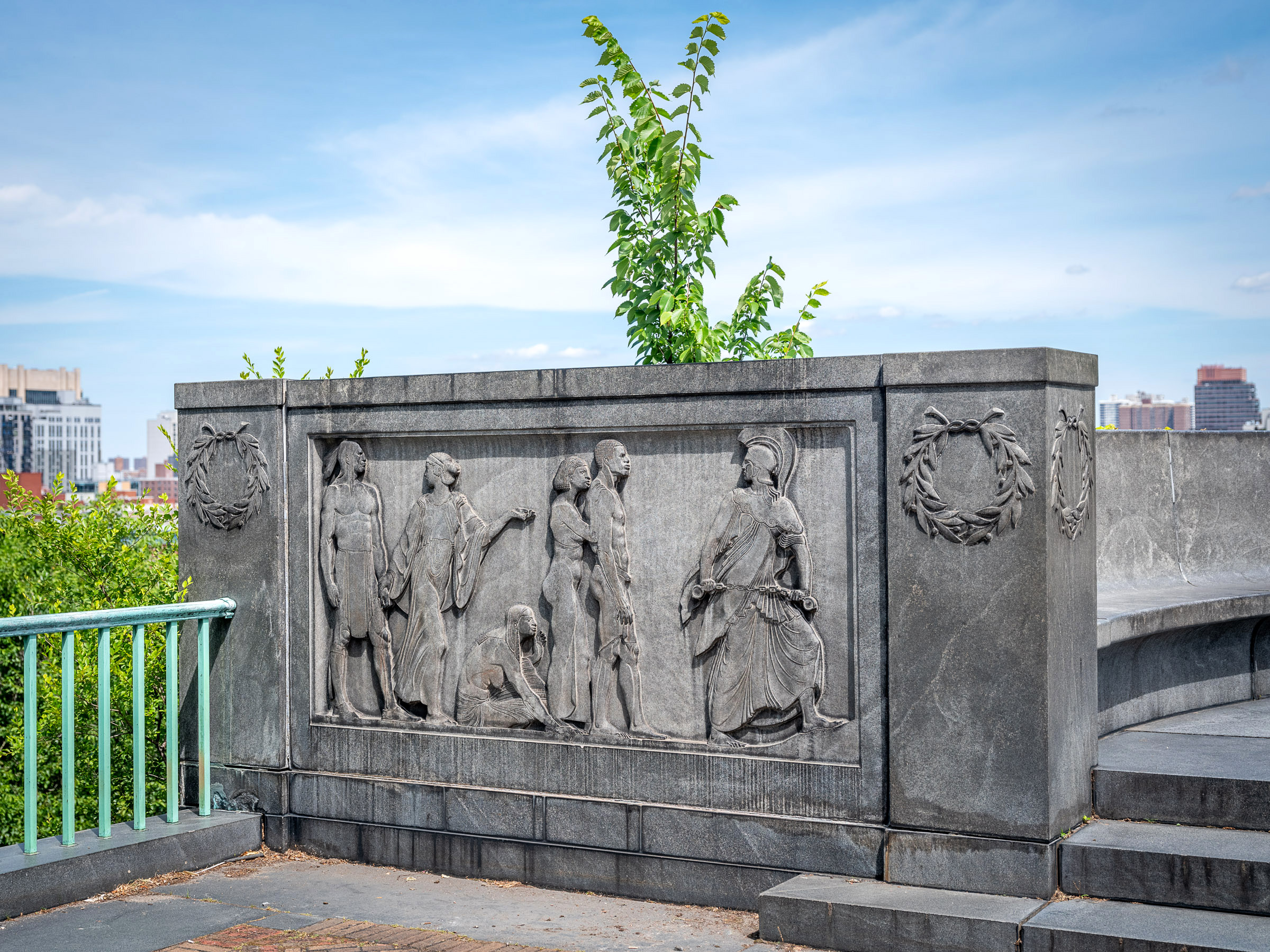
Several of the 30 monuments featured in the book are located on or near the UWS. And collectively, they provide a representative snapshot of the way Felsen says depictions of Black Americans have changed over time when it comes to public monuments. One of the earliest in the neighborhood, a 1913 memorial honoring statesman and Civil War-era reformer Carl Schurz at 116th Street and Morningside Drive, features a Black man and woman in a state of semi-dress, walking toward the fully dressed goddess Athena, who represents emancipation. Such a depiction was typical of the way Blacks were publicly portrayed on early monuments; that is, as symbols and supporting cast, as opposed to people being honored in their own right, said Felsen, who notes also that the Black figures on the monument are half naked while the white goddess is fully clothed.
Other examples of Blacks appearing as a supporting cast to whites on early monuments include what may be the earliest representation of a Black American on a city monument: a barefoot former slave showing a Union widow to her husband’s grave on a plaque on the 1876 Civil War Soldiers’ Monument in Brooklyn’s Green-Wood Cemetery. “The Black man in this statue is there only to help the whites,” Felsen writes.
But as time went on, Black Americans slowly began to be featured in their own right. The first in the vicinity of the UWS were twin statues of pink stone– Man, the Provider, and Woman, the Mother and Housekeeper — unveiled in 1938 by the Works Progress Administration at the newly built Harlem River Houses at 153rd Street and Harlem River Drive. These statues were the first in New York City commissioned specifically “to represent and inspire the Black community,” Felsen writes. Later, memorials were erected for individual Black Americans, such as writer Ralph Ellison, who in 2003 was honored with a bronze monument named after his famous novel, Invisible Man, in Riverside Park at West 150th Street.

The Douglass monument followed in 2011, more than 90 years after a Black NYU student proposed what would have been — had it come to fruition — the city’s first public monument to Douglass: A bust in the Hall of Fame of Great Americans, a sculpture garden in the Bronx. But inclusion in the hall was by vote of an all-white panel of 100 judges, and despite an ongoing campaign by the NAACP and other organizations, Douglass never made the cut. It wasn’t until 1992 that the city began working on the project that eventually became the Douglass monument, and even then, it took two decades before it was unveiled, partly because of controversy over the design and the sculptor, Gabriel Koren, who is white. (Community Board 10 initially was unsure Koren was the right choice, Felsen writes. But when she gave them a presentation on her work, “it became clear that her subjects were exclusively great Black men, [and] the board members were convinced that she could do the job.”)

The most recent monument to honor a Black American is the Women’s Rights Pioneers monument in Central Park, dedicated in 2020; abolitionist and activist Sojourner Truth is among the three figures on the monument.”It’s been encouraging to see … more representation of Black Americans in the overall landscape,” Felsen said. “But there’s still a long way to go.”
Subscribe to West Side Rag’s FREE email newsletter here. And you can Support the Rag here.




Nice–we better hurry and buy it, before it’s banned.
More on the Ralph Ellison sculpture by artist Elizabeth Catlett — a striking departure from the traditional portrait-type monuments. Seeing the trees of the park through it underscores the meaning of “invisible man.”
https://www.nycgovparks.org/parks/riverside-park/monuments/1946
There was great pushback against having the Women’s Rights Pioneers Monument in Central Park, where there were no statues of historical women. After the Park’s Department and CPC FINALLY agreed there were a lot of negotiations as to where the monument would be placed. Once the fight was won for the spot on Literary Lane, a change to the original design had to be made. The original design only featured Susan B. Anthony and Elizabeth Cady Stanton. When all involved agreed to add Sojourner Truth, the design was changed and the monument finally made it into the park. It’s one of the most popular tourist attractions in the park.