

By Bonnie Eissner
In 1977, James Barron, fresh out of Princeton, took a job as a copy boy at The New York Times and moved to the Upper West Side. He was assigned to help cover the blackout that year but missed seeing Reggie Jackson’s World Series-winning home run for the Yankees.
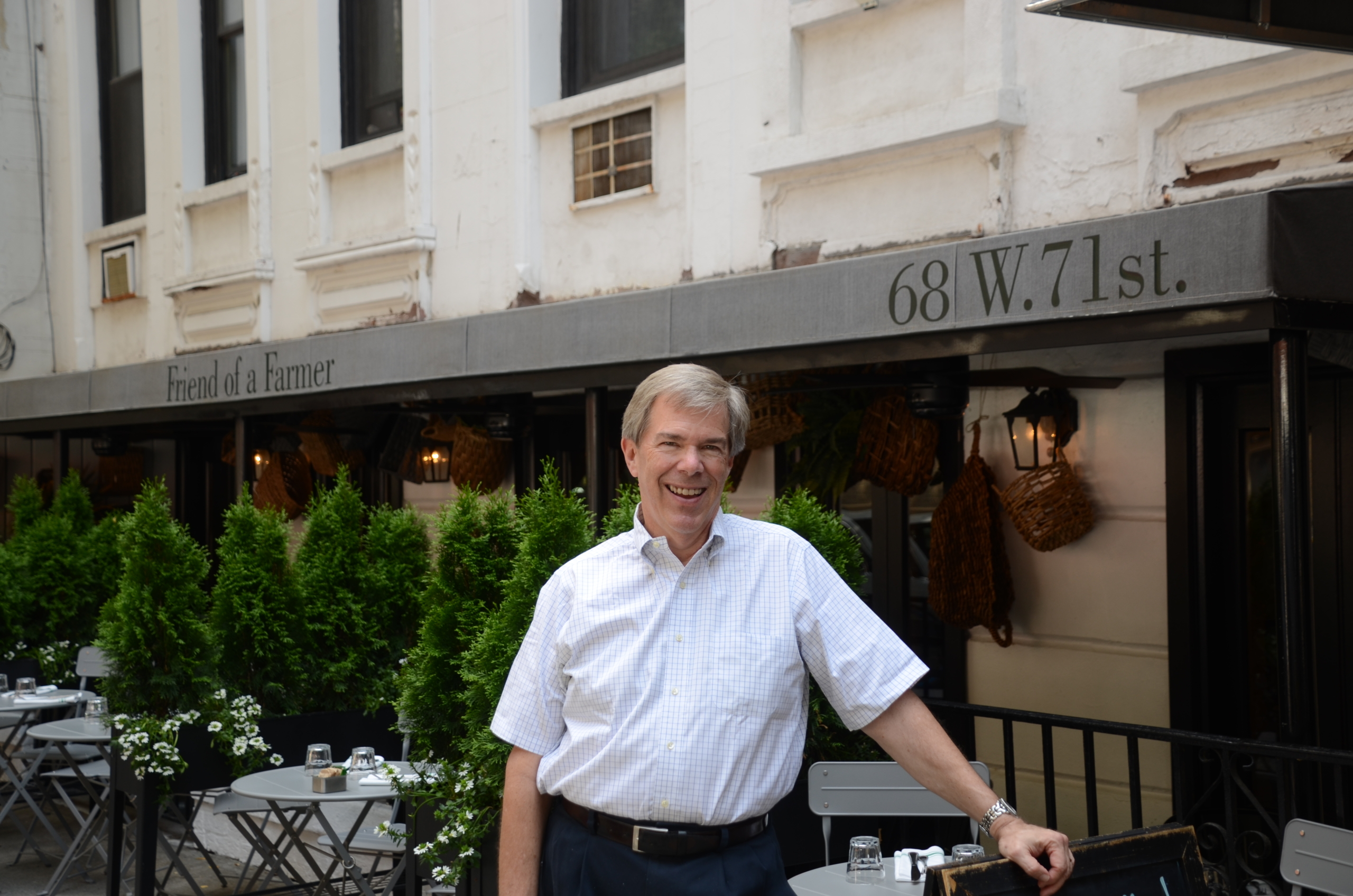
That Barron’s once affordable ground-floor apartment at West 71st Street is now the upscale brunch and dinner spot Friend of a Farmer epitomizes how much the neighborhood has changed.
In his 47 years at The Times, Barron, who still lives on the Upper West Side and now writes The Times’ New York Today newsletter, has covered all angles of his ever-evolving city and neighborhood.
He has written about celebrities, such as Dakota dweller Lauren Bacall, and less well-known but equally fascinating New Yorkers, such as Mary and Stanley Adelman of Osner Business Machines on Amsterdam Avenue, who repaired the typewriters of Joseph Heller, Philip Roth, and Nora Ephron. Barron was moved, he said, when he learned that Mr. Adelman was a Holocaust concentration camp survivor. Adelman once told writer Howard Fast, Barron wrote, that if he could sell German typewriters, Fast, a Jew, could write on one.
Barron’s curiosity has led him to quirky stories, such as the time he watched a crane lift a piano from an apartment window at the Dakota. It was one of Leonard Bernstein’s two Baldwins, and he covered the men who bought them. “Sitting down at a piano that once belonged to a famous musician is like sliding behind the wheel of a Mario Andretti race car or stepping into Ginger Rogers’s pumps,” Barron wrote.
He even helped raise the profile of West Side Rag in 2011, when he was assigned to write about “lobster salad” at Zabar’s that consisted of crawfish, which WSR beat The Times in covering. Barron wrote that WSR sniffed out the scandal the day before and quoted the headline, which he liked: “Zabar’s Committing Lobster Salad Fraud?”
Last week, on a day that would sizzle the blue cheese on Friend of a Farmer’s chef’s salad, he spoke over lunch — avocado tartar — at the site of his first New York City home. These are edited excerpts of what he had to say about his career and covering the city that never sleeps.
When did you know you wanted to be a reporter?
Barron: I started the newspaper in my class in fourth grade, even though the school had a newspaper. And for a while there were a bunch of us at The Times who had done that. So if that’s an indicator, there you are.
Where did you grow up?
Barron: Arlington, Virginia, a D.C. suburb, where in my senior year of high school I did an exhibition of old photos for the local historical society. The local paper, the Northern Virginia Sun, got wind of it and interviewed me and ran a story. A couple of weeks after the story, I got in touch with the editor and ended up being their photographer that summer. But I also got to write things. That led to being in the University Press Club in college, and because I had written for The Times through the Press Club, some editors at The Times knew me when I was trying to get a job.
Why did you move to the Upper West Side when you first came to the city?
Barron: That spring when I was getting out of college and had to find an apartment, a clerk at the paper said, “Go see this guy.” The son of the landlord had worked at the paper, and she said, “This is the place you’re going to want to be.” And I stayed in part because the transportation is very good. Anywhere else that I looked, you couldn’t get there from here the way you can from the Upper West Side, wherever the “there” was.
How did you get to interview Lauren Bacall in her Dakota apartment in 1999?
Barron: I thought you’d never ask. The publicist for her show, Noel Coward’s Waiting in the Wings, called and said, “How’d you like to interview Lauren Bacall?” I said I’m only doing it if I can do it in her apartment. I didn’t want to have to go to work and then come back. Well, what I didn’t bet on was that she doesn’t get up until like noon. So whatever the earliest possible moment was, I went, 2:00 maybe, or 3:00.
It was one of those conversations that you just wanted to run the transcript. No matter how you try and tackle it, you can’t do how special it was, starting with getting there. She opened the door and said, “You go and sit in there and I’ll come and talk. I have to make a phone call.” And I hear her get on the phone and she reams out someone I take to be the doorman at the Dakota for letting her order of ice cream melt. And then the whole voice changed, and we had this elegant conversation, exactly what you would have hoped for, except that it was 4:00. That was in the days when the 6:00 deadline really was the thing.
You write the New York Today newsletter. Do you experience a lot of pressure in having to write a new story every day?
Barron: Yes and no. For a long time, I did breaking news stories, and I’ve always thought I could write fast. That was good practice. Some of figuring out what to do for New York Today is you hear stuff and you think, that’s intriguing, so you figure that out. Or you think of things and you go and do them.
What is your criteria for a good story for New York Today?
Barron: Something that says something to the people who read it who are New Yorkers, so they have a sense of what’s going on here. Anything that will tell them something they don’t know or maybe fill in some of their puzzle that is New York. How does New York work? What is it that makes New York distinctive?
I keep coming back to Philippe Petit [the high wire artist who half a century ago walked on a cable strung, illicitly, between the World Trade Center towers; Barron recently revisited the feat in an interview with Petit for New York Today]. Did that piece say something more because it’s memory? I tried to get him to talk about what was in his mind. He’s told that story before. There was a whole documentary about how they did that. Every time he says it, it’s like some new little thing comes to his mind that he didn’t emphasize that way before in the way that he’s emphasizing now.
What do you like about your job?
You get to find things out and you get to find how things work. Then you get to reassemble that in words, and, on a good day, in words that read well.
Is there a story you missed that you wished you had covered?
Barron: Probably, but this has been too much fun to think of that.
Subscribe to West Side Rag’s FREE email newsletter here.





This is so fascinating. I remember when I was a kid in the 90s my mom would take me to City Diner (don’t remember what it was called then) after school. And I would sometimes hear NY Times reporters talking to each other or sometimes interviewing someone.
Also. Typewriters!!
The Argo
I believe it was Argo diner.
And before Argo, it was called Starks.
The Argo.
“Every time he says it, it’s like some new little thing comes to his mind that he didn’t emphasize…” Not surprising a pro such as Barron knew Petit would have fresh insights on his high wire act of 50 years prior. My grandfather used to say: “If someone starts to tell you something that they already told you, don’t stop them. First, let them get pleasure in the re-telling; second, don’t cause them discomfort by telling them they’re repeating themselves; and third, you may learn something new in the retelling.”
I’m surprised he hasn’t been forced out yet, he must now be considered “old guard” among the staffers.
I still get shivers when I think of Petit.
It’s articles like this why I love the WSR. Thank you for sharing his story and making our world a little brighter.
I grew up on W71st.
My family was on one side of the street and my cousin’s family on the other. In 1977, I was 17. I did not know that a “fancy NY Times writer lived accross the street from where John and Yoko enjoyed there coffee, tea and espressos.
His “Piano:Making of a Steinway Grand” is one of the most fascinating books that I’ve read, and I’ve read a lot of books. Superb story telling skills,in the same league with Robert Caro.