

By Alexia Massoud
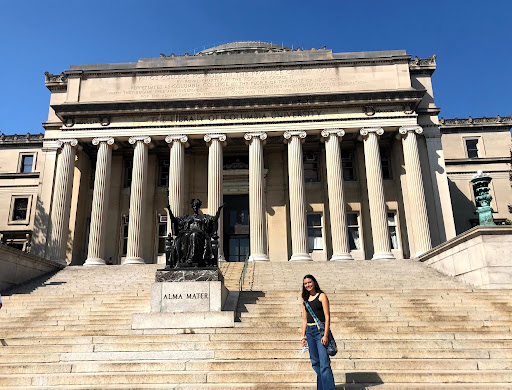
I visited Columbia University with my mom several times between 2021 and 2022. I walked in and out of the Morningside Heights campus as if it were my own: we had no scheduled tours, no appointments, no QR codes, no identification.
We were just two wanderers — one looking into her past, and one looking into what she hoped to be her future, trying to follow in her mother’s footsteps.
I went to high school in Rockland County, New York, less than an hour-long drive from the Columbia University campus. My mom attended Columbia in the late 1990s for her graduate studies, so when I was of age to start looking for colleges, the obvious move was to take a little trip over the George Washington Bridge.
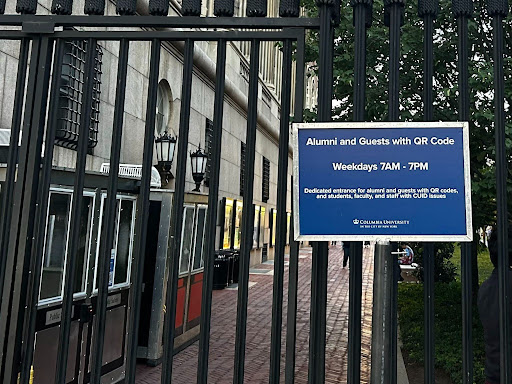
Five years later, the campus is my own. Like my mom, I am a graduate student at Columbia. But it’s not the same as it was when I visited it with her. It’s fortified. Tall black gates surround the entire campus. Every entrance is narrow and monitored by at least two security officers. I have to tap my Columbia ID twice (for some unknown reason) before stepping onto university grounds.
I have to wait in line most times to perform the tapping ritual.
On its website, Columbia says that it “recognizes the importance of its location in New York City and seeks to link its research and teaching to the vast resources of a great metropolis.”
But with the campus closed, how can that creed stay the same?
Ironically, I came from an undergraduate campus that underwent a similar transformation. I watched as George Washington University became less and less welcoming, when the thing that made me fall in love with it in the first place — its openness to Washington, DC — was lost.
The State Department was two blocks away from my sophomore dorm. The White House was part of my walk to my favorite gelato place. Our track and field practices were often held at the National Mall.
But after the spring of 2024, one of our only green spaces on campus had large —and quite ugly— gates surrounding it. I thought they’d be temporary, but two years later, they are still there, appearing permanent.
Columbia is now in its third year of having a closed Morningside Heights campus. I’m beyond fortunate to have been, and still be, a student at institutions like these. Columbia is absolutely beautiful, and people deserve to see it.
I made memories with my mom walking around for hours, full of glimmer in my eyes, as she showed me the buildings she took classes in and where her favorite kebab trucks were. But these are moments that someone else won’t be able to experience for as long as these gates remain closed.
I owe those memories to the open gates of Columbia University in the City of New York.
Read More:
Subscribe to West Side Rag’s FREE email newsletter here. And you can Support the Rag here.











Beautiful essay, Alexia, it really resonated with me. In the late 1980s I was studying English literature in the Graduate School of Arts and Sciences program, and I just loved spending time on the campus, taking in the magnificent buildings and lawns, trees and flower beds. (On occasion my mom would join me on quiet strolls there.) I have fond memories, and miss those wide open gates too!
Who cares keep the gates closed for now. We’re gaining a lot of peace and quiet that we didn’t have when they were open before.
You came to NYC for peace and quiet?
Part of the richness of going to school in NYC is being connected to the city – and NYC bemefits as well. Security matters, but so does openness, exchange and disagreement….everything that we send our kids to college to learn in the first place! And a few years on, I believe many of the students we tried to silence with those gates were brave to speak up. Let’s course correct and open the gates.
The students are free to enter campus as they please and to say what they want as long as they’re not disrupting other people trying to go to class. When the Hamilton Hall protestors were finally arrested the Times found that at least nine of them had no ties to the school at all. That is what’s being prevented and isn’t it odd how once the outsiders were locked out suddenly there’s peace and quiet. It’s almost like they were leading the protests all along.
When I was admitted to their PhD program in 2012 and they gave me a tour of the campus – designed to convince me to take their offer – one of their main points of pride was that they had an open campus, with open gates for the entire city. They took this aspect as an important part of their identity. It was convincing. I ended up going there for my PhD. I often wonder how it would feel to be there now.
Columbia is responsible for protecting the students. They did not create the issues that necessitate the closure. Let them do their job.
PS- If you’re an alum, you can arrange entry.
Protecting the students from different points of views is not protection
People have to change and stop using Columbia’s campus as a protest grounds. It is misguided. Protest where decisions are actually made in Washington, Congress, the White House. People abused their privilege. Put that together with Trump’s anti education divisiveness, ICE agents on campuses arresting students, murders on campus (Brown, Princeton) this is why the gates are closed. NYPD has to take a bigger role in monitoring and screening people entering campus. Campus security cannot be responsible for policing an entire neighborhood.
An open campus was the magnet for all the foreign non student violent activism that necessitated its gates being closed. Keep its access controlled. Most oif those protestors weren’t students.
It saddens me that so many of us are comfortable living and putting others in cages of “protection”. I understand the fear, especially for a parent, but to me they feel like jails or a way to segregate each other from our common humanity.
Thanks for the essay. We live in difficult times.