

by Yvonne Vávra
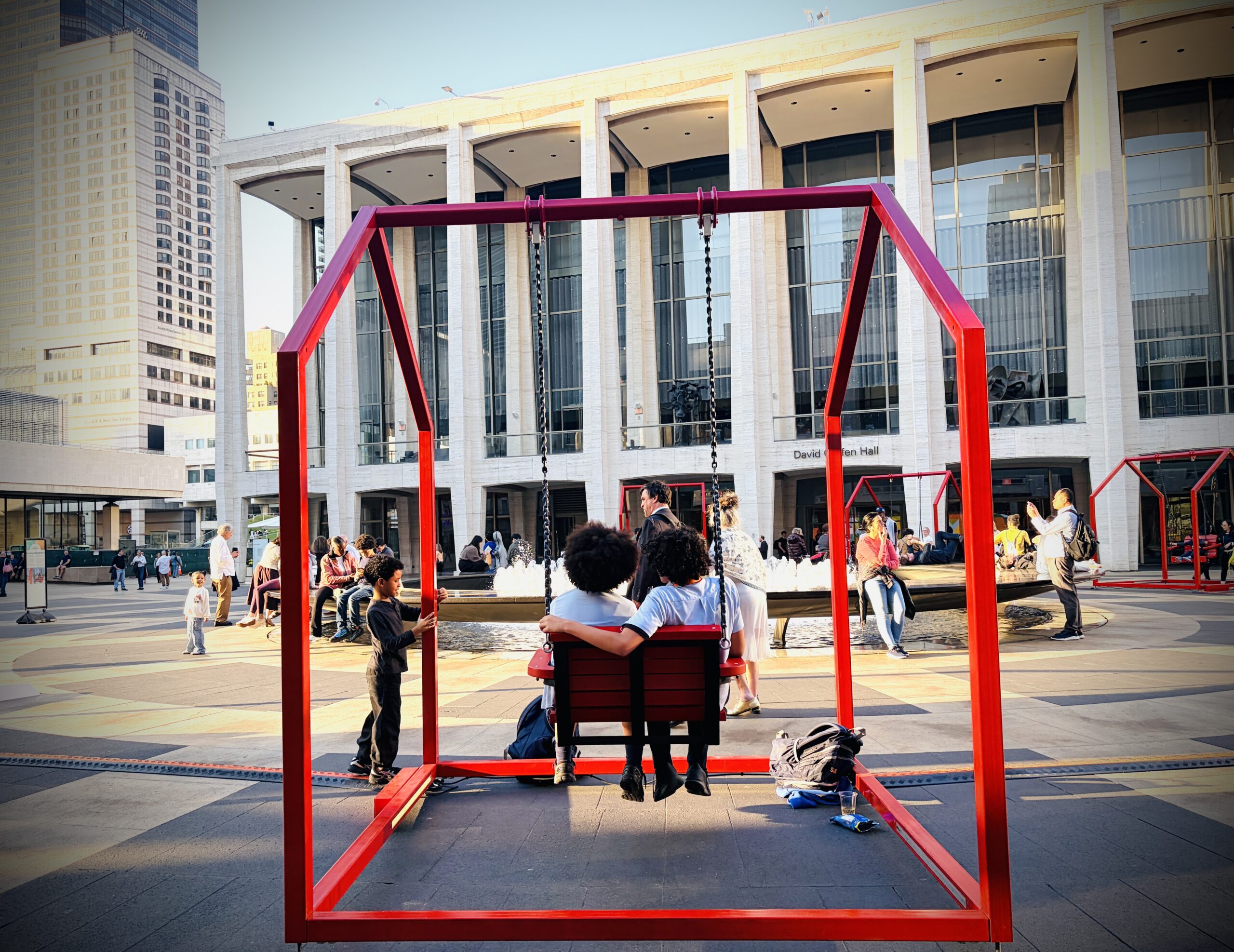
On Monday, I found myself wishing for a grandpa to push me. The girl on the swing next to me had one. Tirelessly, he kept her moving toward the fountain at Lincoln Center. I managed well enough on my own, building up a gentle sway, but I was clearly missing a grandpa with unstoppable determination.
The eight swings surrounding the fountain are an installation called “Mi Casa, Your Casa 2.0” by the Mexico-based design studio Esrawe + Cadena. It features small, house-like structures made of red frames, meant to evoke the atmosphere of local markets in Latin America with all their liveliness and personality. The installation tries to bring that mercado feeling to the Upper West Side, drawing people together and inviting them to linger, relax, and connect.
With every swing, I feel a new pang of guilt. How long can I stay in my casa? Am I taking up space for too long? What’s a fair share of joy? What’s the etiquette here? Luckily, a little girl rescues me from my overthinking. Not the one with the grandpa—they’re still going strong on the swing next door. It’s another little girl coming to my rescue, asking if she can join me.
I learn that she usually hangs out at the playground in West End Park on 63rd Street. No swings there, though. I tell her how much I love the rhino sculpture just next to the playground—yes, that butt-up, snout-down rhino with his horn wedged into a boulder. It’s her favorite too. We have something in common. We’ve connected. The installation is working!
When her friend cruises by on a scooter, I give up my seat and let the girls discuss their worlds. Walking around the casas, I’m soon stopped by a woman from Texas who likes my dog. Next thing I know, I’m looking at dozens of photos of Ruby and Jeff, her two Cocker Spaniels back in Austin. I’m admiring their impressively long leg hair and learning, in detail, about the right way to breed a Cocker Spaniel. And there are more photos. Many more. Many, many more.
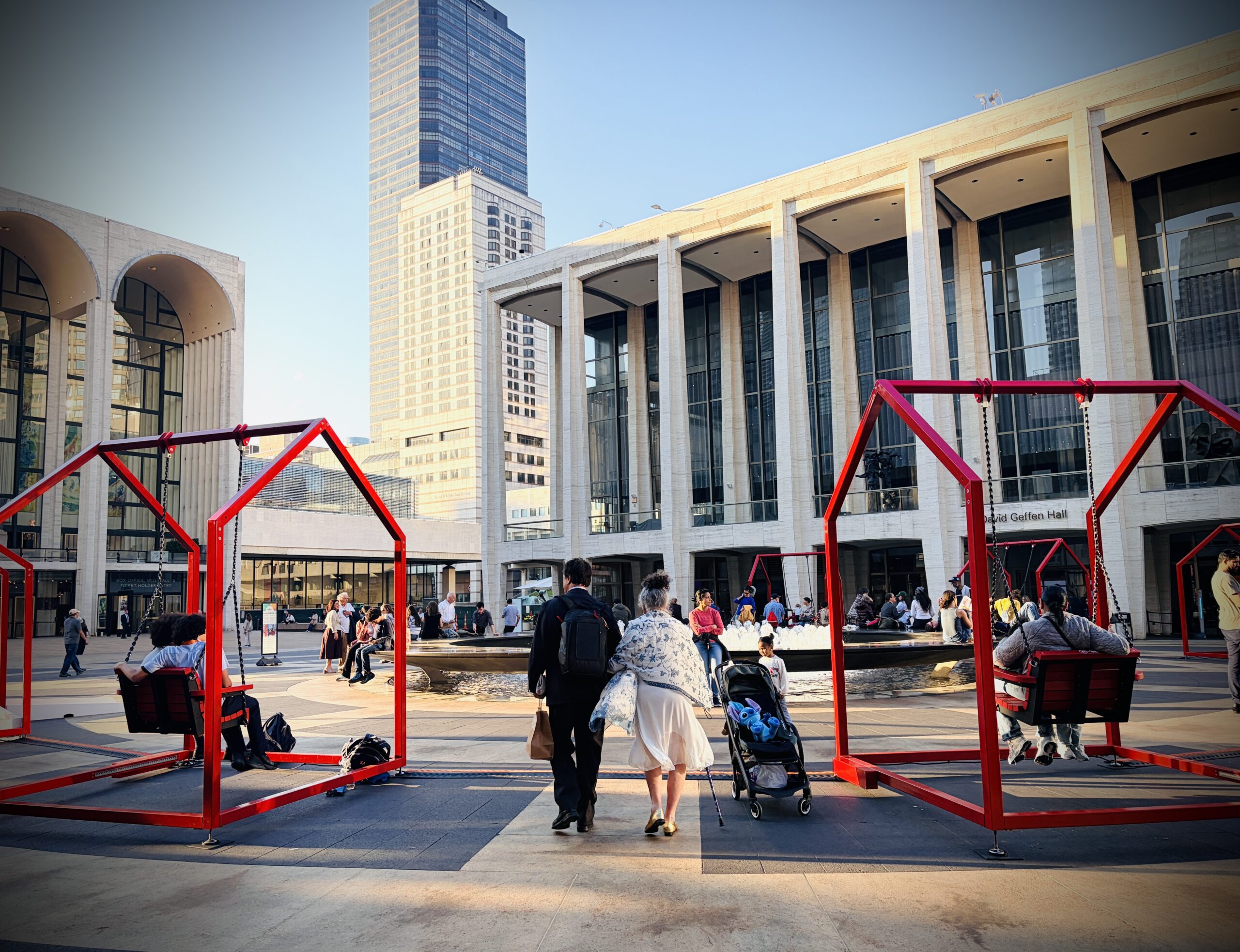 Over at the Met, Puccini’s “La Bohème” is playing, and the plaza is filling up with opera-goers. Nothing wrong with a little pre-show swing. Watching suits and gowns tailored for the more elegant pleasures in life on swings is a show of its own for the rest of us. A lot of inner children are coming out to play.
Meanwhile, in another casa, two kids will soon be out of luck. “Five more minutes,” mom warns. Next door, a young man looks like he knows he has all the time in the world to read his book. Life is unfair on the plaza, but at least it is life.
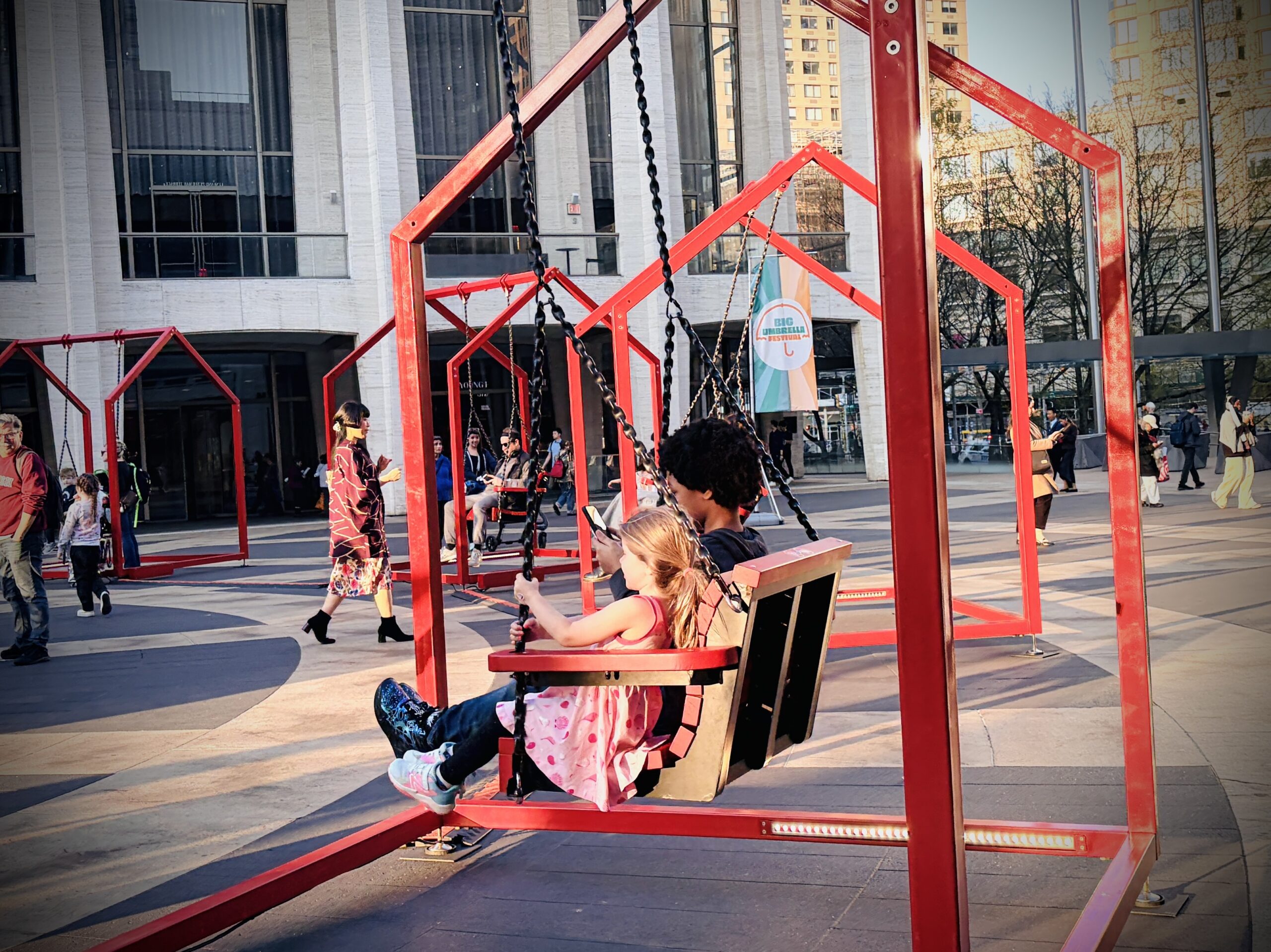 Of course, this has always been a place to meet, wait, and linger—despite being a bit cold, mood-wise. The fountain has really been doing all the heavy lifting here. Now, the installation brings a whole new kind of life to the space. I see people staying a long time, wandering through, dropping in and out of the casas. Something is different, something is new, and curiosity takes the lead. In the end, we all just want to play, and a little red-framed permission to forget that adults are not supposed to do so can work wonders. Playtime, in fact, never stops. The woman in a white satin jacket, swinging toward her companion and beaming, is beautiful proof.
Sometimes, all it takes is an invitation. This installation makes it clear we’re wanted here. Go ahead and step inside, take a swing, stay a while. Just across the plaza, though, the message has long been very different. For decades, Lincoln Center’s architecture drew a hard line between the cultural hub and the residents of the Amsterdam Houses just across the street. From their side, there was no grand fountain, no welcoming plaza. Just a concrete wall dividing those who were invited in from those who were kept out.
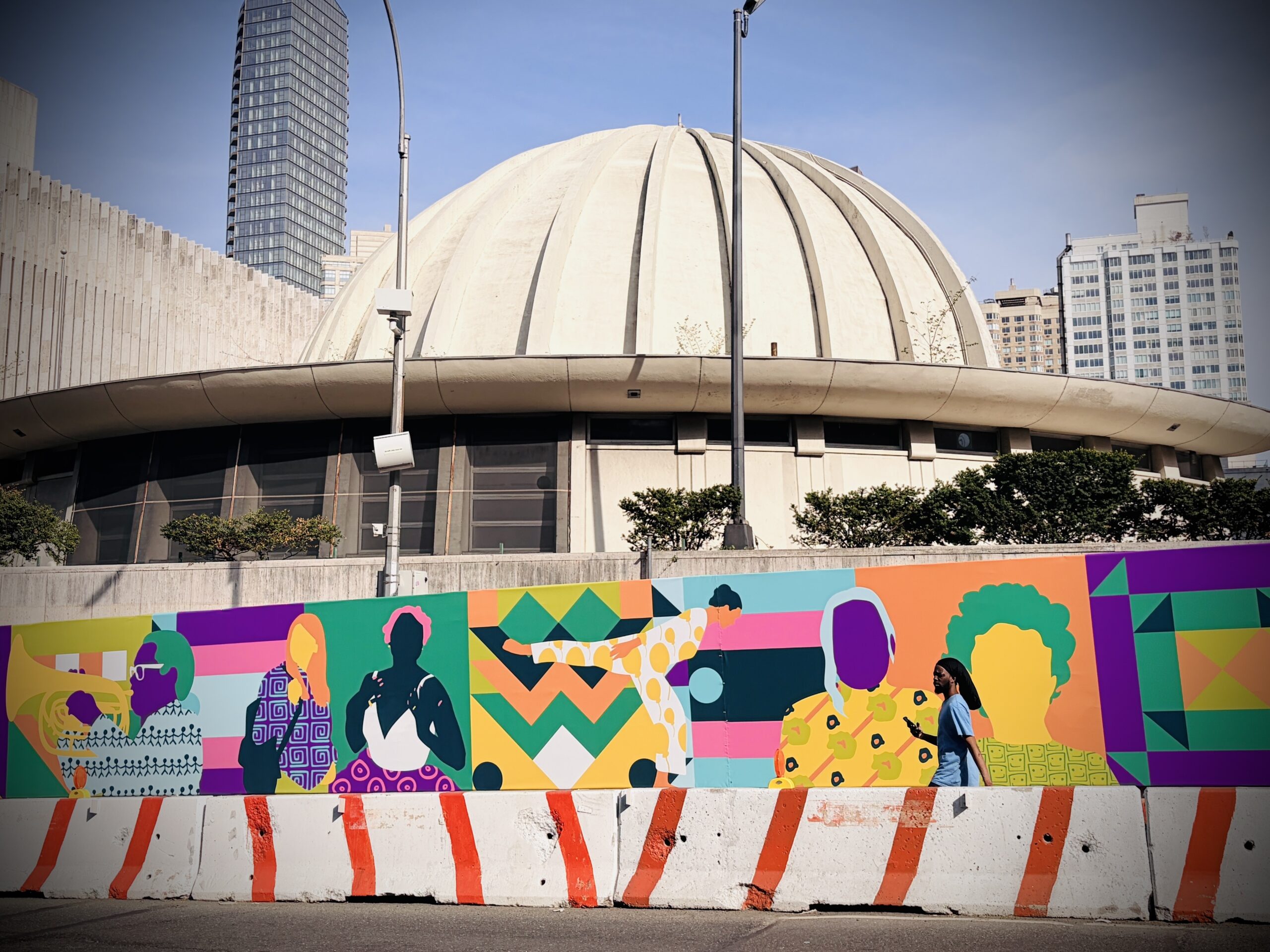
Last Monday, a mural stretching along the construction fencing on the Amsterdam Avenue and 62nd Street sides of Lincoln Center was unveiled. Designed with input from local residents, it’s part of an effort to open the campus to the whole neighborhood, while also honoring San Juan Hill, the diverse community displaced in the 1950s to make way for it. Lincoln Center’s effort to tear down the dividing wall is not just a redesign, but a way to show that architecture can separate a community or bring it back together.
On the swings, it already does.
——
“Mi Casa, Your Casa 2.0” will be open through April 26. The installation is temporarily located at Hearst Plaza, on the north side of the Met, through April 21, before returning to the fountain on April 22.
——
Yvonne Vávra is a magazine writer and author of the German book 111 Gründe New York zu lieben (111 Reasons to Love New York). Born a Berliner but an aspiring Upper West Sider since the 1990s (thanks, Nora Ephron), she came to New York in 2010 and seven years later made her Upper West Side dreams come true. She’s been obsessively walking the neighborhood ever since.
Subscribe to West Side Rag’s FREE email newsletter here. And you can Support the Rag here.




your pangs of guilt are signs of low self esteem.
the chairs are first come first served.
sit and enjoy them for as long as you care to,
That is indeed… a take 🙂
I’d say pathologizing empathy and community awareness isn’t a great sign itself
My goodness – low self-esteem? I suppose you think the guy reading a book has high self-esteem? Let’s skip the armchair psychology, and instead applaud Ms. Vávra as a generous person who let two little girls enjoy “her” swing, and understood that the art project is all about community. (I hope more people at the exhibit are like her than that selfish reader!)
Good people will ignore korts suggestions.
Regardless of how long others are standing around waiting for an opportunity…..
I love this essay and I love how thoughtful you are to think about other people’s potential enjoyment of Lincoln Center, both immediate enjoyment of the swings, and long term enjoyment of the plaza for all our neighbors.
I think I will head there to take a swing today!
I passed by yesterday morning, and the installation was being replaced with stuff for the summertime dancing!
We were there yesterday, as well, and now the swings are over by the pond, on the library side.
I don’t like confrontations. I probably won’t get my opportunity to enjoy the swings. Or maybe Kort will save me a seat…
The best way to assuage your guilt is to get rid of the swings at Lincoln Center. Let’s enjoy one of New York’s best open plazas without the usual summer clutter.
If someone has been hanging out and swinging for a while, with no one else around waiting for a turn, I’d say “Have at it” and swing to your heart’s content. But once you’ve been doing it for a while and there are others who want a turn, it’s time to happily turn your seat over to someone else. If not, you’re like the person in a busy restaurant who lingers at a table, not even drinking water, when others are clearly waiting to be seated.
This is a community project. This is for everyone who is able to use it. One person shouldn’t be claiming it as his or her own personal space, like someone at Starbucks with a laptop.
Adults are worse than little kids in a playground when it comes to taking turns. No mystery. Kids are watching us.
The rules are that once a person more oppressed, with less money or who looks more indigenous than you arrives you have to leave.
I am grinning like crazy, actually shocked that WSR allowed this comment.
What a lovely article! I could imagine myself swinging in the April air, hopping off to let someone else enjoy the experience, and ignoring the cranks who invariably have to weigh in with their mean-spirited gripes and dismal croaking. Thank goodness for the kind people.
Swingsets at Lincoln Center are stupid. Anti-culture Cultural Revolution garbage. What there should be are listening stations to listen to music or watch productions.