

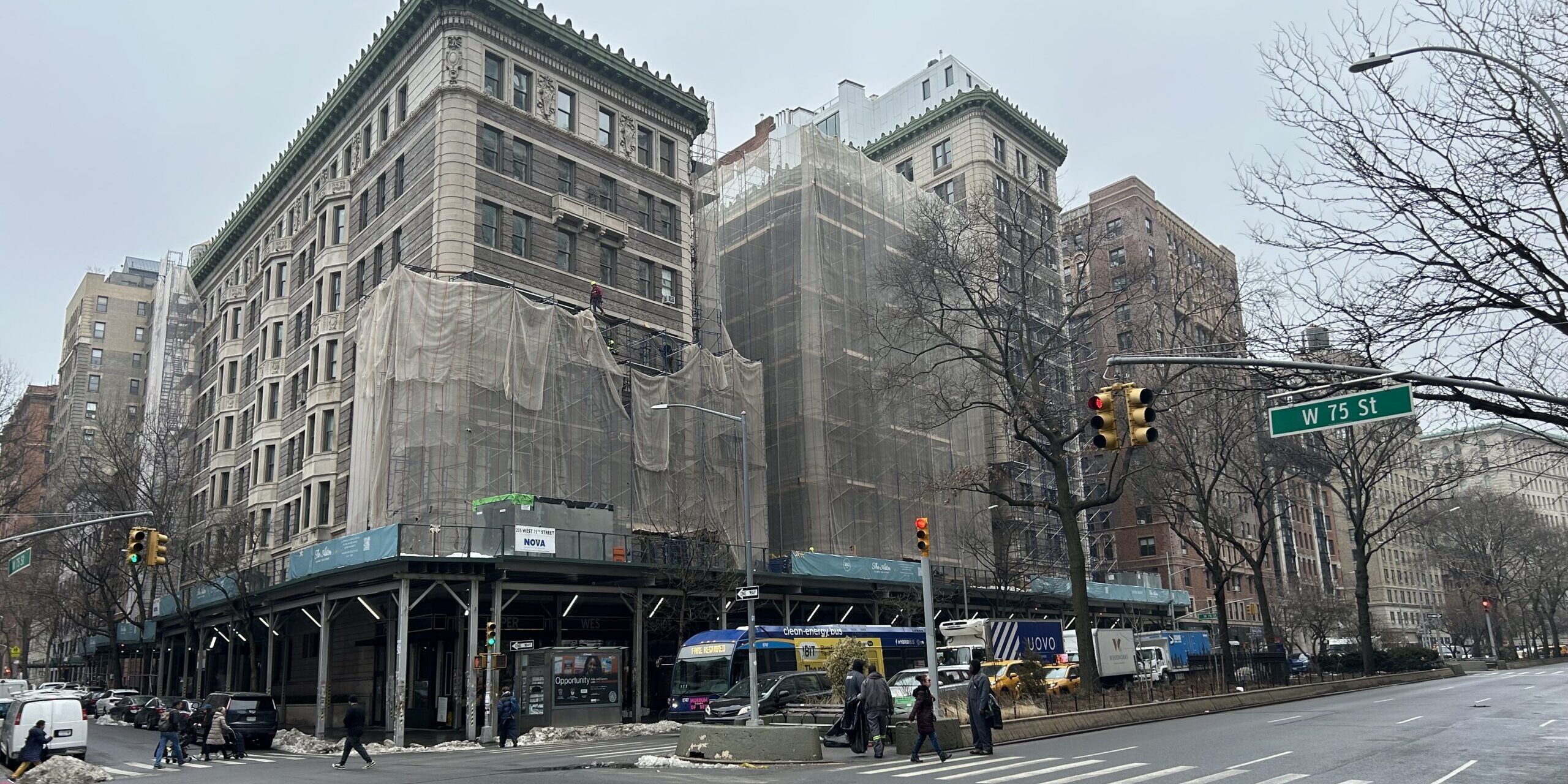
Today the Rag launches a new column, UWS Shed Watch, dedicated to exploring the forests of steel poles, netting, and dark green plywood that are as much a backdrop to city life as rats, pigeons, and traffic.
The legacy of a 1979 tragedy in which a chunk of masonry fell from a building at West 115th Street and Broadway, killing a Barnard College freshman, these so-called “sidewalk sheds” (not to be confused with restaurants’ pandemic-era dining sheds) protect pedestrians from debris that could fall from a building under construction or in need of repair.
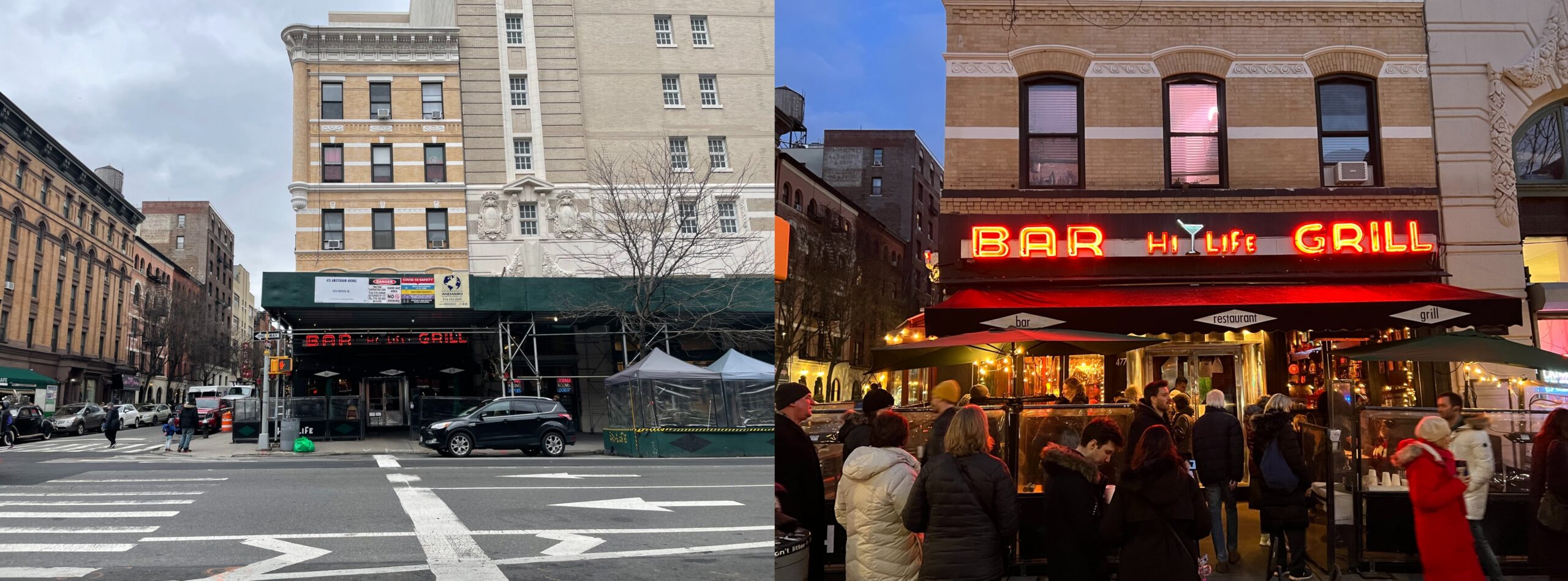
But they also obscure the facades of historic buildings, block the light in rental apartments and luxury condos alike, make businesses harder to spot by obscuring their signs, and create dark tunnels along our sidewalks – often for years, and, in a few notable cases, decades, at a time. (They also have a few good points; just ask the Rag editor who, for a time, was able to walk to work in the rain without an umbrella, thanks to the density of sidewalk sheds on her 10-block commute.)
Last month, Mayor Zohran Mamdani announced a series of programs designed to remove some of the city’s longstanding sidewalk sheds — for example, by allowing some lower-risk buildings to undergo facade inspections every 12 years, instead of the every-five-year inspection mandate that has been in place since 1980.
Mamdani’s effort is far from the city’s first attempt to grapple with this perennial public policy issue. Last year, former Mayor Eric Adams signed a package of legislation aimed at the same goal, and local politicians “honored” particularly egregious offenders with mock awards (“the Sheddies”) to spur action.
In the coming months, we’ll keep an eye on the new programs and explore the multitude of other issues related to sidewalk sheds. But today, we start with what data says about sidewalk sheds in the city and on the Upper West Side.
By Scott Etkin
Have sidewalk sheds really gotten out of hand in New York City? Well, consider something State Senator Eric Bottcher recently told West Side Rag: If lined up from end to end, the city’s sidewalk sheds would reach from here to Montreal, a distance of more than 330 miles. Or look at one block of the UWS that the Rag recently wrote about, where nearly two football fields’ worth (174 yards) of sidewalk sheds wrap around the historic Astor building.
What’s commonly referred to as “scaffolding” is really two parts: Sidewalk sheds are the metal beams and wooden planks that form a ceiling over the sidewalk to protect pedestrians from materials that might fall from above; scaffolding is the netting that covers the building’s facade. They’re both so prevalent because they’re used during construction, repairs, and inspection of the city’s hundreds of thousands of buildings.
Inspection requirements, in particular, have been a primary reason behind the proliferation of sidewalk sheds; they are a frequent target of would-be regulatory reformers. The NYC Department of Buildings’ (DOB) Facade Inspection and Safety Program encompasses Local Law 10 (passed in 1980) and Local Law 11 (passed in 1998), requiring that the facades of buildings taller than six stories be inspected every five years.
A permit from the DOB is required to install any sidewalk shed or any scaffolding over 40 feet in height. Permits can be renewed to extend the work’s timeframe – most Upper West Siders probably know of sidewalk sheds that have remained in place for years. But what does the data say about the number of sidewalk sheds on the Upper West Side and how long they’ve been up?
It may not seem like it, but on the UWS there are currently fewer buildings with active sidewalk shed permits than at any time in the past three years.
There are 391 active permits for sidewalk sheds in the neighborhood as of March 30th, according to a database maintained by the DOB, down from 522 in July 2023 when Mayor Adams announced his plan to “Get Sheds Down.”
Citywide, the number of active shed permits has declined to 7,704 from 9,068 over the same time period.
That’s the good news.
The bad news is that while the number of shed permits has decreased, dismantling the oldest sheds has proven to be a persistent challenge. The average age of a sidewalk shed permit for inspection, construction, or maintenance in NYC has crept up from 497 days in July 2023 to 557 days in March 2026.
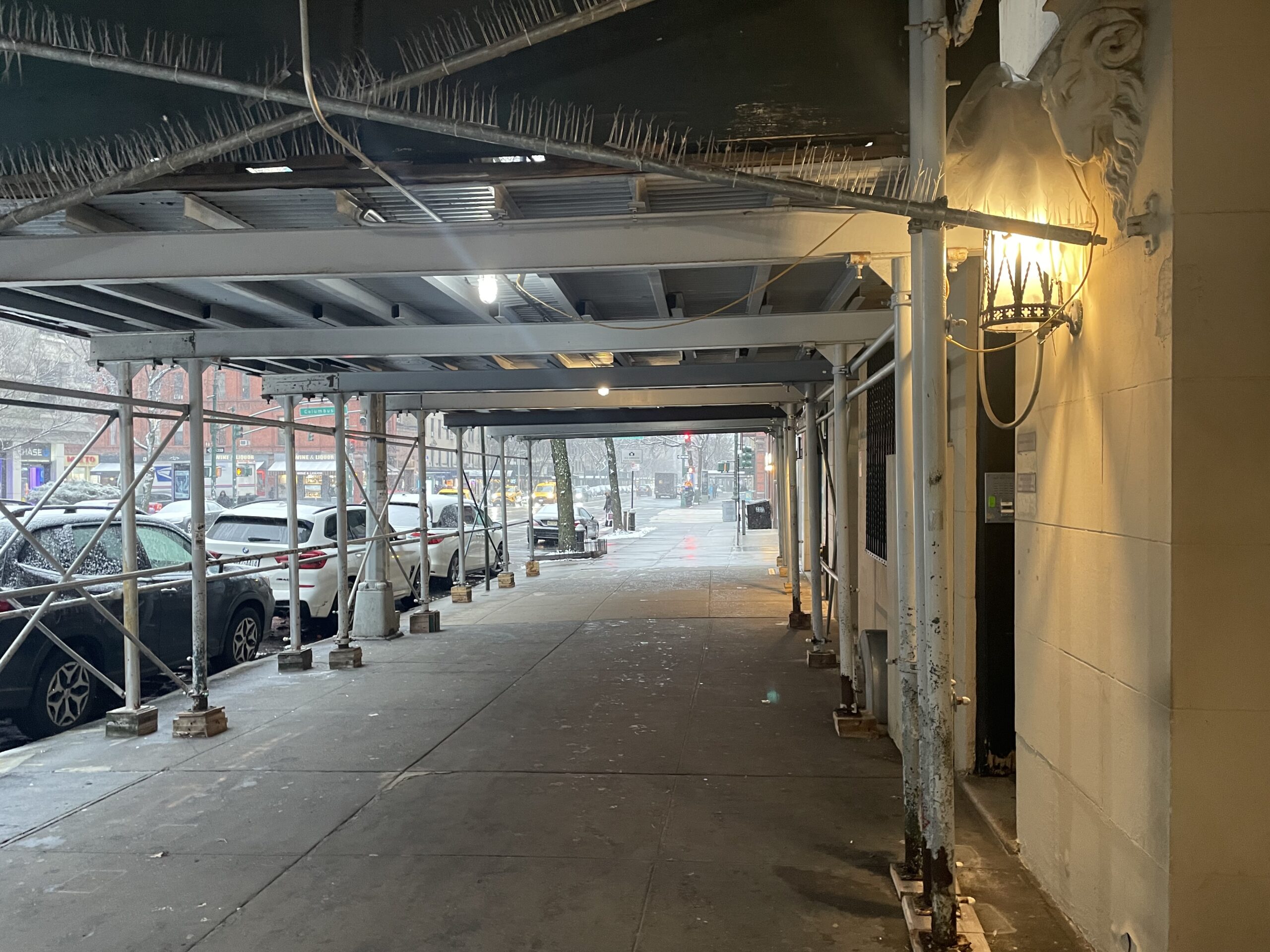
On the Upper West Side, there are currently 18 permits that were issued more than five years ago. Of these, 14 are related to facade inspections required by Local Law 11. The remaining four are related to construction or maintenance.
Manhattan has far and away the most sidewalk shed permits of any city borough, and the Upper West Side has the third-highest number of shed permits of any neighborhood in Manhattan, trailing only the Upper East Side and central Midtown.
State Senator Bottcher, who was elected last month to represent the Upper West Side, sponsored two pieces of legislation in the package signed by Mayor Adams in 2025. His regulations introduce fines to building owners who do not complete facade inspections within two years; they also mandate an increase in the level of lighting under sidewalk sheds.
So the data shows sidewalk sheds are on a downward trend, and now Mayor Mamdani has picked up the torch that every mayor in recent memory has carried – to bring down even more.
“In the greatest city in the world, we should not accept darkened sidewalks and covered walkways as a fact of life,” Mamdani said when he introduced his new shed reforms.
Let us know in the comments: Have you noticed the decline in the number of sidewalk sheds in recent years? What other thoughts or questions do you have about them?
Read more:
Subscribe to West Side Rag’s FREE email newsletter here. And you can Support the Rag here.




Thank you for the focus on side walk sheds. I’ve been a Board member of my condo for over 15 years and been through multiple LL11 cycles. Here are my suggestions for improving the process.
– Change the timing of inspection to start AFTER the latest LL11 work is complete (vs. a fixed 5 year cycle). This will automatically reduce the shed life by 25-30% (conservatively)
– Get the DoB to respond to inspections in an expeditious manner. We are currently waiting for them to complete final inspection on the work on our building. We have been waiting for about 2 months. We can’t remove the sheds until the DoB gives approval
– Allow “terracota like” material to be used on landmarked buildings with terracotta. The time to get replacement real terracota is many, many months (sometimes over a year), causing significant delays
– The industry (engineering consultants, shed providers, etc.) are in cahoots together. There is no incentive for engineering firms to work quickly and shed providers are only too happy to oblige. There should be some standards set for thie industry as well
Many more ideas, but the above will reduce the time sheds are up by a significant amount.
A lot of really good ideas here. Maybe you should write them up and send them directly to the council members involved.
Thank you
Thank you for your comment. I would if anyone would listen. No one wants to fix the problem. They all focus on the wrong things (e.g., fine landlords)) vs. the root cause of the problems.
It also goes back to the “affordability” issue that the politicians love to talk about – LL11 (and other laws like the ludicrous LL87 which mandates a whole bunch of very expensive green initiatives) all contribute to the increasing costs to maintain businesses which, of course, causes rents/prices to increase.
All buildings have already been through more than a few cycles, and they are in much better condition than when LL11 was adopted. It’s time to stretch the cycle to 8-10 years. It’s a disgrace what NY looks and feels like with so much scaffolding. I travel extensively and don’t see anything like this anywhere else either domestically or internationally.
Agreed – every 12 years would be fine.
All improvements but ultimately lipstick on the pig that is LL 11. As someone points out below, similarly old cities don’t have this scourge of scaffolding.
A long time shed was removed this week from the north west corner of 81st & West End.. it wasn’t up anywhere near as long as many, but I’ve looked at it for quite some time and notices the sun shining down on the building immediately !
If you’re referring to the scaffolding around 441-451 west end avenue, yes it has finally come down after 5+ years — however both buildings directly across the street on the east side of WEA now have scaffolding up.
These sheds are terrible and have to be removed. This is an example of laws that went way too far in the wrong direction. Please shame these long-standing sheds.
Yay. A new column!
But… this is all pretty old news.
Is this really an attempt by State Senator Bottcher to get some coverage going on his first month in office? Pretty easy crowd pleaser issue to pick right out of the gate. (Is there any constituency for more sheds?)
Additionally, does a state senator (not NYC council member) really have any say here? Both laws are called “local law 10 and 11.”
I would suggest that, on a state level, tackling the super high cost of NYS insurance (construction, liability and automotive among others) is an issue that should be, and needs to be addressed immediately?
Insurance has definitely gone way up, and if my building is any example, getting insurance company approval for any building work takes FOREVER. Like the estimates we get for construction work expire before the insurance company decides the contractor’s insurance is good enough. NYC DOB permits probably also expire while buildings are waiting for their insurance companies to guarantee coverage.
Can the state actually do anything about that? I’m in, if they can!
I feel like it has such become common place that the actual long-term solution would be to make sheds permanent, but designed to let light in. Let’s be honest, during rain/snow, we are all hiding under these sheds.
Tradeoffs… They also provide nice shelter for folks who have no alternative to living on the streets.
But I’d rather get rid of the shelters, carry an umbrella, and support everything the city can do to provide housing for people who need it.
Thank you WSR–what a great idea for a column! I also know that Micah Lasher has been on top of this issue as well.
A great deal of the Upper West Side is in Landmarked districts, which greatly increase the burden and expense of fixing facades. The Landmarks Commission has maps at
https://www.nyc.gov/site/lpc/designations/historic-district-manhattan.page
I could not find a map of the entire Upper West Side, but counted 12 separate districts on the Upper West Side.
The bills of State Senator Bottcher do nothing to ease the burdens of compliance for those of us in Landmark Districts. They actually increase the cost of compliance.
So I don’t expect much improvement.
What would actually help? A thoughtful overhaul of Landmark’s requirements. Priority: allow cast stone to replace terra cotta, on all floors.. There are only two suppliers of terra cotta that can satisfy Landmarks for many uses, one in Buffalo, one in California, and both have a year + waiting lists.
In my experience, as Board President of a coop on Riverside, Landmarks requirement increase the costs of facade repairs from a few hundred thousand to $4 million, increase the time our building was covered in scaffolding from weeks to 3+ years. The excessive Landmarks requirements actually cause the blight of scaffolding.
Oof. Nah, the issue isn’t with the beautiful landmarkwd buildings and the concept of landmarking buildings or the landmark commission. You’re choosing to live in a landmarked building presumably, let alone be the president of the coop board of one, so be proud of that! The issue is the sidewalk sheds and the practices of those benefiting from them.
The subtext of your comment “You’re choosing to live in a landmarked building” appears to me to be that “you can afford the costs that Landmarks imposes.” We can’t.
Our building has stewardesses, massage therapists, social workers, travel agents, lighting designers, set designers, casting directors, many writers, many retired persons – a very diverse group of New Yorkers. Well over half of us have lived in the building since before it was swept into a Landmark district, with all the additional expenses and red tape that come with that. We had to essentially double our maintenance for 27 months – 2 years and 3 months! with an assessment to pay for our facade work. Much of this expense was to meet visually trivial Landmarks requirements.
We pushed back against certain of Landmark’s requirements – for example, the year delay and additional overhead to get terra cotta replacements from California for an architectural element on lower floors, where the identical architectural element was made for upper floors in Brooklyn. But given Landmarks power to further delay our project by not promptly OK’ing that the colors for roughly 20 elements were up to their standards. Note that Landmarks does not keep a record of what colors, etc. they have approved – so Cycle 10, we have to start from scratch.
Actually, when I purchased my coop, it was not in a landmark district. Landmarks extended an existing district to cover many more blocks, including our building, much later. Had we and others in the area understood what this meant at the time, we would have opposed adding our area to the landmark district.
We went through facade Cycles 1-6 before we were swept into the landmark district. Facade repairs were no big deal. We had a sidewalk shed once, for a very specific issue. There were very few sidewalk sheds on Riverside or West End.
After our uptown part of Riverside and West End was swept into the landmark district, all that changed – for us, and for most of our neighbors.
The cost to complete Cycle 9 went up from a few hundred thousand to $4 million, and the time from weeks to years. Most of the increase was due to onerous Landmarks rules. A non-specialist would not notice if terra cotta decorations on floors 1-6 were replace by cast stone – but sure as heck notices when that facade is covered by scaffolding for 3 years because of that requirement.
Sounds like you should move?
We live on the UWS but are currently in Paris, where sheds are as scarce as les dents de poule. The cities are different planets. With strict enforcement of height limits and measures to control scaffolding, one looks down the rues at the Belle Epoque buildings bathed in sunlight with a sense of astonishment…and awe. We understand that some NYC landlords choose to pay fines rather than repair their buildings. Increase the fines tenfold or whatever is necessary to compel these landlords to fix their buildings in short order. And the city must hold itself to the same standard at NYCHA and other city-owned properties.
well said! i recently went to barcelona, madrid, porto and lisbon. the buildings in these cities are in perfect shape and i never saw a “shed”. what’s the secret?
In my experience, the problem is not that “some NYC landlords choose to pay fines rather than repair their buildings.”
The problem is that the requirements to repair buildings, especially in Landmarked districts, are so onerous it is extremely expensive, time consuming, and difficult to comply. Thus we end up with scaffolding up for years.
I think it’s both. It also depends on how DOB rates the building when the five-yearly LL 11 reviews are done. If they give you an “unsafe” rating, you have to put the shed up instantly, even if you still have six months of bidding and negotiations to do before you can actually repair the facade.
maybe a Landmark mediator could be instrumental, to work as an expediter & historic restoration liaison to get the job done correctly, in an urgent manner instead of riddled w tolerated delays
Adding yet another layer of bureaucracy is not what we need. And the delays were in large part caused by Landmarks, not us.
Landmarks took months to OK the restoration of a limestone corner of our building. It was on side street, not prominent – but the Landmarks guy was not satisfied with a detailed diagram of how we would replace the limestone, but insisted on literally seeing it laid out in our courtyard. Then he made us discard most of the 50+ limestone blocks we had carefully preserved, because using them would cause a couple of more seams in a couple of places.
I honestly don’t know whether all this was to try to get a bribe, or was just overzealous, inexperienced young guy with no sense of the cost/benefit of what he was requiring. It cost us a fortune, long delays.
It was a nightmare.
I have seen this same issue with the vast majority of LPC projects-invariably making increased costs increased delays at the whims of reps who seem to not care about the economics of these projects nor how long it takes. There’s no oversight over there or a standardized process for approval of basic materials even from past projects with recent approvals. If you want to fix LL11, start by streamlining the cne process for historic districts. Past approvals of bricks or stone or mortar within the last 50 years should speed up these projects significantly. Terracotta replacements also desperately need to be approved. The backlog for production is a year in most cases.
It’s good to see the WSR doing this, thank you.
I beg of you, please, please address the wrap-around shed/scaffolding on the NE corner of West 74th x Columbus. It has been up for over 10 years, and in that time I’ve witnessed actual work being done perhaps twice. How the residents of that building cope is beyond me. I’ve tried to get information numerous times to no avail.
And BTW, the DOB database you provided says the first permit was issued on 08/31/2020 — That is incorrect. Maybe that was a renewal date? Again, the scaffold has been up for over a decade. The address is: 61 West 74th Street.
The shed at 125 Riverside dr has been up close to 15 years impacting the quality of life on 126 Riverside dr. Anyone looking into the numerous violations. Destroyed 126 Riverside roof deck and dangerous rusted conditions. Please look into 125 Riverside violations.
I am a Native New Yorker and UWSer old enough to remember the tragic C.U. student accident (even remember her name “Gold”) thus I have been looking at scaffolding since then and something is wrong. I daresay there may be corruption. I have seen scaffolding across from me stay for years, taken down for a blink of an eye and put back up again in front of the Jewish Home for the Aged on 106th Street between Columbus and Amsterdam across the street from where I live. At one point we even had a homeless encompment situation. Now the area is simply splattered with graffiti. Unconscionable.
I sometimes think the increasing rules for every five-year cycle on LL11 is due to a conspiracy by the contractors to push the city to be stricter and stricter. It guarantees work for a lot of people.
the scaffolding on the west side of Broadway from about 75th -76th has also been up for an extremely long time and attracts encampments. Perhaps the regulation can include rules to scaffolding companies, for instance, they can only have a certain number active at one time and the compensation decreases monthly until it is no longer profitable to leave it up at one location when the limited number makes it urgent to move to a new location. Also, a contract with the city & building should be made at the initial inspection and scaffolding initiation, to set a time frame and have penalties if it exceeds that timeframe.
correction: encampment
Who makes the money off this? That’s where you have to put the squeeze on.
Absolutely. I imagine it’s a multi-million dollar business and some group or groups are putting lots of pressure on our representatives to keep it going.
Construction companies – lots and lots of work for them doing facade work.
West Side Rag might also consider a story about the number of workers hurt in accidents while working on facades. Somehow, they are invisible, while a very few incidents of falling objects hurting pedestrians has generated a vast industry of for facade repairs – scaffold providers and engineers and contractors, and enveloped our city in scaffolding for decades.
The City Council has added even more expense to address this, by requiring an on-site safety monitor – which will increase the cost of many projects over the ability of the building to fund them.
Please, elected officials – talk to your constituents, not the industries and lobbyists that benefit from even more onerous regulations. Make facade repairs reasonably easy, economical to do.
I agree with all Miranda said. The Landmarks Preservation requirements burdensome, outrageously expensive and result in needless shed removal delays. That elitist organization is out of step with the needs of the community it is supposed to serve.
My co-op referred to what the article notes as “shed” as a “Bridge”, clearly linked to local law #11. Hence, no confusion whatever. I humbly suggest this simple correction going forward.
Thank you for this column. Maybe you can post a list of sheds up with work appearing to be completed but shed removal hasn’t taken place. I’d like to add 201 West 92nd Street and 212 west 91st Street. And maybe a contact for the building ownership responsible?
I moved back to NYC 15 years ago. A shed/scaffolding on the southwest corner of 76th and Bdwy has been there since then. I never see any work being done. How is this possible?
Whoever owns 400 West 57th Street should recieve a shed longevity award (Shedevity?). The building was totally shedded for decades, with no work seen/heard until relatively recently. The shed is finally gone, but the building is still swathed in protective fencing. What gives?
Any info, please, on the shed on the southwest corner of WEA &78th? Seems to have been up forever.
Let’s not forget get the Astor (Broadway between West 75th and West 76th Streets). The shed has been in place for over 10 years, including a fenced off parking area on West 76th Street.
Glad you started off by showing the Astor. Now the picture should include the encampments lining the sidewalk right on Broadway. It’s the same two men and the same routine. Last week they were told by an “official” to move. You know what they did, they moved all of their “stuff” to the Broadway mall across the street and in the morning I watched ad they moved it all back.
They left behind on the sidewalk ecrement, dead pigeons, rotten food. As a senior it gets harder and harder to avoid their “stuff” without falling. Another result of scaffolding.
And yes I have filed numerous “well being” complaints.
This has really become an unsafe situation and wish that more could be done. I cant understand how the building residents dont do more to assist or want to get these abandoned stores cleaned up and rented.
The worst situation is the West-Park Church at 86th and Amsterdam, which you’ve reported on. The sidewalk shed has been up for over 20 years, because the building is in terrible shape and there isn’t the money to repair it. The church has been trying to sell itself to a developer, but has a landmark designation and there’s been a big hearted but wrong headed effort (including by our council person, Gale Brewer, who campaigned in part on limiting the sidewalk sheds) to preserve the church. Meanwhile, no-one’s even been able to see the landmarked beauty of the church because of the scaffolding. It’s time to face reality — there’s never going to be enough money to preserve the church and operate it safely on an ongoing basis. Let it go, and get rid of the shed.
Brewer promised to raise the very large amount of money to repair the decrepit church. Never raised a nickel. Ditto for the crumbling Soldiers and Sailors Memorial at 90th and Riverside. She epitomizes the empty promises of UWS politicians.
If she wants to preserve the church buy it
I have a very simple question. Why don’t you see this proliferation of scaffolding in Rome, Paris, London, Madrid. These cities have buildings that are not only decades old, but centuries old and maybe even millenia old. Why doesn’t Rome or London or Paris have a Local Law 11?. Doesn’t the coliseum need to be inspected evry five years?
European cities don’t have tall steel frame curtain wall buildings like those on the UWS. The “Hausmanns” in Paris don’t have the same maintenance issues
Thank you for your attention to this. This is a quality of life issue and a blight on our streets that needs to be handled once and for all. The city/sanitation department finally got the bags of trash (along with many rats) off the street with the garbage containers. That was long overdue and so is this.
I lived in Istanbul for 4 years and frequently visit London. NO SHEDS’. My building is about to put them AGAIN at tremendous cost. It’s patently ludicrous.
Thank you for this new column. I’ve lived in a number of cities, moved to NYC five years ago. Stunned by the number of sheds. Does any other city require anywhere near this level of facade inspections: every five years–no matter the age of the building?
Talk about overkill. Is it impossible to change the law(s)? Who want this? Who is benefitting, besides the “shed industry?”
From what I understand, there’s a major problem with LL11: buildings of a certain height + certain age must be inspected every 5 calendar years, *regardless of when the work from the previous cycle ended.* In other words, if the work takes a year (which is often the case, at a minimum), then the shed will be back 4 years after that; if the work takes 2 years, the shed will be back 3 years after that. It’s a ridiculous calculation! If should be 5 years after the *end* of the work, not the beginning of it.
I was just looking up and down bway from 86 and marveling at the relatively unobstructed view
I LOVE this new column! and love that Mamdani said 12 years for low risk buildings.
Low risk is primarily determined by age of the building. Virtually none of the buildings on the UWS fit into the low-risk category unless they are new buildings.
Someone needs to keep track at new tear down of church buildings at W 97th and Amsterdam. Catholic Church recently sold entire SW cornet for $90M.
The Belnord scaffolding is another major leaguer totally around the block
My building is a landmark building. The shed has been up for about 4 years. The replacement of parts of the decorative facade must (by law!) be replaced with the same material as the original—in this case Terra Cotta. We’ve been waiting and waiting. I think it is finally here; but we never get an estimate of when the job will be completed. I moved here about a year before the shed went up. I’m waiting to see my beautiful building restored.
So glad to hear about this new column! Scott Etkin does such an excellent job of defining terms here (scaffolding, sheds) and covering the history of this issue right up to the present. DOB reforms are definitely in order, I’m glad Mayor Mamdani is committed to taking swift action.
Wasn’t there a law at one time that required scaffolding to be removed after a certain time?
https://www.law.com/newyorklawjournal/2025/03/28/a-first-of-its-kind-case-is-brewing-over-nyc-scaffolding/
If I remember correctly, owners are currently fined $1000/mo for scaffolding left up after a reasonable period of time. It’s cost-effective to leave sheds up indefinitely rather than pay for repairs. Let’s lobby to raise the fine to $10,000 or $20,000 per month. That might get results.
The shed at 575 West End (88th and west end) has been up for over 5 years. I noticed in condo and co-ops, they don’t last as long because the residents don’t want them. This is a building with rental apartments. They never clean along the side of the building, on 88th, and the entire street is covered in dog urine all the time.
Estimate of the cost of local law 11 facade work to co-op condo and rental buildings in NYC is close to $400 million per year. How many low income apts can be built instead?
Please look into the hilarious sidewalk sheds at Columbus Sq and Park West Village. The sheds cover sidewalks that are 20-30ft from the buildings. Absolutely pointless,, but they make making the dogs much better in the rain!
Thank you for the article. Local Law 11 has created a permanent additional significant monthly cost for residents in NY apartment buildings. And – “some businesses” are clearly making huge profits at their expense! In addition to destroying the City’s aesthetics for us – we are forced to line “some” pockets. Shame.
Life is not about zero risk. The sheds are awful!
The data base maintained by the city isn’t reliable. There’s a shad that’s been up at least three years on West 77th between West End Ave. and Roverside abd another shed of thr same duration on the west wside of B’way between 75th and 76th Streets where a homeless camp is developing. Neither shows up on the map.