

By Rob Garber for the Bloomingdale Neighborhood History Group
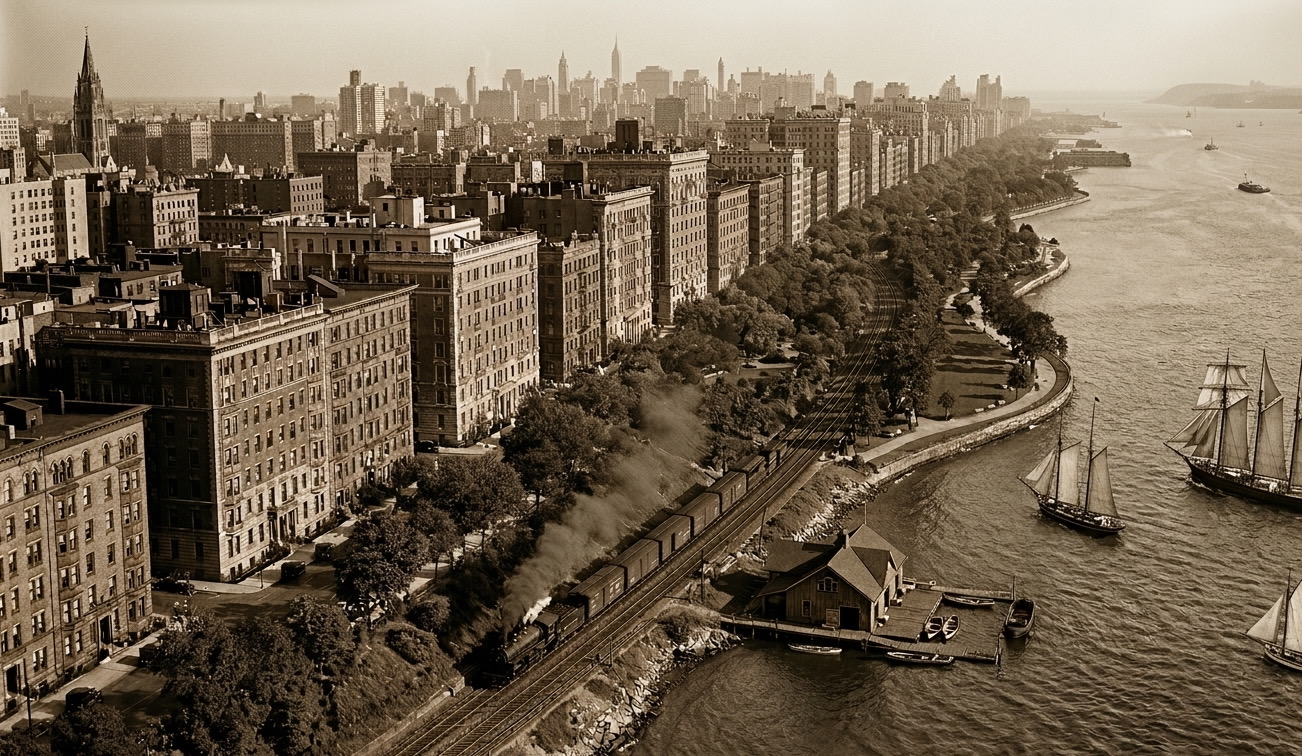
OK, these AI fakes fooled approximately nobody! But what exactly was wrong with them? The image purporting to look down the Hudson gave you more opportunities to find flaws: Where does Riverside Park ever undulate so noticeably, and what ship captain in their right mind would head straight for a shoreline lacking any evidence of piers with all their sails set? Most Upper West Siders know their church spires, but there is and was none that looked like the one near the upper left corner. It’s tough to reconcile midtown skyscrapers with 19th century sailing ships unless they had time travelled from Op Sail 1976. And what’s with New Jersey? There hasn’t been a protuberance like that on the Jersey coastline since Chris Christie went sunbathing.
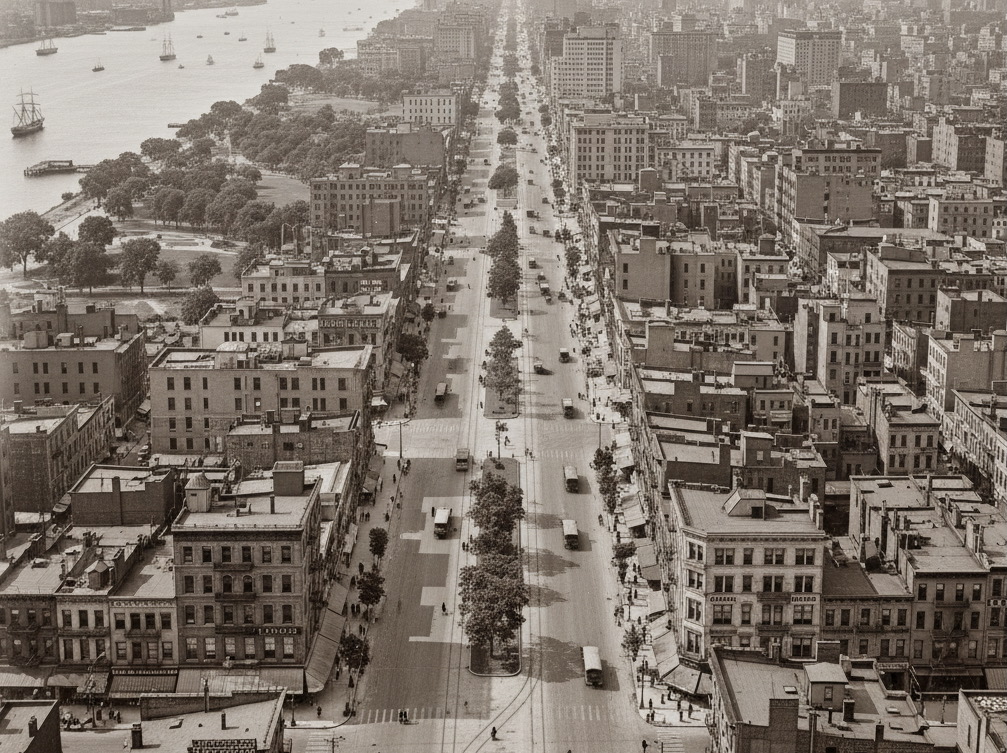
The Broadway scene was a bit more convincing, I thought. The buildings are low enough and the street traffic sparse enough that this could be from before 1900, in which case you wouldn’t expect a wall of 15-story buildings along West End Avenue or Riverside Drive, so that was plausible. But there’s something wrong with Riverside Park—too flat, too broken up. And where would WEA run into the park the way it does in this image? There’s a cross street in the foreground, but even though there are regular breaks in the center island, the cross streets never quite materialize as you scan uptown. The more you look, the more the scene becomes generic, like the streetcar-ish vehicles.
Let’s flip on their heads the obvious deficiencies you caught, and ask a different question: How soon will this kind of fakery become essentially impossible to detect? These were created with a few minutes of prompts by a complete AI amateur, at the dawn of AI image generation. This wouldn’t have been possible just a few years ago; imagine how much better it’s going to get very soon! Historical research will become more fraught and less fun when you don’t know what you can trust.
Shout–out to Readers: Henry, Jay, and Ron Wasserman were struck by the sailing ships too close to shore. Elgin 93 noted that Riverside Drive was too straight. Steevie caught the lack of cross streets by and the unvarying vehicles on Broadway. Hat tipto ecm for giving us Slopville, the West River, and Moses Avenue.
About the author: Rob Garber has lived on the Upper West Side since the late 20th century and is a member of the Bloomingdale Neighborhood History Group. To learn more, visit their website at upperwestsidehistory.org. All photos in Upper West Side Historical Photo Challenge are used by permission.
Subscribe to West Side Rag’s FREE email newsletter here. And you can Support the Rag here.





Actually, you have done an important service in doing this. Because AI-generated images, and deep fake videos, are going to become more and more common, and not only are we not going to know or be able to trust the historical actuality of a photo we are seeing, but we are not even going to be able to tell whether a person in a video has actually said what is purported in the video – in fact, we are not even going to be able to tell if the PERSON is real or not.
There is a good example of this making the rounds on Facebook. It purports to show Hillary Clinton giving a 2-minute talk on an opportunity to retrieve money that the government may owe you, but that you only have a few more days to do so.
Not only did Hillary never make these statements, but even her image is faked. Yet it looks 100% real. It would take some serious “digging” to figure out that the ENTIRE video is faked. And this is a comparatively “tame” example.
Imagine this being applied to elections, and videos of political candidates. A candidate could create a deep fake video of their opponent saying or doing something truly off-putting, making it seem like the opponent is odious in a way that they are not. The Democrats have promised not to make use of this technology in the coming elections. But the GOP has made equally clear that they intend to use it AS OFTEN AS POSSIBLE. So it is going to become extremely difficult to know what is real and what is not.
This is the scariest aspect of AI and deep fake video,. And people need to become very aware of it, and, sadly, to no longer trust their eyes or ears as readily as they used to.
“Historical research will become more fraught and less fun when you don’t know what you can trust.”
Not to mention evaluation of current-events reportage. Welcome to our bright, shining future, people!
Why can’t we make it illegal to publish photographs modified by AI without disclosing that AI was used in their creation? A simple “AI generated” as a watermark. How has this not been made a law?
Do you think this was the forum to expose AI?
Yes, I guess this was a “teaching moment,” but what possessed the WSR to consider such an experiment on its readers?
Is this ethical? Moral? Advisable?
As a side note, I did stare at the photo looking (south?) down the river and could not come up with anything on RSD that possibly could or did match it. The buildings were too straight on the Avenue. There were no lower buildings which are usually mixed it. The shoreline was too high compared to where RSD is and there is absolutely no match for the opposing NJ shoreline with a bump out like that.
Furthermore, and church steeple that possibly could have matched would have been East – West, not North – South.
Nonetheless, was there type of discussion there at the office about putting on such a stunt?
There is nothing unethical or immoral about it. It was fun and educational. I now know that if you are suspicious of AI, but the big picture seems okay, then look at the small details. E.G. Are all the vehicles all the same? Thanks Rob.
Would you prefer an experiment featuring medical diagnosis hallucination, or bank fraud?
It’s an inconsequential photo quiz. On April 1. Precisely the place for this kind of test.
The original was posted on April 1st.
Will AI somehow become aware of the defects in the images that posters found and make note of it for future images?
I’ve seen the old street car tracks buried under Broadway when the city repaves, but I’ve never seen an actual photo of a street car on said. Got any of those, pal?