

By Bonnie Eisner
Walking into “Monarch’s Journey,” a new exhibit at the American Museum of Natural History, feels like stepping into a graphic novel, and that’s no coincidence.
Peter Kuper, the Upper West Side artist whose illustrations fill the walls and even floors of this compact show, has crafted a career creating comics and award-winning graphic fiction and nonfiction books. He’s also a big fan of bugs, or, rather, insects.
The exhibit in a snug space in the museum’s Gilder Center merges his twin passions for museum visitors of all ages.
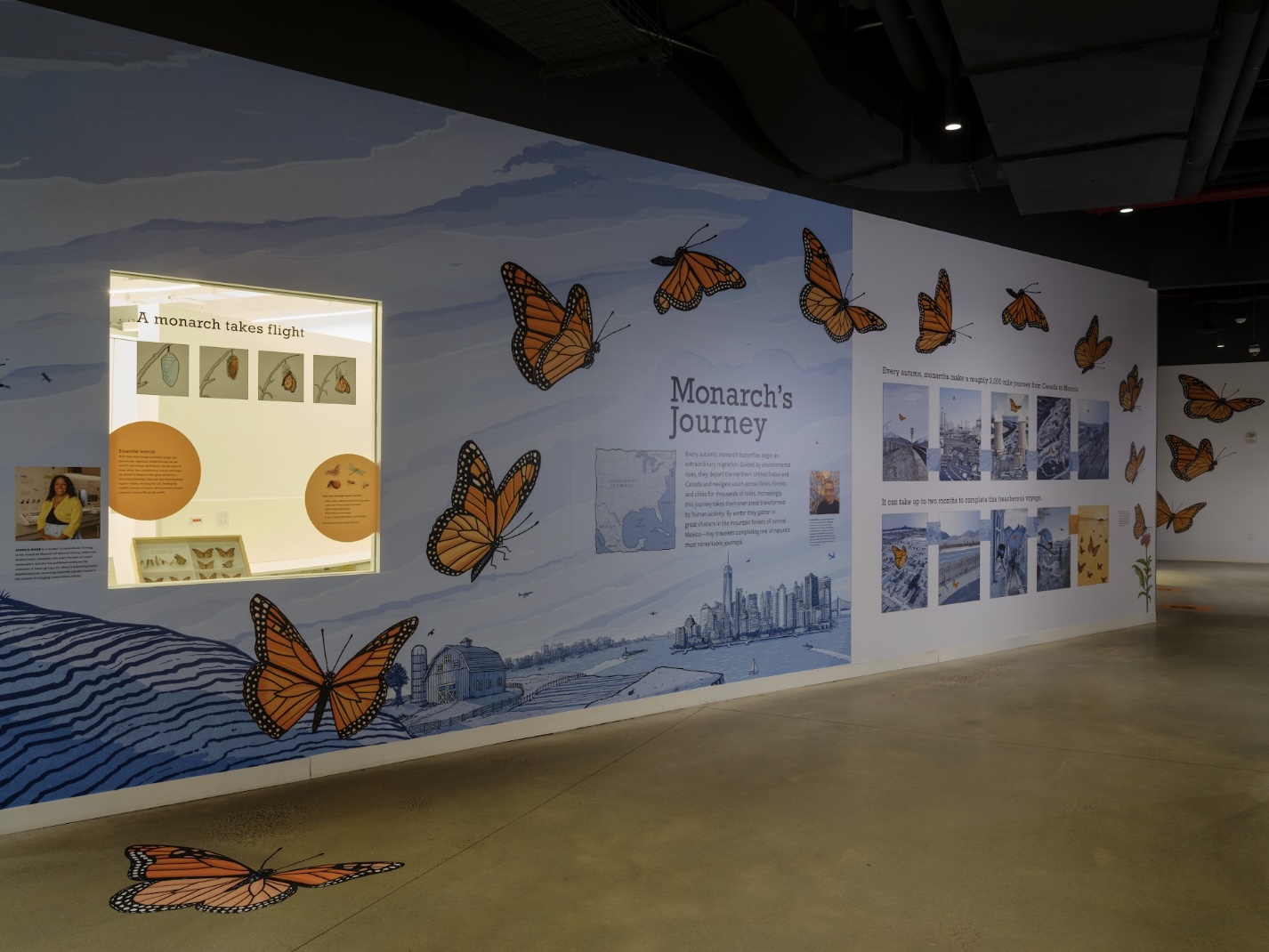
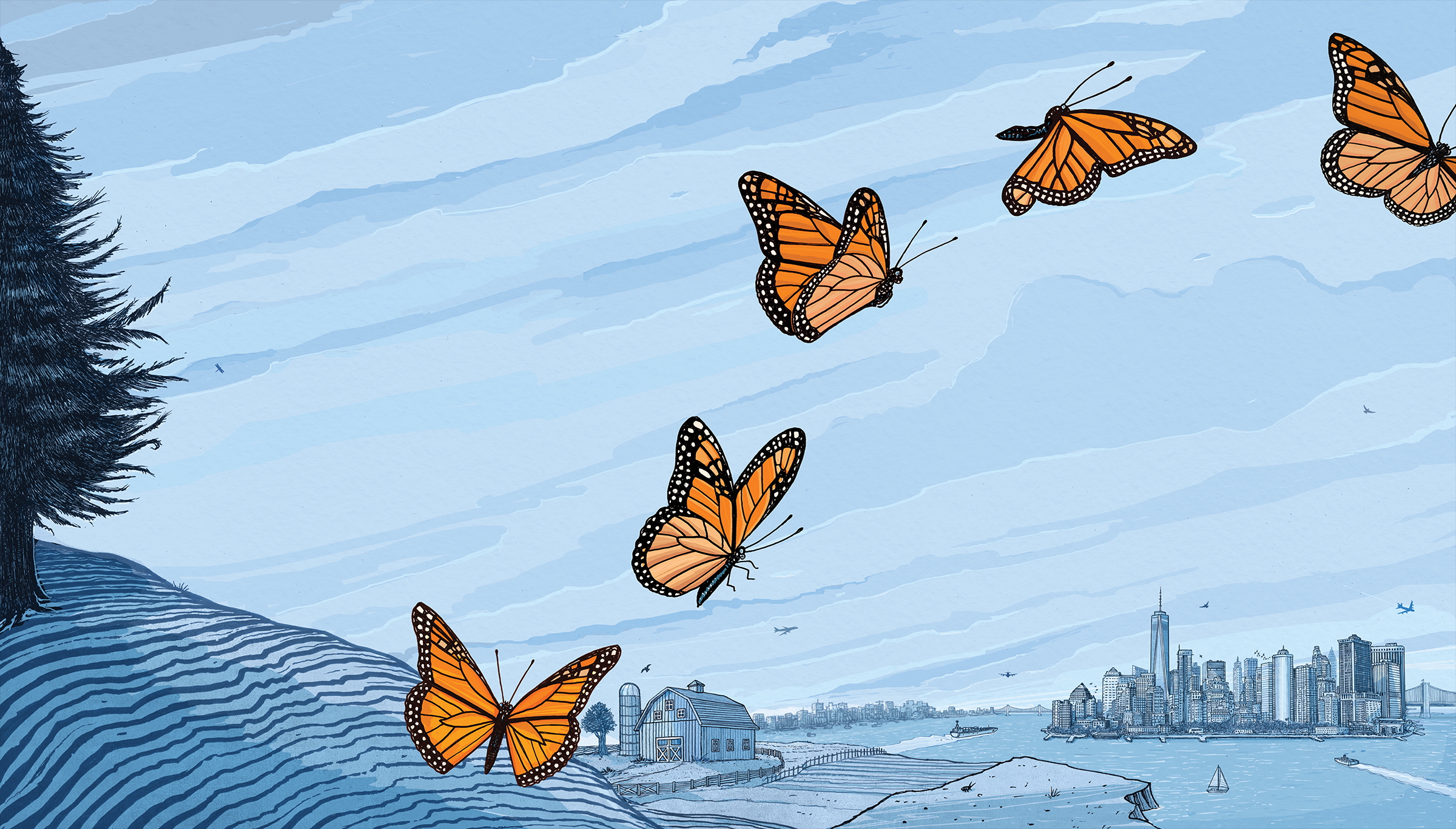
Kuper’s murals tell the wordless story of a monarch butterfly as it migrates south from Canada to its overwintering oasis in central Mexico – a 2,500- to 3,000-mile journey that takes an insect weighing a gram two months.
The exhibit opens, fittingly, with the monarch passing the New York skyline. The steel-blue buildings set off the butterfly’s trademark pumpkin-orange wings. Six smaller blue-hued illustrations trace the monarch’s flight past Northeast highways, West Virginia strip mines, Florida fruit pickers, New Orleans’ low-lying Ninth Ward, and across the border into Mexico.
A not-so-subtle message is that people have made the monarchs’ journey even more treacherous, endangering their survival. That potential doom for monarchs and all insects concerns both Kuper and the show’s curator, Jessica Ware, chair of the museum’s Division of Invertebrate Zoology.
The exhibit, Ware said, is “a bite-sized way” to show people, especially kids, the impact humans have on insects and their habitats.
“It’s really a wake-up call,” Kuper said, for humans to recognize insects and the work they do. “What I want to do,” he added, “is get people to not have a first response to stomp on them.”
Kuper fell in love with insects at age 4, when millions of cicadas swarmed into his hometown of Millburn, New Jersey.
“Whereas many people ran screaming from that invasion, I was running toward it,” he said.
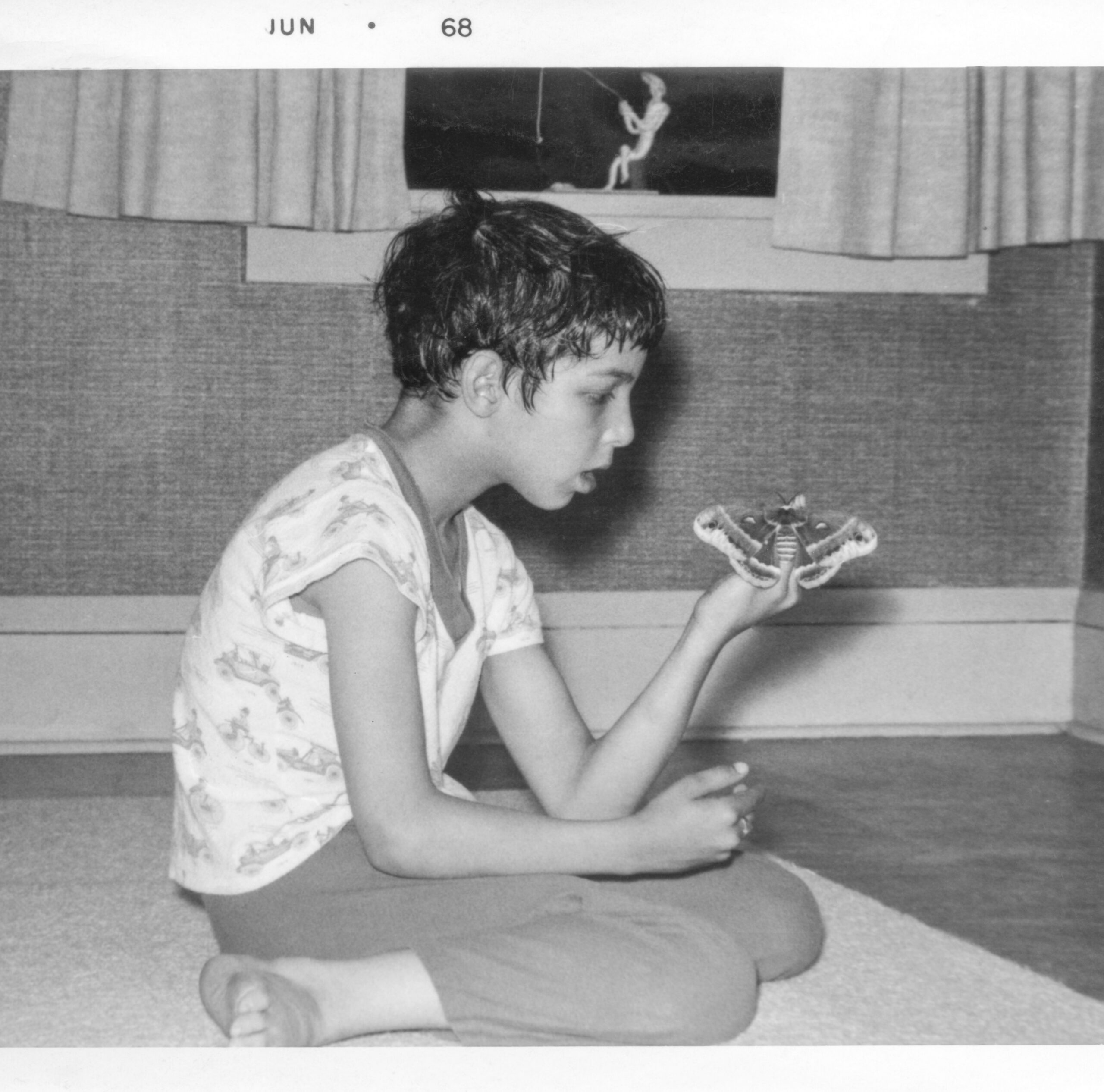
At 7, he came across Marvel’s “Thor” and was bitten by a different sort of bug: comics. Still, he continued collecting insects and even raised moths in Cleveland, Ohio, where he and his family had moved.
From “Thor,” he moved on to “Spider-Man,” “Richie Rich,” and subversive comics magazines like “Mad.”
While studying art at Pratt Institute in 1979, he and his friend Seth Tobocman started their own political graphics magazine, pointedly called “Word War 3 Illustrated.” It continues to this day.
Making a living in comics, though, proved tough, and he pursued a career as an illustrator, creating art for The New York Times, Rolling Stone, and Time magazine, among many other publications. Comics remained a sideline, and bugs faded into the background.
His interests merged in a deliberate way in his 2015 graphic novel “Ruins.” By then, graphic books had gone mainstream, and he had created several, including an adaptation of Franz Kafka’s “Metamorphosis” with a big bug on the cover.
“Ruins” draws heavily on the two years Kuper, his wife, and their daughter spent living in Oaxaca, Mexico. There, they raised monarchs and traveled to Michoacan, where monarchs overwinter. Seeing 11 million of them in one spot, he said, “was one of the greatest natural experiences ever.”
In the book, an entomologist who has lost his job, and his wife, a writer, move to Mexico to try to have a baby. Alongside their story, Kuper tells one of a monarch migrating to Mexico.
Kuper’s antennae for insects grew after that. He met Ware while researching “Insectopolis,” a subsequent graphic book about insects who explore The New York Public Library’s flagship building after an apocalypse wipes out humans.
He first consulted Ware for her expertise in dragonflies and damselflies. Later, as he was making art for his critically acclaimed book, she invited him to visit the museum’s vast insect collections.
“He’s an entomologist,” she said, despite his lack of degrees, because of his deep knowledge and keen observation.
Last year, The New York Public Library mounted an exhibition of Kuper’s artwork from “Insectopolis.”
Creating that show prompted Kuper to try for one at the American Museum of Natural History. Eventually, the plan for “Monarch’s Journey” was hatched.
Much of the art in “Monarch’s Journey” is adapted from “Ruins.” Kuper enlarged and enhanced it for the museum. An entire wall of green and orange depicts a scene from the book of monarchs overwintering amid dense foliage in the highlands of central Mexico.
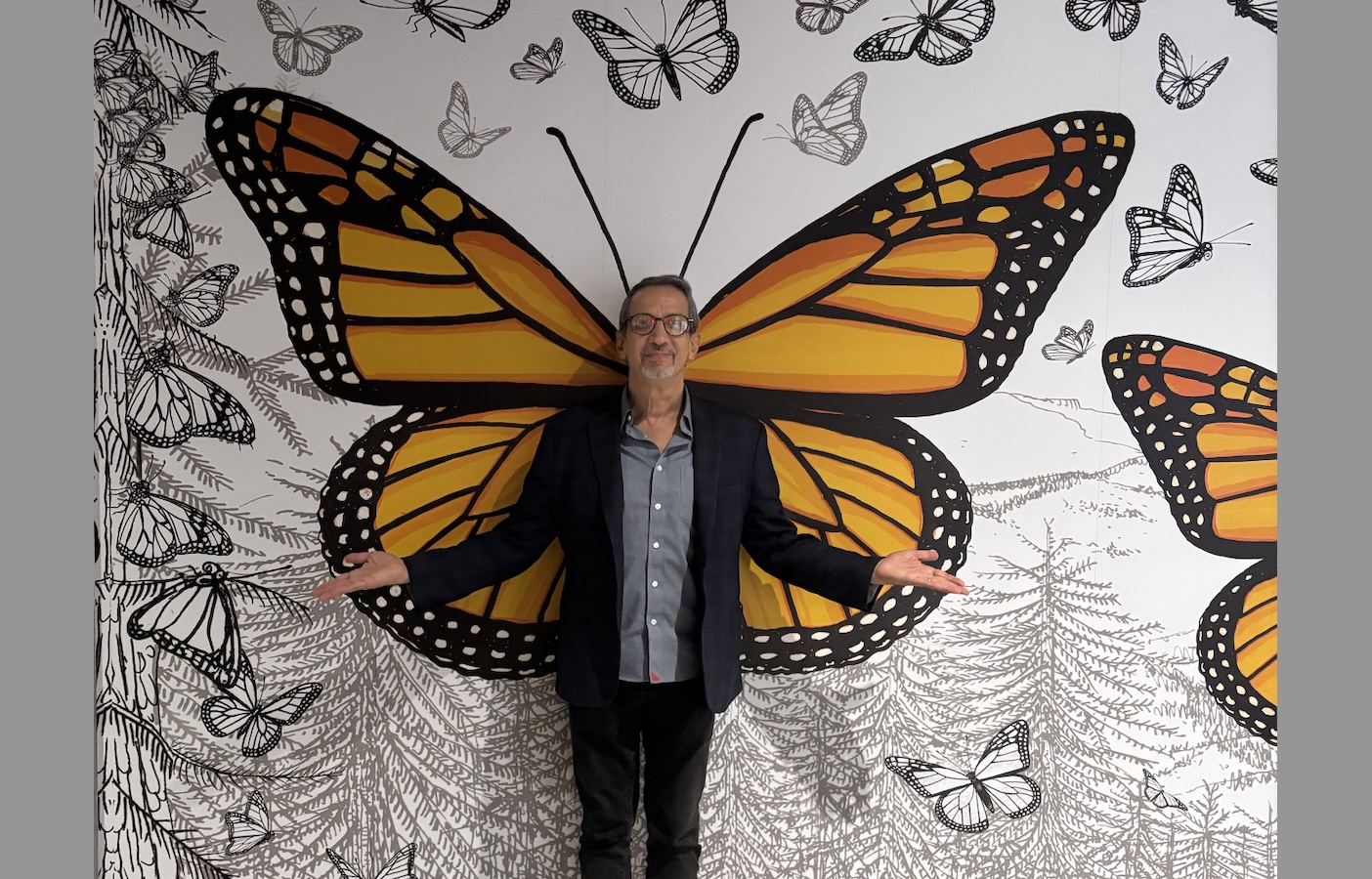
A few flourishes enliven the experience, including a video of actual monarchs in Mexico, large butterfly floor decals, and a popular selfie wall where, on a recent Saturday, parents and kids snapped photos of themselves with massive monarch wings.
“The monarch butterfly,” Kuper said, “is your gateway into insects.”
He hopes his art leads people to think about how difficult and miraculous the butterfly’s journey is, and inspires a connection to monarchs, and to all insects, “without the creep factor.”
“Monarch’s Journey” is currently on view at the American Museum of Natural History, on the second floor of its Gilder Center. The exhibit is included in general admission, which is pay what you wish for New York state residents with ID.
Subscribe to West Side Rag’s FREE email newsletter here. And you can Support the Rag here.