
By Yvonne Vávra
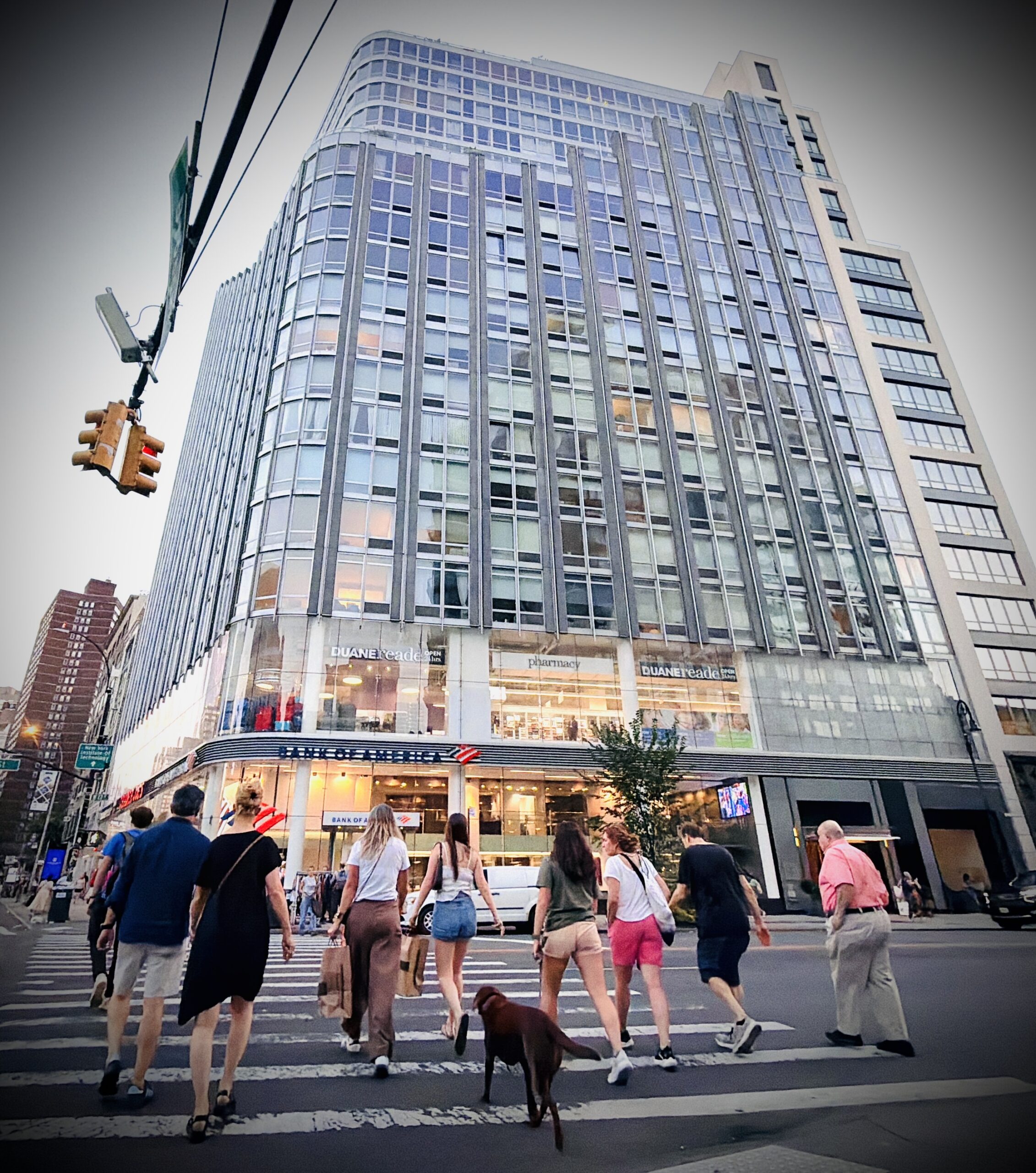
I found myself sneaking around the corner of 72nd Street and Broadway more often than I had any business doing this week. It was the whole will-they-won’t-they that was keeping me hooked. The rumors were rumoring about an imminent Trader Joe’s reopening, but every time I looked, it was still closed as closed can be. By the time this column is published, we’ll know more. We might already be elbow-deep in the freezer bins. Or not. Oh, the delicious drama!
But even if I never get to ride that diva of an escalator again (though perhaps the renovation has finally won her over to the joys of working), I’ve already scored a big win. Because once that corner got me curious, I started digging into its history. Turns out, the urge to get into that corner building is something we have in common with 19th-century Upper West Siders.
The neighborhood was still very rocky, muddy and dusty, but it was about to enter an era of sweeping change, with rickety huts sharing space with mansions and luxury apartment buildings. More and more affluent New Yorkers were moving in, seeing the promise in the dirt. But their problem was that it was all still a little out there, far from where elite life was happening. Then word spread of an exclusive private social club opening.
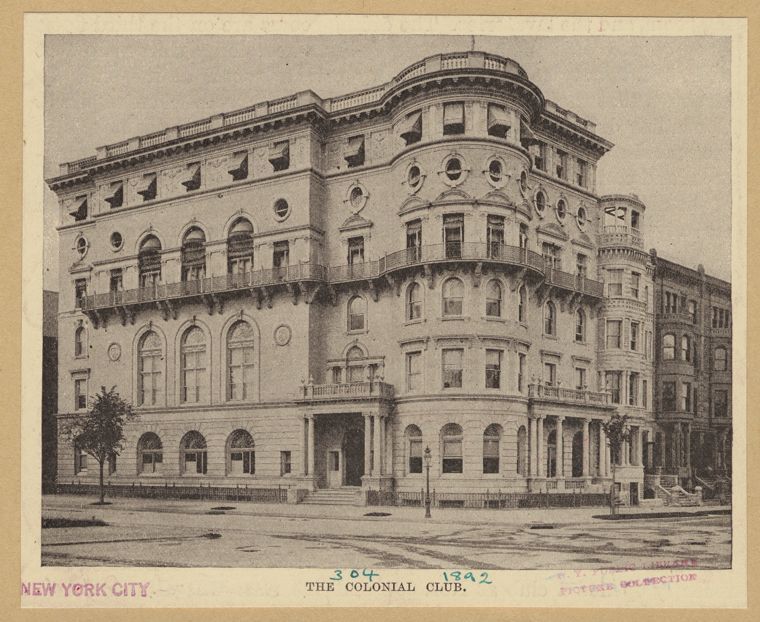
Established in 1889, the Occident Club, almost immediately renamed the Colonial Club, promised the wealthy elite a place to socialize right in the no man’s land they had just moved into. A spectacular building would rise on the corner of 72nd and Broadway, with construction beginning in 1891. Everything had been thought of: a garden and observatory on the roof, an opera house, and rooms for bowling, smoking, dancing, reading, dining, and all sorts of other shenanigans the rich enjoy. There was even a ladies’ entrance, where wives and daughters could make their way to their designated corner of the club. And here’s the fun part: from a gallery on the upper floors, they could look down on the men and their important manly business.
Membership quickly soared into the hundreds. About the size of a Saturday morning Trader Joe’s crowd. In the fall of 1892, the club officially opened with a grand ceremony, which apparently proved that Upper West Siders were not only attractive, but impressively well-haired. Chauncey Depew, president of the New York Central Railroad, told The New York Times that the crowd at the club had convinced him that the neighborhood was populated “by young men and pretty girls. There were very few bald heads on the west side.”
That might have been part of what brought the club down: the hair gap. Well, generation gap. Soon there would be quarrels between the Roses and the Thorns. Those were the names The Sun gave to the younger members and the older, more conservative ones when it reported on an election of club officers in 1894. The Thorns had planned a dinner to discuss the nominations—and guess who wasn’t invited. When the Roses found out about it, they rushed to the dinner, but the election was already over. One of the Thorns told the Sun reporter: “Oh, the sweet young things. Their papas will have to spank them tonight. Sad, isn’t it?”
Oh, those baldies!
The years that followed were understandably thorny at the club, and word was that it was badly managed. In 1903, the Colonial Club was set to close its doors due to financial trouble. “It is too far uptown for luncheon, and in fact, is altogether out of the way,” wrote The New York Times.
Despite a few attempts to save the club, the building was soon converted into office and retail space, and more than a century later, in 2007, it was razed. A glass tower rose from the rubble, and on September 20, 2010, Trader Joe’s opened for business.
The wealthy Upper West Siders at the turn of the century were certainly trying to shape an elite enclave, but the Upper East Side formula never quite took west of Central Park. Sure, the neighborhood did become affluent and architecturally grand, but it became known for a different kind of prestige: its cultural institutions, its intellectual life, its musicians, writers, actors and academics, and its great lox.
That might be changing. Meanwhile, we can have a good chuckle over a neighborhood that once dreamed of an elite social club and is now getting very excited about a grocery store. Trader Joe’s? I hear it opened today.
 Subscribe to West Side Rag’s FREE email newsletter here. And you can Support the Rag here.




The old building was beautiful! And maybe would have offered a better layout for Trader Joe’s . . .?
Well-haired or not, we’re certainly accustomed at making ourselves well-heard … being New Yorkers AND Upper-west-siders! Also, as in any generation, thorns ought to know their place, because in the end, it is the stem and the roots (the mommas and aunties and other women of the clans) who hold the plant steady and nourish it… 🙂
Hear, hear!
Well, your interpretation makes more sense to me. Apparently, the thorns were the oldsters.
P.S.: The former Colonial Club evolved into a wonderful big fruit-and-vegetable store mid-20th century, and continued to offer covenience and quality until the building was torn down. So Trader Joe’s, in a way, continues in the tradition.
That place was called Han’s, one of the many great fruit and veggie stores run by Vietnamese folks that proliferated in the 70’s. I stopped in there all the time.
The New building truly is hideous
Correct. Hideous buildings come at the end of real estate cycles, when builders feel that buyers are desperate for space.
Before Trader Joe’ s there was a small fruit-vegetable store on the corner.
OTB was on 72nd Street too.
Also the M5 bus was co-located with the M104 on Broadway (helpful for bus riders – allows more choice, take whichever bus comes first)
Due to TJ’s, the City forced the M5 to be moved to mid-block.
OTB kind of made that particular stretch of 72nd feel a little sleazy.
There was that amazing bagel place on the corner too. And a Judaica store. Hard to believe not too long ago there were at least 2 Judaica stores on the UWS, and now there are 2 left in Manhattan.
It’s weird as the number of Kosher eateries and groceries have increased exponentially. I suppose there’s some correlation between the increasing cultural identification wile decreasing religiosity
Not really. Judaica objects and books etc can be easily bought online like most anything else. Fresh food needs to be bought in person.
I’ve been trying to remember what was on the NW corner of 72nd/B’way back in the 70s and 80s. What was there before the high rise went up?
There was a movie theater
Yes. A newsreel theater.
I remember a Tower Records on that NW corner years back
Actually that was an HMV cd/record/video store on that corner. For a short time, TOWER had a branch in the Ansonia building before moving down to its biggest (and sadly last) location next to Lincoln Center.
I may be wrong but I believe the club was very unusual for its time, since they supposedly allowed women as members
Today I returned to TJ’s and was so elated to go shopping for myself and my dog.
Until, the cashier unprofessional demeanor changed my experience . I spoke to a manager and she informed me she will talk to her. In the past I didn’t experience such attitude.
However, the store looks good.
I went to Trader Joe’s yesterday. I wanted to see it on day one after the spectacular changes that had been made over the summer long renovation of escalators, elevators, etc. I hate to say I was immediately disappointed that the very first main escalator down into the store was already broken. Maybe instead of hiring so many workers, who always seem to be standing around doing nothing but socializing with each other, they should hire one full time escalator repairman.
Agree. I was there when the escalator broke down again. I couldn’t find my favorite items. What a waste of all that time and expense of closing. The only good thing about Saturday was no wait on the checkout line.
Thank, you, Yvonne, one of your best. I remember when the building came down!
A politely written observation upon the declining wages of gerontocracy. Bless you Yvonne!