


By Brendan Rose
To Antoinette Williams, a 79-year-old former world champion backgammon player, the board game is more like a war, with the checkers as her soldiers.
The Upper West Side native is a fierce competitor and fixture in the professional scene. When she arrived at the Backgammon World Championships in Monte Carlo last month, her fellow competitors greeted her with affection and reverence.
They call her “Legend.”
Williams has lived on the Upper West Side and west side of Manhattan for most of her life, having lived in the Lincoln Houses on 135th Street in Harlem and later in the Lucerne Hotel on 79th Street. Her father introduced her to card games like Bid Whist and pinochle, instilling a competitive streak early on. But Williams would not start playing backgammon until later.
“In the ’70s, backgammon became the rave of America, and a friend of mine talked me into learning to play backgammon, and I’ve been playing ever since,” she said.
Williams began immersing herself in the world of backgammon; she started hanging out at the Mayfair Club, an iconic cardroom in New York City and the center of top backgammon play in the United States, and learned the game by keeping score for top players. She began playing high-level and professional backgammon in the 70s, when women, especially those of color, were rare at tournaments.
According to Williams, the best players spend most of their time studying the game’s probabilities and strategies. High-level backgammon strategy is built on understanding the likelihood of certain dice rolls and the probability of an opponent’s future moves.
“I don’t have the math skills that I need to have in order to get to the top echelon in the game, that prevents me from being as good as I want to be,” said Williams. “My luck factor, I think, is what helps me get by more than my skill factor.”
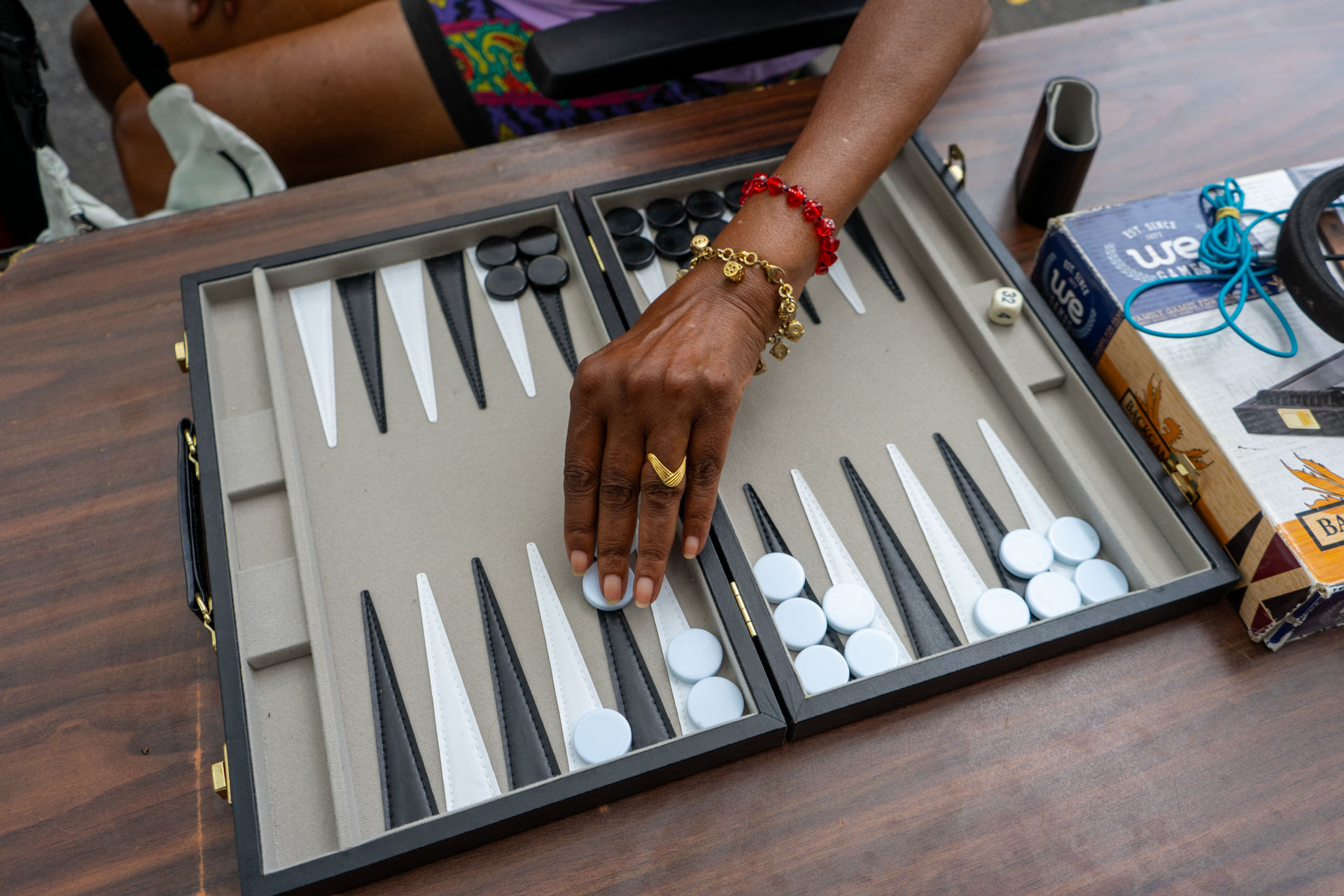
In backgammon, players race to move 15 checkers from one end of the board to the other, using dice to dictate how many places their pieces can move. Players’ skill shows in how they move their pieces. The best players know how to block their opponent from landing on certain places, tripping up their progress, and trapping them in bad positions.
“She was a New Yorker. She was a New York woman,” said Martha Ghio, a top female backgammon player, remembering her impression of Williams when they first met in 1982. “She could be tough as nails.”
“She’s not a player that’s going to be laughing and talking to people coming by and all that. But away from the table, she is one of the most delightful, funny, fun people ever,” Ghio said.
In her 40s, Williams was diagnosed with multiple sclerosis and began using a mobility scooter. The one she’s driving now is painted cherry red, and she calls it her “Ferrari.” Williams has partnered with Lifeforce in Later Years, or “LiLY,” an organization that helps older adults in Morningside Heights and West Harlem, including others with mobility issues, stay socially connected, supported, and independent.
“She can really see the best in everything, and the way she charges through the world… I think it gives people hope,” said Paula Seefeldt, LiLY’s executive director, about Williams.
Williams has dedicated much of her time to promoting backgammon, helping pass along a passion for the 1,600-year-old game to the next generation of players. Williams says that after close to 50 years of competing in tournaments, she has seen the young players she mentored grow up and start families.
Williams now regularly volunteers to teach students at schools in Harlem and on the Upper West Side.
“Backgammon teaches you strategy, teaching you how to think forward,” she said. “Backgammon teaches skills that the children do not learn in school. It teaches you how to be confident, whether you win or you lose.”
And on weekends in the summer, she has partnered with the Columbus Amsterdam Business Improvement District (BID) to give free backgammon lessons, setting up at a table on Amsterdam Ave. during Open Streets.
Earlier this month, between bikes and kids running through the spray of an open fire hydrant, she greeted people as they walked by and invited them to play.
“Every game is going to be different, and my theory is that whatever happens in one roll, whether good or bad, do not carry that over to the next,” she said. “If you’re losing and you continue to think about that kind of thing, it’s going to affect the rest of the match.”
On Saturday the 29th, she will be back at her table outside BID’s office along Amsterdam, waiting for her next game.
Subscribe to West Side Rag’s FREE email newsletter here. And you can Support the Rag here.





How delightful!
Great article! Thank you Brendan Rose!
Williams is a legend. I’ve been waiting for my chance to play her but to be honest I’m a little scared.
Lily member
Looking forward to meeting you, Ms. Williams!
What year did she win? Who did she face? What was the format — one game, winner take all? Or a series? Is there a US team or is she paying her own way to Monaco every year? How many times did she compete? Are there are divisions? These details add credibility to the story.
Great contribution to the kind of development our people need. Had the pleasure of briefly greeting her on one occassion when she played iin Jamaica. Brilliant and courageous!
Great article. Thank you. She sounds wonderful. One note, Saturday is Aug 29, not 28.
Is this the same backgammon champion who recorded her story for The Moth?
I remember when Backgammon was all the rage in the 70s!
Hi interesting article on Antoinette and backgammon
At the end of the article you mentioned next free class on Saturday the 28th. Did you mean to say the 29th or is it Friday the 28th. Easy mistake to make. thank you.!
If you enjoy backgammon, please join the Upper West Side Backgammon group at https://groups.google.com/g/uws-backgammon. Free to join, fee to play. We meet the third Thursday of the month at 6:30 PM. Location will be shared with verified group members.
I was diagnosed with Multiple Sclerosis in 2016 and put on Avonex immediately. I also discovered the Swank MS diet and went on it soon after being diagnosed. A few years later, my liver enzymes were affected and my neurologist said she had other patients who were just on the Swank diet, so I went off the Avonex and have just been on Limitless Natural Wellness MS-4 protocol for several weeks. Now, 5 years after my diagnosis, my annual MRI shows no additional lesions and I have no disability. All my symptoms declined. I work as a realtor and interior designer and am on my feet all day. I am 63 and going strong. Anyone who reads this please do everything you can to get early treatment from Limitless naturalwellness . co m