By Gus Saltonstall
Stephen Dubner’s biography is filled with impressive titles and accomplishments. He wrote for New York Magazine and The New York Times before quitting to write his own books, and in 2005, he co-authored the incredibly popular “Freakonomics.”
In 2010, Dubner launched “Freakonomics Radio,” which routinely ranks among the most listened to podcasts in the United States.
Most importantly for us, though, Dubner is a longtime Upper West Sider.
He’s been in the neighborhood since 2001.
“That makes me 40 percent native,” Dubner said in a phone interview last week with West Side Rag.
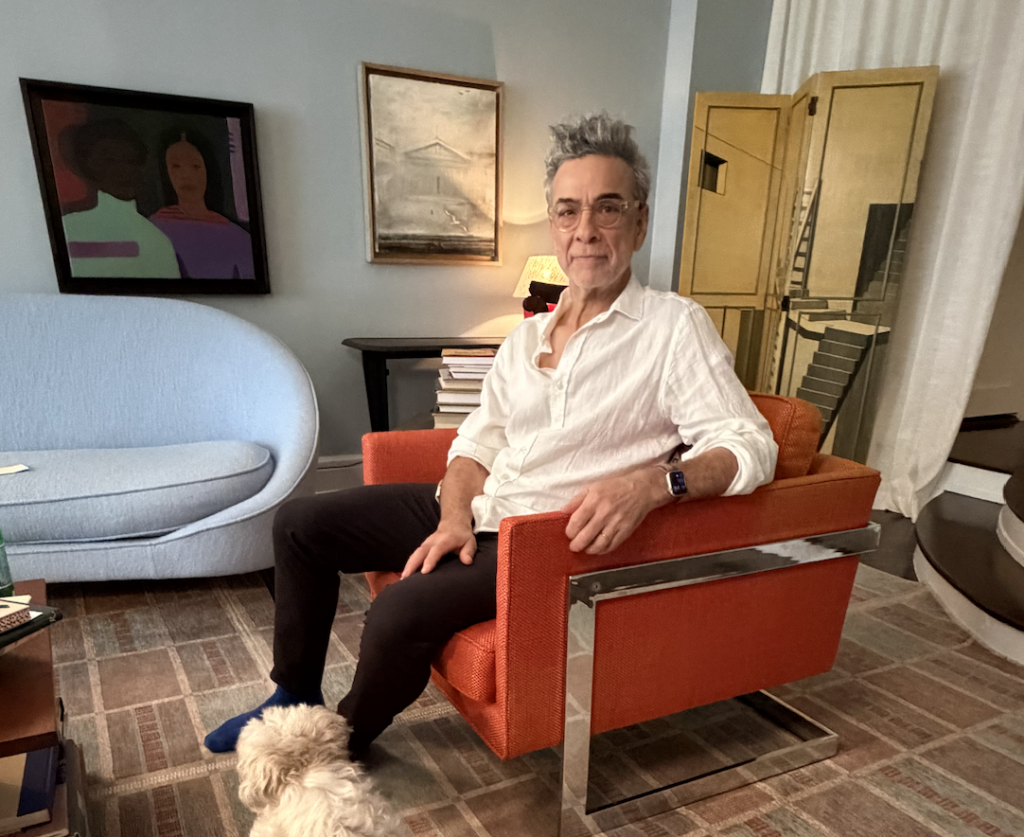
Dubner was speaking to the Rag about his most recent career venture. His new show “Better in Person,” an in-depth, one-on-one interview-styled talk show with different pioneers from various fields. The kicker? He filmed the interviews out of his Upper West Side apartment.
Our interview with Dubner covers the inspiration for his new show, the process of filming in his own home, his favorite spots in the neighborhood, and more.
WSR: How would you describe “Better in Person” to someone hearing about it for the first time?
Dubner: It’s kind of a hard question. I tend to make things in an almost playful sense. All the work I’ve ever done, all the writing I’ve ever done, is mostly just because I was interested in it. At a certain point, yes, you need to be able to describe it so people can understand what it is. In this case, I think of the show as an old fashioned, long form TV talk show. I really loved Dick Cavett. He was in a lot of ways the inspiration for this show. I also really liked The Charlie Rose Show when it was at its best. It was a thrill to be a New Yorker and tune into it, and see what kind of remarkable person was going to be in real conversation. I like things as real as possible.
This show is a fairly intensively produced piece of media in that we set up a place to shoot and thought long and hard about that side of it. We hired people who were unbelievably talented at camera, audio, and lighting.
Another big inspiration for me was the old-fashioned magazine profile, which I love to write and read. I really like humans, I admire how much interesting stuff we do, I especially love interesting stuff if it’s slightly on the side of good for humanity vs. bad for humanity. It’s a thrill for me to sit and have conversations with people like that. So, I made up a show where I could do that.
WSR: How did you end up reaching the decision to host the show out of your Upper West Side apartment? Is that something you knew you wanted to do from the beginning? I’m sure in a lot of ways it is simpler to do in a studio.
Dubner: It came together in different pieces. Wanting to have a show was inspired in part from this big failure we had when we did a live Freakonomics Radio show out in Los Angeles about a year and a half ago. The morning after that failure was really the day the idea for this show was born. The failure was that the theater didn’t record the live show that we made, and it was made for the purpose of being recorded for a podcast. The next morning I was still in shock at what had happened, but I was also inspired to take a different step in that same direction because doing things live is really fun. But, if you do live in a big theater like that, it’s very difficult to control it and make it as intimate as you want. You end up having good conversations, but they’re more performative than I wanted.
Then, I got invited to this party at The Ansonia on the Upper West Side, and it was this awesome, old, funky New York layout. We had a really good time at the party. A few months later, I thought if I had a talk show, it would be nice to have a place like that to do it in. I did talk to many people, both who I know and don’t know, [to ask] if they wanted to let me use their apartment to make this show, and the answer ultimately was no. Therefore, the answer was ultimately that we are going to shoot it in my apartment.
There are 10 guests in the first season of “Better in Person,” including architect Bjarke Ingels, Rabbi Angela Buchdal, author Jennifer Egan, chef Hillary Sterling, and the CEO of Barnes & Noble, James Daunt.
WSR: And did you notice a difference in how guests behaved in your home compared to a more studio environment?
Dubner: First, it’s a very, very different experience for me. I’ve done 99 percent of my Freakonomics Radio interviews remotely. I’ve been remote [since] long before COVID. It’s partly because I like efficiency, and if you don’t have to travel to a studio, and you don’t need the guest to also travel, you can build a much more efficient production machine. So, I’ve just always had a home studio.
When you invite someone into your home, you feel a certain responsibility for them for having a good time. So, I wanted these people to have a good time, but I still wanted to pry when necessary.
It’s a different kind of conversation in my apartment. I think I have a long way to go. The show will continue to get better. It’s still somewhere on the line right now between interview and conversation, because I love having conversations with family and friends, but once you put cameras on it’s different. I recognize that. There’s a different psychic space you enter and it should be that way. On the other hand, my default then is to go into interview mode, which is a little bit more of an interrogation than you might want in a conversation.
WSR: When I saw the title “Better in Person” it immediately evoked thoughts of the COVID pandemic. Is part of the show’s goal to highlight or remind people the power of actually seeing someone in person?
Dubner: Hugely. For me personally, this was a bit of an evolution because as I’ve mentioned, I’ve really always done my work alone. I’ve been a writer my whole life. I’ve collaborated a lot, but I am most happy when I am working alone. When COVID came, and the shock of it was so severe, especially on the Upper West Side, it was a terrible period for so many reasons. Then, once the grave danger began to dissipate, and there was basically a new way of interacting with people, I welcomed it. I thought, I’ve never got to go out to another meeting, or work lunch, and I thought it was going to be awesome.
Then a few months in, I got really down. I thought of something the late economist Gary Becker once said when he was asked what the most addictive substance on the planet was, and Becker said “people.” I was baffled for a minute, but then I thought about it and I think he’s right. It took me a while to want to get back out, but being with people in person is crucial. I play backgammon, I play golf, part of the thrill of those is to be with people. It is so bad to create a cone around yourself in almost any environment. So, I started to make an effort just to be out more, beyond just my family and very close friends. That’s what led to that live show in LA and a few others. I did those shows hoping to feel that connection with my guests, and I’m not going to lie, live shows are really fun, it is exciting, but for making my work, that environment feels a little imprecise and sloppy. I want it to be a little more finely produced.
That’s what led to this weird dream of doing a talk show in my living room.
WSR: There is a lot of discourse around how late-night TV talk shows perform in the modern media landscape. You have a line at the beginning of your trailer where you ask, “Does TV have to suck?” What made you want to take on that challenge and then what did you find out?
Dubner: I’m not going [after] the same audience as those talk shows. One reason I was willing to try this is that Freakonomics Radio has proven to me that there is a massive audience of nice, smart people out there who want to consume thoughtfully made and interesting media. They don’t need to be shouted at or preached at.
We came really close several times to making TV, and I always pulled away because I knew it wouldn’t be very good. There’s this old saying, “They call TV a medium because it is neither rare nor well done.” I admit there is a fair amount of really good TV, but as a percentage of the total, it’s pretty low. I’m not competing with that, though. What I’m looking for is a way to do what I like to do in what is a new and old format. The old format being people sitting in a place and having a conversation together. But I also want to bring to that all the production and editorial storytelling that I’ve learned over the years from writing articles, books, and the radio.
WSR: You’ve lived on the Upper West Side for more than 25 years; could you share some of your favorite spots in the neighborhood?
Dubner: I love Florentin. I like Bustan, as well. I like Zingone’s Market. It’s not where you buy your everything, but I like that [that] type of place exists. Citarella and Zabar’s almost in equal measures, but they are so different. I think of my Zabar’s attachment and my Citarella attachment as two different functions, left brain and right brain, they can co-exist.
I love Teddy Roosevelt Park. Central Park is legendary and amazing, and I’m in it pretty often, but I’m in Roosevelt Park almost every day. It’s a beautiful urban park. I also love the south side of 81st Street, between Columbus and Central Park West.
You can check out “Better in Person” on the Freakonomics Youtube Channel. The first episode came out on July 14 and new episodes will continue to drop every Tuesday. You can also listen to the show where ever you get your podcasts, but Dubner does recommend watching the show for the full effect.
Subscribe to West Side Rag’s FREE email newsletter here. And you can Support the Rag here.


I do enjoy the Freakonomics podcast. Mr Dubner is a great interviewer. He listens well and his questions are thoughtful and well crafted. Will have to give this a go.
There are additional Dubner’s on the UWS. We just didn’t happen to write a great book or host a very cool podcast.
Sincerely,
Todd Dubner
“…author Jennifer Egan, chef Ci Siamo,”
The chef’s name is Hillary Sterling. Her restaurant is Ci Siamo.