Painting and Essay by Robert Beck
Neighborhoods evolve. There are good times, bad times, declines, and resurgences. The transition is usually slow, a thing of generations. Sometimes it’s forced, like when Lincoln Center ignited rapid refashioning in all directions. The biggest change in New York history began quietly as a ship crested the horizon.
Each part of the Upper West Side has a similar origin story. Dirt roads got paved, farms and properties got purchased, the wealthy built mansions in the “country,” which were replaced by apartment buildings, and boom, here we are. Few narratives include the Native Americans, how they lived, or what the place looked like before the influx of Europeans. They were then; we are now.
Topography had a lot to do with how people occupied the land, and how the city grew after the settlers arrived. Small villages appeared along the Wickquasgeck Trail traveled by the Lenape and Wappinger people, which became Bloomingdale Road and then Broadway. Morningside Heights, Manhattan Valley, and the Bloomingdale district all come together, roughly, at 110th & Broadway.
We Americans mark our history by wars and the intervals between, and this location is known for being darn close to the Battle of Harlem Heights during the Revolution. (Happy 250!) Lots of things have happened here since, but there were 3,000 years of Lenape history before Europeans showed up with muskets and notions of land ownership. The Native Americans were more focused on sustenance than wealth accumulation. Manhattan was a land of hills, valleys, freshwater ponds, tidal creeks, rocky outcrops, and swamps. Then as now, it had a lot to offer.
The UWS as we know it is ribbons of asphalt flanked by sidewalks and tall buildings that we negotiate as we go to and from places of habit. Many of us cover the same ground every day as we get around, and we have a myopic view of our slice of the city. I avoid the uphill section of 79th on the way home, and I don’t go down to the Hudson all that often because it’s a serious hike to get back. I flatten out my neighborhood. We all adjust how we see and use the topography in some way to suit our personal requirements.
It feels permanent, but the city is something temporarily growing on the skin of the earth. The land below has been obscured for a long time. Our parks offer a therapeutic glimpse at what it used to be like, in a staged and useful way, but for the most part they are playgrounds. We travel our neighborhoods’ prescribed surfaces, and we climb and descend using stairs and elevators.
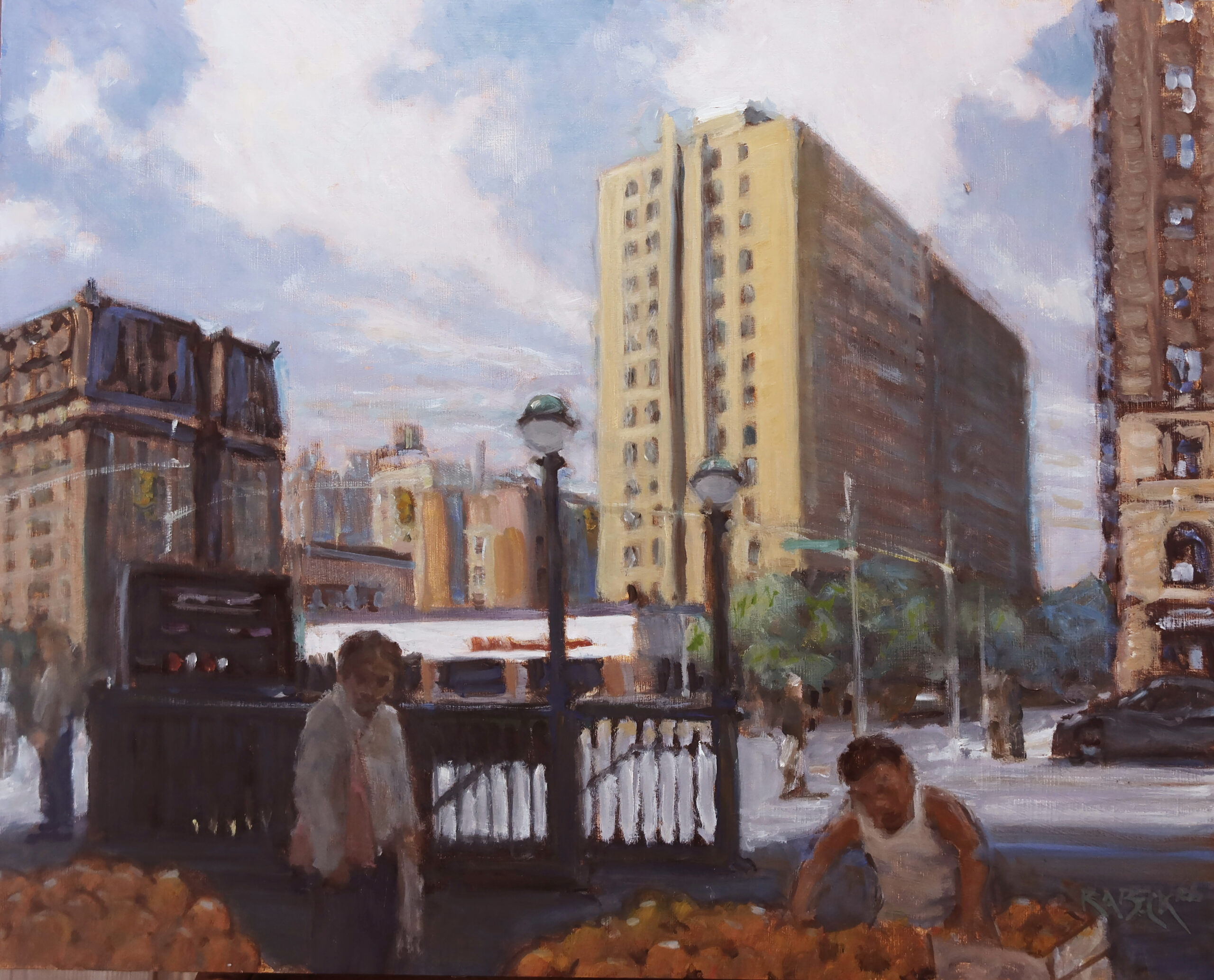
The crossroads of Broadway and 110th feels open, because both streets are very wide, and the southwest view is empty, compared to a typical UWS intersection. One can reasonably expect that to change. It’s hard to picture, but the location once was stands of maple, oak, and chestnut.
There are a few versions of where the name Manhattan came from, all based on the Lenape language. One cites the word Manahatta, referring to a hilly island. The one I like is Manaháhtaan, which means the place you go to gather wood to make bows. That would be the groves of hickory trees. The wood was flexible, resilient, and there for the taking. Probably not far from the areas they used for hunting and planting, or the excellent spots to catch fish.
See more of Robert Beck’s work and visit his UWS studio at www.robertbeck.net. Listen to an interview with him on Rag Radio — Here. Let him know at info@westsiderag.com if you have a connection to an archetypical UWS place or event that would make a good West Side Canvas subject. Thank you!
Note: Before Robert Beck started West Side Canvas, his essays and paintings were featured in Weekend Column. See Robert Beck’s earlier columns here and here.
Subscribe to West Side Rag’s FREE email newsletter here. And you can Support the Rag here.



Interesting take on the west side.Big hike back from the tall ships but worth it.
I grew up in that building on 109th & Broadway in the 50’s – 70’s on the far left side of the photo!!
Thank you for this splendid painting and the detailed text. Years and years ago, this would have been the view from Whelan’s drug store (situated at the northeast corner of 110th). Catercorner, looking from right (north) to left (south), one would have seen: Wollman’s department store, Woolworth’s 5 & 10, and Party Cake. At least, that’s how I remember it. Those were the days when the Nemo movie theater was located on the east side of Broadway, south of 110th.
https://www.youtube.com/watch?v=UOg_8hCC4u4
If all these UWS paintings were anthologized in an over-sized art book, the world would have a beautifully-rendered (if not a bit idealized) notion of the neighborhood in both image and tone. I’d buy it.