By Tracy Zwick
Today it styles itself as the nation’s museum of folk and self-taught artists, but before attaining that status, the American Folk Art Museum was already an Upper West Side treasure.
This neighborhood jewel on Columbus Avenue near West 66th St., which is always free to visitors, is celebrating two important milestones. The institution itself will mark its 65th anniversary in a few weeks with a gala at the nearby Mandarin Oriental Hotel. And with two exhibitions that opened last week and run through September, it’s also offering a 250th birthday tribute to our nation, in keeping with its focus dedicated to the historically sidelined.
“Folk Nation: Crafting Patriotism in the United States” honors America’s birthday while offering some counter-programming to the big birthday party planned in Washington, D.C. “Folk Nation” asks us to consider who and what’s been traditionally represented in the history of American art, and what’s been left out. It speaks to long-held American themes, including family, religion, and belonging, but from the perspectives of artists from historically marginalized communities.
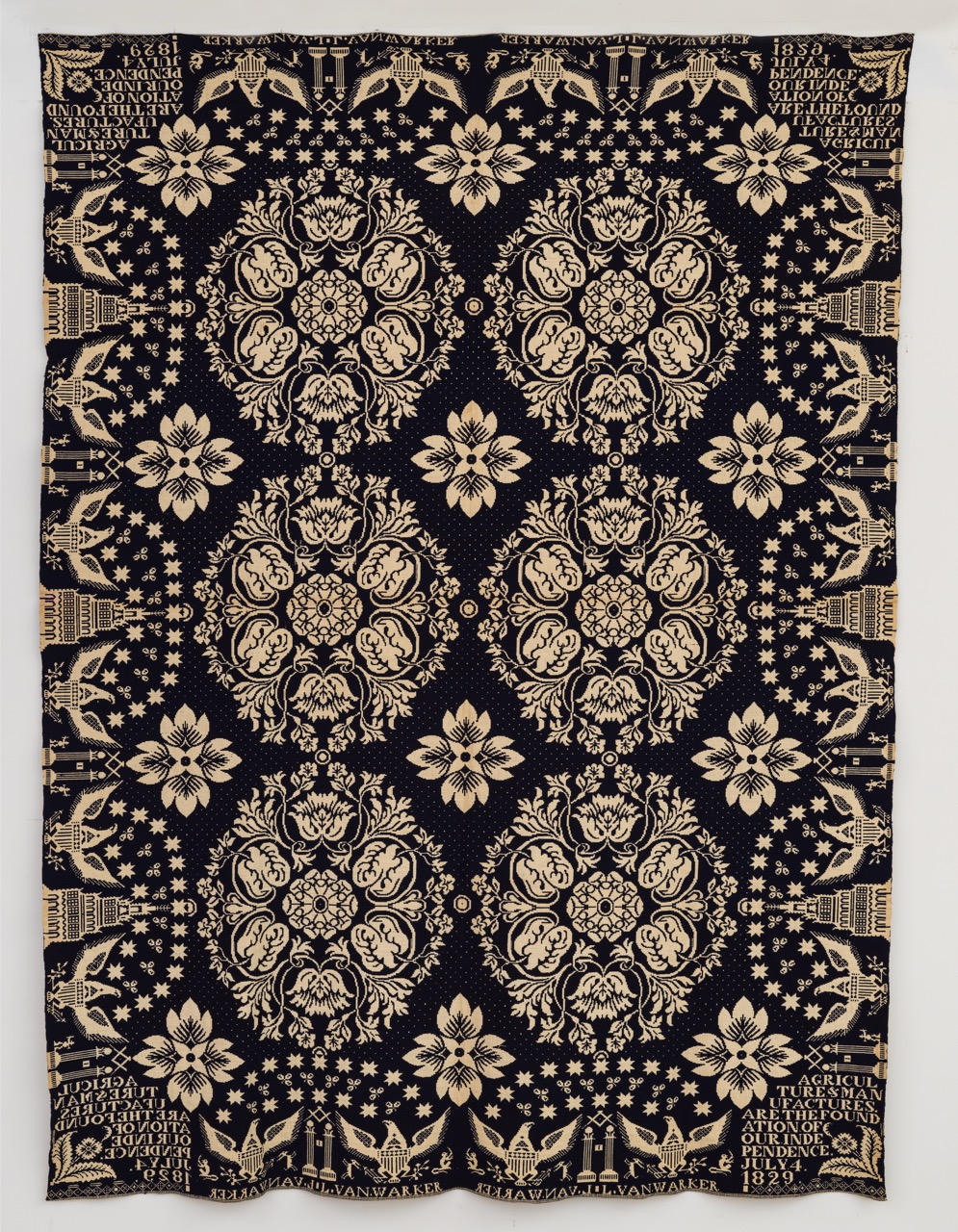
The exhibition opens with one of the most patriotic pieces in the show, an 1822 ivory on near-black coverlet inscribed with the date July 4th, 1829. Its unidentified maker, who literally wove a sense of American pride into their design, filled the textile with stars, eagles, and other Americana. In one corner, there’s text celebrating American industry: “Agriculture and manufactures are the foundation of our independence.”
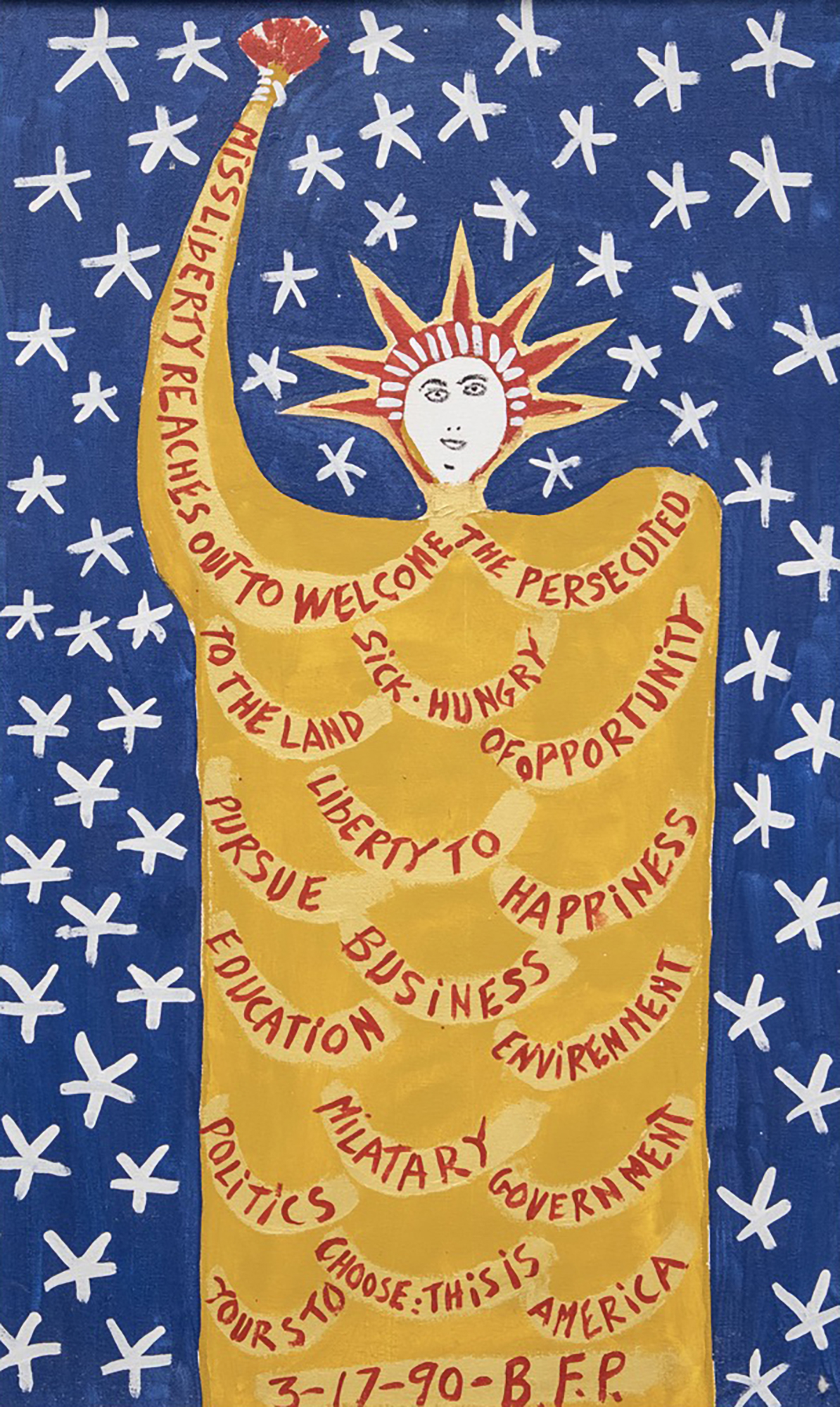
Nearby is Reverend Benjamin Franklin Perkins’s “Miss Liberty Reaches Out to Welcome the Persecuted,” a 1990 canvas that runs NYC’s familiar national icon, the Statue of Liberty, through a folk-art lens. Her body is rendered as a yellow rectangle, with an out-of-scale torch-bearing arm raised against a lapis-like, star-filled background. Lady Liberty has phrases written in garland-shaped swags across her body, calling attention to values like “opportunity,” “liberty to pursue happiness,” and “education.” Just above his signature, Perkins wrote: “Yours to choose: this is America.”
More choices come in the next gallery, where “Self-Made: A Century of Inventing Artists” begins. The show unfolds in three sections, each in its own gallery: Self-Portraits, Alter Egos, and Autobiographies. You can start anywhere; taken together, the trio of galleries offers viewers an array of choices made by artists who – without academic training – have depicted themselves, on their own terms.
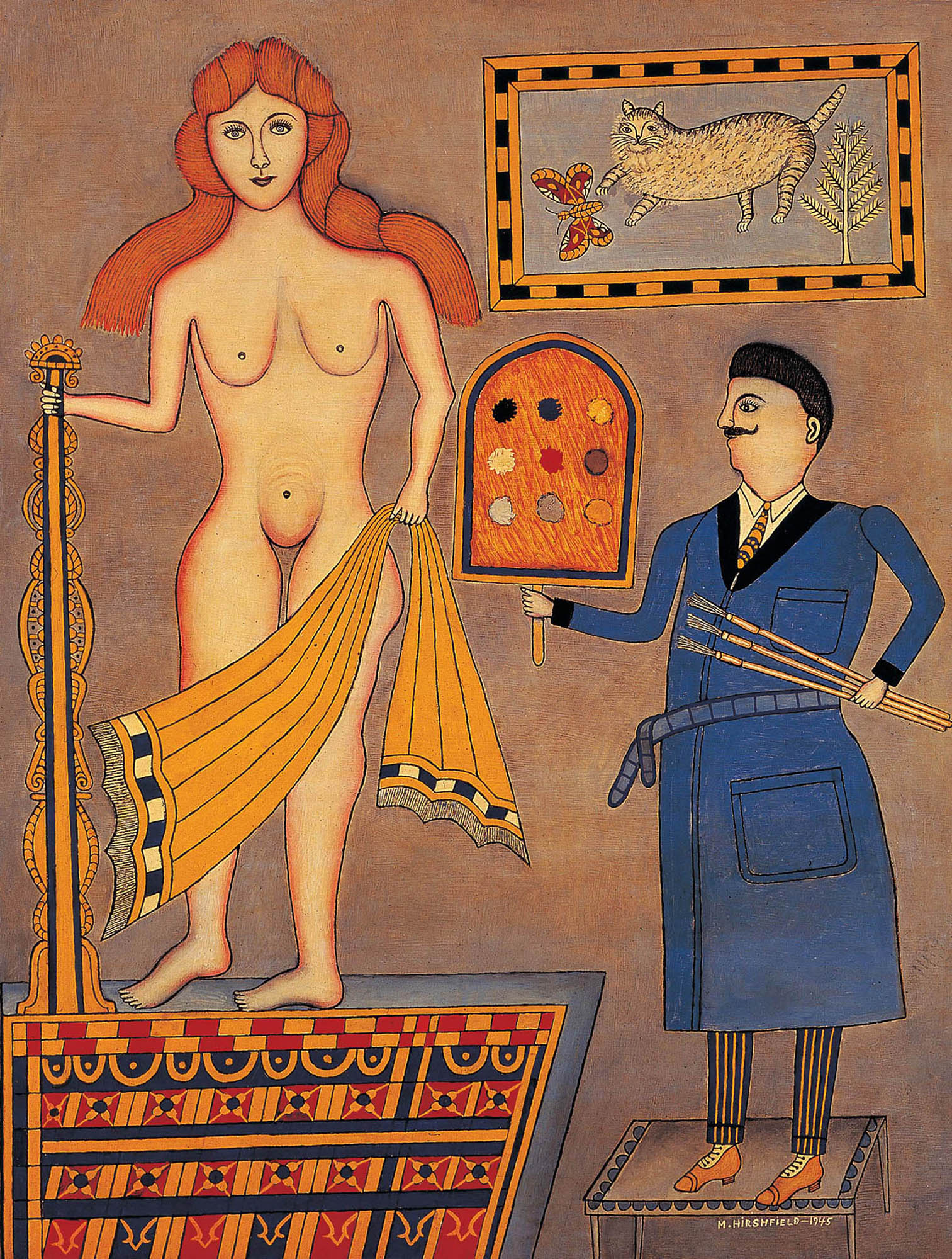
One of the first objects you’ll encounter is Morris Hirschfield’s 1945 “The Artist and His Model,” which includes a self-portrait, a landscape, and a classical female model. The artist brandishes his palette the way a crossing guard holds up a “Stop” sign. His other hand holds three brushes the way a medieval knight might hold his lance. There are patterns everywhere, on the wall, on the plinth, and in the model’s scarf, that match with the robed artist’s tie and slacks.
The attention to textiles makes sense when you learn that before painting, Hirschfield had been involved in manufacturing clothing and slippers. If you look closely at the painting within the painting, of a cat chasing a butterfly, you’ll see he’s included an olive branch behind the playful feline. Americans have, throughout our history, yearned for hope and peace.
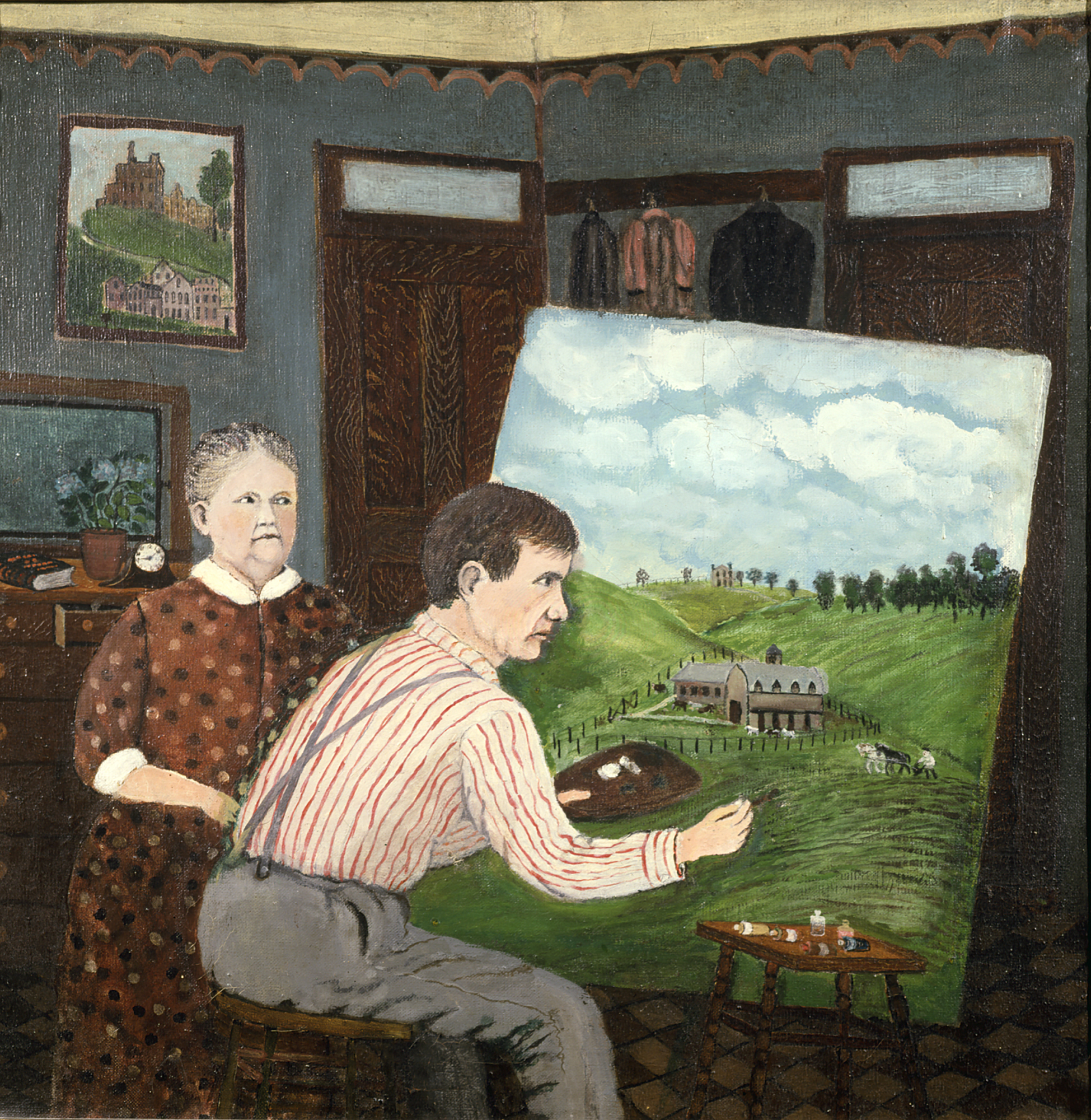
Go deeper and you’ll find works by once-marginalized but now Sotheby’s-approved artists like Adolf Wölfli, John Kane and Henry Darger. No need for UWSers to travel to MoMA, the Met or The Whitney to check out some of these artists’ prize works.
One artist whose work was new, and winning, to me was Susan Janow, whose practice has been supported by Creative Growth, a non-profit in California that advances the inclusion in contemporary art of artists with developmental disabilities. In two 10-minute single-channel videos, Janow poses questions to herself in voiceover – some simple, some deep – while sitting interview-style, facing the camera, in a Tigger t-shirt and blazer. In the next video, we see her answering the questions, her responses written in pretty, childlike handwriting on placards. Viewers may find themselves responding to her questions with their own answers.
In 2023, the AFAM launched a project to review and revise catalog entries, filling in or fixing missing, incomplete, or misleading information about its vast 20th and 21st-century collection. “Self-Made” grew out of that effort. As curators learned more about the works and the artists who created them, they were able to reassess and re-present the art with greater attention to the artists’ voices, interests, and intentions. Visitors now have a chance to reconsider history too, particularly American history.
The museum, closed for a time last summer for construction work, still has construction equipment up outside around the entrance, but the restrooms, galleries, and charming shop are newly redone and fully open for business. Because of its manageable size, just four galleries, it’s easy to spend an hour or an afternoon at the museum, and there are plenty of cafes a few steps away to refuel after a visit – Maman, La Botaniste, and Rosetta Bakery among them. There’s robust programming around both of the new exhibitions, including free guided tours, musical performances in the galleries, talks, and artist-led workshops (including one with Janow).
In a moment of historical uncertainty, curator Valerie Rousseau mentioned during a walk-through of the show this week that she hopes visitors will respond to the authenticity of the work on view. These exhibitions offer opportunities for critical thinking, away from the big birthday hullabaloo planned for the nation’s capital.
Subscribe to West Side Rag’s FREE email newsletter here. And you can Support the Rag here.


Thanks for this. I haven’t been to that museum in a while but your article makes me want to visit again.